
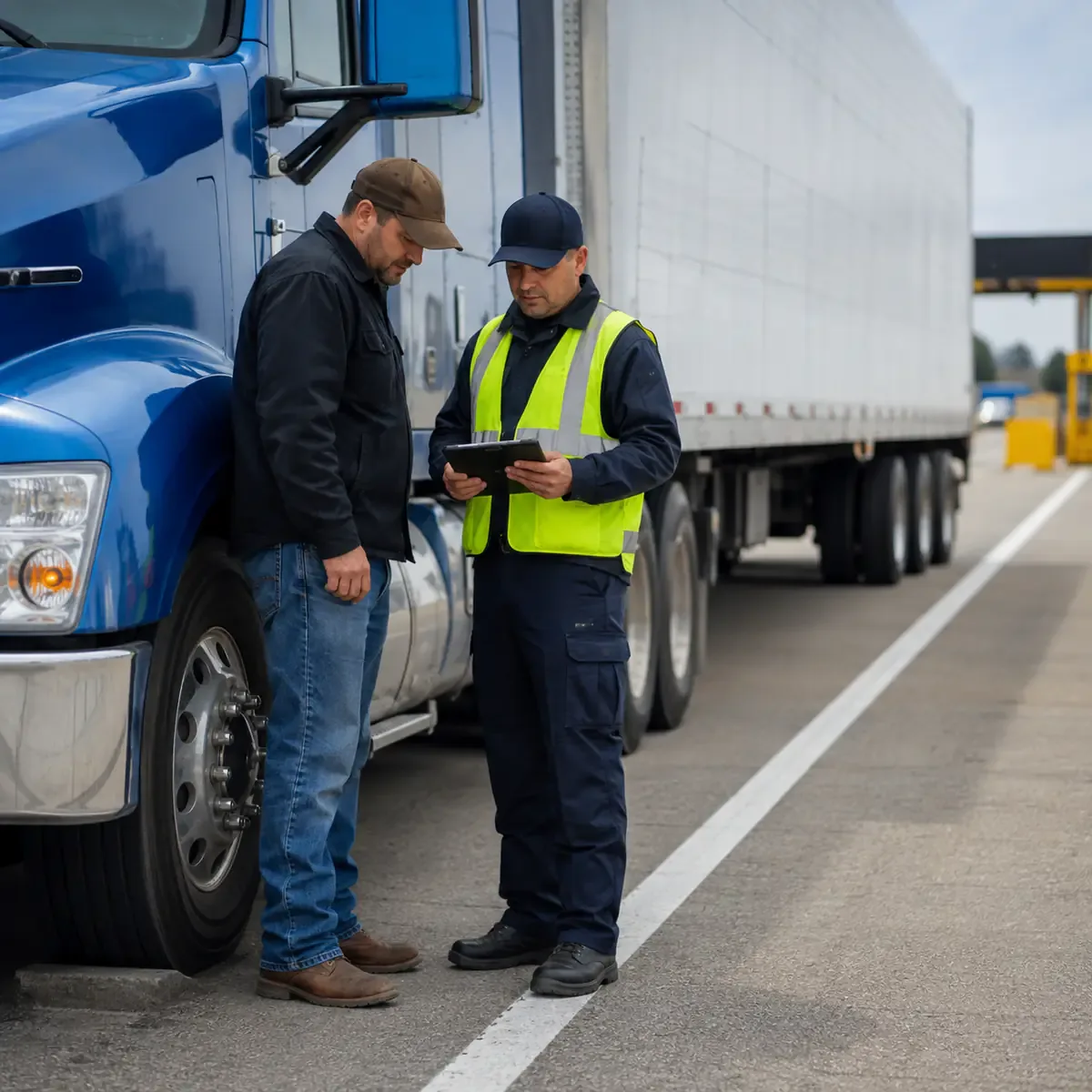
A roadside inspection can last a few minutes or become the most important compliance event a small carrier has had all year.
The difference is not just the inspection level.
It is what the inspector finds.
A roadside stop can produce:
- no violations;
- one or more violations;
- a citation;
- no citation at all;
- a driver out-of-service condition;
- a vehicle out-of-service condition;
- safety data that later appears in FMCSA systems;
- a DataQs review;
- or evidence of a larger management problem that the carrier needs to correct.
For an owner-operator or small fleet, the roadside report should therefore be treated as more than a piece of paper handed back to the driver.
It is an external test of the carrier’s:
- driver qualification;
- hours-of-service controls;
- vehicle maintenance;
- cargo securement;
- registration;
- operating authority;
- drug and alcohol compliance;
- and document management.
The useful question is not simply:
“Did I pass?”
It is:
“What exactly did the inspection test, what did the inspector record, and what must the carrier do next?”
What people mean by a “DOT inspection”
“DOT inspection” is industry shorthand.
Roadside inspections are performed by qualified federal, state, provincial or local enforcement personnel under the North American Standard Inspection Program and applicable motor-carrier safety rules.
The scope depends on the inspection level.
Some inspections examine:
- the driver and vehicle together;
- only the driver and credentials;
- only the vehicle;
- one specific safety item;
- or, increasingly, certain information electronically.
A driver who prepares only for a mechanical inspection can therefore be unprepared for a Level III credential review.
A driver with perfect paperwork can still fail to identify a serious brake, tire or cargo-securement problem during a Level I or Level II inspection.
The inspection levels at a glance
The current North American Standard framework includes Levels I through VIII, but they are not eight versions of the same ordinary roadside stop.
| Level | Primary scope | What a small property carrier should know |
|---|---|---|
| I | Driver + comprehensive vehicle inspection | The full standard roadside examination and the most complete preparation target |
| II | Walk-around driver + vehicle | Vehicle items are examined without the inspector physically getting under the vehicle |
| III | Driver / credentials / administrative | Focuses on license, HOS, status and required driver information rather than a full mechanical inspection |
| IV | Special inspection | Usually targets a particular item or study rather than a full standard inspection |
| V | Vehicle only | Level I vehicle items without the driver present |
| VI | Select radiological shipments | Specialized inspection beyond ordinary general-freight operations |
| VII | Jurisdiction-specific mandated inspection | Applies to programs that do not fit another North American Standard level |
| VIII | Electronic inspection | Designed for electronic or wireless inspection without direct officer interaction |
For most interstate owner-operators hauling general freight, Levels I, II and III are the ones to understand first.
Level V also matters operationally because it is a vehicle-only inspection.
Level I: the full North American Standard Inspection
Level I is the comprehensive driver-and-vehicle inspection.
CVSA describes it as a 37-step procedure.
The driver portion can include examination of:
- driver’s license;
- medical qualification when applicable;
- Skill Performance Evaluation certificate when applicable;
- alcohol and drugs;
- record of duty status;
- hours-of-service compliance;
- seat belt;
- applicable vehicle inspection reports.
The vehicle portion can include:
- brakes;
- cargo securement;
- coupling devices;
- driveline or driveshaft;
- exhaust;
- frame;
- fuel system;
- lighting;
- steering;
- suspension;
- tires;
- wheels, rims and hubs;
- windshield wipers;
- and additional applicable equipment.
That list explains why “my truck is mechanically good” is not enough preparation.
A Level I inspection evaluates the driver’s legal readiness and the vehicle’s mechanical readiness together.
What Level I should change in carrier preparation
The best preparation is not a folder assembled at the scale house.
The carrier should arrive with compliance already embedded in daily operation.
The driver side should be able to support:
- identity and licensing;
- medical status;
- HOS status;
- ELD records where required;
- vehicle inspection information;
- carrier identity.
The vehicle side should be able to withstand inspection of safety-critical systems.
The documents-inside-the-truck guide separates documents that belong in the cab from records that can remain at the carrier’s office.
Level II: walk-around driver and vehicle inspection
Level II still examines both driver and vehicle.
The main difference is physical scope.
CVSA explains that the vehicle portion generally covers items that can be inspected without physically getting under the vehicle.
That does not make it a paperwork-only inspection.
The inspector can still review major visible safety systems, including:
- brakes;
- cargo securement;
- coupling;
- lights;
- tires;
- suspension;
- wheels;
- steering;
- fuel and exhaust;
- other accessible components.
For an owner-operator, a Level II should trigger the same basic preparation philosophy as Level I:
the driver, paperwork and visible vehicle condition all need to be right.
Level III: driver, credential and administrative inspection
Level III is often misunderstood as an “easy” inspection because it does not include the full mechanical examination.
It can still create serious consequences.
CVSA lists Level III items including, when applicable:
- driver’s license;
- medical qualification;
- SPE certificate;
- record of duty status;
- hours of service;
- seat belt;
- vehicle inspection reports;
- carrier identification;
- carrier status.
Traffic violations can also appear in connection with the inspection.
Mechanical equipment violations that belong to Level I or II should not simply be inserted into a Level III as though it were a vehicle inspection.
Why Level III matters to a new authority
A new carrier can have a new truck with no deferred maintenance and still create roadside problems through:
- wrong carrier identification;
- unavailable HOS records;
- expired licensing information;
- medical status;
- ELD problems;
- out-of-service status;
- authority or registration issues.
That is why the driver qualification file and cab-document system matter even when the truck itself is new.
Level IV: special inspection
Level IV is not a lighter version of Level I.
It is a special inspection, typically focused on one item.
CVSA explains that these inspections are often used:
- to support a study;
- to verify a suspected trend;
- or to refute a suspected trend.
A carrier therefore should not interpret the lack of a full inspection as proof that every other compliance area was examined and found clean.
The inspection report tells you what was actually inspected.
Level V: vehicle-only inspection
Level V includes the vehicle inspection items from the Level I standard but is performed without a driver present.
It can occur at any location.
This matters for carriers because enforcement findings can arise from the vehicle independently of the driver’s documentation.
Level I and Level V inspections can also qualify a vehicle for a CVSA decal when the vehicle meets the applicable requirements and no critical vehicle inspection item violations are found.
A decal is useful evidence of a recent qualifying inspection, but it is not immunity from future inspection or responsibility for defects that develop later.
Level VI: select radioactive-material shipments
Level VI is a specialized inspection for select radiological shipments, including certain highway route controlled quantities of radioactive material and specified transuranic-waste movements.
For a normal dry-van, reefer or flatbed owner-operator who does not transport these materials, Level VI is not the everyday planning concern.
It belongs in the inspection-level taxonomy because it is a formal North American Standard level, not because every carrier should prepare for it.
Level VII: jurisdictional mandated inspections
Level VII covers mandated inspection programs created by a jurisdiction that do not meet another standard inspection level.
CVSA gives examples involving operations such as:
- school buses;
- limousines;
- taxis;
- shared-ride transportation;
- hotel shuttles;
- other intrastate or intra-provincial operations.
This is another reason a search result saying “there are six DOT inspection levels” is incomplete under the current CVSA framework.
For general interstate trucking, however, Level VII is not usually the core roadside inspection encountered by an owner-operator.
Level VIII: electronic inspection
Level VIII is the North American Standard Electronic Inspection.
Its definition is very different from a traditional roadside stop.
The inspection is conducted electronically or wirelessly while the vehicle is in motion, without direct interaction with an enforcement officer, and requires the applicable electronic data points.
Those data can include:
- driver identity validation;
- license class and endorsements;
- license status;
- medical qualification;
- current record of duty status;
- hours-of-service compliance;
- USDOT or NSC number;
- power-unit registration;
- operating authority;
- UCR compliance;
- federal out-of-service orders.
FMCSA began an operational test of in-motion CMV inspections to evaluate how Level VIII could be implemented alongside existing safety-monitoring tools.
For the ordinary carrier, the practical lesson is not to expect every Level VIII concept to operate exactly like a staffed weigh-station inspection today.
The larger point is that compliance data is becoming increasingly capable of being evaluated electronically.
What inspectors actually look for during a roadside stop
The inspection level controls scope, but a carrier should think in five readiness layers.
1. Driver identity and qualification
Questions can include:
- Is the license valid?
- Does the driver have the required class and endorsements?
- Is medical qualification current when required?
- Is the driver subject to an out-of-service order?
- Is the driver otherwise qualified for the operation?
2. Hours of service and ELD
The inspector can review:
- current duty status;
- previous required records;
- remaining driving time;
- HOS violations;
- ELD information;
- falsification or manipulation indicators.
The 11-hour and 14-hour rules guide explains the clocks most property-carrying drivers encounter.
3. Carrier and vehicle credentials
Depending on the operation and inspection, this can involve:
- USDOT identification;
- operating authority;
- vehicle registration;
- applicable permits;
- other carrier status information.
4. Mechanical condition
A driver should expect safety-critical items to matter.
A cracked component, defective tire, brake problem or failed securement system is not cured by having excellent paperwork.
5. Cargo and operation
Cargo securement can be part of the inspection.
In the 2026 International Roadcheck, CVSA specifically emphasized cargo securement as the vehicle focus and ELD tampering/falsification/manipulation as the driver focus.
Those campaign focuses do not replace the ordinary inspection scope.
Inspectors continued checking the rest of the applicable Level I items.
Violation, citation and out-of-service order are three different things
This distinction prevents a large amount of confusion after a roadside inspection.
| Term | What it means | Why the carrier cares |
|---|---|---|
| Inspection violation | A violation recorded on the roadside inspection report | Can enter FMCSA safety data and require correction |
| Citation / ticket | A separate State enforcement action associated with alleged conduct | Can create fines, court process and later adjudication data |
| Out-of-service condition | A condition serious enough under applicable rules/criteria to restrict the driver or vehicle from continuing | Can stop the load immediately and carries greater operational significance |
A driver can therefore have:
- an inspection violation without a citation;
- a citation associated with an inspection;
- an OOS violation;
- multiple combinations of the three.
Do not let the driver report only:
“I didn’t get a ticket.”
The carrier needs the Driver Vehicle Examination Report.
An inspection violation can affect SMS without a ticket
FMCSA is explicit on this point.
Violations recorded on a roadside inspection report can be used in the Safety Measurement System even if the State officer:
- does not issue a citation;
- gives a verbal warning;
- handles the State enforcement side differently.
The inspection data and State citation process are separate.
This is one reason the carrier should review the actual violation code and regulation section.
The companion guide on CSA and SMS explains how inspection violations can flow into the carrier’s safety profile.
Not every violation puts the truck out of service
A roadside report can contain a valid violation that does not meet the threshold for an out-of-service condition.
The carrier still needs to correct it.
The mistake is thinking:
“The officer let me drive, so nothing was wrong.”
The ability to continue the trip and the existence of a regulatory violation are separate questions.
A lighting defect, documentation issue or other violation can be real even if the driver or vehicle is not placed out of service.
The carrier should treat every valid violation as a corrective-action item.
What “out of service” actually means
An out-of-service condition is more serious.
CVSA’s North American Standard Out-of-Service Criteria identify critical conditions that can prohibit a driver or vehicle from operating until the applicable problem is resolved.
The criteria are updated annually.
The 2026 criteria took effect April 1, 2026 and replaced the previous edition.
The regulations and current CVSA criteria should be read together when deciding whether a particular condition is OOS.
Vehicle out of service
When a vehicle is declared out of service under the applicable rules, it cannot simply be driven away in ordinary operation before the required repairs are completed.
The response should be operational:
- secure the vehicle;
- identify each OOS condition;
- arrange qualified repair;
- document the repair;
- confirm that movement is legally permitted before dispatch resumes.
Driver out of service
A driver OOS condition can arise from matters involving:
- hours of service;
- qualification;
- alcohol/drugs;
- certain record-of-duty-status problems;
- other serious driver conditions.
The restriction can depend on the specific violation.
Do not treat “driver OOS” as though every violation has the same waiting period or corrective action.
2026 OOS changes make ELD manipulation especially important
The 2026 out-of-service criteria included changes concerning false records of duty status and ELD tampering.
CVSA specifically added an OOS condition addressing tampering that makes it impossible to determine what events occurred.
This is consistent with the 2026 International Roadcheck focus on ELD tampering, falsification and manipulation.
A carrier should therefore treat intentional or systemic ELD manipulation as much more than a log-editing problem.
What happens immediately after the inspection
The roadside event should create a controlled workflow.
Post-roadside-inspection workflow
- 01 Get the complete inspection report
The driver should transmit the Driver Vehicle Examination Report to the carrier promptly instead of summarizing the stop by phone.
- 02 Identify OOS conditions first
Separate conditions that prohibit further operation from ordinary violations and administrative observations.
- 03 Correct every valid violation
Complete required repairs or driver/compliance corrections and preserve evidence showing what was done.
- 04 Verify the report for accuracy
Check carrier, driver, vehicle, violation codes, OOS status and factual details against the underlying records.
- 05 Certify correction on time
Under 49 CFR 396.9, the carrier must complete the required certification within 15 days after the inspection.
- 06 Return the form if the State requests it
Under the rule effective July 22, 2026, federal law requires return to the issuing State agency only when that agency requests the signed form.
- 07 Retain the report
Keep the carrier copy for 12 months from the inspection date.
- 08 Check FMCSA data
Review the inspection after it appears in federal systems and use DataQs when a supportable factual correction is needed.
- 09 Fix the root cause
Change maintenance, dispatch, qualification, HOS or documentation controls so the same problem is less likely to repeat.
The driver’s report-delivery obligation matters
49 CFR 396.9 requires the driver who receives an inspection report to deliver it to the motor carrier.
The current regulation is more precise than the common shorthand “send it within 24 hours.”
The driver should provide it when arriving at the next terminal or facility.
If the driver is not scheduled to arrive within 24 hours, the report must be transmitted to the carrier by mail, fax or another method rather than waiting.
For a modern small carrier, the sensible policy is simpler:
Send a readable copy immediately after the inspection is complete and the vehicle is safely parked.
That internal policy gives management time to act before regulatory deadlines become urgent.
The carrier’s 15-day correction obligation
The motor carrier must examine the inspection report.
Violations or defects have to be corrected in accordance with the applicable rules.
Within 15 days following the inspection, the carrier must complete the required certification that the violations have been corrected.
This deadline should not be interpreted as permission to operate for 15 days with an unsafe defect.
An OOS condition can prevent operation immediately.
Other defects that affect safe operation can also require repair before the vehicle is permitted to continue in service.
The 15-day rule is a post-inspection certification requirement—not a universal repair grace period.
A major 2026 change: returning the signed report to the State
This is an area where older compliance articles can now be wrong.
Historically, federal guidance commonly described the process as:
- correct the violations;
- sign the report;
- return it to the issuing State agency within 15 days;
- retain a copy.
FMCSA changed the federal rule in 2026.
The final rule was published June 22, 2026 and became effective July 22, 2026.
Under the current rule:
- the carrier still has to examine the report;
- correct the violations;
- certify correction;
- retain the report;
- but return the completed signed roadside inspection form to the issuing State agency only if that agency requests its return.
This is a narrow administrative change.
It does not eliminate the obligation to fix the violations.
Keep the inspection report for 12 months
The current rule requires the carrier to retain the roadside inspection report for 12 months from the date of inspection.
That report should not live alone.
For any inspection with violations, the carrier file should contain enough evidence to reconstruct the response.
Useful evidence can include:
- inspection report;
- repair invoice;
- work order;
- parts receipt;
- mechanic statement;
- photos;
- ELD records;
- corrected qualification document;
- correspondence with the agency;
- DataQs submission;
- DataQs decision;
- signed certification.
The vehicle maintenance file guide explains how repair and maintenance evidence should fit into the broader vehicle record.
What to do when the report is wrong
A roadside inspection report is government safety data, but it can still contain errors.
Possible issues can include:
- wrong carrier;
- wrong vehicle;
- wrong driver;
- duplicate event;
- incorrect violation;
- incorrect OOS indicator;
- information later affected by an eligible adjudication.
The carrier should first identify the exact factual problem.
Then gather evidence.
FMCSA’s DataQs system is the established process for requesting review of data believed to be incomplete or incorrect.
A strong DataQs request is specific
A useful submission explains:
- which inspection;
- which violation;
- what field or conclusion is wrong;
- what the correct fact is;
- what evidence proves it.
A weak request argues only about impact
This is not a useful basis:
“Please remove this because it is hurting our CSA.”
The question is whether the federal data should be corrected.
The CSA/SMS guide explains the distinction between correcting inaccurate data and improving the carrier’s underlying safety performance.
Citation adjudication can matter, but the inspection record is separate
A State citation and an FMCSA roadside violation are not identical records.
If a citation associated with a roadside inspection is later dismissed, reduced or results in another eligible adjudication outcome, FMCSA has processes governing how adjudicated citation information can affect federal safety data.
The carrier should therefore preserve:
- citation;
- inspection report;
- court disposition;
- certified records where available.
Do not assume that winning a State traffic case automatically causes every federal database to update without action.
Likewise, do not assume that paying a ticket means the carrier has completed all of its federal post-inspection duties.
A clean inspection does not mean “nothing happened”
An inspection with no violations can be valuable information.
It demonstrates that, for the items actually inspected at that time, no violations were recorded.
But the carrier should keep the scope in perspective.
A clean Level III does not prove that every brake, tire and suspension component passed a Level I mechanical inspection.
A clean Level V does not establish that a driver’s hours-of-service records were examined.
The correct interpretation is:
No violations were identified within the scope of that inspection.
That is more precise and more defensible.
CVSA decals: useful, but not a shield
CVSA explains that Level I, Level V and Level VI are the inspection levels that may result in issuance of a CVSA decal.
For ordinary general freight, Levels I and V are the relevant examples.
A qualifying decal signals that the vehicle completed the applicable inspection without critical vehicle inspection item violations.
CVSA notes that a valid decal signals a qualifying inspection within the preceding three months.
But the decal does not mean:
- the vehicle cannot be reinspected;
- later defects do not matter;
- the driver is automatically compliant;
- the carrier can skip daily inspection and maintenance controls.
The truck can deteriorate after the decal is applied.
A roadside inspection should be reconstructed, not merely closed
Consider a common scenario.
That final question is what turns roadside enforcement into useful risk control.
Driver violations require the same root-cause discipline
Suppose the violation is HOS-related instead of mechanical.
The carrier should not stop at:
“The driver made a mistake.”
Review:
- dispatch appointment;
- prior duty period;
- ELD record;
- unidentified driving;
- edits;
- detention;
- personal conveyance;
- training;
- supervisor review.
A violation can be technically attributable to the driver while still exposing a weak carrier process.
For example, repeated HOS violations across different drivers can point to unrealistic dispatch planning.
Prepare for inspection by category, not by fear
A practical inspection-readiness system can be organized into four layers.
Driver
Before dispatch, verify:
- correct license;
- required endorsements;
- medical status;
- HOS availability;
- ELD readiness;
- no unresolved prohibition.
Vehicle
Verify:
- pre-trip completed;
- safety defects resolved;
- lights;
- tires;
- brakes;
- coupling;
- securement;
- required inspection status.
Documents and credentials
Verify the documents appropriate to the operation, including:
- vehicle registration;
- carrier identification;
- shipping documentation;
- permits where applicable;
- inspection-related records required in the vehicle.
Communication
The driver should know:
- who to contact after an inspection;
- how to send the report;
- not to alter or discard it;
- not to speculate about what the officer “really meant”;
- how to document an OOS repair.
This is more reliable than telling drivers to “be careful at scales.”
What the driver should do during the inspection
The carrier’s policy should encourage calm, accurate cooperation.
The driver should:
- follow lawful instructions;
- provide requested documents;
- answer factually;
- avoid guessing;
- avoid arguing about issues that can be documented later;
- obtain the complete inspection report;
- identify whether any driver or vehicle OOS condition was issued;
- contact the carrier before resuming operation when the result is unclear.
An inspection lane is not the place to invent a legal theory or conceal a record.
When a factual error exists, the carrier can preserve the evidence and use the appropriate review process.
What the driver should not do after the inspection
Several bad practices make the event worse.
Do not leave with only a verbal summary
The carrier needs the report.
Do not keep driving through an OOS condition
That can create additional serious violations and enforcement consequences.
Do not “repair” the paperwork by editing records improperly
Correcting a compliance problem is different from falsifying historical evidence.
Do not throw away the report after paying a citation
The federal inspection and State citation are separate.
Do not wait weeks before telling management
The carrier has a regulatory correction/certification workflow and needs time to act.
Roadside inspections and the Safety Measurement System
FMCSA’s SMS uses roadside inspection violations as one of its important safety-data inputs.
The current system evaluates carrier performance across categories such as:
- Unsafe Driving;
- Hours-of-Service Compliance;
- Vehicle Maintenance;
- Driver Fitness;
- Controlled Substances/Alcohol;
- Hazardous Materials Compliance;
- Crash Indicator.
The impact of a specific inspection depends on:
- violation;
- BASIC;
- inspection type;
- severity under the current methodology;
- time;
- carrier inspection history;
- data sufficiency;
- other SMS factors.
Do not try to predict the result from the number of violations alone.
A carrier with two violations is not automatically “twice as bad” as a carrier with one.
Small carriers should care about inspection denominator effects
A one-truck carrier may have very few roadside inspections.
That makes each event operationally important.
If the carrier has two inspections and one has significant violations, management has very little clean history against which to evaluate the problem.
Again, SMS is not a simple violations-divided-by-inspections formula.
But the practical point remains:
Small carriers have fewer roadside events, so every inspection deserves review.
This is especially important in the New Entrant period, when the carrier is still proving that its safety-management controls actually work.
The 2026 out-of-service criteria should be the current reference
CVSA updates the North American Standard Out-of-Service Criteria each year, normally effective April 1.
The 2026 edition became effective April 1, 2026.
That matters because an old article, training deck or laminated checklist can become outdated.
CVSA reported 17 changes for the 2026 edition, including revisions affecting:
- license endorsements and restrictions;
- alcohol;
- false records of duty status;
- ELD tampering;
- brake-system criteria;
- cargo securement;
- coupling devices;
- wheels/rims/hubs;
- certain passenger-vehicle emergency exits;
- hazmat placarding;
- federal out-of-service orders.
A general owner-operator does not need to memorize the proprietary criteria handbook.
The carrier does need current:
- driver policies;
- maintenance controls;
- ELD practices;
- inspection training.
What International Roadcheck does—and does not mean
CVSA’s International Roadcheck receives heavy industry attention each year.
In 2026 it ran from May 12 through May 14.
CVSA emphasized:
- ELD tampering, falsification and manipulation on the driver side;
- cargo securement on the vehicle side.
But the inspections themselves remained ordinary North American Standard inspections.
The event did not create a temporary set of rules applicable only for three days.
The better takeaway is:
The same weaknesses that cause problems during Roadcheck can cause problems during an ordinary roadside inspection in August, November or February.
Inspection readiness should therefore be permanent.
How to classify the result internally
After each roadside inspection, assign one of four internal outcomes.
| Outcome | Meaning | Required management response |
|---|---|---|
| Clean | No violations recorded within inspection scope | Archive and track as part of inspection history |
| Violation — no OOS | Violation exists but did not trigger OOS status | Correct, certify, document and analyze root cause |
| Driver OOS | Driver restricted from continued operation under applicable condition | Stop operation, resolve driver issue, document and review management control |
| Vehicle OOS | Vehicle restricted from continued operation until required condition is corrected | Repair before lawful return to service, preserve proof and investigate maintenance failure |
This classification is more useful than a binary “pass/fail” field.
Build a one-page inspection response record
For every inspection with violations, create a short internal record.
Include:
Inspection
- date;
- State;
- level;
- report number.
Driver
- name;
- CDL;
- HOS status.
Equipment
- tractor;
- trailer;
- VIN or unit number.
Finding
- violation code;
- regulation;
- OOS status.
Correction
- action;
- date;
- person responsible;
- repair/supporting evidence.
Data
- accurate or disputed;
- DataQs number if applicable.
Prevention
- root cause;
- policy/process change;
- follow-up owner.
This document turns an isolated roadside event into evidence of active safety management.
Why this matters during a future audit or investigation
A regulator reviewing the carrier later may see the roadside event.
The carrier’s response can show whether management:
- ignored the violation;
- repaired only enough to move the truck;
- or used the event to strengthen compliance.
For example, one brake violation followed by:
- documented repair;
- maintenance review;
- adjusted preventive-maintenance interval;
- subsequent clean records
tells a different story from repeated brake violations with no evidence of system correction.
This is not about creating paperwork for appearance.
It is about proving that the control exists.
The roadside inspection file should connect to other records
A roadside report can affect several carrier systems.
Vehicle maintenance
Mechanical defects should connect to:
- repair orders;
- maintenance file;
- recurring-defect analysis.
Driver qualification
License or medical issues should connect to:
- DQ file;
- monitoring process;
- expiration calendar.
HOS / ELD
Log violations should connect to:
- ELD records;
- driver coaching;
- dispatch practices;
- supporting documents.
Drug and alcohol
Applicable violations should connect to:
- testing records;
- Clearinghouse controls;
- return-to-duty process where relevant.
CSA / SMS
Federal safety data should connect to:
- monthly SMS review;
- DataQs;
- safety trend analysis.
The inspection report is therefore a hub, not an isolated record.
Ten questions to ask after any roadside violation
- What inspection level was performed?
- What exactly does the report say?
- Was a citation issued separately?
- Was the driver or vehicle placed out of service?
- Has the immediate safety problem been corrected?
- What evidence proves the correction?
- Is every material field on the report accurate?
- Does the issuing State request return of the signed report?
- What process allowed the violation to happen?
- Who owns the preventive action?
If the carrier can answer all ten, the event is under control.
If management knows only:
“The driver got stopped but it’s handled,”
the event is not under control.
Treat the inspection as a sequence, not one score
A DOT roadside inspection is not one test with one pass/fail result.
It is a documented enforcement event with a defined scope.
The inspection level tells you what was examined.
The inspection report tells you what was recorded.
The OOS status tells you whether the driver or vehicle is immediately restricted.
The carrier’s post-inspection process determines whether the same weakness is likely to return.
The strongest small-carrier response is therefore:
report → safety correction → evidence → data verification → root-cause correction → monitoring
That sequence works whether the inspection involves:
- one defective light;
- a major brake problem;
- an HOS violation;
- an expired driver qualification;
- or a completely clean result.