
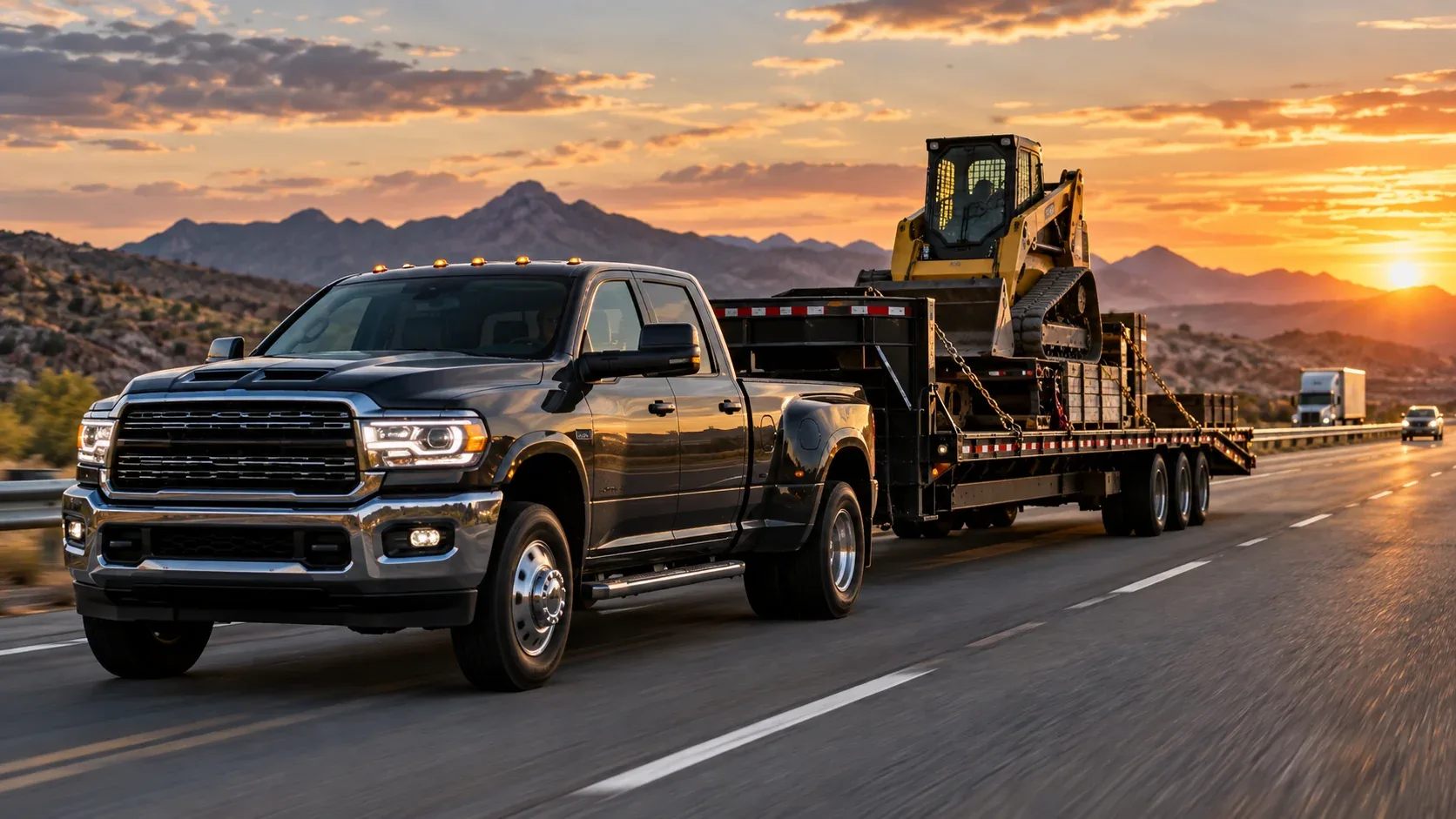
The hotshot question usually starts with the wrong number: How heavy can I go without a CDL? That matters, but it is only one line in the compliance map.
A dually pickup pulling a gooseneck can be below the federal CDL threshold and still be a regulated interstate commercial motor vehicle. It can need a USDOT Number, medical qualification, hours-of-service records, an ELD, operating authority, insurance filings and state credentials. The answer depends on the actual truck-and-trailer combination and the work being performed, not on the word “hotshot” in a Facebook group or insurance quote.
The useful way to approach the business is to calculate the equipment first, classify the freight and commerce second, and buy compliance services only after those two decisions are clear.
Three weight lines matter more than the word hotshot
For interstate cargo operations, FMCSA uses a 10,001-pound threshold as one of the triggers for USDOT registration. The agency looks at the gross vehicle weight rating, gross combination weight rating, actual gross vehicle weight or actual gross combination weight, whichever is greater.
That creates three practical bands for a typical hotshot property carrier.
| Truck-and-trailer profile | What the threshold can mean |
|---|---|
| Below 10,001 lb | The federal CMV rules tied to the 10,001-pound interstate threshold generally do not apply solely because of weight, although cargo, passenger and state rules can still matter. |
| 10,001 to 26,000 lb | A USDOT Number and federal safety rules can apply in interstate commerce even though the driver may not need a CDL. |
| 26,001 lb or more | CDL analysis becomes critical. A Class A CDL generally applies to a qualifying combination when the towed unit is over 10,000 lb. |
The important word is combination. A pickup with a modest GVWR can cross a federal threshold once the trailer rating is included. Conversely, a trailer rated above 10,000 pounds does not by itself create a Class A CDL requirement if the combination remains below 26,001 pounds.
USDOT registration: where the 10,001-pound line starts
FMCSA says a company operating a vehicle at 10,001 pounds or more in interstate commerce must obtain a USDOT Number when the federal registration criteria are met.
Interstate commerce is broader than simply crossing a state line. A movement can be interstate in character when the shipment is part of trade that begins or ends outside the state, even if the driver’s own segment stays within one state.
For a new hotshot business, document these facts before filing:
- pickup GVWR;
- trailer GVWR;
- expected actual loaded weight;
- whether loads will cross state lines;
- whether the freight is part of interstate movements;
- whether the carrier owns the cargo or transports property for others;
- commodity type;
- operating states.
If the operation changes later — for example, the carrier upgrades from a lighter bumper-pull trailer to a heavier gooseneck — rerun the analysis. A business can cross a regulatory threshold without changing its name, customers or lanes.
For a broader registration decision tree, see USDOT vs. MC Number.
MC authority: are you hauling someone else’s regulated freight for pay?
A USDOT Number identifies the carrier for safety oversight. Operating authority addresses whether the business is authorized to perform a regulated transportation service.
FMCSA states that companies generally need interstate operating authority when they transport federally regulated commodities owned by others for compensation in interstate commerce. That is the normal model for a for-hire hotshot carrier taking brokered general-freight loads.
The label “hotshot” does not change that.
A private company moving only its own equipment can have a different authority result. So can a carrier moving only commodities that fall outside the ordinary authority requirement. A carrier working solely intrastate must analyze the state regime instead of assuming federal MC authority solves the problem.
If the business is launching its own authority, use the full sequence in Getting Your Own Trucking Authority rather than treating the MC application as the finish line.
CDL: calculate the combination before you buy the trailer
Under the federal CDL classifications, Class A generally covers a combination with a GCWR or GCW of at least 26,001 pounds when the towed unit has a GVWR or GVW above 10,000 pounds.
That produces a common hotshot misconception: “My truck is under 26,001 pounds, so I do not need a CDL.”
That is incomplete. For a combination vehicle, the relevant numbers include the truck and trailer together.
Consider two simplified setups.
Example 1: 25,500-pound combination
A pickup is rated at 11,500 pounds and the trailer at 14,000 pounds. The combination rating is 25,500 pounds.
The trailer is over 10,000 pounds, but the combination is still below 26,001 pounds. On those facts alone, FMCSA guidance says the combination does not become a Class A vehicle.
Federal motor-carrier rules may still apply because the operation is well over the 10,001-pound CMV threshold.
Example 2: 27,500-pound combination
A pickup is rated at 12,500 pounds and a gooseneck trailer at 15,000 pounds. The combined rating is 27,500 pounds and the towed unit exceeds 10,000 pounds.
That configuration reaches the federal Class A threshold.
Real vehicles should be checked against their actual ratings, weight definitions, state CDL implementation and any hazardous-material or passenger rules. Do not design the business around a rough estimate from curb weight.
Non-CDL can still mean logs and an ELD
Another common mistake is using “non-CDL” as shorthand for “no logbook.”
The ELD rule generally applies to drivers who are required to keep records of duty status under Part 395. FMCSA provides exceptions, including drivers who qualify for the short-haul exception and drivers who need paper RODS no more than eight days in a 30-day period.
The practical workflow is:
- decide whether the vehicle and operation are subject to federal HOS;
- determine whether the driver qualifies for a short-haul or other HOS exception;
- determine whether RODS are required;
- only then determine whether an ELD is mandatory.
That is why a non-CDL hotshot driver traveling long interstate lanes may need an ELD while another driver using a heavier vehicle locally may qualify for a short-haul exception.
See ELD Rules and Exemptions Every Owner-Operator Should Know and Short-Haul Exception: 150 Air-Mile Rule for the separate HOS analysis.
Drug testing follows CDL-required operation, not the hotshot label
FMCSA’s owner-operator guidance is more specific here. An owner-operator operating a CMV that requires a CDL is subject to DOT drug and alcohol testing.
Affected owner-operators must participate in a consortium/third-party administrator’s random testing pool rather than simply ordering an occasional test themselves.
That means a business deliberately operating a non-CDL combination should not automatically buy a Part 382 testing package simply because a vendor says “all hotshot drivers need one.” Conversely, once the operation requires a CDL, treating the business as a one-person company does not remove the testing obligation.
The site’s drug and alcohol testing consortium guide explains how to vet the service rather than buying the first compliance bundle offered after obtaining a USDOT Number.
Insurance: the FMCSA filing is only one layer
For an interstate for-hire carrier with operating authority, FMCSA requires the applicable financial responsibility to be on file before authority is granted. The exact federal requirement depends on entity type, authority, cargo and vehicle type.
A hotshot business should separate four different questions:
- What must the insurer file with FMCSA?
- What liability limit applies to the operation?
- What cargo or physical-damage coverage is required by contract, lender or broker?
- What additional coverage is needed to protect the business rather than merely activate authority?
A certificate of insurance sent to a broker is not the same thing as the insurer’s filing with FMCSA.
The complete distinction is covered in Owner-Operator Truck Insurance and BMC-91 and BMC-91X Insurance Filings.
State credentials are where many first trips go wrong
A hotshot carrier can have an active USDOT and MC record and still be missing credentials for the actual truck or route.
Depending on weight, base jurisdiction and operating states, review:
- Unified Carrier Registration;
- apportioned registration under IRP;
- IFTA;
- Form 2290 when the taxable vehicle threshold is met;
- state weight-distance or highway-use taxes;
- oversize or overweight permits;
- intrastate authority;
- state-specific truck registrations.
This is especially important when a pickup-and-trailer combination moves from a lighter setup into heavier interstate service. IRP and IFTA use their own qualification tests. They do not simply appear because an MC Number is active.
Build the compliance file from the equipment outward
Before buying a compliance package, build the operation on paper.
- Record the exact GVWR and GCWR figures from the equipment.
- Decide whether the freight will be interstate, intrastate or both.
- Classify the operation as for-hire or private.
- Identify the commodities and customers.
- Determine USDOT and operating-authority requirements.
- Determine CDL status from the actual combination.
- Analyze HOS and ELD separately from CDL status.
- Set up drug and alcohol testing if the CDL-required operation triggers Part 382.
- Obtain insurance based on the real authority and cargo.
- Map UCR, IRP, IFTA and state-specific credentials for the planned lanes.
The advantage of this sequence is that each filing follows the business model. The expensive alternative is buying a truck, applying for every service marketed as “hotshot compliance” and discovering later that the combination, authority or operating states require something different.
Before paying for a hotshot compliance package
- Write down the pickup GVWR, trailer GVWR and expected loaded weight.
- Classify the work as interstate or intrastate and private or for-hire.
- Confirm whether the combination requires a CDL before choosing the driver setup.
- Determine whether RODS are required and whether an ELD exception actually applies.
- Map the states you expect to run before buying IRP, IFTA or state permits.
- Separate FMCSA insurance filings from the coverage limits demanded by brokers and contracts.
Before you accept the first brokered load
Run one final check against the load you are actually about to move, not the business you planned three months ago.
Confirm the truck and trailer ratings, the driver’s license class, the cargo, the interstate character of the movement, active authority when required, insurance status, hours-of-service method and every route-specific credential. If one of those facts changed, the compliance answer may have changed with it.
That is the practical advantage of treating hotshot as an operating configuration rather than a regulatory category: the rules become a series of testable questions instead of a generic “hotshot checklist.”