
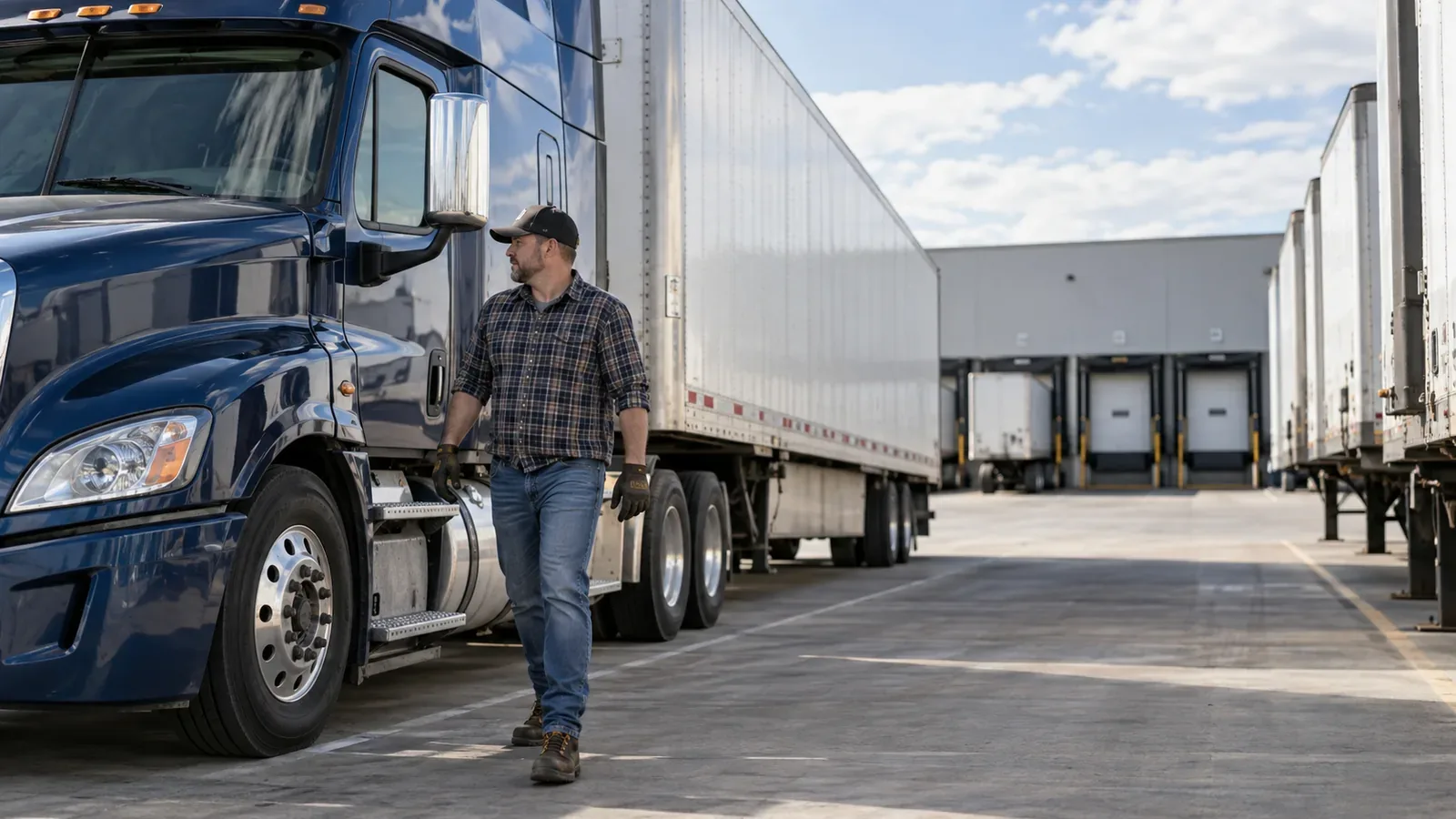
The tractor belongs to the carrier. The trailer does not. While backing into a tight dock, the right rear corner of the trailer strikes a concrete post. The freight and tractor are untouched, but the trailer needs several thousand dollars of repair work.
Which policy responds?
That is the problem trailer interchange insurance is designed to address. The coverage can be easy to misunderstand because the owner-operator is operating equipment owned by someone else while several other policies may already sit around the same movement: auto liability, physical damage on the tractor, cargo insurance and perhaps general liability.
None of those labels, by itself, answers the central question: who pays for covered physical damage to somebody else’s trailer while it is in your possession?
Start with ownership
The fastest way to understand trailer interchange is to separate three assets.
| Asset | Typical insurance question |
|---|---|
| Tractor you own | Do you have physical damage coverage on your own equipment? |
| Freight inside the trailer | Does your motor truck cargo policy respond? |
| Trailer you do not own | Do you have coverage for physical damage to that non-owned trailer? |
The third row is the trailer interchange problem.
Progressive describes trailer interchange insurance as physical damage insurance for non-owned trailers being pulled under a trailer interchange agreement. For comparison, the site’s physical damage insurance guide explains how coverage works for equipment the insured owns.
That distinction matters.
Your tractor’s collision and comprehensive coverage protects scheduled equipment according to the policy.
It does not automatically turn every trailer attached to the fifth wheel into your insured property.
Responsibility can attach without ownership
Ownership and responsibility are different questions.
A carrier, shipper, leasing company or another motor carrier may own the trailer.
But the agreement under which you take possession may make you responsible for damage while the trailer is in your care.
That is where the exposure begins.
Imagine a trailer worth $45,000.
You do not own it.
You may never own it.
But if your agreement makes you responsible for covered damage while you possess it, the economic exposure can still be yours.
The cheapest limit can become expensive very quickly when the trailer is not yours.
When trailer interchange coverage applies
A trailer interchange agreement is an arrangement under which one party transfers a trailer to another carrier or trucker for use in completing transportation.
In practical terms, one operator hands equipment to another.
The receiving operator takes possession.
The agreement defines responsibilities surrounding that equipment.
For insurance purposes, the exact contractual arrangement matters because trailer interchange coverage is commonly tied to trailers used under an interchange agreement.
Do not reduce the analysis to:
“I pull trailers I don’t own.”
That fact is important.
It may not be enough by itself to determine which coverage applies.
The policy and the agreement need to line up.
The written agreement can be a coverage condition
Progressive’s current trailer interchange product requires the trailer to be in the insured’s possession under a written trailer interchange agreement.
Other insurers may use different forms, endorsements or definitions.
That is why an owner-operator should not assume that every non-owned trailer automatically falls under trailer interchange coverage.
Before relying on the policy, confirm:
- whether a written agreement is required;
- what the policy means by trailer interchange;
- when the trailer is considered in your possession;
- whether the coverage applies while the trailer is detached;
- what types of trailers are eligible;
- whether any contractual requirements exceed the insurance limit.
The agreement creates the responsibility.
The policy defines the insurance response.
Those two documents should not be reviewed separately.
The coverage is for physical damage
The easiest comparison is with physical damage on your own tractor.
Physical damage generally deals with loss to the insured equipment itself from covered causes.
Trailer interchange applies a similar concept to qualifying trailers you do not own.
Progressive identifies examples including:
- collision;
- fire;
- theft;
- explosion;
- vandalism.
Actual policy wording controls.
An article cannot tell you that every loss of those types will be covered by every insurer.
Deductibles, exclusions, definitions and conditions still apply.
But the conceptual purpose is clear:
protect the non-owned trailer against covered physical damage while it is within the insured trailer-interchange exposure.
Four claim scenarios
Scenario 1: you hit a concrete barrier
You are pulling a customer’s trailer.
While maneuvering at a warehouse, the trailer strikes a fixed barrier.
The trailer body and rear door are damaged.
There is no cargo loss.
This is the kind of claim where trailer interchange coverage may become relevant because the damaged property is the non-owned trailer itself.
The first questions would include:
- Was this trailer eligible under the policy?
- Was it being used under the required agreement?
- Was the trailer in the insured’s possession?
- Is collision damage covered?
- What deductible applies?
- What is the policy limit?
The fact that the accident happened at low speed does not make the repair cheap.
Trailer doors, structural components and refrigeration equipment can change that calculation quickly.
Scenario 2: the trailer is stolen
You stop during the trip.
The tractor and trailer are stolen together.
Your own tractor has physical damage coverage.
The trailer belongs to another party.
Those are two different property losses.
Progressive specifically uses theft of an exchanged trailer as an example of the type of loss trailer interchange coverage can address.
This illustrates why simply having comprehensive coverage on the tractor is not enough.
The owner-operator needs to know what protects each piece of equipment.
Scenario 3: cargo is damaged but the trailer is not
A load shifts inside the trailer.
The freight is damaged.
The trailer itself has no meaningful physical damage.
That is primarily a cargo question, not a trailer interchange question.
Trailer interchange coverage is not a substitute for motor truck cargo insurance. One protects qualifying non-owned equipment; the other addresses covered loss to freight. They solve different problems.
Scenario 4: trailer and cargo are both damaged
The combination rolls over.
The tractor is damaged.
The trailer is damaged.
The freight is damaged.
Now three separate property interests may exist:
| Loss | Coverage to investigate |
|---|---|
| Your tractor | Physical damage |
| Non-owned trailer | Trailer interchange or applicable non-owned trailer coverage |
| Customer’s freight | Motor truck cargo |
One accident can therefore generate several claims under different parts of the insurance program.
This is why the sentence:
“I have full coverage.”
is not useful in commercial trucking.
Coverage needs a noun after it.
Coverage for what?
What trailer interchange does not replace
Suppose your truck hits another vehicle and injures the driver.
That is fundamentally a liability exposure.
Trailer interchange is concerned with physical damage to the qualifying trailer itself.
These coverages should not be mentally merged because both can arise from the same accident.
A backing accident might damage:
- the non-owned trailer;
- a parked automobile;
- a loading dock.
Those losses do not necessarily belong to the same coverage.
The insurance analysis follows the damaged property and legal responsibility.
Non-trucking liability is different
Non-trucking liability is another term owner-operators regularly encounter.
It addresses a very different exposure associated with certain non-business uses of a commercial truck.
It does not exist to protect a non-owned trailer from physical damage during an interchange operation.
Similar names do not mean similar functions.
When comparing insurance, classify each coverage by the question it answers.
Trailer interchange answers:
What protects the qualifying trailer that I do not own?
Limits, deductibles and contract requirements
Buying trailer interchange coverage does not mean the insurer will pay any amount demanded after a total loss.
The policy has a limit.
Consider:
- trailer value: $55,000;
- trailer interchange limit: $30,000;
- deductible: $1,000.
If a covered total loss is valued above the insurance limit, the carrier can still face a substantial uninsured amount.
The precise claim calculation depends on the policy and settlement terms.
But the commercial lesson is straightforward.
A $30,000 limit does not become $55,000 merely because the damaged trailer was worth more.
Match the limit to equipment you may actually pull
An owner-operator who usually handles ordinary dry vans may have a different exposure from one pulling:
- newer refrigerated trailers;
- specialized flatbeds;
- tank trailers;
- intermodal chassis and containers;
- specialized high-value equipment.
The correct limit should not be chosen solely by asking:
“What is the cheapest option the insurer offers?”
Ask instead:
What is the highest realistic value of equipment I may become responsible for?
Then compare that exposure with:
- the policy limit;
- contractual minimums;
- deductible;
- exclusions;
- any sublimits.
The premium matters.
So does the gap left after the premium is paid.
The contract can require more insurance than you currently carry
A motor carrier or shipper may require a specific trailer interchange limit before allowing the owner-operator to use its equipment.
Suppose your policy provides $25,000.
The contract requires $50,000.
The problem is not solved because both documents contain the words “trailer interchange.”
The numbers need to match.
Before signing an agreement, compare:
Contract requirement
against
Actual policy
not against what you remember asking the agent to quote.
Deductibles change the economics of small claims
Trailer interchange policies also use deductibles.
A higher deductible can reduce premium.
It also means the insured retains more of each covered loss.
Suppose a trailer repair costs $4,500.
A $1,000 deductible and a $5,000 deductible create very different outcomes.
For a one-truck owner-operator, that cash difference may matter more than it would for a large fleet.
Do not compare quotes by annual premium alone.
Compare:
premium + deductible + limit + scope of coverage.
A cheaper policy can simply be transferring more risk back to you.
Possession, custody and condition
One detail worth asking the agent is whether coverage applies while the non-owned trailer is in your possession but not attached to the tractor.
Operations do not always involve continuous towing.
A trailer may be:
- dropped in a yard;
- waiting at a dock;
- parked overnight;
- staged for another driver.
Some insurance products expressly contemplate trailers while in the insured’s care or possession.
The exact trigger depends on the policy.
Do not assume “attached” and “in your possession” mean the same thing.
Ask.
Know when possession starts
The agreement may specify when responsibility transfers.
Possible moments include:
- signing an interchange receipt;
- physically connecting to the trailer;
- accepting the equipment at a terminal;
- removing it from the owner’s facility.
The policy may use its own language.
This can become important if damage is discovered immediately after pickup.
If a dent already existed, who caused it?
If a tire was damaged before the interchange, who owns that loss?
A simple equipment-condition record at transfer can prevent a claim from becoming an argument about timing.
Inspect the trailer before accepting it
Insurance is not the first control.
Inspection is.
Before taking possession of a non-owned trailer, look for obvious existing damage.
Where practical, document:
- trailer number;
- date and time;
- exterior condition;
- tires;
- lights;
- doors;
- landing gear;
- visible roof or side damage;
- refrigeration unit condition where relevant;
- photographs of existing damage.
This is useful for safety.
It is also useful for insurance.
A carrier should not pay for yesterday’s damage because nobody looked at the trailer today.
Specialized equipment needs a separate check
A reefer is not merely a dry van with colder freight.
The refrigeration unit itself can add significant value.
If the agreement makes you responsible for the full trailer and reefer equipment, a low trailer interchange limit may be inadequate.
This is exactly the kind of issue that should be clarified before the first load.
Ask whether the policy’s definition and limit address:
- trailer body;
- refrigeration equipment;
- permanently attached equipment;
- accessories.
Never assume because the trailer is covered that every component has the same treatment.
Intermodal operations deserve separate review
Intermodal operations can involve:
- containers;
- chassis;
- interchange agreements;
- terminal requirements;
- UIIA-related insurance obligations.
UIIA insurance materials make the intermodal issue more concrete. They state that trailer interchange coverage required by participating Equipment Providers must protect physical damage to non-owned equipment—including containers, chassis and trailers—while that equipment is in the motor carrier’s care, custody or control. UIIA also notes that required limits and deductibles vary by Equipment Provider.
An intermodal owner-operator therefore should not buy a generic trailer interchange limit and assume every contractual requirement is satisfied. The applicable Equipment Provider requirements and the actual interchange agreement still need to be checked.
Cargo value does not determine trailer value
An empty trailer can still create a large exposure.
Suppose you pick up an empty refrigerated trailer worth far more than the freight you normally haul.
Cargo coverage is almost irrelevant to the value of the empty equipment.
The trailer is still somebody else’s asset.
This is another reason not to size trailer interchange coverage using your cargo limit.
They protect different property.
Owned, leased and other non-owned trailers
If you only pull a trailer that you own and schedule under your own physical damage coverage, trailer interchange may not be the relevant coverage for that equipment.
The exposure changes when you begin pulling trailers owned by others under arrangements that make you responsible for them.
That can happen when an owner-operator changes customers or leases to a different motor carrier.
Insurance that fit last year’s operation may no longer fit this year’s contracts.
Operational changes should trigger an insurance review.
Leased and rented trailers need their own coverage analysis
A trailer can be:
- owned;
- long-term leased;
- rented;
- borrowed;
- interchanged;
- temporarily in the carrier’s custody.
Those descriptions can lead to different insurance treatment.
Trailer interchange is not automatically the right label for every trailer you do not own.
Some policies may offer other forms of non-owned trailer physical damage coverage.
This is where policy language matters more than internet terminology.
Tell the agent exactly how the trailer enters your operation.
Do not simply say:
“It’s not mine.”
Five questions to ask before buying the coverage
An owner-operator can learn a great deal from five questions.
1. What trailers qualify?
Ask how the policy defines the non-owned trailer and whether a written interchange agreement is required.
2. When does coverage apply?
Clarify whether the trailer must be attached to the power unit and how possession is defined.
3. What causes of loss are covered?
Ask about collision, theft, fire, vandalism and other physical damage events.
4. What limit and deductible apply?
Confirm the actual dollar amount and whether special sublimits exist.
5. What exclusions matter for my operation?
Describe the equipment and work honestly.
The correct answer for a dry-van owner-operator may not be the correct answer for intermodal or specialized equipment.
Compare insurance quotes with a trailer scenario
A useful way to compare quotes is to stop looking only at the premium. The same principle applies more broadly when comparing commercial truck insurance quotes.
Give each agent the same scenario:
“I may pull non-owned trailers worth up to $60,000 under written interchange agreements. Some may be detached overnight in customer yards. What coverage would respond if one is stolen or damaged?”
Then compare the answers.
That question forces the quote into the real operation.
A carrier can then evaluate:
| Item | Quote A | Quote B |
|---|---|---|
| Trailer interchange included? | ||
| Limit | ||
| Deductible | ||
| Written agreement required? | ||
| Detached trailer treatment | ||
| Theft coverage | ||
| Specialized equipment issues | ||
| Major exclusions |
This is more useful than comparing two annual premiums with different coverage underneath them.
A certificate of insurance is not the policy
A certificate may show that trailer interchange coverage exists and list a limit.
That is useful evidence for a contracting party.
It is not the complete coverage contract.
The policy and endorsements contain the actual:
- definitions;
- exclusions;
- conditions;
- deductible;
- valuation method;
- territory;
- coverage triggers.
Do not use a one-page certificate to answer a question that requires policy wording.
Three common mistakes
Buying the minimum limit without checking trailer values
The contract may accept the limit.
The actual equipment may be worth much more.
Those are different tests.
Assuming cargo insurance covers the trailer
Cargo is the property being transported.
The trailer is transportation equipment.
Damage to one does not automatically mean coverage for the other.
Assuming every non-owned trailer is automatically covered
The arrangement, policy definitions and possession requirements matter.
A trailer being physically connected to your tractor does not rewrite the insurance contract.
Keep the insurance file usable as the operation changes
For an operation regularly using non-owned trailers, keep:
- current policy;
- trailer interchange endorsement;
- applicable limits and deductibles;
- certificates supplied to contracting parties;
- interchange agreements;
- customer insurance requirements;
- records of significant policy changes;
- agent correspondence clarifying unusual equipment where useful.
If a claim occurs, you should not be searching old email threads to discover whether trailer interchange was ever added.
The file should already answer that question.
Review coverage when the operation changes
Trailer interchange exposure can change without buying another truck.
A new customer may use more expensive trailers.
A carrier may begin pulling reefers.
A new lease may impose a higher required limit.
An intermodal contract may introduce different equipment.
A policy that was adequate six months ago can become inadequate because the business changed.
Insurance review should follow operational change.
Not just renewal date.
The decision is really about borrowed value
Strip away the insurance terminology and the commercial decision becomes simple.
You are taking possession of an asset you do not own.
The contract may make you responsible for it.
The asset may be worth tens of thousands of dollars.
Your own tractor’s physical damage coverage does not necessarily protect it.
So before pulling the trailer, answer four questions:
What is the trailer worth?
When am I responsible for it?
What policy protects it?
Is the limit high enough?
If those answers are clear, trailer interchange insurance is a manageable part of the operation.
If they are not, the problem will usually become much more expensive after the trailer is damaged.