
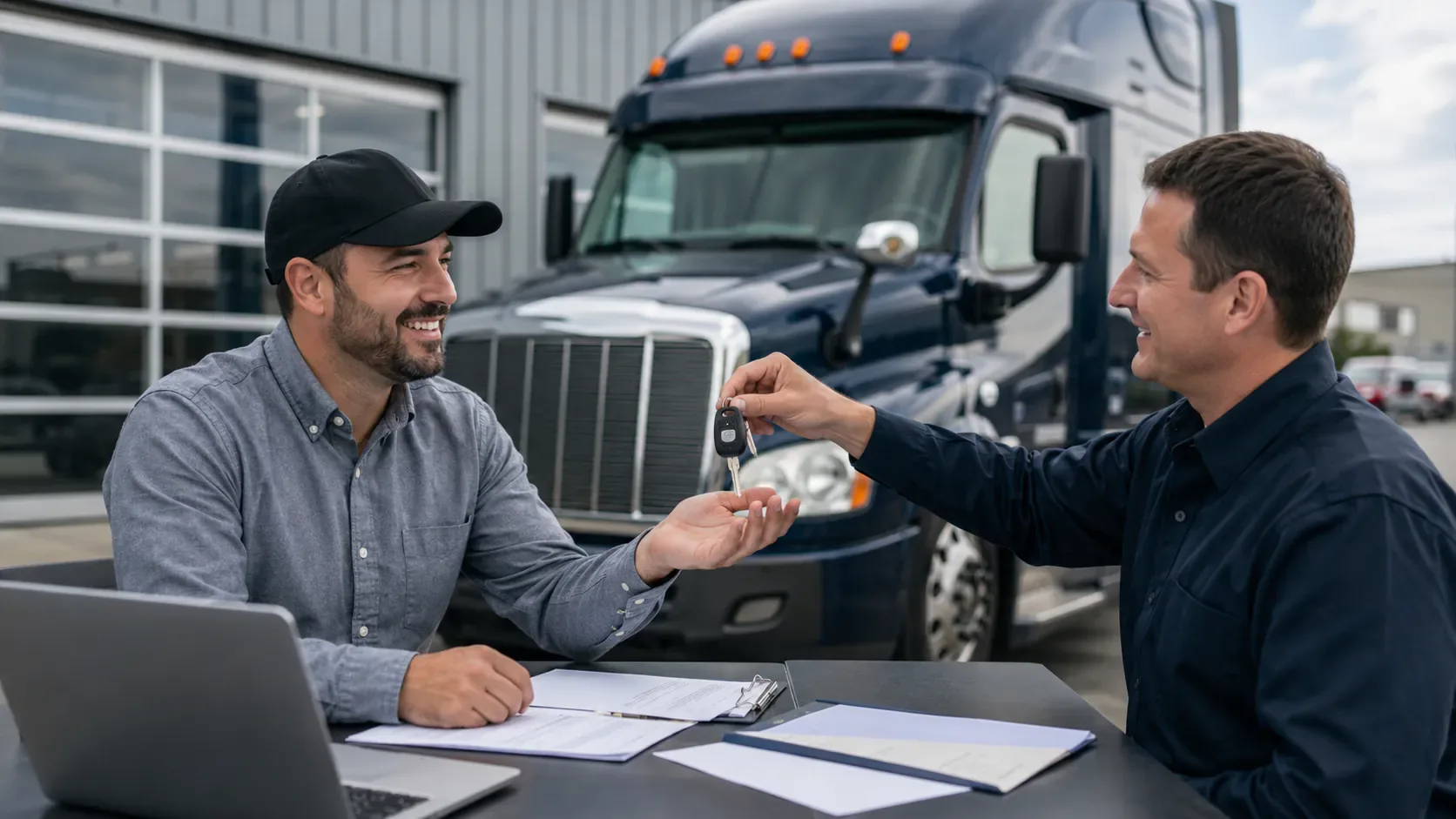
A truck-financing application is not one approval.
It is two.
The lender must approve:
- the borrower;
- the truck.
A new carrier can have excellent personal credit and be declined because the selected tractor is too old, too specialized or worth less than the purchase price.
Another applicant can choose an excellent late-model truck and be declined because the business plan does not leave enough cash to repay the loan.
The lender is trying to answer three questions:
Can this owner operate the business?
Can the business make the payment?
Can the lender recover enough value if the loan fails?
A strong application answers all three before the underwriter has to ask.
Why startup truck financing is different
An established carrier can provide:
- business tax returns;
- historical profit and loss statements;
- balance sheets;
- bank history;
- customer payment history;
- fleet performance;
- existing debt record.
A startup cannot.
The lender therefore shifts more weight to:
- personal credit;
- owner liquidity;
- trucking experience;
- CDL and employment history;
- quality of the business plan;
- projected cash flow;
- down payment;
- equipment collateral;
- personal guaranty.
The absence of business history does not make financing impossible.
It makes documentation and equipment selection more important.
The underwriting triangle
A startup application is strongest when all three sides of the underwriting triangle support one another.
| Underwriting area | What the lender evaluates |
|---|---|
| Owner | Credit, experience, character, liquidity and guaranty |
| Business | Plan, projected revenue, expenses, reserves and repayment ability |
| Equipment | Price, age, mileage, condition, title, useful life and resale value |
A weak side can sometimes be supported by a stronger one.
Examples:
- limited business history supported by substantial trucking experience;
- lower personal credit supported by a larger down payment;
- older equipment supported by a lower purchase price and independent inspection;
- thin liquidity supported by smaller loan size.
No compensating factor is guaranteed.
The lender sets the credit policy.
Requirement 1: prove the borrower exists and controls the business
The lender first verifies the legal applicant and its owners.
Prepare:
- legal business name;
- entity formation documents;
- EIN;
- business address;
- operating agreement or bylaws;
- ownership percentages;
- government identification;
- Social Security numbers or tax identifiers;
- business bank account;
- assumed-name filing where applicable.
Bank of America states that business-loan applicants can be required to provide information about:
- beneficial owners;
- controlling individual;
- ownership percentage;
- identity;
- personal income;
- residence and housing payment.
The lender must know who owns and controls the borrower before evaluating the truck.
Keep names identical
The following should match:
- entity filing;
- EIN record;
- bank account;
- purchase agreement;
- insurance;
- FMCSA registration;
- loan documents;
- title application.
A missing comma will not normally destroy an application.
A different legal entity can.
Requirement 2: personal credit and credit history
A startup has little or no business credit.
The owner’s personal profile becomes a central underwriting source.
The lender can review:
- credit score;
- payment history;
- revolving utilization;
- delinquencies;
- collections;
- bankruptcies;
- tax liens;
- judgments;
- recent inquiries;
- housing obligation;
- personal debt payments.
There is no universal minimum score
Commercial truck lenders use different programs.
The acceptable credit profile changes with:
- loan amount;
- down payment;
- time in business;
- experience;
- truck age;
- truck mileage;
- loan term;
- cash reserve;
- lender type.
A statement such as “truck financing requires a 650 score” is not a universal rule.
One lender can decline that profile.
Another can approve it with:
- higher down payment;
- shorter term;
- different truck;
- higher price;
- additional guarantor.
Review reports before applying
The owner should review personal credit for:
- wrong balances;
- duplicate accounts;
- inaccurate late payments;
- fraud;
- outdated addresses;
- unresolved public records.
Do this before the lender performs the inquiry.
A disputed error is easier to address before the purchase deadline.
Requirement 3: personal financial statement
The lender may request a complete personal financial statement.
SBA Form 413 is used to assess repayment ability and creditworthiness for programs including:
- 7(a);
- 504;
- disaster loans;
- surety guarantees.
A personal financial statement normally identifies:
- cash;
- securities;
- retirement accounts;
- real estate;
- vehicles;
- other assets;
- mortgages;
- installment debt;
- revolving debt;
- contingent liabilities;
- net worth.
Liquidity matters more than paper net worth
An owner can have substantial net worth tied up in:
- home equity;
- retirement assets;
- personal vehicles.
That does not mean cash is available for:
- down payment;
- first insurance installment;
- repair;
- emergency fuel.
The lender can distinguish between:
- total net worth;
- liquid net worth;
- cash contribution;
- post-closing liquidity.
Requirement 4: trucking and management experience
A startup carrier can be new while the owner is experienced.
Document:
- CDL class and endorsements;
- years driving;
- equipment operated;
- freight hauled;
- safety history;
- dispatch experience;
- maintenance knowledge;
- prior employer history;
- owner-operator history;
- business-management experience.
Why experience matters
Truck ownership involves risks unfamiliar to a general small-business lender:
- volatile revenue;
- fuel exposure;
- expensive repairs;
- broker payment delay;
- compliance;
- driver qualification;
- equipment downtime.
An applicant who has operated similar equipment and freight can present a more credible plan.
No experience requires stronger support
A borrower entering trucking without direct experience should explain:
- driver hiring;
- safety management;
- dispatch;
- maintenance support;
- insurance;
- compliance consultant;
- customer acquisition;
- financial controls.
Buying a truck is not a substitute for operating knowledge.
Requirement 5: business plan
SBA recommends that startup applicants prepare:
- business plan;
- expense sheet;
- financial projections.
A truck-financing plan does not need to be a long academic document.
It needs to show how the truck earns enough money to pay every cost.
The operating model
Describe:
- freight type;
- geographic lanes;
- expected loaded and deadhead miles;
- driver;
- trailer arrangement;
- load sources;
- customer concentration;
- dispatch process;
- payment terms;
- maintenance process;
- insurance;
- compliance.
Avoid unsupported revenue promises
Weak:
Truck will earn $30,000 every month.
Stronger:
- expected weekly miles;
- expected revenue per total mile;
- expected utilization;
- source of rate assumptions;
- seasonality;
- conservative scenario;
- broker payment timing.
The projection should be traceable to operating assumptions.
Requirement 6: financial projections
A lender needs to see the expected ability to repay.
Prepare at least:
- startup-use budget;
- monthly profit and loss projection;
- monthly cash-flow projection;
- opening balance sheet;
- debt schedule;
- break-even analysis.
Profit is not cash flow
A projected business can show an accounting profit and still run out of cash because:
- fuel is paid today;
- brokers pay later;
- insurance requires a large down payment;
- repairs are immediate;
- loan payments are fixed.
The cash-flow projection should show:
- beginning cash;
- customer collections;
- operating payments;
- loan payments;
- owner draw;
- ending cash.
Use three cases
Create:
- base case;
- low-revenue case;
- repair-and-downtime case.
The lender is more likely to trust a plan that acknowledges risk.
Requirement 7: ability to service debt
The financing must fit the truck’s operating economics.
A common concept is debt-service coverage.
Use:
Debt-service coverage = cash available for debt service ÷ required debt payments
The lender can calculate it differently depending on the program.
The principle is simple:
- projected cash must exceed required loan payments;
- by enough margin to survive normal variation.
Example
Projected annual cash available for equipment debt:
- $42,000.
Annual truck-loan payments:
- $30,000.
Coverage:
- $42,000 ÷ $30,000;
- equals 1.40.
This means the projection provides $1.40 of cash for each $1.00 of scheduled debt.
The ratio does not prove approval.
It gives the lender and carrier a way to measure payment pressure.
Stress the payment
Recalculate after:
- diesel rises;
- revenue falls 10%;
- truck loses two weeks;
- insurance is higher than projected;
- maintenance reserve increases.
A payment affordable only in the best month is not affordable.
Requirement 8: down payment
The down payment creates borrower equity and reduces lender exposure.
There is no universal percentage.
The requirement can change with:
- credit;
- experience;
- time in business;
- truck type;
- age;
- mileage;
- valuation;
- dealer;
- private-party purchase;
- loan term;
- market demand.
Why startups can face higher equity requirements
The lender cannot rely on historical company cash flow.
A larger down payment can:
- reduce loan-to-value;
- demonstrate commitment;
- create protection against depreciation;
- lower the payment.
More down is not always safer for the business
Assume the owner has:
- $40,000 total available cash.
Option A:
- $35,000 down;
- $5,000 remaining.
Option B:
- $25,000 down;
- $15,000 remaining.
Option A creates a smaller payment.
It can leave the carrier unable to pay:
- insurance;
- plates;
- fuel;
- repair;
- first household draw.
A stronger financing plan balances:
- lender equity;
- post-closing working capital.
Prove the source
The lender can require evidence that down-payment money is:
- owned by the borrower;
- seasoned in an account;
- not undisclosed debt;
- transferred lawfully.
Document gifts, investor capital or borrowed funds accurately.
Requirement 9: post-closing liquidity
A lender can approve the purchase and still require the owner to retain cash.
The carrier needs liquidity for:
- insurance;
- registration;
- fuel;
- tolls;
- factoring reserve;
- repairs;
- deductible;
- payment delay;
- owner living costs.
Separate three cash buckets
- Closing cash
- Operating cash
- Emergency reserve
Do not present the same dollar in all three categories.
Startup runway
Estimate the weeks between:
- closing;
- authority activation;
- first load;
- invoice approval;
- first payment.
The previous article shows how to calculate complete startup capital.
Requirement 10: bank statements and tax records
A lender can request:
- personal bank statements;
- business bank statements;
- personal tax returns;
- business tax returns;
- year-to-date financial statements;
- debt schedule;
- proof of income;
- proof of down payment.
Bank of America advises applicants to have recent:
- business and personal tax returns;
- financial statements;
- specific equipment or vehicle information.
Established business products can require multiple years of tax returns and financial statements.
A new company should provide:
- available personal history;
- complete opening business records;
- projections;
- source documentation.
Keep business records separate
IRS Publication 583 recommends complete and separate records for each business.
A clean business bank account helps the lender identify:
- owner contribution;
- business expenses;
- available cash;
- undisclosed obligations.
Requirement 11: authority and compliance plan
Lender policies differ on operating authority.
Possible approaches include:
- active authority required;
- USDOT Number sufficient before approval;
- conditional approval pending activation;
- financing available before registration;
- established-carrier lease-on required.
The applicant should provide:
- entity and EIN;
- USDOT and MC application status;
- intended authority type;
- BOC-3 plan;
- UCR;
- IRP and IFTA plan;
- drug-testing program;
- ELD;
- driver qualification;
- New Entrant preparation.
Do not activate expenses blindly
The lender can require proof that the business will operate legally.
The owner should avoid starting expensive insurance too early without coordinating:
- closing;
- plate availability;
- authority timeline;
- truck delivery.
Requirement 12: insurance
The lender normally requires insurance before releasing funds or permitting operation.
The package can include:
- primary liability;
- physical damage;
- cargo;
- general liability;
- trailer coverage;
- other required policies.
The lender protects the collateral
The loan documents can require the lender to appear as:
- loss payee;
- lienholder;
- additional interest.
This is separate from FMCSA’s insurance filing.
Obtain the quote before selecting the truck
Insurance can change with:
- VIN;
- truck value;
- radius;
- cargo;
- owner experience;
- authority age;
- garaging location.
A truck with an attractive payment can become unaffordable after insurance.
Policy lapse can trigger default
The agreement can permit the lender to:
- purchase force-placed coverage;
- charge the borrower;
- declare default;
- repossess.
The carrier should know:
- required limits;
- deductible maximum;
- evidence deadline;
- renewal process.
Requirement 13: acceptable truck and trailer
The equipment is collateral.
The lender evaluates its ability to remain useful and recover value.
Prepare:
- purchase order;
- VIN;
- year;
- make;
- model;
- engine;
- mileage;
- title status;
- seller;
- purchase price;
- inspection;
- maintenance history;
- photographs;
- equipment specification;
- trailer information.
Age and mileage
Lenders can impose limits on:
- age;
- mileage;
- model;
- equipment type.
Bank of America’s public Business Advantage Auto Loan, which is designed for cars, vans and light trucks, currently lists requirements including:
- four years in business;
- vehicle no more than five years old;
- fewer than 75,000 miles.
Its FAQ states that vehicles over 2.5 tons are generally handled through an equipment loan instead.
This illustrates two important points:
- a standard business auto product may not finance a tractor-trailer;
- every lending program has its own equipment filters.
A startup needs a lender whose product actually covers heavy commercial equipment.
Title and lien status
The truck should have:
- valid title;
- correct seller;
- disclosed lien;
- clear payoff process;
- no undisclosed salvage or branded status;
- correct VIN.
A private-party transaction can require more verification than a dealer sale.
Valuation
The lender may finance the lower of:
- purchase price;
- appraised value;
- lender-approved value.
A $140,000 purchase agreement does not force the lender to value the truck at $140,000.
The difference can become additional down payment.
Equipment type and resale value
Common road tractors can be easier to finance than highly specialized equipment.
Lender risk can increase with:
- custom build;
- vocational conversion;
- niche body;
- unusual engine;
- limited resale market;
- discontinued equipment;
- imported equipment;
- high-mileage powertrain.
Specialized equipment can still qualify.
The lender can require:
- more equity;
- shorter term;
- additional collateral;
- established customer contract.
Requirement 14: independent inspection
A lender can verify value without guaranteeing mechanical condition.
The carrier should obtain an independent inspection covering:
- engine;
- transmission;
- aftertreatment;
- fault history;
- cooling;
- brakes;
- suspension;
- tires;
- electrical;
- leaks;
- annual inspection condition;
- trailer structure where applicable.
Financing a repair is not the same as financing a truck
An older unit can have:
- lower purchase price;
- higher immediate maintenance;
- shorter useful life;
- greater downtime.
Build the first-year repair plan before closing.
Requirement 15: seller and transaction quality
The lender can review the seller.
Possible sellers include:
- franchised dealer;
- independent dealer;
- auction;
- private owner;
- related party.
Risk can increase when:
- seller cannot prove ownership;
- price differs materially from value;
- transaction is related-party;
- documents conflict;
- title is in another name;
- truck is outside the lender’s territory;
- deposit is nonrefundable before approval.
Do not pay a large nonrefundable deposit too early
Use a purchase agreement that addresses:
- financing contingency;
- inspection;
- title;
- refund;
- closing deadline;
- equipment condition.
The lender can decline the truck after approving the borrower.
Four financing paths
A new carrier should compare structures, not only lenders.
1. Conventional equipment loan
The lender finances the truck.
The borrower usually owns it subject to a lien.
Typical characteristics can include:
- down payment;
- fixed or variable rate;
- monthly principal and interest;
- term based on useful life;
- personal guaranty;
- UCC or title lien.
Best fit
- borrower with sufficient credit and cash;
- acceptable equipment;
- desire to own the asset;
- predictable long-term use.
2. Equipment lease
The financing company owns the equipment during the lease term.
Common structures include:
- fair-market-value lease;
- fixed purchase option;
- nominal buyout structure;
- tax lease;
- finance lease.
Questions
- Who owns the truck?
- What is the purchase option?
- Is there a residual?
- What happens after early termination?
- Are mileage or condition limits imposed?
- Who receives tax benefits?
- Is maintenance required by contract?
Do not evaluate a lease from the monthly payment alone.
3. SBA 7(a)
SBA’s 7(a) program can support:
- machinery and equipment;
- short- and long-term working capital;
- multiple-purpose loans.
The maximum 7(a) amount is currently $5 million.
The borrower applies through a participating lender, not directly to SBA.
Eligibility includes:
- operating for profit;
- U.S. location;
- small-business status;
- creditworthiness;
- reasonable ability to repay;
- inability to obtain desired credit on reasonable non-government terms.
Startup advantage
A 7(a) structure can potentially combine:
- truck;
- trailer;
- working capital;
- startup costs.
The lender still makes a credit decision.
The SBA guarantee does not remove:
- down payment;
- collateral;
- documentation;
- guaranty;
- repayment.
Personal guaranty
SBA Form 148 states that individuals owning 20% or more of the applicant must provide an unlimited personal guaranty.
The SBA guarantee protects the lender.
It does not cap the owner’s obligation.
4. SBA microloan
SBA microloans provide up to:
- $50,000.
They can be used for:
- working capital;
- machinery;
- equipment;
- supplies.
The average SBA microloan is currently about $13,000, and terms are set by intermediary lenders.
A microloan may be useful for:
- trailer;
- down payment;
- make-ready repair;
- compliance;
- working capital.
It may be too small to finance a late-model tractor by itself.
What about SBA 504?
SBA 504 financing supports long-term fixed assets.
Eligible machinery and equipment must have a useful remaining life of at least 10 years.
The program cannot be used for ordinary working capital or inventory.
A commercial truck project may not fit automatically because:
- remaining useful life may be shorter;
- equipment can be mobile;
- CDC and lender requirements apply;
- startup needs often include working capital.
Ask a Certified Development Company about the exact equipment.
Do not assume 504 is the correct truck-financing program because its maximum amount is large.
Lender examples show why requirements vary
Commercial financing requirements are product-specific.
Traditional bank auto program
A public bank auto-loan product can require:
- years in business;
- newer vehicle;
- low mileage;
- minimum value.
It may exclude heavy tractors entirely.
Commercial equipment group
Commercial banks also maintain specialist equipment-finance divisions for:
- commercial vehicles;
- transportation equipment;
- new and late-model used equipment.
These programs can serve larger or established carriers differently from a retail small-business auto loan.
Specialized truck lender
A specialist can accept:
- newer business;
- higher-mileage truck;
- weaker credit.
The trade-off can include:
- larger down payment;
- higher total cost;
- shorter term;
- stronger guaranty;
- stricter insurance;
- additional fees.
The carrier should not interpret easier approval as lower risk.
Prepare the application package
A complete startup truck-finance file can contain:
| Section | Documents |
|---|---|
| Identity and ownership | Formation, EIN, ownership, identification and addresses |
| Owner financials | Credit authorization, tax returns, bank statements and personal financial statement |
| Experience | CDL, resume, employment, safety and equipment history |
| Business plan | Freight, lanes, customers, miles, rates and management |
| Financial plan | Startup budget, cash flow, P&L, balance sheet and debt schedule |
| Equipment | Purchase order, VIN, title, mileage, inspection and valuation |
| Compliance | Authority status, insurance quote, ELD and registration plan |
| Closing | Down-payment proof, bank details and insurance binder |
Submit one consistent file.
Do not make the lender reconstruct the business from text messages and separate attachments.
Compare loan terms beyond the payment
Two offers can have the same monthly payment and very different economics.
Review:
- amount financed;
- down payment;
- interest rate;
- APR where provided;
- origination fee;
- documentation fee;
- filing fee;
- term;
- amortization;
- balloon;
- prepayment;
- late fee;
- default rate;
- personal guaranty;
- collateral;
- GPS requirement;
- insurance;
- tax and title;
- total payment.
Rate versus APR
Interest rate describes the cost charged on principal.
APR can incorporate certain finance charges into an annualized comparison.
Commercial transactions do not always present APR in the same standardized way as consumer loans.
Ask for:
- payment schedule;
- all fees;
- total of payments;
- payoff method.
Amortization and term
A loan can have:
- 60-month amortization;
- 48-month maturity;
- balloon at month 48.
The monthly payment can appear lower than a fully amortizing shorter loan.
The borrower must know the final balance.
Prepayment
Possible structures include:
- no penalty;
- declining percentage;
- fixed minimum interest;
- payoff premium;
- rule of 78s or another formula;
- no discount for unearned charge under certain structures.
Ask for payoff amounts after:
- 12 months;
- 24 months;
- 36 months.
Fees
Possible fees include:
- origination;
- documentation;
- UCC;
- title;
- inspection;
- appraisal;
- broker;
- closing;
- wire;
- late;
- returned payment.
A fee deducted from proceeds increases the cash needed at closing.
Hypothetical payment comparison
Assume a truck costs:
- $120,000.
Down payment:
- 20%;
- equals $24,000.
Amount financed:
- $96,000.
At a hypothetical 12% annual rate over 60 months:
- monthly payment is approximately $2,135;
- total scheduled payments are approximately $128,128;
- total scheduled interest is approximately $32,128,
before additional fees.
Now compare a 48-month term:
- monthly payment rises to approximately $2,528;
- total scheduled interest falls to approximately $25,346.
The longer term improves monthly cash flow.
The shorter term lowers total interest and builds equity faster.
The correct choice depends on:
- truck life;
- maintenance;
- monthly margin;
- cash reserves.
Loan-to-value risk
Loan-to-value compares the loan with the lender’s accepted equipment value.
Use:
Loan-to-value = amount financed ÷ lender value
Example:
- truck purchase price: $130,000;
- lender value: $120,000;
- loan: $96,000.
LTV:
- $96,000 ÷ $120,000;
- equals 80%.
The borrower must also cover:
- purchase-price difference;
- tax;
- title;
- fees;
- repairs.
A seller price above lender value increases closing cash.
Personal guaranty
A personal guaranty makes the owner responsible when the business does not pay.
Review whether it is:
- unlimited;
- limited;
- joint and several;
- continuing;
- released after a period;
- secured by personal assets.
An LLC does not prevent liability created by a signed personal guaranty.
Collateral and UCC filing
The lender will usually take a lien on the truck.
It can also seek:
- trailer;
- all business equipment;
- accounts;
- deposit accounts;
- blanket business assets.
Determine:
- exact collateral;
- lien priority;
- cross-collateralization;
- release after payoff;
- effect on future financing.
A broad blanket lien can interfere with:
- factoring;
- working-capital line;
- second equipment loan.
Cross-default
A cross-default clause can make one agreement default when another obligation fails.
Example:
- fuel-card balance defaults;
- related lender declares truck loan default;
- or another loan default triggers remedies.
Review all connected finance products.
Default and repossession
Default can include more than missed payment.
Possible triggers:
- insurance lapse;
- false application;
- unauthorized sale;
- failure to maintain equipment;
- moving equipment outside permitted area;
- insolvency;
- other debt default;
- failure to provide financial information.
Consequences can include:
- acceleration;
- repossession;
- legal fees;
- deficiency balance;
- guaranty enforcement.
The truck is collateral.
Returning it does not necessarily eliminate the debt.
If sale proceeds are below the payoff and costs, the borrower can remain liable for a deficiency, subject to the agreement and law.
Keep working capital after closing
The most dangerous startup approval uses every dollar to acquire the truck.
The carrier then finances operations through:
- personal credit card;
- fuel advance;
- expensive factoring;
- delayed maintenance;
- unpaid owner labor.
A financing plan should leave cash for:
- insurance down payment;
- plates and taxes;
- fuel;
- tolls;
- first repairs;
- deductible;
- household support;
- slow payment.
The two-loan problem
A startup can finance the truck but lack working capital.
Possible solutions include:
- smaller down payment where prudent;
- SBA 7(a) multiple-purpose loan;
- microloan;
- owner equity;
- separate line;
- controlled factoring;
- delayed equipment purchase.
Do not use short-term high-cost cash products to support a long-term truck payment without modeling the combined cost.
Buy the truck the business can support
The lender can approve more truck than the carrier should buy.
A newer truck can offer:
- warranty;
- lower expected repairs;
- better lender terms;
- longer useful life.
It can also create:
- larger principal;
- higher insurance value;
- larger sales tax;
- longer obligation.
An older truck can offer:
- lower purchase price;
- smaller loan.
It can create:
- larger down payment percentage;
- shorter term;
- immediate repair;
- downtime;
- weaker resale.
The correct truck minimizes total operating and financing risk.
Affordability test before signing
Calculate the financed truck using the real cost-per-mile model.
Include:
- payment;
- interest and fees;
- insurance;
- fuel;
- maintenance;
- tires;
- owner pay;
- compliance;
- factoring;
- deadhead;
- downtime reserve.
Then test:
Base month
- expected miles;
- expected rates;
- ordinary fuel.
Weak month
- 20% lower revenue;
- same fixed payment.
Repair month
- one week down;
- repair expense;
- same payment.
Insurance renewal
- higher premium;
- same freight market.
The loan is affordable when the business remains solvent under a plausible weak case.
Why applications are declined
Common reasons can include:
- insufficient credit;
- unresolved collections;
- inadequate cash;
- no experience;
- weak business plan;
- unrealistic projections;
- truck too old;
- high mileage;
- purchase price above value;
- title problem;
- unacceptable seller;
- insurance too expensive;
- debt burden;
- inconsistent documents.
Ask for the real reason
A decline can mean:
- borrower does not qualify;
- truck does not qualify;
- loan program does not fit;
- lender does not serve startups;
- application is incomplete.
The solution depends on the reason.
Improve the application without hiding risk
Strengthen the owner file
- correct credit errors;
- reduce revolving balances;
- document experience;
- explain prior issues accurately;
- save more cash.
Strengthen the business file
- use conservative projections;
- show actual insurance quotes;
- calculate CPM;
- show working capital;
- document load sources.
Strengthen the truck file
- choose newer or lower-mileage equipment;
- negotiate price;
- obtain inspection;
- use reputable seller;
- provide maintenance records.
Strengthen the structure
- increase down payment prudently;
- reduce loan amount;
- add qualified guarantor;
- shorten term;
- use a different program.
Do not misstate:
- experience;
- revenue;
- customer contracts;
- equipment condition;
- source of funds.
A false application can create default even after months of successful payments.
Before closing
Confirm:
- exact truck and VIN;
- title and lien payoff;
- purchase price;
- down payment;
- amount financed;
- payment;
- due date;
- rate;
- all fees;
- term;
- amortization;
- balloon;
- prepayment;
- collateral;
- guaranty;
- insurance;
- default;
- payoff process.
Also confirm the lender will release funds only after:
- inspection;
- title;
- insurance;
- closing conditions.
Do not dispatch before:
- ownership;
- registration;
- insurance;
- authority;
- equipment readiness
are complete.
After closing
Keep:
- signed agreement;
- payment schedule;
- title and lien record;
- insurance evidence;
- inspection;
- purchase documents;
- tax treatment;
- payoff contacts.
Record the truck correctly in the business books.
IRS Publication 583 emphasizes maintaining records that clearly show business income and expenses.
The owner should coordinate with a tax professional regarding:
- depreciation;
- interest;
- lease treatment;
- basis;
- business-use percentage.
Financing approval does not determine tax treatment.
The decision rule
A new trucking business qualifies by presenting a credible owner, a financeable truck and a cash-flow plan that survives imperfect operations.
The strongest application does not simply prove that the first payment can be made.
It proves that the business can:
- insure the truck;
- operate it;
- maintain it;
- pay the owner;
- survive downtime;
- repay the lender.