
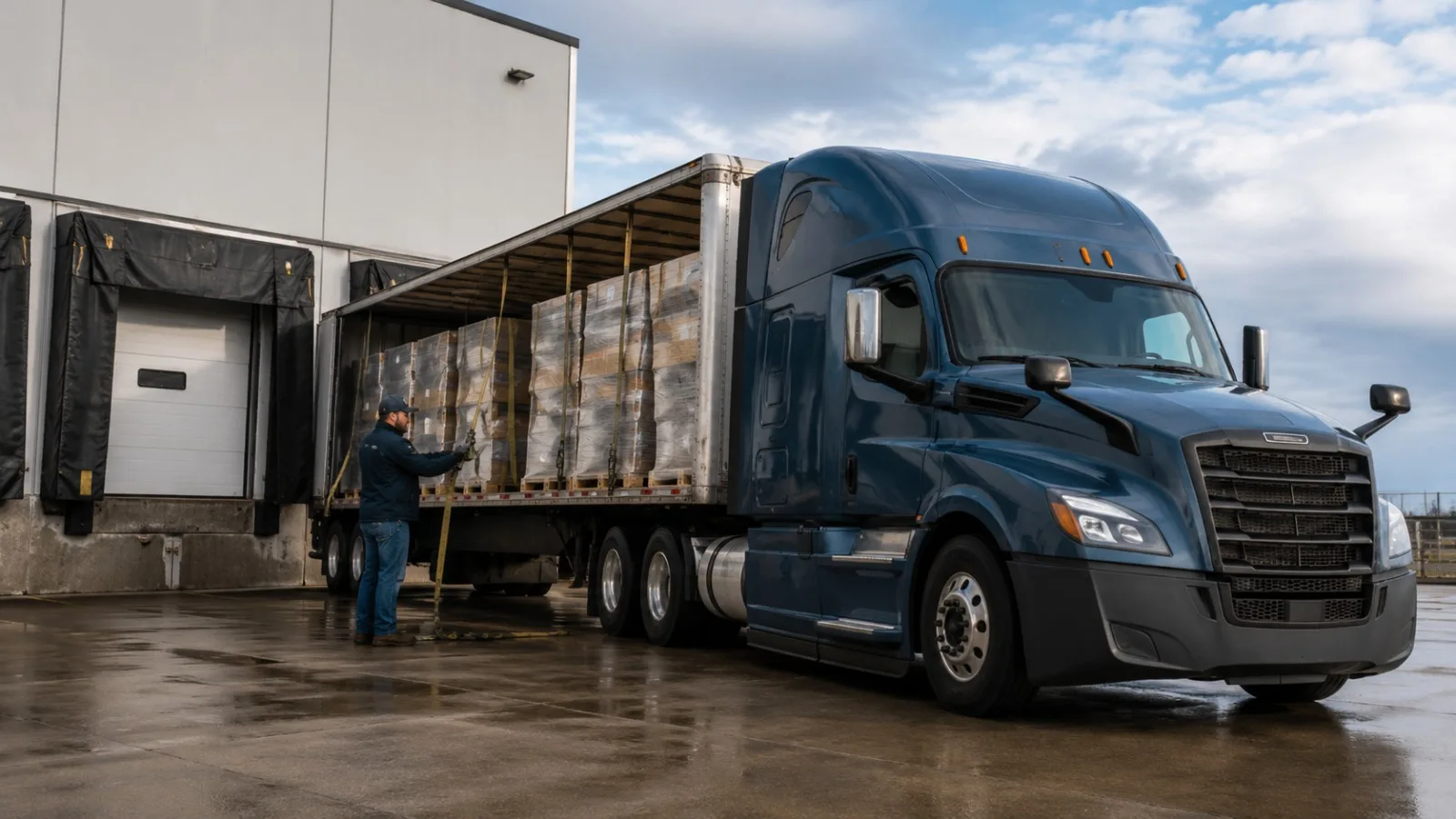
Motor truck cargo insurance protects freight rather than the truck carrying it.
That distinction sounds simple, but many costly misunderstandings begin when a carrier assumes that purchasing a policy with a large headline limit means every load is fully protected.
A cargo policy can contain:
- excluded commodities;
- sublimits;
- deductibles;
- theft conditions;
- unattended-vehicle restrictions;
- refrigeration requirements;
- geographic limitations;
- storage time limits;
- valuation provisions;
- claim-reporting duties;
- and exclusions for particular causes of loss.
The limit shown on the certificate is therefore only the starting point.
A carrier must answer three separate questions:
- Is cargo insurance legally or contractually required?
- Is the selected limit large enough for the real exposure?
- Does the policy actually cover the cargo and loss scenarios the business expects?
What motor truck cargo insurance covers
Motor truck cargo insurance is designed to protect a motor carrier against covered loss of or damage to goods being transported.
Depending on the policy, covered causes of loss may include events such as:
- collision;
- overturn;
- fire;
- theft;
- vandalism;
- certain water damage;
- loading or unloading accidents;
- damage caused while preventing a larger loss;
- debris removal;
- salvage expense;
- and earned freight relating to an undelivered load.
These examples are not universal. Each policy determines:
- the insured interest;
- covered property;
- covered causes of loss;
- when coverage begins;
- when coverage ends;
- the geographic territory;
- the deductible;
- the valuation method;
- and the exclusions.
Care, custody and control
Cargo coverage commonly addresses property belonging to someone else while it is in the carrier’s care, custody or control.
The relevant period may begin when the carrier accepts possession of the shipment and end when delivery is completed, but the exact trigger depends on:
- the policy;
- bill of lading;
- contract of carriage;
- pickup records;
- delivery receipt;
- trailer interchange;
- and temporary storage arrangements.
A carrier should not assume that freight is covered indefinitely merely because it remains inside the trailer.
Cargo insurance does not protect the truck
Cargo insurance and physical-damage insurance protect different property.
| Property or exposure | Coverage normally reviewed | Not automatically protected by cargo insurance |
|---|---|---|
| Freight being transported | Motor truck cargo | Coverage still depends on commodity and cause of loss |
| Owned tractor | Physical damage | Yes |
| Owned trailer | Physical damage | Yes |
| Non-owned trailer | Trailer interchange or non-owned trailer physical damage | Yes |
| Injury to another motorist | Applicable auto liability | Yes |
| Driver’s occupational injury | Workers’ compensation, occupational accident or other applicable protection | Yes |
| Lost operating income after truck damage | Downtime or business-income protection where available | Yes |
Is cargo insurance federally required?
The federal answer depends on the type of operating authority.
FMCSA’s current filing chart shows a zero-dollar cargo-insurance filing requirement for ordinary for-hire property carriers transporting property other than household goods.
That means an interstate general-freight carrier does not ordinarily need to file BMC-34 or BMC-83 cargo security with FMCSA to activate its property-carrier authority.
However, this does not mean that operating without cargo insurance is commercially realistic.
A broker, shipper, customer, lender or contract may require:
- a specified cargo limit;
- particular deductibles;
- refrigeration coverage;
- vehicle-hauling coverage;
- theft-sensitive commodity protection;
- additional insured or loss-payee provisions;
- notice of cancellation;
- or specific insurer qualifications.
Ordinary property carrier
For a carrier hauling property other than household goods:
- FMCSA cargo filing: generally not required;
- cargo policy: frequently required by commercial agreements;
- appropriate limit: determined by exposure and contract;
- state requirements: must be checked separately.
Household-goods carrier
FMCSA requires household-goods carriers to maintain cargo security.
Under 49 CFR § 387.303, the federal minimum is:
- $5,000 for loss of or damage to household goods carried on any one motor vehicle;
- $10,000 for a loss or aggregate of losses occurring at one time and place.
These figures are federal filing minimums. They are not evidence that $5,000 provides sufficient protection for an entire household move.
| Entity | FMCSA cargo requirement | Federal filing | Practical consideration |
|---|---|---|---|
| General property carrier excluding household goods | $0 federal cargo filing | None for cargo | Brokers and shippers may still require substantial cargo coverage |
| Household-goods motor carrier | $5,000 per vehicle and $10,000 per occurrence | BMC-34 or BMC-83 | Actual household shipment values may be much higher |
| Household-goods freight forwarder | $5,000 per vehicle and $10,000 per occurrence | BMC-34 or BMC-83 | Additional freight-forwarder financial responsibility also applies |
| Intrastate carrier | State-specific | Depends on jurisdiction | Federal operating-authority rules may not be the only rules involved |
BMC-34, BMC-83 and BMC-32
These forms perform different functions.
- BMC-34 is the certificate used to provide FMCSA with proof of qualifying cargo liability insurance.
- BMC-83 provides cargo security through a qualifying surety bond.
- BMC-32 is the prescribed endorsement attached to a household-goods motor-carrier cargo policy.
The carrier does not normally submit BMC-34 personally. FMCSA requires insurance and surety filings to be submitted electronically by an authorized financial-responsibility filer.
The carrier should still verify:
- exact legal name;
- docket number;
- effective date;
- filing status;
- and continued maintenance of the filing.
Why carriers buy cargo insurance when FMCSA does not require it
Cargo insurance can be necessary to obtain and keep freight.
A broker or shipper may require proof because the carrier will take possession of valuable property and can face a claim if the freight is lost, stolen or damaged.
Commercial requirements can address:
- minimum cargo limit;
- deductible ceiling;
- insurer rating;
- excluded commodities;
- reefer breakdown;
- unattended theft;
- notice of cancellation;
- cargo claim procedures;
- and policy territory.
A carrier that buys the cheapest available cargo policy may discover that it cannot haul its intended freight.
Contract access
A policy can affect which loads the carrier can book.
Examples include:
- a dry-van shipper requiring a specified cargo limit;
- an auto-auction network requiring transported-vehicle coverage;
- a food distributor requiring refrigeration breakdown;
- an electronics customer requiring theft controls;
- a broker refusing policies with an excessive deductible;
- a warehouse requiring coverage while freight is temporarily stored.
Protection of working capital
Without usable cargo insurance, a serious claim may have to be paid from:
- operating cash;
- maintenance reserves;
- equipment equity;
- retained earnings;
- or business assets.
A single cargo loss can exceed several months of carrier profit.
Cargo insurance is not the same as carrier liability
This distinction is essential.
Carrier liability concerns whether the carrier owes the cargo owner for the loss.
Cargo insurance coverage concerns whether the insurer must reimburse the carrier under the insurance contract.
Those questions can produce different answers.
For many interstate property shipments, 49 U.S.C. § 14706 establishes carrier liability for actual loss or injury to property, subject to applicable statutory and contractual rules.
The statute can also permit a carrier to limit liability through a reasonable written or electronic declaration or agreement with the shipper in qualifying circumstances.
The result depends on:
- bill of lading;
- contract;
- rate confirmation;
- shipper declaration;
- tariff or rules;
- applicable federal law;
- cause of loss;
- and evidence.
Insurance denial does not automatically erase the cargo claim
An insurer may deny coverage because:
- the commodity was excluded;
- the policy condition was breached;
- the truck was unattended contrary to requirements;
- the loss occurred outside the territory;
- the freight was stored too long;
- the driver was not eligible;
- required documentation was missing;
- the claimed event was not covered.
That decision concerns the insurance contract.
The cargo owner may still allege that the carrier is legally or contractually responsible.
How to choose the correct cargo limit
The correct cargo limit should reflect the maximum realistic exposure, not merely the average load value.
A carrier should evaluate:
- highest-value planned load;
- number of loads exposed in one location;
- trailer capacity;
- mixed commodities;
- temporary storage;
- cross-docking;
- consolidation;
- loading and unloading;
- salvage and debris expense;
- earned freight;
- reefer spoilage;
- broker requirements;
- shipper requirements.
Limit per vehicle versus aggregate exposure
A policy may provide a limit per vehicle, per occurrence or under another structure.
The carrier should ask:
- Is the limit per truck?
- Is it per trailer?
- Is it per occurrence?
- Is there an aggregate?
- Does the same limit include debris removal?
- Does earned freight reduce the remaining limit?
- Do defense expenses reduce the limit?
- Are sublimits part of or additional to the main limit?
| Exposure question | Why it matters | Document to check |
|---|---|---|
| What is the total invoice value? | The shipment may exceed the policy limit | Commercial invoice or shipper declaration |
| Is one commodity subject to a sublimit? | The usable limit may be lower than the headline limit | Commodity endorsement and exclusions |
| Can multiple loads be present at one location? | One event can affect more than one shipment | Occurrence and location wording |
| Are cleanup and salvage inside the limit? | Expenses can reduce funds available for cargo value | Supplementary coverage provisions |
| Is the load temperature controlled? | Standard cargo coverage may not cover spoilage | Reefer or temperature endorsement |
| Will the load remain parked overnight? | Theft conditions may apply | Unattended-vehicle and security provisions |
Example: the average load is not the maximum load
Do not rely only on the certificate
A certificate of insurance may show:
- insurer;
- policy period;
- cargo limit;
- deductible;
- certificate holder.
It normally does not reproduce every:
- exclusion;
- sublimit;
- endorsement;
- warranty;
- security requirement;
- or valuation provision.
The policy controls.
Deductibles and cargo sublimits
The deductible is the amount the carrier retains before qualifying insurance payment.
A cargo policy may use:
- one standard deductible;
- a higher theft deductible;
- a different reefer deductible;
- a percentage deductible;
- a commodity-specific deductible;
- or a deductible applied to each shipment.
A large deductible must be funded
A deductible is not merely a number used to lower premium.
It is a cash obligation after a claim.
A carrier should maintain a reserve capable of covering:
- cargo deductible;
- physical-damage deductible;
- towing;
- temporary repairs;
- claim-related downtime;
- and uninsured expenses.
Sublimits can matter more than the main limit
A policy with a $250,000 headline cargo limit might contain:
- $25,000 electronics sublimit;
- $10,000 personal-effects sublimit;
- lower theft limit;
- lower earned-freight limit;
- restricted refrigeration coverage.
The carrier should build a commodity matrix showing the actual available protection.
| Policy element | Illustrative amount | Practical effect |
|---|---|---|
| Main cargo limit | $150,000 | Maximum potentially available for covered property |
| Standard deductible | $2,500 | Carrier retains the first qualifying portion of the loss |
| Theft deductible | $5,000 | Higher retained amount for qualifying theft claims |
| Electronics sublimit | $25,000 | Electronics protection may stop far below the main limit |
| Debris-removal sublimit | $10,000 | Cleanup expense may have a separate maximum |
These amounts are hypothetical. Actual policy structures differ.
Common exclusions and restrictions to investigate
There is no universal exclusion list that applies identically to every cargo policy.
Progressive, for example, publicly identifies exclusions or restrictions involving property such as:
- art;
- jewelry;
- money;
- paper;
- contraband;
- property in another carrier’s custody;
- cargo stored for more than 72 hours;
- explosives;
- radioactive materials;
- certain pharmaceuticals;
- tobacco;
- alcohol;
- and goods missing from shipping documents.
Another insurer may use different wording or accept some of these risks by endorsement.
The carrier should therefore ask whether the policy addresses the following categories.
High-value and theft-sensitive goods
Review protection for:
- electronics;
- computers;
- phones;
- pharmaceuticals;
- alcohol;
- tobacco;
- jewelry;
- precious metals;
- designer goods;
- firearms where legally transported;
- auto parts;
- high-value machinery.
Possible requirements include:
- approved routes;
- continuous tracking;
- team drivers;
- secure parking;
- no unattended stops;
- alarm systems;
- seal procedures;
- rapid theft reporting.
Unattended vehicles
The policy may define when a truck or trailer is unattended and impose security requirements.
Questions include:
- Must the driver remain within a specified distance?
- Is a locked cab sufficient?
- Must the trailer be in a fenced yard?
- Are truck stops accepted?
- Is a kingpin lock required?
- Is GPS tracking required?
- Does the rule apply only to theft-sensitive goods?
- Is overnight parking restricted by location?
Fraudulent pickup and fictitious carrier schemes
Traditional cargo theft and fraudulent pickup are not always treated identically.
Review whether the policy covers losses involving:
- identity theft;
- stolen carrier credentials;
- forged documents;
- unauthorized subcontracting;
- fictitious pickup;
- double brokering;
- social-engineering fraud;
- voluntary parting with cargo.
A standard theft clause may not automatically protect every fraudulent-transfer scenario.
Employee dishonesty
A loss caused intentionally by:
- driver;
- employee;
- contractor;
- dispatcher;
- or other insider
may be excluded or require crime-related coverage.
Delay and loss of market
Cargo may arrive intact but late.
Standard cargo insurance may not cover:
- contractual penalties;
- loss of market;
- missed delivery windows;
- consequential damages;
- customer chargebacks;
- lost future business.
These exposures should be reviewed separately.
Inherent vice and ordinary deterioration
Some goods can deteriorate because of their own nature rather than an external event.
Examples include:
- produce ripening;
- natural shrinkage;
- evaporation;
- fermentation;
- ordinary wear;
- internal defect;
- improper packaging by the shipper.
Coverage depends on the policy and cause of loss.
Refrigerated cargo and temperature-change coverage
A standard cargo policy may cover fire, theft or collision without covering spoilage caused by temperature change.
A reefer carrier should specifically review:
- refrigeration breakdown;
- temperature variation;
- driver error;
- incorrect thermostat setting;
- failure to monitor;
- fuel exhaustion;
- mechanical malfunction;
- power interruption;
- pre-cooling;
- maintenance requirements;
- temperature records;
- alarm response;
- age of refrigeration unit.
Progressive states that reefer breakdown is additional protection and that its broader Cargo Plus product can address certain temperature changes and driver error when combined with appropriate refrigeration coverage.
That is a description of one insurer’s product, not an industry-wide guarantee.
Maintenance and documentation conditions
A reefer endorsement may require evidence such as:
- maintenance records;
- pre-trip inspection;
- set-point instructions;
- download of temperature data;
- alarm history;
- fuel records;
- repair report;
- loading temperature;
- seal number;
- pulp-temperature readings.
A carrier that cannot prove the condition of the equipment and freight may struggle to establish a covered loss.
Reefer cargo documentation checklist
- Shipper temperature instructions
- Required set point and operating mode
- Pre-cooling record
- Loading temperature
- Trailer and reefer-unit identification
- Recent refrigeration maintenance
- Fuel level before departure
- Continuous temperature log
- Alarm and fault history
- Driver check records
- Seal number
- Delivery temperature
- Receiver rejection report
- Product inspection or laboratory report
Loading, securement and packaging losses
Cargo insurance should be reviewed alongside operational responsibility.
A claim can involve:
- improper loading;
- insufficient securement;
- load shift;
- crushed cartons;
- water intrusion;
- tarping failure;
- packaging defect;
- shipper load and count;
- concealed damage;
- loading performed by the shipper;
- unloading performed by the receiver.
Shipper load and count
When the shipper loads and counts the freight, documentation should identify:
- number of pallets;
- seal;
- visible condition;
- whether the driver could inspect;
- exceptions noted at pickup.
The carrier should avoid signing a clean receipt for cargo it knows is damaged or cannot verify without noting the relevant qualification permitted by the documents and circumstances.
Flatbed and open-deck freight
Open-deck carriers should verify protection for:
- wetness;
- rust;
- corrosion;
- tarping;
- load shift;
- chains and binders;
- oversized machinery;
- loading and unloading;
- weather exposure.
Progressive notes that its expanded endorsement can cover wetness, rust and corrosion. This illustrates why a carrier should not assume those causes are included in every basic cargo form.
Storage and terminal exposure
Cargo coverage may be designed principally for transportation rather than indefinite warehousing.
Review:
- maximum storage period;
- approved terminals;
- scheduled locations;
- overnight parking;
- drop yards;
- cross-docking;
- trailer detention;
- loaded trailers awaiting delivery;
- freight held after rejection;
- storage after a breakdown.
A major insurer publicly lists cargo stored for more than 72 hours among its exclusions. Another policy may use a different limit or provide warehouse-related coverage.
How to compare cargo insurance quotations
Cargo quotations should be compared using the same operation and coverage specification.
Cargo policy comparison process
- 01 Create a complete commodity list
List ordinary, occasional, seasonal, high-value, refrigerated and theft-sensitive goods.
- 02 Identify maximum exposure
Calculate the highest realistic value in one truck, trailer, terminal or occurrence.
- 03 Set comparable limits
Request the same main limit, sublimits and deductibles from each insurer.
- 04 Describe the operating model
Include radius, states, overnight parking, storage, drop trailers and subcontracting.
- 05 Review exclusions
Compare excluded commodities, causes of loss, unattended theft, fraud, delay and temperature change.
- 06 Review claim expenses
Determine whether debris removal, salvage, sue-and-labor and earned freight are inside or outside the main limit.
- 07 Confirm contractual acceptance
Check the chosen policy against broker, shipper and customer requirements before binding.
| Policy feature | Quote A | Quote B | Question to resolve |
|---|---|---|---|
| Main cargo limit | Record amount | Record amount | Are both per occurrence? |
| Deductible | Record amount | Record amount | Is theft treated differently? |
| Maximum commodity value | Record sublimit | Record sublimit | Does it cover the intended freight? |
| Reefer breakdown | Included or excluded | Included or excluded | Does driver error qualify? |
| Unattended theft | Record conditions | Record conditions | Can the carrier comply operationally? |
| Temporary storage | Record maximum | Record maximum | Are yards and terminals covered? |
| Earned freight and cleanup | Record limit | Record limit | Does it reduce the cargo limit? |
Cargo claim requirements and deadlines
A cargo incident should be reported immediately under the policy, even when the total amount is not yet known.
Insurance notice and the formal cargo claim are related but may not be the same document.
Under 49 CFR Part 370, a formal cargo claim generally must:
- identify the shipment;
- assert liability for the loss, damage, injury or delay;
- and demand a specified or determinable amount of money.
A damage notation alone may not satisfy every formal claim requirement.
Carrier response under Part 370
The federal claims regulations provide that a carrier should:
- acknowledge a qualifying written claim within 30 days unless already paid;
- investigate the claim promptly and thoroughly;
- pay, decline or make a firm written compromise offer within 120 days;
- or provide written status updates at 60-day intervals when final disposition remains delayed.
These regulatory claims procedures do not replace the policy’s notice requirements.
Documents to preserve
Cargo claim evidence checklist
- Bill of lading
- Rate confirmation
- Cargo invoice or proof of value
- Pickup receipt
- Delivery receipt
- Exception notation
- Photographs before and after transport
- Seal records
- Driver statement
- ELD and GPS data
- Temperature records
- Police report for theft or collision
- Inspection report
- Repair or replacement estimate
- Salvage value
- Disposal authorization
- Written claim amount
- Correspondence with broker and shipper
Do not dispose of damaged cargo prematurely
The carrier should preserve damaged property when reasonably possible until:
- insurer;
- adjuster;
- shipper;
- or other interested party
has an opportunity to inspect and provide instructions.
Disposal can be necessary for safety, contamination or legal reasons, but the carrier should document:
- condition;
- quantity;
- reason;
- authority;
- photographs;
- disposal receipt;
- and salvage value.
Immediate response to a cargo loss
- 01 Protect people and property
Address emergency, collision, spill, fire, theft and food-safety risks first.
- 02 Notify the required parties
Contact the carrier’s insurer, broker, shipper, receiver and law enforcement where applicable.
- 03 Prevent additional damage
Take reasonable steps to preserve cargo without admitting liability or violating safety requirements.
- 04 Document the scene
Photograph cargo, packaging, seals, trailer, temperature display, vehicle and surroundings.
- 05 Preserve records
Save bills of lading, dispatch messages, ELD data, GPS, maintenance and temperature records.
- 06 Coordinate inspection and salvage
Do not discard, sell or move damaged cargo without documenting instructions and value.
- 07 Track the formal claim
Separate insurance notice from the written cargo claim and maintain a complete claim file.
Common cargo-insurance mistakes
Mistake 1: Buying the limit requested by one broker only
One customer’s requirement may not cover the carrier’s highest-value load.
Mistake 2: Treating all general freight as equivalent
Dry food, electronics, machinery and alcohol can create very different policy treatment.
Mistake 3: Ignoring commodity sublimits
The main limit may not apply in full to every type of cargo.
Mistake 4: Assuming reefer spoilage is automatically covered
Temperature loss can require a specific endorsement and compliance with maintenance or monitoring conditions.
Mistake 5: Ignoring unattended-theft rules
The carrier’s normal parking practices must be compatible with the policy.
Mistake 6: Believing cargo insurance repairs the trailer
Cargo, tractor and trailer protection are separate coverages.
Mistake 7: Assuming an insurance denial ends the cargo dispute
Carrier liability and policy coverage are not identical.
Mistake 8: Accepting a load before confirming value
The carrier should know the declared or invoice value before assuming the policy is sufficient.
Mistake 9: Disposing of damaged cargo without authority
Loss of evidence or salvage value can complicate the claim.
Mistake 10: Reporting only to the broker
The policy may require direct and prompt notice to the insurer or designated claims administrator.
Cargo policy review checklist
Before binding or renewing cargo insurance, confirm:
Complete motor truck cargo policy checklist
- Main cargo limit
- Per-vehicle or per-occurrence structure
- Aggregate limit, if any
- Standard deductible
- Theft deductible
- Commodity sublimits
- Excluded commodities
- High-value cargo requirements
- Unattended-vehicle conditions
- Approved parking requirements
- Tracking or alarm requirements
- Fraudulent-pickup protection
- Employee-dishonesty treatment
- Reefer breakdown
- Temperature-change protection
- Driver-error treatment
- Wetness, rust and corrosion
- Loading and unloading coverage
- Debris removal
- Sue-and-labor expense
- Earned freight
- Temporary storage period
- Territory
- Claim-reporting deadline
- Valuation method
- Salvage procedure
- Policy cancellation terms
What the carrier should do next
A general property carrier should:
- identify every commodity it intends to haul;
- determine the highest realistic load value;
- collect broker and shipper insurance requirements;
- compare main limits and commodity sublimits;
- review unattended-theft conditions;
- add refrigeration coverage where needed;
- confirm temporary-storage treatment;
- compare deductibles;
- verify that the policy matches actual routes and operations;
- create a cargo-claim procedure;
- train drivers to document pickup and delivery condition;
- maintain a deductible and uninsured-loss reserve.
A household-goods carrier must additionally:
- confirm the applicable authority classification;
- arrange the qualifying federal cargo security;
- have the authorized filer submit BMC-34 or BMC-83;
- verify the filing;
- maintain the filing continuously;
- select practical limits above the federal minimum where necessary.