
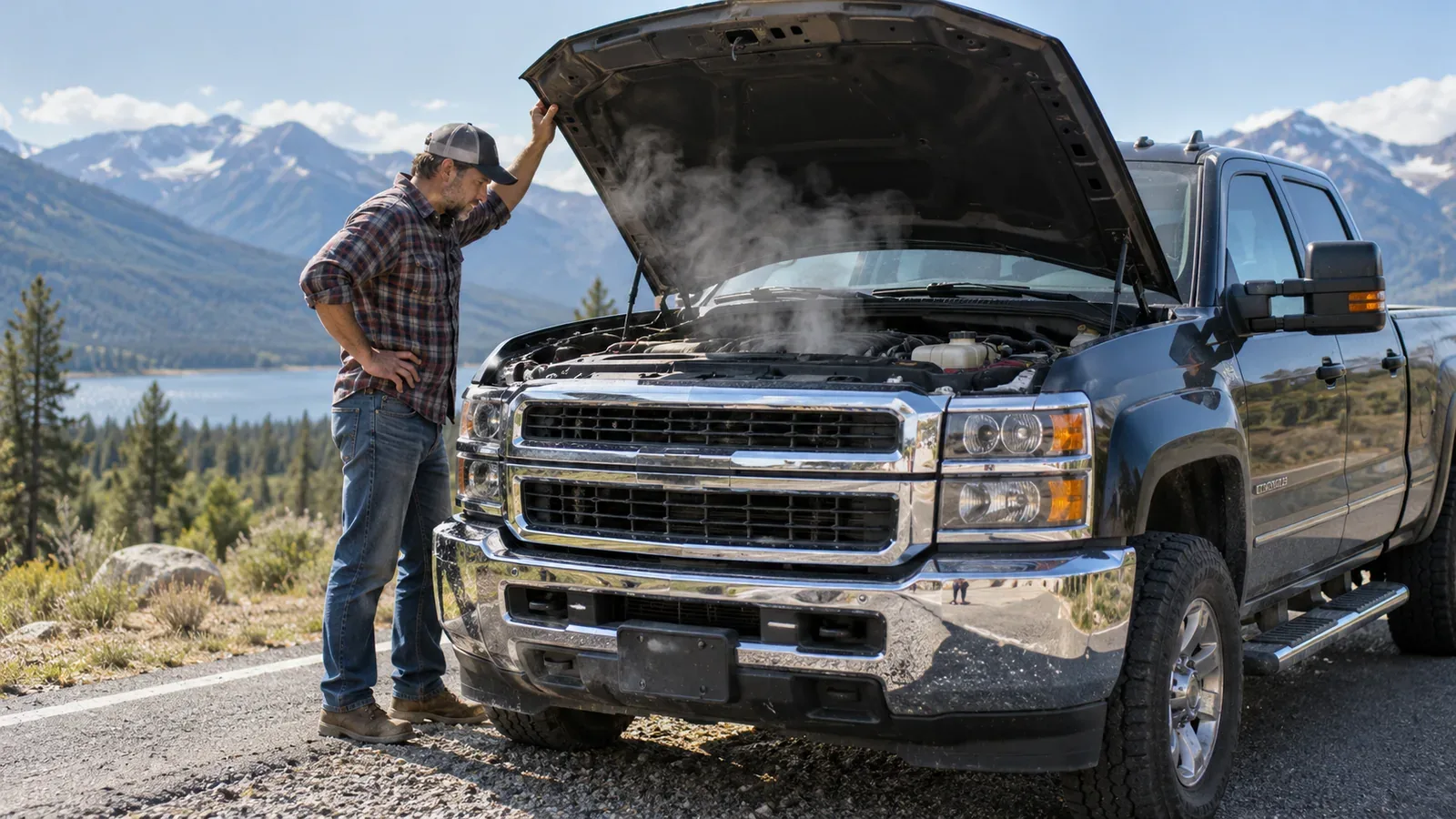
A work pickup can make an ordinary afternoon complicated in a hurry. You’re ten miles from a jobsite, carrying tools or pulling a trailer, when the temperature needle rises higher than you’ve ever seen it. The air conditioner cuts out. A warning appears on the dash. Or you notice steam drifting from the front of the truck after you park.
The immediate question is not which part should I buy? It’s whether the truck can be operated safely at all. Only after that comes the more expensive question: was this a low coolant level, a leak, a fan problem, a thermostat, a water pump—or something else?
This guide is written for pickup and light work-truck owners who want to take the right next step and communicate clearly with a repair shop. The symptom patterns below can help prioritize inspection, but they do not establish a mechanical diagnosis. Trucks differ, especially when towing, using diesel engines, or operating in model-specific reduced-power modes. Your owner’s manual and the warning displayed by your vehicle take priority.
Quick answer: what should you do when your truck overheats?
If you see a red engine-temperature warning, the gauge reaches the red zone, steam is escaping, or the engine loses power with an overheating message, leave traffic and stop as soon as it is safe. Follow your manufacturer’s specific instructions on shutting down. Serious or recurring overheating, steam or coolant loss calls for roadside assistance rather than experimenting with another highway drive.
Do not remove the radiator cap or coolant reservoir pressure cap while the engine is hot. Pressurized coolant and steam can escape forcefully, even after the engine has been switched off. Do not approach visible steam, reach near an automatic cooling fan, or pour cold water onto a hot engine. AAA and Ford both warn against continuing to operate an overheating vehicle; the manufacturer’s manual should govern the exact sequence for its cooling strategy.
A temporary, managed temperature increase while towing is not identical to an overheat fault. Certain trucks—Ford offers an example in its owner’s manual—may reduce engine power during a long, hot climb without directing an immediate stop. That exception must not be applied to another truck, or to a red warning or visible steam. When the situation is unclear, stop safely rather than assuming a managed mode is active.
First decision: stop, cool, or call for a tow?
| What you observe | Safer next step | Why it matters |
|---|---|---|
| Red temperature warning, gauge fully in red, or “stop engine” message | Stop safely and follow the owner’s manual; request assistance when necessary | Continuing can cause engine damage or a breakdown in traffic |
| Steam, an obvious spray of coolant, or a rapidly expanding leak | Keep clear, stop the engine as instructed, and arrange recovery | A pressurized cooling-system failure can cause burns and rapid fluid loss |
| Loss of power or a reduced-power temperature alert | Move out of traffic safely; check the exact manufacturer warning before doing anything else | Some systems intentionally limit power; others require an immediate stop |
| Gauge moves somewhat higher only during a heavy climb, with no critical warning | Use the vehicle-specific towing/temperature-management directions | Some vehicles manage heat under load without indicating mechanical failure |
| Temperature seems normal again after parking | Do not assume the problem has repaired itself; obtain a cooling-system assessment | The fault can return when load, traffic, or temperature changes |
These are decision prompts, not driving instructions for every vehicle. For example, some manufacturer procedures specify a short period of controlled idling after stopping in a particular high-load condition; others direct the driver to switch the engine off immediately. Never replace the actual warning message with generic internet advice.
What you can safely do after stopping
- Get the vehicle into a safe location, away from moving traffic, and secure it. If you are on an unsafe shoulder, prioritize occupants and roadside-assistance guidance over inspection.
- Note the exact warning text, temperature-gauge behavior and operating situation from memory. You do not need to restart the truck or repeat the event to collect evidence.
- Keep away from steam, hot fluid, belts and fans. An electric fan can operate unexpectedly.
- Once the engine and cooling system are completely cold, inspect the coolant level through a translucent reservoir if one is accessible. Do not open a pressure cap merely to satisfy this checklist. Follow your manual for any inspection or refill.
- Write down any visible puddle, dried coolant residue or odor without reaching beneath the truck or removing guards. If leakage, damage or overheating is evident, arrange a professional inspection or tow.
Never use the absence of steam as proof that the engine is safe. Conversely, not every wisp under the hood is coolant; a technician should determine the source.
Why trucks overheat: the system, explained simply
A liquid-cooled engine moves heat into coolant, circulates that coolant through passages and the radiator, and sheds heat to the outside air. The thermostat regulates flow according to design. A pump moves fluid. Radiator airflow comes from vehicle movement and the fan system. Hoses, reservoirs, caps and seals must retain the correct coolant quantity and pressure.
Overheating can happen because too little coolant is present, coolant cannot circulate or transfer heat properly, airflow is insufficient, or engine load exceeds the system’s ability to reject heat. Problems can occur together: a slow leak might lower the coolant level, and an air pocket after a repair might add another complication. The most visible symptom is not always the first failure.
1. Low coolant or a leak
A low level may be the result of a hose, fitting, radiator, reservoir, pump seal or another leak. A hot engine may leave no obvious puddle because coolant evaporates on warm surfaces. A cooling system can also lose fluid internally. The correct response is to locate the reason for the loss, not to label the truck fixed because the reservoir was topped up.
Look for the pattern: did the level fall slowly over several weeks, did a warning appear right after repair work, or was there sudden steam? Record it. A shop may perform a cooling-system pressure test when cold and inspect the radiator, hoses and connections. The test procedure and pressure must match the vehicle; this is not a reason to pump pressure into a hot system at home.
2. Radiator airflow and fan problems
When a truck is stopped in traffic, it has little natural airflow across the radiator. Its electric fan or mechanical fan/clutch system becomes especially important. If the temperature climbs during long idle periods but settles at normal cruising speed, a technician may start with fan operation, fan controls, and radiator/condenser airflow.
That observation is useful, not conclusive. Insufficient coolant, a partially obstructed radiator, a damaged shroud, a malfunctioning sensor or an inadequate cooling-system condition may produce overlapping behavior. Do not try to prove a fan failure by running a visibly overheating vehicle with the hood open; fans and belts can injure you unexpectedly.
3. Thermostat or circulation trouble
The thermostat controls coolant routing as the engine warms. If it does not open as intended, heat may not move through the system effectively. The pump and drive arrangement also matter: some pumps use a belt, while some systems use electric pumps or multiple cooling circuits.
A shop should check the symptoms, coolant level, codes and vehicle-specific components before prescribing a thermostat or pump. Rapid heating is not by itself a reliable thermostat test. A broken belt, coolant loss, an air pocket or another circulation fault may require a different response. Do not touch hoses to judge operating temperature or attempt to open the system while hot.
4. Radiator condition or restricted heat exchange
A radiator can lose effective cooling ability if its exterior airflow is obstructed by debris or its internal passages are compromised. Work pickups that visit dusty jobsites or travel in heavy insects and debris may need inspections appropriate to their operating conditions. The shop can assess whether the radiator is actually restricted, whether the cooling fan is performing properly, and whether the coolant condition is compatible with the vehicle.
A proposed radiator replacement should come with evidence of damage or performance failure. “It overheats, so it needs a radiator” is not a diagnosis. Nor does every used cooling system benefit from a flush when the underlying problem is a leaking hose or failed fan control.
5. Less obvious causes a shop may need to rule out
Electrical sensor or wiring faults can affect warnings and fan control. The cooling system might contain air after prior service. A faulty pressure cap may change how pressure is retained. More serious internal engine faults can pressurize the coolant or cause repeated unexplained loss. Engine oil warnings are a separate urgent concern; low oil pressure must not be treated as a cooling-system-only problem.
A good technician does not replace every item on this list. They use the truck’s history, service procedures and test results to narrow the fault safely.
Does the overheating happen at idle, on the highway, or while towing?
The operating condition is one of the most useful details a driver can provide. It tells a shop what to look at first, not what to order.
| Pattern already observed | First areas to evaluate professionally | Avoid jumping to |
|---|---|---|
| Temperature rises mostly at stoplights or prolonged idle | Fan operation, control system, airflow, coolant quantity | “The fan is definitely broken” |
| Temperature rises on long highway grades or under heavy load | Cooling capacity, coolant quantity, radiator condition, load and model-specific temperature management | “The thermostat must be bad” |
| Temperature rises shortly after cooling-system work | Correct fill, trapped air, leaks, parts installation | Repeating the same repair without checking it |
| Temperature rises with A/C in use | Fan and condenser/radiator airflow, cooling margin, actual warning state | “The A/C compressor caused the overheating” |
| Temperature rises and coolant keeps disappearing | Leak investigation, pressure integrity, potentially internal loss | Adding coolant indefinitely |
| Temperature spikes with a red alert or visible steam | Immediate safety response and professional recovery | Another test drive to collect more data |
Why does towing change the picture?
Towing increases the engine’s work, particularly on grades and in high outside temperatures. A cooling system that appears sufficient on unloaded local trips may show a weakness while pulling a trailer. On some models, high-load heat management intentionally limits power. On others, a temperature warning means the driver must stop promptly.
Before another towing trip, the owner and shop should check the actual loaded vehicle, the owner’s manual, the towing/grade history and any cooling-system faults. Do not use a generic statement such as “just slow down and continue” when a warning instructs you to stop. And do not assume towing caused the defect; it may only have revealed a pre-existing cooling problem.
Why does it happen in traffic but not on the freeway?
The difference between low and high airflow is a useful clue. At speed, passing air helps the radiator. While stationary, the vehicle depends more on its fan system. Fan faults, missing shrouds or blocked airflow therefore deserve consideration. But thermostat, pump, coolant and sensor problems can complicate that pattern. Diagnosis requires a vehicle-specific inspection, not a universal rule.
Six details to write down before speaking to a shop
If the engine has cooled and the truck is safe, make a short record. You do not need a complicated app or temperature scanner.
- Vehicle: year, make, model, engine, mileage, whether gas or diesel, and any recent cooling work.
- Conditions: idle, highway, traffic, long grade, outside heat, trailer, approximate load, and A/C use.
- Warnings: exact dash text, warning colors, gauge behavior, reduced power and any other alerts.
- Visible evidence: steam, puddle, dried residue, smell, and whether coolant appeared low after fully cooling.
- Timing: first occurrence, how quickly the change happened, and whether it has happened more than once.
- Outcome: whether the engine stopped, whether assistance was required, and anything a mechanic has already tested.
When possible, attach a photo of the dash taken by a passenger when safe or while parked. Never handle your phone to document a warning while driving.
What tests should you ask the workshop to consider?
You are not asking for every test in every case. You are asking the technician to explain the findings behind the quote. Depending on the vehicle and complaint, reasonable diagnostic work may include:
- Cooling-system pressure and leak assessment: performed using the vehicle’s specified procedure, normally with the system cold, to identify leaks or inability to hold pressure.
- Coolant quantity, condition and specification: distinguish correct fluid and fill from contamination or a refill with incompatible coolant.
- Radiator and fan inspection: verify fan command/operation, control inputs and obstructions rather than guessing from the symptom.
- Thermostat and coolant-flow assessment: check the components and control logic applicable to the specific engine.
- Belt/pump inspection: check the relevant drive arrangement, wear or leakage using safe procedures.
- Electronic diagnostics: look at stored trouble codes and sensor values where supported; a code indicates where to investigate, not necessarily which part is bad.
- Further engine assessment if indicated: repeated coolant loss, abnormal pressure or signs of internal leakage may justify additional tests performed by a qualified technician.
NAPA describes cooling-system pressure testing as a diagnostic tool; Continental documents tools for pressure and combustion-gas leak checks. Neither means that every overheating truck needs every test or that an owner should open a hot cap.
How to judge a repair estimate
Suppose a garage quotes a water pump. Ask: What evidence showed that the pump was defective? Did it leak, fail a specified operation check, or demonstrate a genuine drive/circulation problem? If the garage recommends a thermostat, ask which observation or test supports it and whether coolant leakage was ruled out. If the cooling system recently had work done, ask whether correct filling and bleeding were verified.
Also ask whether the estimate includes the necessary coolant, associated seals, applicable labor, safe bleeding and a post-repair confirmation. The cheapest quote is not necessarily the best if it replaces a part without resolving the original cause. Conversely, a complete repair may reasonably address a confirmed failed component and related damage or an original cause.
A quote should separate what is diagnosed, what is only suspected, and what remains to be tested.
Three practical examples with different outcomes
These are deliberately illustrative scenarios, not real customer stories or verified invoices. The correct technical answer depends on the particular vehicle and inspection.
Example A: temperature climbs at idle, then returns to normal on the road
A landscaper’s pickup has shown rising temperature after waiting at several long traffic lights. There is no known coolant loss, and the owner remembers the fan sounding unusual. The shop verifies a fan-control fault and confirms normal cooling performance after repair.
Lesson: A consistent idle-related pattern helps target the first inspection, but a fan part should not be purchased until testing supports that diagnosis.
Example B: the first warning appears during a loaded climb
A contractor towing a trailer sees a reduced-power temperature message on a long summer grade. The driver safely follows the exact vehicle manual, stops when instructed, and reports the load and conditions. At the shop, the cooling system passes inspection and the technician explains the truck’s specified temperature-management behavior and towing limits.
Lesson: Not every load-related rise is automatically a failed component. Equally, no one should assume a critical red alert is normal just because the truck is towing.
Example C: the reservoir keeps getting low after a repair
A delivery-business owner has added coolant twice since a hose replacement. The truck sometimes runs hot even on short trips. Instead of replacing a thermostat by guesswork, the shop inspects the previous repair and pressure-tests the cold cooling system. A leak at a hose connection is confirmed and corrected.
Lesson: A recurring low level is a symptom with a cause. Topping up can temporarily hide it and expose the owner to repeated downtime.
How to avoid a second breakdown after repairs
After the technician identifies and corrects the fault, ask for a record of the failed component, the diagnostic finding, coolant used, and verification steps. A completed job should address the original overheating complaint, not just silence the warning briefly. If a leak test or driving verification was appropriate, ask what was done under safe, manufacturer-approved conditions.
For a work truck, it is also worth recording days out of service and the effect on scheduled jobs. That is not the same as assigning a generic repair cost: invoices vary by model and region, and losing a business day may cost more than the part itself. Keep the record for future maintenance and any later repair-or-replace decision.
Preventive care is simpler than a diagnostic crisis: inspect coolant levels cold at the manufacturer’s intervals, follow the correct coolant specification, service the system as scheduled, and investigate unexplained loss, unusual warnings, or damaged hoses before the next heavily loaded trip.
Frequently asked questions
My truck overheats at 70 mph. Is that definitely a radiator problem?
No. A highway-speed complaint can involve coolant quantity, circulation, cooling capacity, load or multiple issues. A shop should inspect before committing to a radiator replacement. Avoid repeating the conditions if there is any safety warning.
Should I turn on the cabin heater when the truck runs hot?
Some automotive advice describes turning off A/C and switching on cabin heat briefly while finding a safe place to stop, because the heater can remove some engine heat. It is not a substitute for pulling over, not appropriate for every vehicle, and does not repair a cooling-system fault. Follow the specific warning and manual rather than extending a trip with the heater running.
Is a full coolant reservoir proof that the cooling system is fine?
No. A level seen from outside is only one observation. A pressurized or complex system can have circulation, airflow, control or internal faults. Levels also change with temperature; check only when fully cold according to the vehicle manual.
Is it safe to open the hood as soon as I stop?
Stay clear of steam, sprays, hot components, moving belts and automatic fans. Do not put your hands near the system until conditions are safe, and never open a hot coolant pressure cap. If you cannot safely assess the engine bay, wait for professional assistance.
Could a bad coolant temperature sensor cause the warning?
Sensors or wiring can contribute to abnormal readings or fan behavior, but treating every warning as a false alarm is unsafe. A technician should compare available diagnostics with the vehicle’s actual condition and service specifications.
Can I drive it after adding coolant?
A top-up does not prove the reason for overheating is gone. If there was steam, coolant loss, repeated overheating, a red warning or reduced engine performance, arrange an inspection or tow. Only follow vehicle-specific instructions once fully safe and assessed.
Sources and editorial scope
This guide synthesizes manufacturer safety instructions and consumer repair guidance from AAA Automotive, Ford Motor Company, Firestone Complete Auto Care, NAPA Know How and Continental Aftermarket (accessed October 22, 2026). The source documents are identified in the article’s reference metadata. No diagnostic tests, personal repair experiences, search volumes, repair quotes or individual vehicle outcomes are claimed as verified.
Bottom line: When a truck overheats, make a safe stopping decision first. Afterwards, a clear record of when it happened and what the technician actually tested is more valuable than guessing at parts. That protects both the engine and the work the truck is supposed to do.