
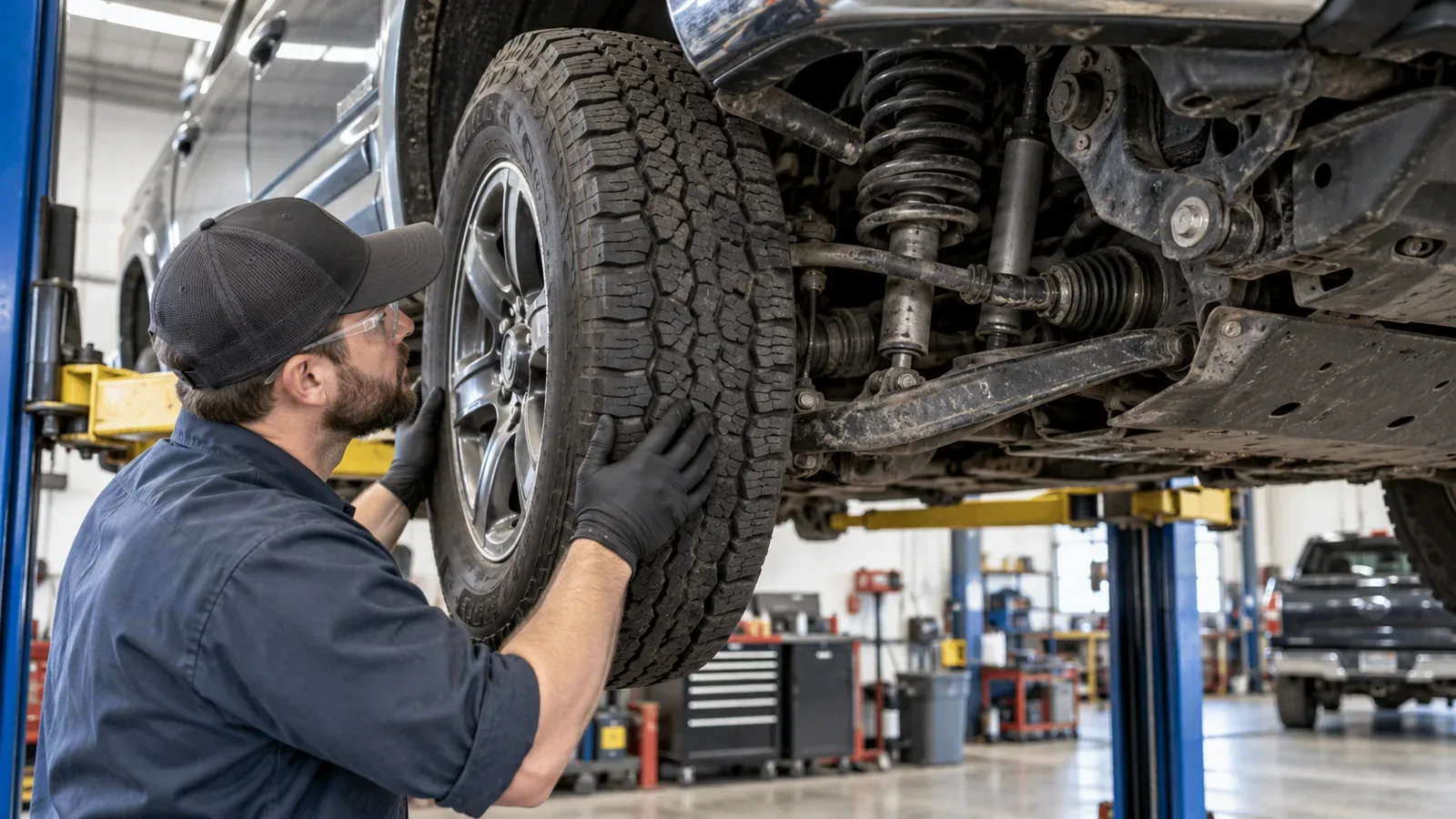
A pickup that feels fine around town can suddenly develop a noticeable shake on the interstate. Maybe the steering wheel starts trembling at about 60 mph. Maybe the seat vibrates even though the wheel feels steady. Or perhaps the problem appears only when you accelerate uphill with a load in the bed.
Those differences matter. A tire-and-wheel problem, worn steering component, brake issue, or driveline fault can produce similar complaints, but they do not all call for the same repair. Paying for an alignment when a tire is damaged, or buying a new set of tires before checking a driveshaft, can leave you with the same vibration and a larger bill.
Start here: If the truck develops a new, strong shake, feels unstable, pulls unexpectedly, has a visibly damaged tire, or produces a clunk after a road impact, do not try to reproduce the symptom at highway speed. Reduce speed safely, stop somewhere safe, and arrange professional inspection or towing as appropriate. This guide is for organizing observations and talking to a technician—not for proving a diagnosis while driving.
Quick answer: what usually causes a truck to shake at highway speeds?
A vibration that appears within a particular road-speed range often puts the tire-and-wheel assemblies near the top of the inspection list. Possible causes include an out-of-balance assembly, uneven tire wear, a bent wheel, or tire irregularity. But road speed alone does not prove which part has failed.
A shake that changes when you apply the throttle may point toward the driveline or powertrain. A shake mostly associated with braking brings the brakes and related hardware into the discussion. Steering looseness, unusual noises, or a recent pothole strike make steering and suspension inspection important.
The smartest question is not “Which part causes this?” but “What observation would distinguish the likely causes, and what test will confirm it?”
The five details worth noticing
Before authorizing repairs, write down the following—using symptoms you have already noticed during normal driving. Do not drive an unsafe vehicle simply to gather more evidence.
- When does it happen? At any speed, at a narrow highway-speed range, during acceleration, while coasting, or only when braking?
- Where do you feel it? Primarily through the steering wheel, the seat, the floor, or the brake pedal?
- Does anything change it? A heavier load, a trailer, an uphill grade, a different road surface, or a turn?
- What happened recently? New tires, a tire repair, wheel removal, a pothole, a curb strike, suspension work, or prolonged parking?
- Are there other warnings? Pulling, clunks, grinding, hot smells, tire-pressure warnings, abnormal tire wear, or visible damage?
A single answer is not a diagnosis. The combination helps the shop select sensible checks and avoid treating every shake as a wheel-balance problem.
Match the pattern to a sensible first inspection
| What you notice | Possible areas to investigate | What to ask the technician |
|---|---|---|
| Steering wheel trembles in a fairly narrow speed range | Front tire/wheel assemblies; steering and suspension | Were inflation, tire condition, wheel balance, and runout checked? |
| Seat or floor vibrates at road speed | Rear tire/wheel assemblies; driveline; mounts | Can you identify whether the vibration follows road speed or engine load? |
| Vibration gets stronger under acceleration | Driveshaft, U-joints, CV joints where fitted, mounts, misfire | What observations distinguish a driveline issue from an engine problem? |
| Shake appears mainly when the brakes are applied | Brake discs/rotors and related hardware; tire/steering issues | Were brake components inspected and measurements taken before replacement? |
| Shake began after a pothole or curb strike | Tire damage, bent wheel, alignment, suspension components | Did you inspect for structural damage before balancing or aligning? |
| Truck pulls or the steering wheel sits off-center | Tire pressures, tire condition, alignment, steering components | Is an alignment justified after checking tires and mechanical play? |
| Vibration changes with trailer or cargo | Load distribution, tire inflation per vehicle specification, trailer tires, vehicle or trailer components | Can the truck and trailer be assessed separately and safely? |
This is a triage table, not a fault-code chart. Multiple faults can coexist. For example, a worn tire might vibrate at speed while a worn suspension part contributes to abnormal tread wear. Correcting only one symptom may not fix the underlying problem.
1. Tires and wheel balance: common, but not the only explanation
Wheel balancing is about how evenly a rotating tire-and-wheel assembly distributes its mass. Small weight differences can cause noticeable shake at road speed. Alignment is different: it concerns the directions and angles of the wheels relative to the vehicle. An aligned truck can still have an out-of-balance wheel, and a balanced wheel can still wear poorly because of alignment or suspension problems.
If a truck begins shaking after tire installation or tire repair, tell the shop exactly when the symptom started. It is reasonable to ask whether the wheel was correctly mounted and balanced. If standard balancing does not solve a persistent problem, the technician may need to assess wheel runout, tire uniformity, or damage—not simply repeat the same service.
A bulge, cut, exposed cord, obvious tread separation, or rapidly falling tire pressure is a safety issue rather than a routine balancing appointment. Do not assume a tire with visible damage can be repaired or made safe by balancing it.
Can a brand-new tire cause a vibration?
Yes. “New” means it has not been used much; it does not guarantee the tire-and-wheel assembly was correctly mounted, balanced, or free of damage or uniformity problems. If the complaint began immediately after tire installation, return to the installer for a documented check. Do not automatically order another set of tires without identifying the fault.
What about mud packed inside a wheel?
After a muddy jobsite visit, off-road driving, or snow accumulation, an uneven buildup on a wheel can affect how it rotates. A safe visual check while parked may reveal debris. Do not reach behind a wheel when the vehicle can move, work under an unsupported truck, or use high-pressure cleaning around components in ways the manufacturer prohibits. If cleaning does not resolve the problem, a technician should inspect the assembly.
2. Tire wear, damage, and incorrect inflation
A work pickup may carry changing loads, travel on rough access roads, or tow equipment. None of those factors makes tire condition optional. Incorrect pressure and uneven wear affect how the tire carries its load and contacts the road.
When the truck is safely parked, a basic exterior tire check can identify obvious concerns:
- A bulge, cut, exposed reinforcement, missing tread section, or other damage.
- One tire noticeably lower than the others or a tire-pressure warning.
- Uneven wear, cupping, or an unusually worn shoulder.
- A different size or specification than the vehicle requires.
Check pressure cold, using the vehicle’s tire-and-loading label or owner’s manual for the correct vehicle and loading condition. The large pressure number molded on the sidewall is not the normal target inflation pressure for the truck. Tire size, load range, pressure requirements, and dual-rear-wheel configurations require vehicle-specific guidance.
If a tire looks damaged or the truck behaves abnormally, have it inspected before further use. A visually normal tire can still have an issue that requires specialist equipment to identify.
3. Steering and suspension: don’t use balancing to mask mechanical wear
Steering and suspension components help the wheels stay controlled over bumps and during turns. Loose or worn parts can produce movement, noise, uneven wear, or a vague steering feel. Problems may be especially noticeable in a heavily used pickup or one that regularly drives over rough surfaces.
Tell the technician about clunks, delayed steering response, pulling, rapid tire wear, or a vibration following a hard impact. Ask for the specific worn component and the evidence supporting replacement. An alignment is not a substitute for repairing unsafe play or damaged parts.
The diagnosis should fit the truck. A solid-front-axle pickup, independent-front-suspension pickup, and commercial truck can have different component layouts. Do not rely on a generic online procedure as though every model were identical.
4. Driveline vibration: what changes when you accelerate?
Many pickups have a driveshaft connecting the transmission or transfer case to a differential. Depending on the drivetrain, the system may also include universal joints, CV joints, and other components. Damage, wear, or imbalance in rotating parts can create vibration, sometimes accompanied by a clunk or squeak.
One useful observation is whether the symptom was stronger under load—for instance while accelerating or climbing a hill—than when the truck was maintaining speed. A technician can use that information alongside inspection and vehicle-specific tests. However, throttle sensitivity is not exclusive to a driveshaft fault: engine misfires, transmission behavior, mounts, and other issues can overlap.
If the shake is accompanied by a loud clunk, loss of power, a sudden change in handling, or severe vibration, stop and arrange assistance. Do not crawl under the truck, loosen shaft fasteners, or attempt to check moving components.
5. Brakes: vibration during braking is a different clue
If the steering wheel or brake pedal shakes primarily when you press the brakes, describe that separately from a vibration felt during steady cruising. Brake disc thickness variation, disc runout, pad deposits, sticking hardware, and related faults may need assessment. A shop should inspect the system and take appropriate measurements rather than label every case a “warped rotor” by default.
A truck that has reduced braking performance, severe pulsation, pulling under braking, smoke, or a burning smell needs prompt attention. It is not a good candidate for a highway-speed comparison drive.
A sensible inspection order that avoids guessing
There is no universal order for every truck. A vehicle with a bulging tire needs an immediate tire safety assessment. One with obvious brake trouble needs brake attention first. For a mild, stable, road-speed vibration without warning signs, the following sequence gives a technician a practical starting point:
- Clarify the complaint. Confirm the vehicle, wheel/tire setup, load condition, recent repairs, and whether the symptom follows vehicle speed, throttle input, or braking.
- Inspect tires and wheels. Check pressures, size/specification, visible damage, uneven wear, wheel condition, and installation.
- Check balance and wheel/tire uniformity when indicated. Record what was tested; do not assume that an alignment will correct rotational imbalance.
- Inspect steering, suspension, and bearings. Look for looseness, damage, or a wear pattern that explains repeated tire problems.
- Investigate the driveline or engine under relevant symptoms. Follow vehicle-specific service information and use suitable equipment.
- Verify the repair. Confirm the original complaint is resolved under safe, appropriate conditions and document any remaining issue.
The point is to move from observation → inspection → test → documented repair, rather than from “shake” straight to a shopping list.
What should you ask the repair shop?
A description such as “the truck shakes above 60 mph” is a start, but it invites guesswork unless it comes with context. You can say:
“The vibration is most noticeable through the seat around highway speed. It became apparent after the tires were changed. It doesn’t seem tied to braking. Could you check tire and wheel condition, balance, and runout first, then let me know what evidence points to any other repair?”
Good follow-up questions include:
- Which component do you believe is responsible, and what test supports that conclusion?
- Is there a safety problem requiring the truck to stay off the road?
- Could another worn component cause the same symptom or premature tire wear?
- Does the quote include only the necessary repair, or unrelated maintenance too?
- What will you check afterward to verify the vibration is actually gone?
An honest shop may need several checks to isolate a subtle vibration. A diagnosis that changes after a documented test is not automatically bad work. Charging for repeated parts replacement without a clear rationale is a reason to ask more questions.
Three realistic examples—and why the answers differ
The following cases are illustrative, not accounts of actual owners or verified shop invoices.
Case 1: the vibration started after installing tires
A contractor notices a steering-wheel shimmy during a normal highway trip, a day after fitting new tires. There are no clunks or brake symptoms. The tire shop checks mounting and balance; one assembly requires correction. The vibration disappears after the service.
Lesson: The timing of a symptom is valuable. It supports checking the recent work first, but does not prove the cause before inspection.
Case 2: highway shake plus a new clunk under acceleration
A pickup used to haul tools develops a floor vibration accompanied by a clunk as load changes. The tires look normal from the outside. A technician finds evidence of wear in a driveline component and confirms that the fault explains the complaint.
Lesson: Paying repeatedly for wheel balancing would not address a confirmed driveline defect. Clunks and worsening vibration also make it more important to avoid unnecessary driving.
Case 3: a pothole followed by a worsening vibration
After a hard impact, a driver notices a new shake. One tire develops a sidewall bulge. The correct response is to stop using the damaged tire and arrange safe repair or recovery, not to “see if it smooths out” at higher speed.
Lesson: Safety findings override the desire to narrow the diagnosis through more road testing.
What makes a repair quote trustworthy?
Before approving an expensive recommendation, look for three things: the actual finding, the proposed fix, and a verification step. If the shop recommends four tires, ask what condition makes each tire unserviceable. If it recommends a driveshaft, ask what inspection or measurement supports that diagnosis. If it recommends alignment, ask whether damaged or loose components have already been ruled out.
Quotes should identify the parts and labor involved and, where applicable, whether tire balancing, alignment, or additional diagnosis is included. You do not need to know every mechanical specification to request a clear explanation.
A cheaper quote is not automatically better. One that fixes only the symptom while ignoring a dangerous tire or worn steering part may be poor value. Conversely, the most expensive proposed repair is not necessarily the right one.
For a work truck, add operational impact to the discussion. Can the shop confirm the expected time out of service? Is a follow-up check included? If the pickup carries tools or tows a trailer, does the repair plan account for its normal approved configuration? The goal is a safe, reliable truck—not merely a quiet five-minute test drive.
Downloadable worksheet: Truck Vibration Diagnostic Log
The accompanying two-page PDF is designed to help the owner and technician keep observations, safety checks, tests, and outcomes together. Page one records the pattern; page two records the inspection findings and whether the original complaint was resolved.
Use it during a service appointment. It is not a DIY repair authorization or a substitute for the manufacturer’s service instructions.
Frequently asked questions
Why does my truck shake at 60–70 mph but feel smooth at lower speeds?
A vibration concentrated in a road-speed range is often associated with tire-and-wheel imbalance or irregularity, but other rotating parts can produce similar behavior. Have tires, wheels, and relevant mechanical components inspected; the speed range alone cannot confirm the cause.
Should I get an alignment or a wheel balance for highway vibration?
These services solve different problems. Balancing addresses how a wheel-and-tire assembly rotates; alignment adjusts wheel angles. A steering-wheel vibration at road speed can justify balance and tire checks, while pulling and uneven wear can justify an alignment assessment. Neither should replace inspection for damaged tires or worn mechanical parts.
Why does the steering wheel shake when braking at highway speed?
A brake-related issue may be involved, especially if the shake occurs when the brake pedal is pressed and not during steady driving. A technician should inspect the brakes and related steering/suspension components and measure what needs measuring before replacing parts.
Can a bad driveshaft cause my pickup to vibrate on the highway?
Yes. Driveshaft or joint problems are among several possible causes, particularly when vibration varies under acceleration and comes with clunks or other driveline symptoms. Inspection must confirm the cause; a floor vibration alone does not prove a driveshaft failure.
Is it safe to keep driving if the truck only shakes a little?
Not enough information. Some vibrations can come from relatively simple issues, but others signal tire or steering problems that can worsen. If the symptom is new, recurring, or increasing, arrange an inspection promptly. Stop driving and seek assistance if the truck is unstable, the shake is severe, a tire is damaged, braking is impaired, or there is a sudden new noise.
Could the vibration be caused by a trailer or heavy load?
Yes, the symptom can change with load and towing, and the trailer itself may have a tire, wheel, or suspension problem. Follow vehicle and trailer ratings and tire specifications, and have the combination assessed safely. Do not reproduce a dangerous vibration by adding weight or increasing speed.
Bottom line
A highway-speed shake is a symptom with several possible causes, not an automatic order for new tires, alignment, or a driveshaft. Note when it happens, where it is felt, and what changed shortly before it began. Prioritize any safety warning. Then ask the shop to explain the evidence behind the repair and how the result will be checked.
That process is usually more useful than buying the part that somebody online says is “always” responsible.
Technical references and editorial basis
These sources explain the underlying inspection and maintenance principles. They do not diagnose any particular vehicle.
- NHTSA — Tire Safety: tire condition, inflation, balancing, and alignment.
- NHTSA — Summer Driving and Road Trip Tips: vehicle-placard pressures and checking tires cold.
- Michelin — Vibration or Shimmy: common tire, wheel, and suspension-related symptoms.
- Michelin — Wheel Alignment and Balancing: why balance and alignment are different.
- Continental — Balancing Tires: imbalance and road-speed vibration.
- Continental — Wheel Alignment: alignment symptoms and professional adjustments.
- Firestone — Drive Shaft Repair: driveline symptom patterns.
- Firestone — Why Is My Car Shaking?: acceleration, braking, and higher-speed symptoms.
Editorial scope: This guide addresses pickups and light work trucks in general, particularly for U.S. readers. Vehicle-specific service manuals, tire/load labels, and technician findings take precedence. Examples are hypothetical, not price quotes or personal experience. Updated October 22, 2026.