
Truck Steering Wheel Hard to Turn? Causes and Safety Checks
You are turning into a parking space when the steering wheel suddenly feels much heavier than usual. Or perhaps the truck has started to resist turning in one direction, especially when parking or backing a trailer. A steering change like that is worth taking seriously: the truck may be harder to place accurately, and the reason can range from low tire pressure to a serious fault in the assist or steering linkage.
A hard-to-turn truck steering wheel is a symptom, not proof that the power steering pump has failed. The right next step depends on the truck’s steering design, when the extra effort occurs and whether the wheel binds, catches or triggers a warning.
This guide covers pickups and work trucks in the United States. It focuses on safe observations, how hydraulic and electric systems differ, and what a repair shop should verify before replacing expensive components.
Quick answer: If your truck suddenly becomes hard to steer, reduce speed carefully, move to a safe stopping place and follow any steering warning in the owner’s manual. Severe binding, unpredictable steering or difficulty controlling the vehicle calls for professional assistance rather than another test drive. On a parked, switched-off truck, you can check the recommended front tire pressures and look for obvious leaks or belt damage without touching moving parts. The shop must then identify whether the issue involves assist, mechanical linkage or tires.
The first distinction: heavy steering or steering that binds?
These sensations are not quite the same.
Heavy but smooth steering means the wheel still turns continuously, but doing so takes more effort than it used to. A loss or reduction of power assist can produce this sensation. Low front tire pressure can make slow maneuvering feel heavier too.
Binding or catching means the wheel resists at a particular position, feels notchy, or does not turn smoothly through part of its travel. That can suggest a mechanical concern in the steering shaft, linkage or related components. Because steering control is essential, a severe catch or lockup should not be investigated through repeated driving.
Intermittent assistance feels normal one moment and unexpectedly heavy the next. Electrical, hydraulic or thermal-protection behavior may be involved, depending on the vehicle. Do not assume the problem has disappeared just because normal steering returns.
| Steering behavior | Possible area to investigate | Appropriate response |
|---|---|---|
| Suddenly much heavier with a steering fault message | Assist system or electrical fault | Stop safely and follow the displayed manufacturer instructions |
| Heavy mostly while parking or moving slowly | Assist performance, tire pressure or mechanical resistance | Check safe basics; arrange prompt assessment |
| Notchy, sticking or catching at certain wheel positions | Steering linkage or shaft binding | Avoid further driving if control is affected; arrange professional inspection |
| Whine while turning on a hydraulic-equipped truck | Fluid, pump or related hydraulic system | Inspect for leaks when parked and request diagnosis |
| New pull or uneven steering feel after impact | Tire, suspension, alignment or linkage | Check visible tire condition and get the steering components inspected |
Hydraulic, electric and mixed-assist steering
It is important to know which system your truck actually has. There is no power steering fluid reservoir on a purely electric power-assist system, and modern trucks do not all use the same design.
Hydraulic power steering
A traditional hydraulic system uses pressurized fluid to reduce the driver’s effort. Depending on the vehicle, the pump may be belt-driven, and assistance may operate through a steering gear or rack. Low fluid, a leak, belt trouble, pump performance or internal steering-gear faults may affect operation.
A low fluid level is a reason to look for a leak, not a reason to keep topping up the reservoir indefinitely. Never select a fluid by color alone. Ford, for example, specifies particular fluids for specific hydraulic-equipped trucks; your own vehicle manual controls the choice.
Electric power steering
Electric power steering uses motor assistance controlled electronically. Faults in power supply, wiring, sensors, control modules or related components may reduce that assist. There is no hydraulic reservoir to check in a fully electric setup.
Some electric systems are designed to remain mechanically steerable after loss of power assistance, although the wheel can require much more effort. Ford’s electric steering guidance explicitly explains that assist reduction can make steering heavier, and it directs owners to follow the warning message. Being able to steer with more effort does not mean the truck is safe to keep driving normally.
Systems that combine technologies
Some heavy-duty pickups use a combination of hydraulic steering and electronically controlled assistance features. As an example, Ford describes supplemental electronic torque overlay with a hydraulic steering system on certain Super Duty configurations. Do not classify a vehicle simply by its model year or by whether you see a steering warning light.
Common reasons a truck becomes hard to steer
Low hydraulic fluid or a leak
On a hydraulic-equipped truck, insufficient fluid can prevent normal assist. A failing hose, fitting, seal or steering gear can be involved. You may notice fluid near the front of the vehicle, a whining sound or steering effort that increases during parking. Leaks can be hidden, and their position on the ground may not identify the source.
With the engine off and cool as required, the manufacturer’s manual may permit checking a marked reservoir. Do not open pressurized parts, touch hot components or run a system dry to see what happens.
Pump or belt-drive problems
Some hydraulic power steering pumps depend on the engine’s accessory belt. A damaged belt, failed tensioner or pump problem can affect assistance. A squeal can accompany a slipping belt, but it is not a definitive diagnosis. A belt can also drive other critical components, so a sudden belt-related failure may produce several warning lights.
Do not press on a belt to judge tension or reach toward the pulleys while the engine is running. Even with the engine off, belt tension is design-specific; a universal “half-inch of play” rule is not appropriate for modern automatic tensioners. A visual inspection from a safe position is enough for the owner.
Worn or binding mechanical parts
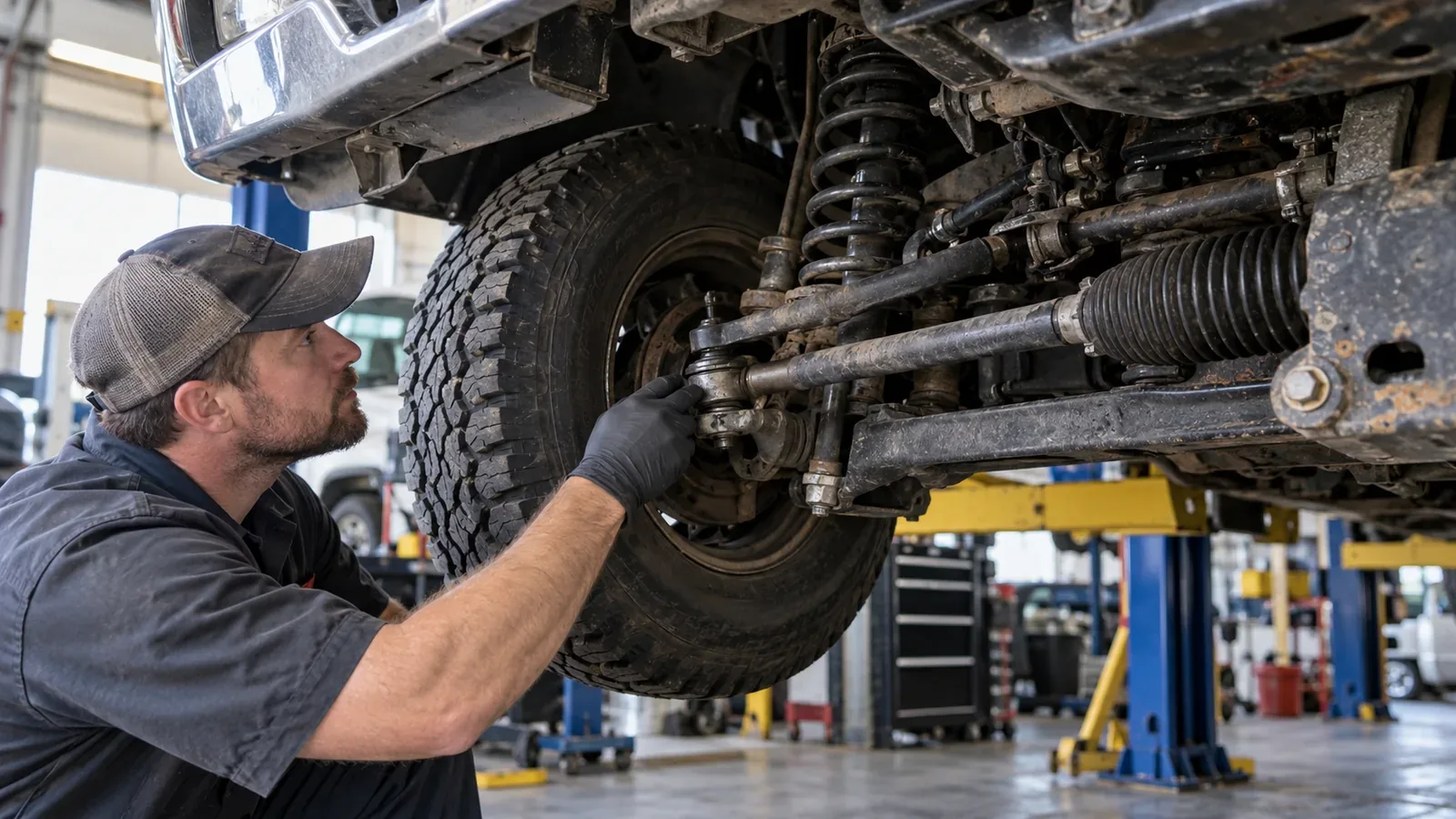
The steering shaft, universal joints, tie rods, ball joints and related hardware transfer steering movement to the front wheels. Corrosion, impact damage or component wear can produce looseness, binding or inconsistent effort. A vehicle may have full hydraulic or electric assist and still have an unsafe mechanical fault.
Mechanical steering and suspension checks often require the truck to be lifted and components loaded or unloaded in specified ways. That is workshop work, not a reason to crawl under an unsupported truck.
Electrical supply or assist-control concerns
Electric systems may respond to low voltage, wiring faults or detected failures by reducing assistance or setting an alert. A technician may need a scan tool that reads the steering control module, not just generic emissions-related OBD-II codes. A U- or C-series code may provide direction, but it does not automatically identify a part to replace.
Low tire pressure or tire damage
Underinflated front tires can make low-speed steering feel heavy or sluggish. Check cold pressures against the truck’s door-jamb placard or the specified setting for its load and tires, not the maximum pressure molded into the sidewall. Watch for a visibly damaged or rapidly deflating tire; if unsafe, arrange assistance rather than driving farther. The tire manufacturer Continental notes that low pressure can produce heavier steering and slower response.
Four safe checks while parked
- Read the warning exactly. A “Service Power Steering” message is different from an unrelated stability-control indicator. Record when it appeared and consult the manual for that model.
- Check front tire pressures and visible damage. Use a gauge on cold tires and the correct load-related pressure guidance. Do not drive a truck with an obviously compromised tire.
- Look for fluid only if the truck has hydraulic steering. From a safe standing position, check for obvious leaks and, if directed by the manual, the reservoir level with the engine off. Never add generic fluid to an unidentified system.
- Look at the accessible belt area with the engine switched off. Visible missing belt sections, fraying or fluid contamination may be useful information. Do not dismantle guards or touch moving or hot parts.
Do not repeatedly turn the wheel against the steering stop or run a test that requires one person to hold the throttle while another inspects the engine bay. More testing by the driver is not necessarily safer or more informative.
When not to drive the truck
Arrange a tow or suitable roadside service when steering binds or locks, effort changes abruptly enough to compromise control, the truck cannot be directed predictably, or a serious warning instructs you to stop. A major leak, damaged steering linkage or suspected component separation also demands immediate attention.
If an electric-assist system temporarily overheats from extended steering maneuvers, the manufacturer may describe a reduction in assist that later recovers. But never assume a sudden or recurring steering fault is merely normal thermal protection. Read the model-specific warning and have the symptom investigated if it returns.
If you experience a sudden change while driving, hold the wheel firmly, avoid abrupt inputs, reduce speed carefully and pull over when safe. Do not switch off the engine while moving unless the manufacturer specifically directs that action as part of an emergency procedure; doing so may change steering and other vehicle assistance.
What a good repair diagnosis looks like
The correct repair depends on the system. A hydraulic-equipped truck may need a leak and fluid-level check, pump/drive assessment, pressure testing and steering-gear inspection. An electric system may require battery and charging checks, fault-code data from the steering module, electrical measurements and the manufacturer’s diagnostic routine. Mechanical binding requires a physical inspection of the shaft, joints and linkage.
Ask the shop to explain which symptom it reproduced and what measurement or finding confirms the failed part. If it recommends an expensive rack, steering gear or pump, request the relevant test result. If an electronic module is proposed, ask whether wiring, power supply, software instructions or applicable service information were checked first.
The FTC’s guide to auto repairs recommends getting the problem, needed parts and anticipated labor on a written estimate. Ask how the shop will confirm that steering assistance and mechanical travel are normal before returning the truck.
What to tell the shop
A useful description sounds like this: “The steering became heavy twice while parking, once with a warning on the cluster. It feels normal at highway speeds, and I have not seen a leak.” That description is more helpful than “replace the pump,” especially if the truck has electric steering and no pump.
The aim is not to become your own steering mechanic. It is to describe the problem clearly, avoid unsafe tests and make sure the repair is supported by evidence.
Frequently asked questions
Why is my truck’s steering wheel hard to turn at low speeds?
Low-speed maneuvering demands more steering effort and may expose a weak assist system, low tire pressure or mechanical resistance. The cause depends on whether steering is hydraulic, electric or a combined design.
Can low power steering fluid make steering stiff?
Yes, on hydraulic-equipped vehicles. A low level suggests a need to investigate the cause, including leaks. Fully electric steering does not have a power steering fluid reservoir.
Why did my power steering suddenly stop working?
An assist-system fault, electrical issue, hydraulic failure or belt problem may be involved depending on the vehicle. Reduce speed and stop safely; sudden loss of assistance warrants prompt attention.
Is it safe to drive with a hard steering wheel?
Not if you cannot steer predictably, it binds or locks, or a serious warning appears. Arrange professional assistance. A little extra effort without a confirmed cause still deserves inspection.
Could low tire pressure make the wheel harder to turn?
Yes. Underinflated front tires can increase steering effort, particularly while parking. Check cold pressure against the truck’s specified setting and inspect the tires for damage.
Can a generic OBD-II reader diagnose electric steering?
Not always. Many generic readers focus on emissions-related engine codes. Steering-system fault data may require an enhanced scan tool and a model-specific diagnostic procedure.