
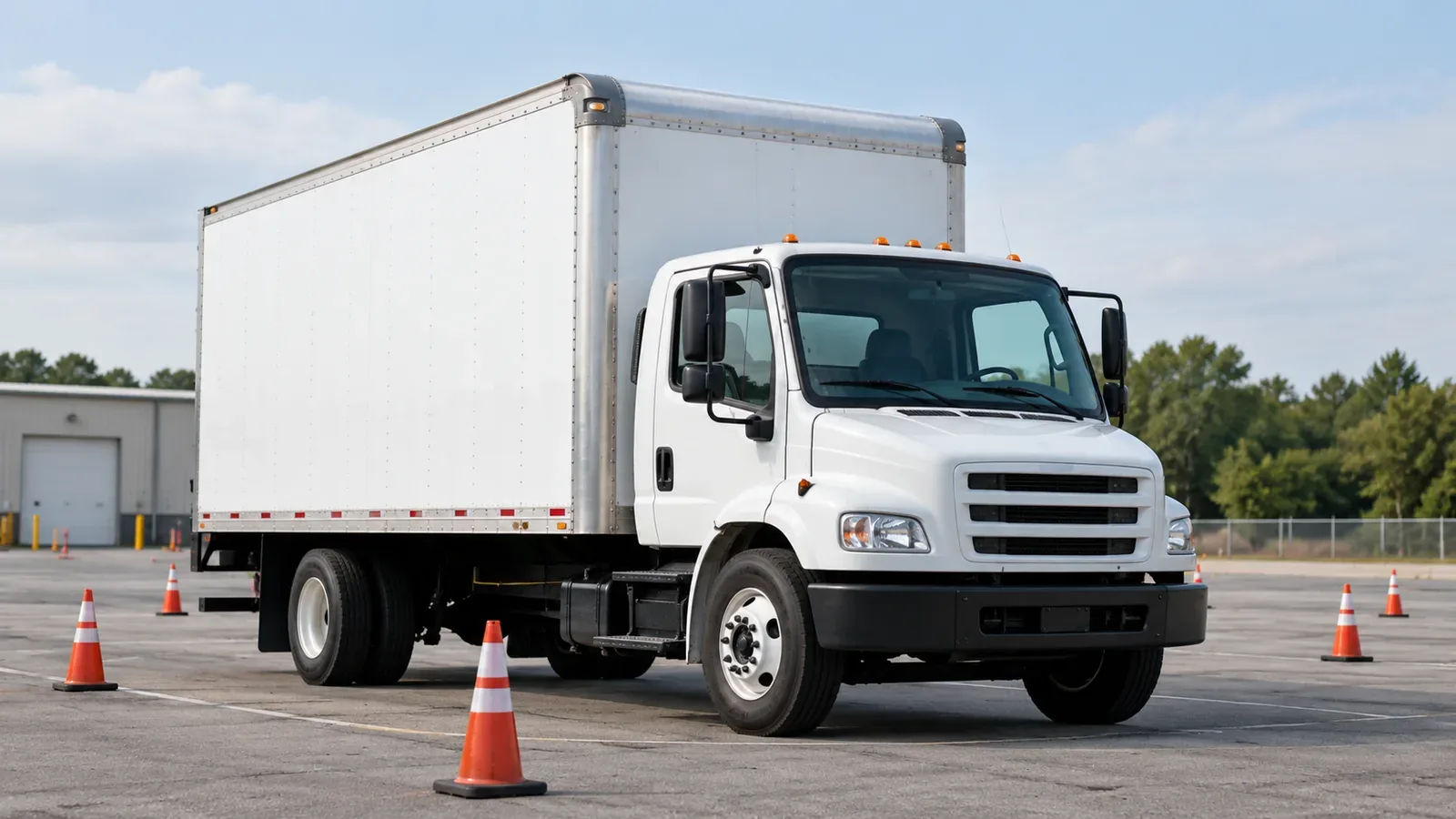
A delivery company can own two box trucks with the same 26-foot cargo body and need different driver licenses for them. A larger box does not automatically mean a CDL, and a smaller one is not automatically exempt.
The decision depends on the exact vehicle’s certified and actual weights, what it tows, the cargo and the operation. In the United States, the rules for needing a CDL are also different from the rules that can bring a trucking business under FMCSA safety oversight.
This guide gives you a practical way to check a vehicle before assigning a driver, renting equipment or buying a truck. It explains the federal baseline; state licensing rules and exceptions still require separate verification. To answer different questions, use the 26-foot payload calculation for carrying capacity and the box-truck size comparison for physical dimensions. Neither measurement replaces the license-class check below.
The federal CDL decision, in one table
The key federal classifications are in FMCSA’s CDL driver guidance and 49 CFR § 383.5. They apply to vehicles used in commerce. The table below simplifies ordinary cases; it is not a substitute for the complete rule or state requirements.
| Vehicle or operation | Typical federal CDL outcome | Check next |
|---|---|---|
| Single property-carrying box truck below 26,001 lb in both GVWR and actual gross weight, without a special cargo/passenger trigger | No CDL under the federal weight test alone | State license, trailer, cargo and DOT obligations |
| Single truck with 26,001 lb or more GVWR or actual gross weight | Generally Class B | Any towing that changes the combination classification |
| Truck-and-trailer combination at 26,001 lb or more GCWR or actual combined gross weight, with towed unit over 10,000 lb GVWR or actual gross weight | Generally Class A | Actual rating/weight of every unit and allowed towing capacity |
| Truck below Class A/B weights carrying hazardous materials requiring placards, or covered select agents/toxins | Generally Class C, with applicable endorsements | Material classification, placarding and the special select-agent rule |
| Personal non-business moving or recreational use | Federal CDL exception may apply | Home-state licensing and whether the use genuinely qualifies |
Threshold precision matters: 26,000 lb and 26,001 lb are different sides of the federal weight boundary. But a vehicle described as non-CDL in an advertisement is not enough evidence for a particular driver or trip.
First, understand GVWR, actual weight and cargo-box length
Four measurements are often confused:
- Cargo-box length: the approximate usable or marketed length of the cargo compartment. It is a space measurement, not a licensing class.
- GVWR (gross vehicle weight rating): the maximum loaded weight assigned to an individual vehicle by its manufacturer. It does not go down when the truck is empty.
- Actual gross vehicle weight (GVW): what the vehicle actually weighs at a particular time, including its body, equipment, fuel, occupants and cargo.
- GCWR (gross combination weight rating): a rating for a truck-and-trailer combination. Under 49 CFR § 383.5, the defined value is the greater of a qualifying manufacturer-specified value or the highest applicable sum of the vehicles’ individual rated and/or actual weights. The definition does not itself authorize a particular trailer weight.
Federal CDL definitions take the relevant rated or actual weight, whichever is greater. See 49 CFR § 383.5. That is why a nominally low-rated truck cannot be treated as exempt simply because someone overloaded it. Overloading is a separate safety and legal problem; it is never an acceptable way to use a truck.
Where do you find the weight rating?
- Look for the manufacturer’s vehicle certification label, commonly around the driver-side door or door jamb.
- Record the VIN, GVWR and axle ratings shown on the specific completed vehicle.
- Compare the certification label with the registration and upfit documentation. If a body conversion created inconsistent labels, resolve that discrepancy before assigning the truck.
- For any realistic concern about actual weight, use a reliable scale ticket. A cargo-space brochure is not proof of gross weight.
- If towing, identify the trailer’s GVWR and actual weight plus the combination’s GCWR and actual gross weight.
A title or registration weight, advertised payload and cargo-body length are not interchangeable with the ratings required for federal classification.
Five realistic scenarios: which license do you need?
These are illustrative compliance scenarios, not specifications for specific vehicles or automatic determinations for all states. Assume ordinary property delivery in commerce unless stated otherwise.
Scenario 1: A 16-foot truck rated at 14,500 lb
- Single straight truck, GVWR 14,500 lb.
- Actual gross weight 12,100 lb, no trailer.
- Ordinary nonhazardous deliveries.
Federal weight-based CDL finding: no Class A or B CDL requirement from these facts alone. However, interstate use can still trigger USDOT registration and other FMCSA rules because the truck is above the separate 10,001-lb safety threshold. A non-CDL license is not a regulatory exemption for the business.
Scenario 2: A 26-foot truck rated at 25,999 lb
- Single straight truck, GVWR 25,999 lb.
- Actual gross weight 21,800 lb.
- Ordinary packaged-goods delivery, no towing.
Federal weight-based CDL finding: generally no Class A or B CDL, despite the 26-foot box. The decisive number is the weight classification, not the length. Verify the actual truck: a different chassis with an identical box can have a higher GVWR.
Scenario 3: A 26-foot commercial truck rated at 33,000 lb
- Single straight truck, GVWR 33,000 lb.
- Currently operating at only 19,000 lb gross weight.
- No trailer, normal commercial freight.
Federal CDL finding: generally Class B. The truck’s high rated weight still counts when it is lightly loaded. Sending it out empty does not make it a non-CDL vehicle.
Scenario 4: A smaller truck pulling a heavy equipment trailer
- Power unit GVWR 18,000 lb.
- Trailer GVWR 12,000 lb.
- Under the federal GCWR definition, the two GVWRs alone produce a 30,000-lb combination figure (18,000 + 12,000); a manufacturer-specified GCWR could be higher.
Federal CDL finding: generally Class A, assuming the actual combination and operation meet the definitions. This does not mean the truck is physically approved to tow 12,000 lb. The operator must separately check the manufacturer-rated towing capacity, hitch, axle and braking limits.
Scenario 5: A lighter truck carrying placarded hazardous materials
- Single truck below the Class A/B weight thresholds.
- Cargo is classified as hazardous material requiring placards.
Federal CDL finding: a Class C CDL and applicable hazardous-material endorsement requirements generally apply when the cargo meets the placarding requirement, irrespective of the lower truck weight. The federal definition also covers any quantity of certain select agents or toxins listed in 42 CFR Part 73, even without relying on the usual placarding test. Not every product described informally as a chemical or hazardous substance requires placards; determine its regulated classification first. See 49 CFR § 383.5.
Class A vs. Class B: what changes when you add a trailer?
A box truck operating alone is a straight vehicle. A trailer adds a second set of ratings, and the federal Class A test considers both the combination threshold and the towed vehicle’s weight.
| Question | Why it matters |
|---|---|
| Is combined rated or actual gross weight 26,001 lb or greater? | Establishes the combination-weight part of the Group A test |
| Does the towed unit exceed 10,000 lb GVWR or actual gross weight? | Establishes the heavy-towed-unit part of the Group A test |
| Does the power unit itself meet the heavy straight-vehicle threshold? | Class B can still apply when Group A is not triggered |
| Is the combination mechanically and legally permitted? | License class does not establish safe or lawful towing capability |
Refer to 49 CFR § 383.91 and FMCSA’s Class A/B/C definitions. In borderline or complicated combinations, obtain the actual vehicle records instead of estimating from curb weights or an online sales listing. For the weight test, GCWR is a defined licensing metric, not simply the truck’s advertised tow rating; the manufacturer’s applicable weight limits must be checked separately.
Do air brakes change the CDL requirement?
Air brakes do not, by themselves, make an otherwise non-CDL box truck require a federal CDL. The starting point remains the vehicle’s weight, combination, passengers and qualifying cargo. If a CDL is required, however, the driver’s air-brake knowledge and skills tests can affect the restrictions on that CDL. For example, FMCSA lists the L and Z restrictions for certain air-brake testing limitations in its CDL driver guidance. Always check the actual brake configuration and the driver’s license restrictions.
If a CDL is required, what training does a new driver need?
A driver obtaining a Class A or Class B CDL for the first time, or upgrading Class B to Class A, is generally subject to federal Entry-Level Driver Training (ELDT) before the applicable skills test. First-time hazardous-material (H), passenger (P) and school-bus (S) endorsements also have ELDT requirements. Training must come from a provider listed on the FMCSA Training Provider Registry, subject to the applicable exceptions. See FMCSA’s ELDT guidance.
The other threshold: a non-CDL box truck can still be regulated at 10,001 lb
This is one of the most expensive mistakes for a new delivery business. A CDL requirement and a federal commercial-vehicle safety requirement are not the same test.
Under FMCSA’s USDOT registration guidance, an interstate property-carrying business can be covered when its vehicle or combination reaches 10,001 lb in applicable rated or actual weight. The definition of interstate commerce can include freight that is part of an interstate shipment even if the driver stays inside one state.
| Question | Federal CDL weight rule | USDOT / interstate CMV safety threshold |
|---|---|---|
| Ordinary single property-carrying truck | Generally 26,001 lb GVWR or actual gross weight | Generally 10,001 lb qualifying rated or actual weight in interstate commerce |
| Purpose | Driver’s license class | Carrier identification and relevant safety regulations |
| Does “non-CDL” eliminate the other requirement? | No | No |
Depending on the exact operation, rules can involve vehicle inspection and maintenance, driver qualification, hours-of-service records, insurance and authority. They do not all arise identically or automatically from one weight figure. For example, an interstate CMV driver can need a DOT medical certificate at the 10,001-lb threshold even when a CDL is not required, unless an exception applies. See FMCSA’s medical-certification FAQ. For the operational details, see our driver qualification file checklist, DOT maintenance records guide and ELD exemptions guide.
If your deliveries never cross a state line, verify whether the shipment is nonetheless part of interstate commerce. If genuinely intrastate, check the state carrier rules: some states regulate smaller vehicles or require intrastate registrations. Our intrastate versus interstate authority guide explains why route geography alone is not always the end of the analysis.
What about a 26-foot rental truck for a personal move?
An advertised 26-foot moving truck is not necessarily a heavy-CDL vehicle. A rental company’s product page describes one fleet configuration; the exact rental truck, its certifications and its actual use still need checking.
FMCSA separately discusses the non-business transportation of personal property. A genuinely personal move may fall outside the federal CDL rules even where an otherwise comparable commercial operation would be covered. However, the home state’s licensing requirements still control, and a paid freight-moving service is not the same as transporting your own household belongings. See FMCSA’s non-business-use FAQ.
Never assume that renting a vehicle, attaching temporary business branding or carrying your own items creates a blanket exception. The purpose of the trip and the licensing jurisdiction matter.
Practical pre-dispatch CDL verification checklist
For each new vehicle, rental or towing setup, make a one-page driver-assignment record:
| Record | What to capture | What it prevents |
|---|---|---|
| Vehicle | VIN, door-label photo, GVWR, actual gross weight if relevant | Guessing the class from box length |
| Towed unit (if any) | Trailer identifier, GVWR/actual weight, combination rating and towing approval | Missing a Class A or towing-limit issue |
| Cargo and service | Ordinary property, placarded hazardous materials, covered select agents/toxins, passenger use, business/personal purpose | Missing Class C and exception issues |
| Route | Interstate, intrastate or freight with an interstate origin/destination | Confusing geography and legal operation |
| Driver | Valid state-issued license, class, applicable endorsements/restrictions, CDL training where required | Assigning an unqualified driver |
| Safety compliance | USDOT applicability, medical qualification if required, maintenance and hours rules | Mistaking non-CDL for unregulated |
Documented finding: record the applicable federal rule, the state check performed, the reviewer and the date. If anything is uncertain, hold the assignment until licensing staff or the state licensing agency confirms the answer.
A useful internal worksheet has three distinct outputs: (1) CDL class, (2) other carrier safety/registration requirements, (3) vehicle loading/towing limits. Combining these into a single “legal to drive” checkbox conceals important risks.
The mistakes to avoid
- “A 26-foot truck always needs a CDL.” False. Body length is not the CDL test.
- “A truck rated 25,999 lb can be overloaded without changing license exposure.” False. Actual weight is relevant, and overloading itself is unsafe and potentially unlawful.
- “A regular license means I do not need a USDOT number.” False. The safety-registration test is separate and can apply below the CDL threshold.
- “Every trailer behind a box truck makes it Class A.” False. The applicable combined-weight and towed-unit thresholds both matter.
- “All intrastate delivery businesses follow the same federal process.” False. States can have different licensing, intrastate commercial-vehicle and exemption rules.
- “My insurer or rental desk decides the CDL class.” False. Insurance and rental contracts may add conditions, but the driver’s licensing requirements depend on law and the actual vehicle/operation.
- “Air brakes always mean a CDL.” False under the federal classification test; they can create testing and license-restriction issues when a CDL is otherwise required.
Editorial scope and source-check method
This article summarizes federal CDL classification and related FMCSA registration guidance as checked on October 21, 2026. The five examples are independently constructed teaching scenarios, not representations of real manufacturers’ vehicles or permission to operate. No keyword search-volume or difficulty estimates are claimed. State licensing rules, exemptions, permit conditions and individual vehicle documentation must be verified for the specific assignment.
If you’re buying a new truck, ask the seller for the certification label and completed-vehicle documentation before choosing drivers. If you’re already operating, use the records checklist above to document each fleet vehicle rather than inferring licensing from the body length or a model nickname.