
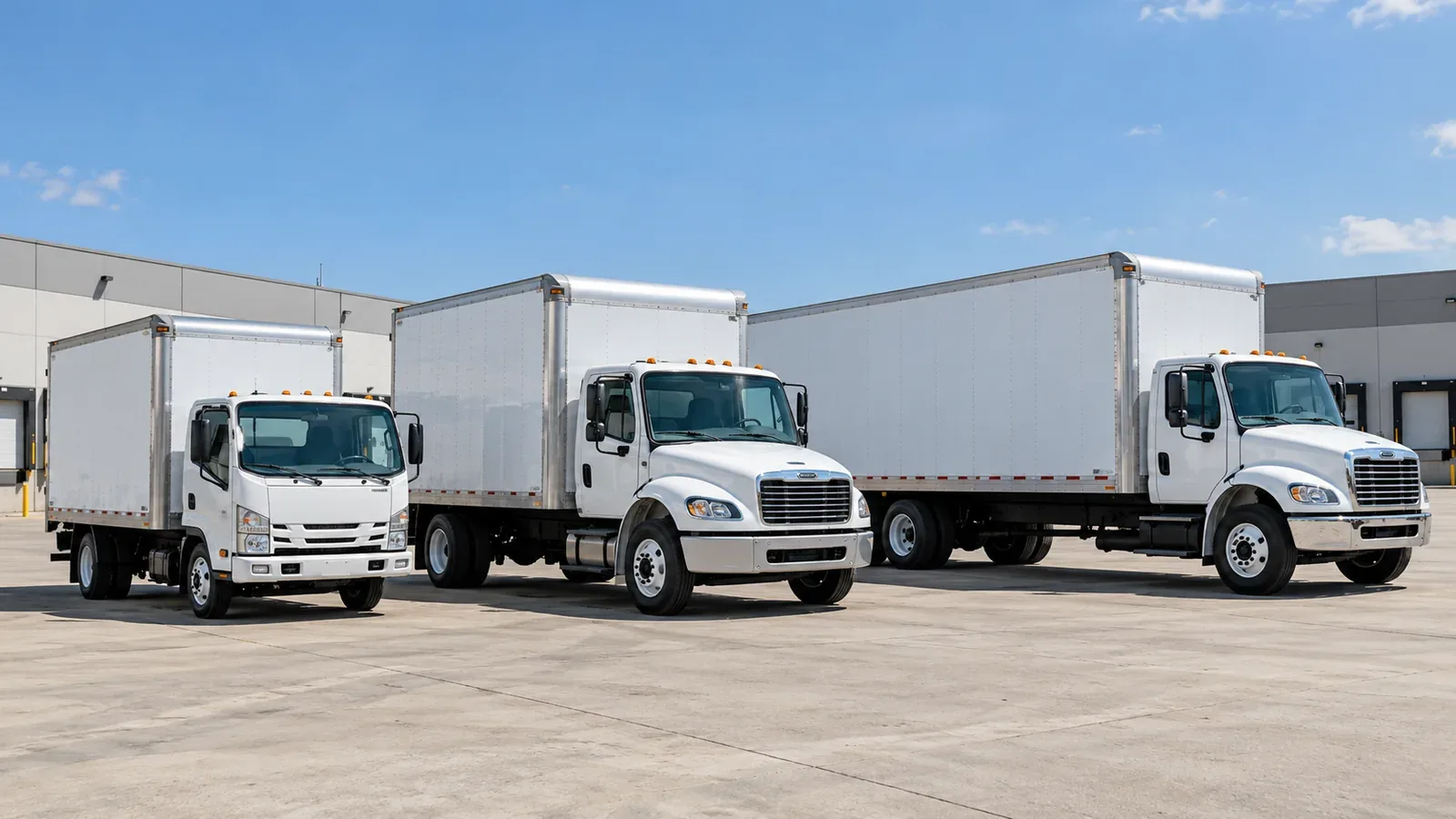
A truck advertised as a “20-footer” might sound like a simple step up from a “15-footer.” But for delivery planning, that number answers only one question: approximately how long is the cargo body? It does not describe the complete truck length, rear-door dimensions or how much freight the vehicle can legally carry.
The right size is the smallest practical vehicle that can handle your recurring load and your most demanding loading site without compromising weight limits or safety. If you are still deciding whether a separate box body is necessary, begin with the cargo van versus box truck comparison.
Compare common box lengths using a real fleet example
U-Haul publishes a consistent comparison of its rental trucks. The values below are examples from that provider’s fleet, not standards that every truck maker follows.
| Rental size label | Published interior L × W × H | Published cargo volume |
|---|---|---|
| 10 ft | 9 ft 11 in × 6 ft 4 in × 6 ft 2 in | 402 cu ft |
| 15 ft | 15 ft × 7 ft 8 in × 7 ft 2 in | 764 cu ft |
| 20 ft | 19 ft 6 in × 7 ft 8 in × 7 ft 2 in | 1,016 cu ft |
| 26 ft | 26 ft 2 in × 8 ft 2 in × 8 ft 3 in | 1,682 cu ft |
Source: U-Haul moving-truck sizes. The comparison table lists an 8 ft 2 in interior width for its 26-foot truck, but U-Haul’s individual 26-foot truck page lists 8 ft 1 in. These two published dimensions are inconsistent; neither should be treated as a guaranteed measurement of the vehicle you receive. U-Haul also warns that specifications are approximate and production configurations vary. Ask for the actual truck’s clear inside width and door opening before committing to a load. The advertised number is not the same as a measured, usable cargo floor.
For a commercial purchase, obtain the body builder’s dimension sheet and photograph the vehicle’s certification labels. If there is a door track, refrigeration evaporator, safety railing or protective lining, the nominal rectangular volume may overstate usable space.
How to interpret 12-, 16-, 20- and 26-foot box trucks
Delivery companies frequently describe trucks using size bands such as 12, 16, 20 and 26 feet. These are shopping categories, not uniform engineering classes. The same nominal length may be offered on different weight-rated chassis.
Small delivery bodies: around 10 to 12 feet
Consider a smaller truck when space constraints, frequent stops and moderately bulky orders are the real problem. Typical tasks include parcel overflow, boxed appliances and local store replenishment, provided the freight fits the body and legal load limits.
Check the rear opening. A shorter truck does not help if the widest recurring shipment cannot pass through the door.
Mid-size bodies: around 14 to 17 feet
This is often the first size range worth investigating when you need a more rectangular cargo space than a van can provide. Furniture, appliance and mixed business-to-business deliveries may fit well.
Ask whether you need a liftgate. A liftgate adds capability but also its own weight and operating constraints; verify the platform’s rated capacity independently of the truck’s payload.
Larger local-delivery bodies: around 18 to 22 feet
These can reduce second trips for large orders but introduce more constraints around docking, loading bays and residential parking. Many carriers should compare the cost of a partial second trip against the carrying cost of a larger vehicle used every day.
Long bodies: around 24 to 26 feet
A long box makes sense where cubic capacity or long freight is the main requirement. However, cargo-body length alone never proves that the truck can safely haul a heavy load. A 26-foot rental truck and a 26-foot commercial straight truck may have different GVWRs, liftgates, body weights and payload limits.
Door opening, floor height and usable width are deal breakers
Ask for five dimensions before accepting a quote:
- Inside length: measure clear usable space to the closed rear door.
- Inside width: identify obstructions and the narrowest location.
- Inside height: include roof fixtures, rails and any refrigeration equipment.
- Rear-door clear opening: both width and height, not the box’s outside dimensions.
- Load floor height: distance from ground and from the available dock or lift platform.
For example, two 48-inch-wide pallet loads nominally require 96 inches of width before any clearance, packaging, load movement or securing equipment. Even where U-Haul’s general comparison lists 98 inches of interior width, its 26-foot truck detail gives a rear-door opening of only 7 ft 9 in (93 inches). This does not necessarily prevent loading two pallets separately and positioning them side by side inside, but it does mean a 96-inch-wide combined load would not pass straight through that door. Verify the actual truck’s clear doorway, maneuvering space, load restraints and axle distribution.
Cubic feet versus payload: a worked example
Imagine two different box trucks:
- Truck A: 20-foot box, 16,000-lb GVWR and 10,400-lb ready-to-work weight.
- Truck B: 26-foot box, 25,999-lb GVWR and 17,500-lb ready-to-work weight.
Their starting remaining weight allowances are:
| Example | GVWR | Ready-to-work weight | Difference before other load |
|---|---|---|---|
| Truck A | 16,000 lb | 10,400 lb | 5,600 lb |
| Truck B | 25,999 lb | 17,500 lb | 8,499 lb |
Both sets of weights are hypothetical. They are not real vehicle specifications. Additional occupants, gear and freight consume the remaining allowance. Neither result overrides individual axle, tire or component ratings. Our 26-foot box-truck payload walkthrough shows how to apply the calculation to a published rental-fleet example without treating it as a universal capacity.
The lesson is not that every longer truck carries more. It is that rated gross weight minus actual configured weight determines the initial weight budget. Chassis manufacturers such as Isuzu publish different GVWR and body/payload allowances for different models. A body allowance before upfitting is not the same as final cargo payload.
A practical sizing worksheet
Make one table for each candidate vehicle. Fill it using the actual finished truck, not generic internet averages.
| Check | Measured or verified answer |
|---|---|
| Largest regular item (L × W × H) | ______ |
| Maximum regular shipment weight | ______ lb |
| Minimum rear opening required | ______ in × ______ in |
| Route parking/height restrictions | ______ |
| Actual interior floor length | ______ ft |
| GVWR from certification label | ______ lb |
| Ready-to-work scale weight | ______ lb |
| Axle and tire ratings reviewed | Yes / No |
| Required loading equipment | ______ |
| Price per completed stop or pallet | ______ |
Use the cost-per-mile calculator to test the operating-cost side, then account for handling time and revenue per completed delivery.
Cargo securement still applies inside an enclosed box
A box body does not automatically secure the freight it contains. Poorly restrained pallets, furniture and equipment can shift against the walls or create unstable loading.
FMCSA’s cargo securement guidance explains that covered commercial motor vehicles must prevent cargo movement with suitable methods such as structures of adequate strength, blocking, bracing, tiedowns or dunnage. Commodity-specific rules can also apply. Follow the applicable rules and avoid assuming that a closed door is sufficient.
A buying decision with fewer surprises
Before buying or leasing, insist on a finished-vehicle walkaround and a documented load plan. Have the supplier confirm the box builder, chassis model, liftgate rating, actual height and turning clearance. Use a scale rather than a brochure estimate for your truck’s ready-to-work weight.
Where one large order per week causes the size problem, compare rental or subcontracting for those loads rather than permanently upsizing the fleet. Before assigning a driver, check the truck’s license category independently of its advertised box length using the box-truck CDL decision guide.
Editorial method and limitations
The comparison table reproduces specific manufacturer/rental published dimensions with explicit attribution. The payload table is original, hypothetical arithmetic. Real equipment, including trucks with similar advertised lengths, may have different dimensions, loaded axle weights and legal obligations. Confirm the actual truck before making a purchase or loading decision.