
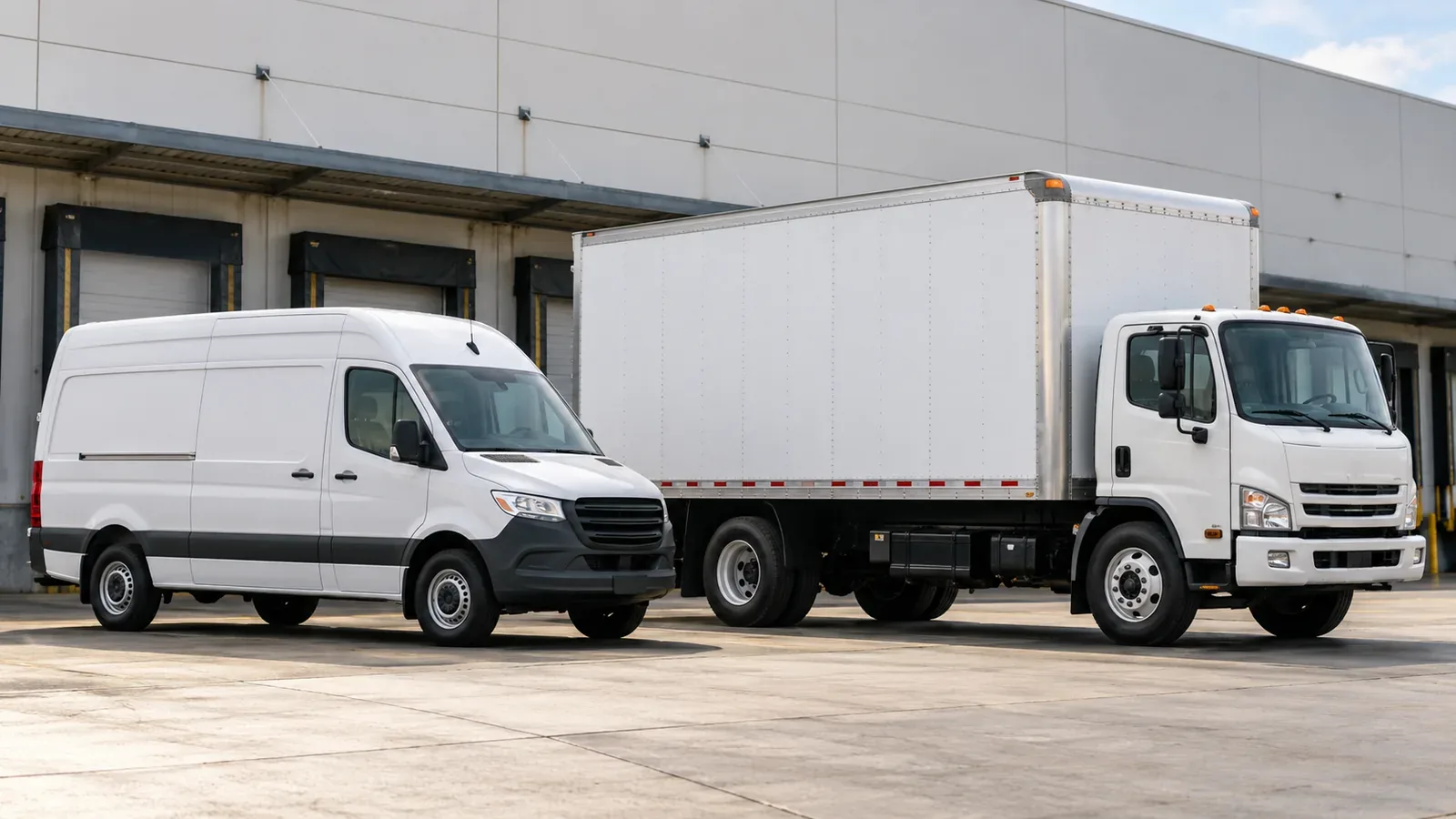
A delivery vehicle is a piece of route equipment, not just a cargo container. A vehicle that carries more freight may still cost more per successful delivery when the route has tight alleys, short stops, limited parking or a long walk from the loading area.
The decision is usually between two operating patterns:
- Cargo van: frequent small deliveries, mixed parcels, technicians’ supplies, limited loading spaces and frequent door access.
- Box truck: fewer, larger shipments, bulky products, appliance deliveries, pallets or operations that benefit from a dedicated cargo box and a liftgate.
Those are tendencies, not guarantees. Start with the loads you actually carry and the sites you actually visit.
Cargo van vs. box truck: the practical comparison
| Decision factor | Cargo van | Box truck |
|---|---|---|
| Typical delivery fit | Parcels, bins, light commercial goods, service supplies | Furniture, appliances, large cartons and palletized goods |
| Parking and access | Often easier in constrained locations | Requires more clearance and turning space |
| Cargo opening | Side and rear doors; opening dimensions vary | Usually a large rear door; roll-up door and liftgate availability vary |
| Inside load area | Vehicle body may narrow usable space around wheel housings | A rectangular box can make freight layout simpler |
| Loading labor | Good for hand-loaded smaller orders | Can reduce handling when the right liftgate, dock or ramp is available |
| Upfit trade-off | Shelves and bulkheads reduce usable payload and space | Box body, liftgate and refrigeration equipment can reduce remaining payload |
| Licensing | Depends on rated and actual weight, use and state rules | Same principle; body length does not determine license class |
| Best financial metric | Cost per completed stop | Cost per completed stop or cost per delivered pallet |
Important: The table describes operating characteristics, not model-specific ratings. A high-capacity van may legally carry more weight than a poorly configured box truck, and the reverse can also be true.
Start with a one-week route audit
Before comparing vehicle advertisements, record the following for at least five representative delivery days:
- Orders: count of stops, parcels and pallets, plus maximum shipment dimensions.
- Freight weight: actual or documented shipment weights, including packaging and handling equipment.
- Customer access: alley restrictions, parking bays, loading docks, stairs and required appointment windows.
- Time: driving, finding parking, unloading, failed deliveries and returning empty.
- Equipment: dollies, shelving, bulkheads, pallet jacks, liftgate and securement gear.
The single largest shipment matters, but so does the most common shipment. If one oversized load arrives each month, renting a box truck for that day may be more economical than purchasing one for every daily route.
Cargo space: compare usable geometry, not a headline number
Ford lists a maximum of 487.3 cubic feet behind the first row for certain 2026 Transit cargo-van configurations. That is a manufacturer maximum for selected body and roof choices, not a promise that every Transit has that much usable space. Ford also notes that payload depends on configuration. See Ford’s 2026 Transit specifications.
For box trucks, the most useful measurements are usually:
- unobstructed floor length between the front wall and the closed door;
- clear width between any wheel wells or interior fixtures;
- inside standing height and rear-door opening;
- usable width at pallet-jack handle height;
- loading-floor height above the ground;
- ramp or liftgate platform dimensions and rated lifting capacity.
A 16-foot box can be unusable for a long piece of equipment if its door opening is too narrow. A van with ample advertised cubic feet can likewise fail if a rigid item cannot clear its rear doorway.
Payload: account for the complete delivered vehicle
Payload is a weight limit, not a measure of internal volume. The manufacturer’s weight rating is the starting point, but a practical loading decision must also account for the truck as actually equipped.
Use this planning method:
- Identify the truck’s GVWR from its certification label.
- Get a credible ready-to-work scale weight, with its box or shelves, fluids, liftgate and other installed equipment.
- Subtract the occupants and any gear not already included in that scale weight.
- The remainder is your estimated freight allowance, subject to front/rear axle ratings, tires and loading distribution.
For an illustrative truck rated at 14,500 lb that scales at 9,800 lb with its permanent equipment, and with 400 lb of driver/passenger and removable gear added later, the calculated remaining capacity is 4,300 lb. This is a teaching example, not a published rating for a particular model.
The Isuzu N-Series gas specifications show how different chassis classes have distinct GVWRs and body/payload allowances. Critically, a chassis manufacturer’s body/payload allowance may be stated before a delivery body and liftgate are installed. It must not be presented as the finished vehicle’s available cargo payload. Review the manufacturer’s specifications.
Don’t confuse a non-CDL truck with an unregulated truck
For a typical single-unit property-carrying truck, the federal Class B CDL threshold is 26,001 lb GVWR or actual gross vehicle weight, whichever is greater, subject to the relevant exceptions and rules. Combined vehicles have additional Class A rules. See FMCSA driver classifications.
That is not the threshold for every federal trucking safety obligation. FMCSA’s guidance says that a business using a property-carrying vehicle at or above 10,001 lb in interstate commerce may need a USDOT number and must comply with applicable safety regulations. Intrastate rules differ by state. Verify your operation with FMCSA’s USDOT guidance.
Don’t purchase a box truck solely because it is advertised as “non-CDL.” Confirm the vehicle certification label, actual weights, cargo and operation. For a step-by-step license check, see when a box-truck driver needs a CDL. The separate question of how much a particular vehicle can haul is covered in the 26-foot box-truck payload guide.
Compare the economics using cost per completed stop
An illustrative local route shows why lower daily vehicle cost does not always win:
| Assumption | Cargo van | Box truck |
|---|---|---|
| Daily operating cost, including allocated labor | $285 | $365 |
| Successful deliveries | 32 | 38 |
| Cost per successful delivery | $8.91 | $9.61 |
These figures are hypothetical and not average market rates. The van has the lower cost per stop in this example, even though the truck finishes more deliveries. Change the shipment mix or reduce unloading time, however, and the larger truck could win.
Use your own fuel, insurance, wages, maintenance, finance and downtime data with the cost-per-mile calculator. If buying equipment, compare loan and lease structures with the truck loan versus lease calculator.
When a cargo van is the stronger choice
A van is worth serious consideration when all of the following are largely true:
- cargo is regularly hand-loaded and fits through its doors;
- parking near delivery points is scarce;
- loading docks and forklifts are uncommon;
- route density rewards a smaller physical footprint;
- the van’s payload, axle ratings and securement arrangements are sufficient.
Do not treat low floor height as a guarantee of ergonomic unloading. Measure lift height and handling time with representative packages.
When a box truck is the stronger choice
A box truck often earns its additional space and cost when:
- orders include pallets, furniture or large appliances;
- multiple bulky orders can be delivered without a second trip;
- loading docks are available or a properly rated liftgate is necessary;
- product separation, racking or temperature-controlled upfits are important;
- the vehicle can reach delivery sites without repeated access failures.
Also verify overall truck height, not just box length. Garages, tree branches, loading bays and low bridges create real route constraints. If a box truck fits the operating pattern, use our box-truck size comparison to narrow the body length and loading requirements before requesting quotes.
Before signing the contract
Ask the seller or fleet supplier for the actual certification-label GVWR and GAWR values, delivered empty weight, interior dimensions, floor rating, equipment weight, documented door opening, and warranty coverage. Confirm insurance eligibility and whether the route requires federal or state carrier registrations.
Then test one representative route in a rental or demonstrator. A half-day of measuring and loading can expose problems a brochure never mentions.
For business-wide planning, read financing your first truck and the maintenance-file requirements that may apply to regulated commercial vehicles.
Editorial method and source limits
This comparison combines published manufacturer specifications with a route-based decision framework. The cost table and 14,500-lb payload calculation are explicitly hypothetical; no shipment prices, fuel economy or payload are presented as universal industry averages. Verify the exact model-year configuration, upfit and legal rules before acting.