
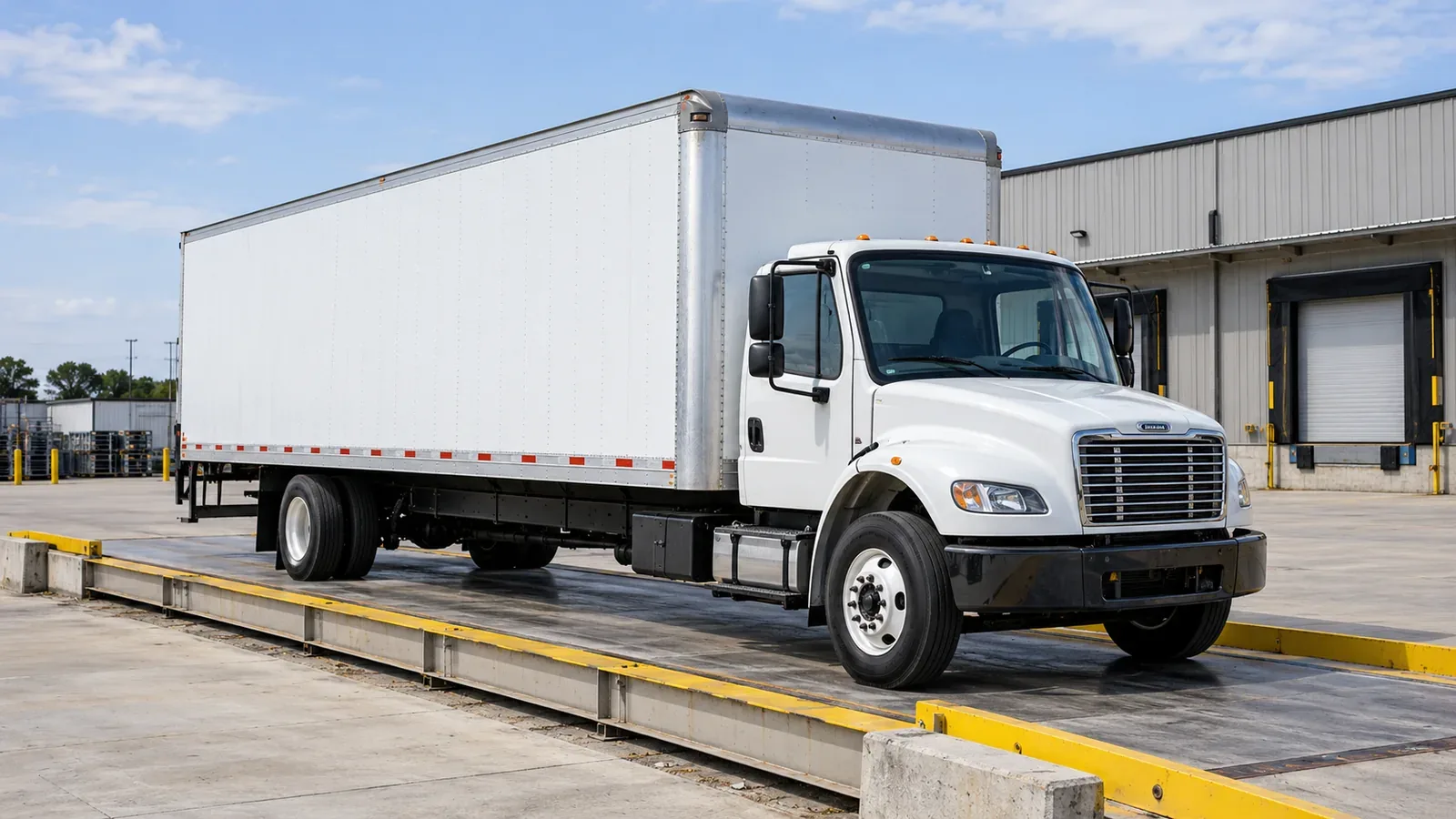
“How much can a 26-foot box truck carry?” is the wrong question unless you know which 26-foot truck. Twenty-six feet usually refers to the length of the cargo body; it does not tell you the vehicle’s gross weight rating, finished empty weight, axle ratings or usable freight payload.
The safest answer comes from the exact truck’s certification plate and a scale ticket, with all its installed equipment included. If you are comparing different body lengths rather than a specific truck’s carrying capacity, start with box-truck sizes compared.
The documented U-Haul 26-foot example
U-Haul’s published 26-foot rental truck specifications list the following values:
| Published specification | U-Haul 26-foot rental example |
|---|---|
| Maximum gross vehicle weight | 25,999 lb |
| Published empty weight | 13,140 lb |
| Published maximum load | 12,859 lb |
| Cargo volume | 1,682 cu ft |
| Inside length | 26 ft 2 in |
| Overall clearance height | 12 ft |
The source notes that rental-truck measurements are approximate. These figures are not a manufacturer’s rating for every commercial 26-foot box truck. They do not authorize loading a different truck to 12,859 lb, nor do they override the actual rented unit’s documentation and restrictions.
Notice the arithmetic: 25,999 − 13,140 = 12,859 lb. That is the published gross-weight difference for this example. Additional weight that is not already reflected in the published empty-weight basis consumes the remaining allowance.
How to calculate payload for your exact truck
Work from weights and ratings, not a cargo-box measurement.
Step 1 — Read the certification label. Record GVWR, front/rear GAWR and tire information. Do not substitute the box maker’s volume rating for any of these.
Step 2 — Weigh the ready-to-work truck. Include the installed box, permanent shelving, fuel, fluids, liftgate, refrigerated equipment and other equipment that the truck will actually carry. Keep the scale ticket.
Step 3 — Account for variable weight. If the driver, passengers, dollies or removable equipment were absent at the scale, add them to the calculation.
Step 4 — Calculate the remaining gross-weight allowance.
Estimated freight allowance = GVWR − ready-to-work scale weight − additional non-freight weight.
This is only the first limit. Loading must also respect axle, tire, component and any applicable legal limits.
Original worked example: ready-to-work delivery truck
Suppose a 26-foot commercial straight truck has the following hypothetical values:
| Item | Weight |
|---|---|
| GVWR from its label | 25,999 lb |
| Ready-to-work measured vehicle weight, no driver | 16,850 lb |
| Driver, passenger and removable equipment | 450 lb |
| Remaining gross-weight freight allowance | 8,699 lb |
Calculation: 25,999 − 16,850 − 450 = 8,699 lb.
This is not a manufacturer’s 26-foot payload rating or a suggestion that 8,699 lb can automatically be loaded. A different liftgate, heavier body or axle distribution can change the result significantly. If the driver was already in the truck during weighing, do not subtract that driver’s weight again.
Why two 26-foot trucks have different payloads
The same nominal cargo-body length may be fitted to:
- a different chassis GVWR or axle package;
- a heavier or lighter body builder’s box;
- a liftgate, loading ramp or rear step;
- refrigeration equipment or custom shelving;
- different fuel capacity and equipment packages;
- a cab configured for more occupants.
A larger box often increases volume, but extra body weight can reduce the freight allowance if gross weight ratings stay the same.
For fleet comparisons, record each vehicle’s finished empty weight rather than relying on body length or the chassis-only payload estimate.
Gross vehicle weight is not the only weight limit
Imagine that the total loaded truck is below its GVWR, but the rear axle is overloaded because dense pallets were stacked behind the axle. The loading plan can still be unsafe or unlawful.
You need to verify:
- front and rear axle loads against their ratings;
- tire capacities and inflation requirements;
- allowable loading-floor concentration;
- liftgate platform capacity for each item being lifted;
- safe cargo securement and any applicable route weight restrictions.
FMCSA’s cargo securement guidance explains that covered carriers must prevent cargo movement using adequate structures, tiedowns, blocking, bracing and other appropriate measures. A closed box does not make unsecured freight safe.
Does a 26-foot truck require a CDL?
Length does not establish the license class. FMCSA explains that federal Class B covers a single vehicle with GVWR or actual gross weight of 26,001 lb or more, whichever is greater, including specified towing situations. Other Class A, C and endorsement rules may apply depending on vehicle combination, passengers or hazardous materials. See FMCSA CDL classifications.
The example U-Haul publishes a maximum GVW of 25,999 lb, just below that Class B weight threshold. But that fact does not establish the classification of every truck with a 26-foot body, nor remove all other regulatory requirements. Follow the box-truck CDL decision guide for a separate check of GVWR, actual weight, towing, cargo and state-level requirements.
Also distinguish the 10,001-lb threshold that can bring interstate property-carrying operations into FMCSA registration and safety requirements. A truck may not require a CDL by weight while still being a regulated commercial motor vehicle. For conditions and state differences, see FMCSA’s USDOT number guidance.
What about pallets and bulk freight?
Volume, weight and load distribution are independent constraints. A high-cube load of lightweight cartons may fill the box before the truck reaches its gross-weight allowance. A few dense pallets may reach an axle or GVWR limit while much of the box is empty.
Before accepting a load, obtain:
- total freight weight with packaging;
- dimensions of each unit and the total loading footprint;
- any center-of-gravity, stacking or fragility restriction;
- a plan for where each item sits relative to the axles;
- securement and handling equipment requirements.
If the freight is dense or axle balance is uncertain, weigh the loaded front and rear axles rather than inferring compliance from the total weight alone.
The hidden cost of a heavier truck
If two trucks have the same rated gross weight but one carries a heavier liftgate and upfit, it may transport less revenue-generating freight. Compare economics by deliverable revenue per trip, not just available cubic feet.
For example, if Truck A can legally and practically carry 8,000 lb of a dense product per run while Truck B can carry 6,000 lb, repeated shipments may require extra runs from Truck B. That is an illustrative planning scenario, not a benchmark payload claim.
Model fuel, maintenance, insurance and finance using the cost-per-mile calculator and the loan versus lease calculator. For regulations on vehicle maintenance records, see the DOT vehicle maintenance file guide.
Five checks before you load
- Confirm the exact vehicle’s certified GVWR and GAWR.
- Obtain a real scale weight including the equipment actually installed.
- Subtract occupants and loose gear only if not already weighed.
- Check axle, tire, floor, liftgate and securement limits.
- Confirm applicable CDL, DOT and state operating obligations.
Editorial method and limitations
The published U-Haul data is identified as one rental-provider example. The 8,699-lb calculation and operational comparisons are original teaching scenarios, not surveyed market averages or universal specifications. Actual payload may be lower due to component, axle or legal constraints. Check the vehicle’s plates, scale ticket and authoritative instructions before loading.