
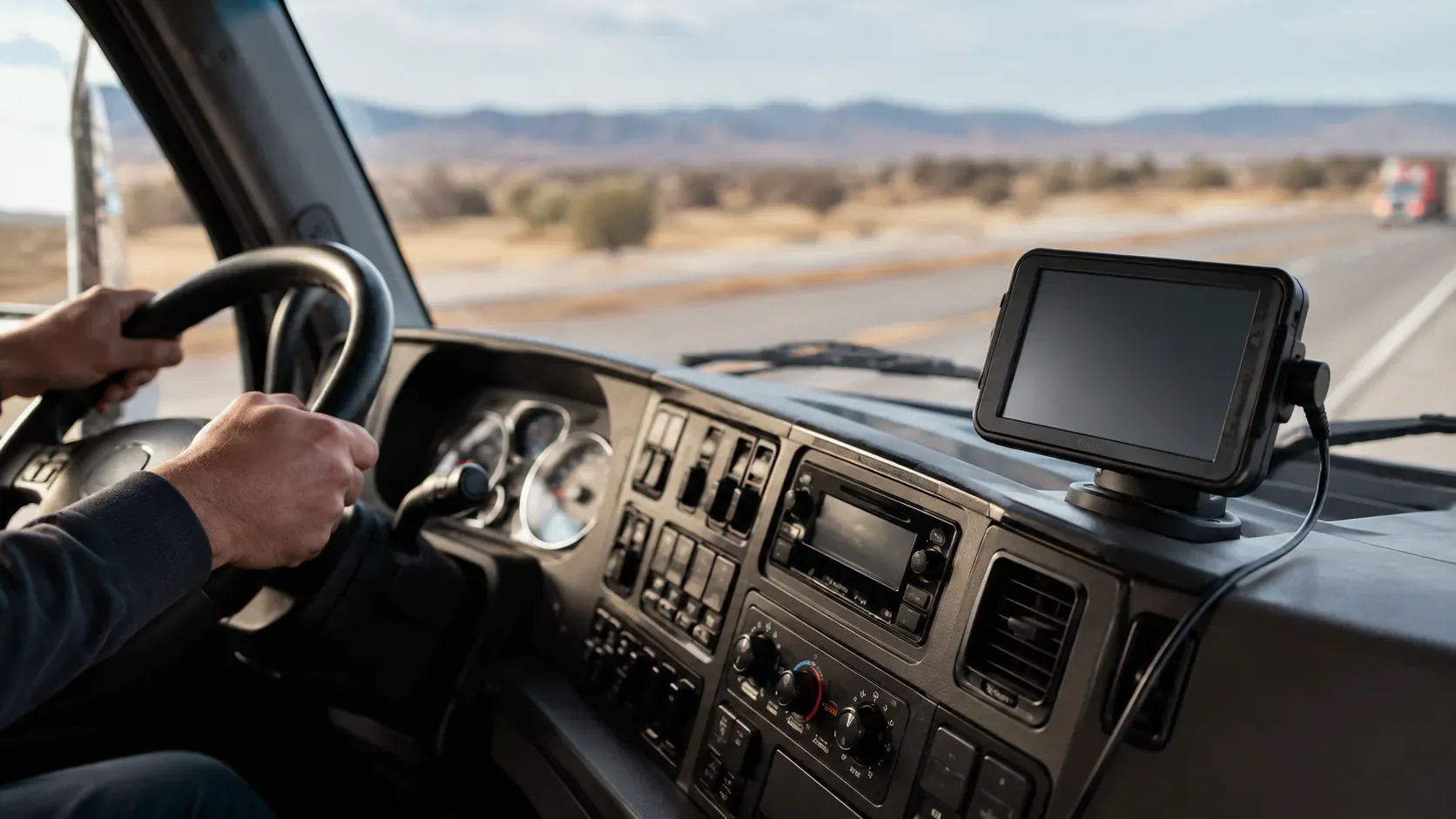
The ELD question is often asked backward.
Owner-operators commonly begin with:
Do I have a CDL?
Do I have an MC Number?
Is my truck over 26,000 pounds?
Those facts can matter, but none of them answers the ELD question by itself.
The more reliable starting point is:
Must the driver prepare a record of duty status for this operation?
When the answer is yes, an FMCSA-registered ELD is generally required unless a specific exception applies.
When the answer is no because the driver qualifies for a complete RODS exception, an ELD is generally unnecessary for that operation.
That distinction prevents two opposite errors:
- buying an ELD for an operation that only requires time records;
- using paper logs when the driver has exceeded the limits of an ELD exception.
The 30-second decision rule
Use this sequence before reviewing any exemption.
| Question | If yes | If no |
|---|---|---|
| Is the driver operating a CMV covered by federal HOS rules? | Continue | Federal ELD rule generally does not apply |
| Is the operation interstate commerce? | Continue under federal Part 395 | Check the State’s intrastate rules |
| Must the driver prepare RODS? | ELD generally required unless an exception applies | Use the required time-record system instead |
| Does a specific ELD exception apply? | Use the permitted alternative record method | Use a registered ELD |
This article focuses on federal interstate rules.
A State can impose different or additional requirements on intrastate carriers.
First question: is the vehicle covered by federal HOS rules?
FMCSA’s current HOS guidance states that the federal rules generally cover a vehicle used in business and interstate commerce when it meets at least one of these descriptions:
- actual weight of 10,001 pounds or more;
- GVWR or GCWR of 10,001 pounds or more;
- designed or used to transport 16 or more passengers, including the driver, without compensation;
- designed or used to transport 9 or more passengers, including the driver, for compensation;
- transporting placarded hazardous materials.
The threshold is therefore not limited to CDL vehicles.
A 14,000-pound straight truck can be subject to federal HOS and medical rules even though the driver does not need a CDL.
Why the CDL threshold causes confusion
The common 26,001-pound CDL threshold answers a licensing question.
The 10,001-pound CMV threshold can answer an HOS question.
The two systems overlap but are not identical.
A carrier should review:
- actual gross weight;
- manufacturer rating;
- combination rating;
- passenger design;
- hazardous-material status;
- interstate commerce.
Second question: is the trip interstate commerce?
Interstate commerce includes obvious cross-border transportation, but it can also include a same-State truck movement that forms part of a shipment originating or terminating outside the State.
A local route can therefore be interstate for HOS purposes.
Examples include:
- final-mile delivery of imported freight;
- port-to-customer movement within one State;
- rail-terminal delivery within one State;
- local segment of freight already committed to an out-of-State destination.
The truck’s immediate route is not the only fact.
The cargo’s complete movement and shipper intent can matter.
Third question: must the driver prepare RODS?
An ELD electronically creates the driver’s record of duty status.
A driver who is not required to create RODS generally does not need an ELD.
The most common example is a driver who satisfies the short-haul exception.
A driver who must prepare RODS only occasionally may qualify for the separate eight-day ELD exception.
These are different rules.
Exception 1: qualifying short-haul operations
The short-haul exception is the most valuable ELD alternative for a genuinely local owner-operator.
A property-carrying driver generally qualifies when the driver:
- operates within a 150 air-mile radius of the normal work reporting location;
- reports to and returns to the same normal work reporting location;
- is released from duty within 14 consecutive hours;
- satisfies the other conditions in § 395.1(e);
- has qualifying carrier time records.
When every condition is met, the driver is exempt from ordinary RODS and supporting-document requirements for that operation.
No RODS means no federal ELD mandate for those days.
An air mile is not a road mile
One nautical or air mile is approximately 1.1508 statute miles.
A 150-air-mile radius is therefore roughly 172.6 statute miles measured as a straight-line radius.
It is not:
- 150 odometer miles;
- 150 route miles;
- 150 loaded miles;
- 150 miles from the company mailing address.
The center is the driver’s normal work reporting location.
The driver must return and be released
A local route is not automatically short-haul.
The driver must return to the normal reporting location and be released within the applicable 14-hour period.
An overnight stay away from the location generally breaks that day’s short-haul conditions.
The carrier still keeps time records
The exception does not mean no records.
The carrier’s time records should show the information required by § 395.1(e), including the driver’s:
- time reporting for duty;
- time released from duty;
- total hours on duty;
- other required identifying information.
Those records remain company records even though the driver does not create a graph-grid RODS.
What happens on a failed short-haul day?
A driver who leaves the radius, fails to return or exceeds the applicable duty period may need a RODS for that day.
That day also counts toward the eight-day ELD exception analysis.
A carrier should not backdate a local timecard and pretend the conditions remained satisfied.
Exception 2: RODS required on no more than eight days
A driver who needs RODS on no more than eight days in any rolling 30-day period is not required to use an ELD.
The driver generally prepares paper RODS or uses another permitted method on those days.
This exception is useful for a primarily short-haul carrier that occasionally:
- exceeds the radius;
- stays away overnight;
- exceeds the short-haul conditions;
- performs a longer interstate trip.
The 30-day period rolls every day
This is not a monthly allowance.
The carrier must consider any 30 consecutive days.
For example:
- June 15 through July 14 is one 30-day period;
- June 16 through July 15 is another;
- June 17 through July 16 is another.
A driver can remain below eight days in June and below eight days in July but still exceed eight in a rolling period spanning both months.
Count days requiring RODS
The relevant count is not simply:
- days driven;
- interstate loads;
- nights away;
- paper logs completed.
Count each day on which the driver was required to prepare a RODS.
A single trip can create several RODS days.
The ninth day changes the result
When the driver must use RODS on more than eight days in any rolling 30-day period, the driver becomes subject to the ELD rule unless another exception applies.
The carrier should install and configure the ELD before exceeding the limit.
It is risky to discover the ninth day after dispatch.
| Rolling 30-day RODS count | ELD result |
|---|---|
| 0–8 days | Driver can generally use the eight-day ELD exception |
| 9 or more days | ELD generally required unless another exception applies |
Exception 3: qualifying driveaway-towaway operations
The driveaway-towaway exception applies when the vehicle being driven is part of the shipment being delivered.
Typical examples include:
- delivering a new truck from manufacturer to buyer;
- moving a commercial vehicle as the commodity;
- transporting a motorhome;
- transporting a recreational vehicle trailer under the qualifying rule.
The exception is not a general exemption for:
- towing freight;
- moving a normal loaded trailer;
- driving a truck to a terminal;
- transporting a modular home;
- operating an empty tractor between loads.
The vehicle itself must be the commodity
The distinction is functional.
When the power unit is being used to transport ordinary cargo, the operation is not driveaway-towaway merely because the vehicle is also moving.
FMCSA specifically states that moving mobile or modular homes does not qualify under this exception.
RODS can still be required
The exception removes the ELD requirement.
It does not automatically remove hours-of-service limits or RODS.
The driver can still need paper records for the trip.
Exception 4: pre-2000 vehicle or engine
A driver operating a vehicle manufactured before model year 2000 is not required to use an ELD.
FMCSA generally looks to the model year shown through the vehicle’s VIN and registration.
The agency also recognizes a qualifying pre-2000 engine installed in a later-model vehicle.
Keep evidence at the business
The driver is not generally required to carry engine-model documentation in the truck solely for this exception.
The carrier should retain reliable evidence at the principal place of business, such as:
- engine serial number;
- manufacturer record;
- rebuild or replacement documentation;
- purchase invoice;
- maintenance record;
- vehicle registration.
A later vehicle without an ECM is not automatically exempt
FMCSA states that a model-year-2000-or-newer vehicle without a conventional ECM remains subject to the ELD rule.
The carrier must use an ELD capable of satisfying the technical accuracy requirements through an appropriate method.
“No ECM” and “pre-2000” are not equivalent.
Paper RODS remain
The pre-2000 exception removes the device requirement.
It does not remove ordinary HOS or RODS requirements.
The driver generally uses paper logs unless another RODS exception applies.
The exemptions compared
| Exception | ELD needed? | RODS needed? | Main evidence |
|---|---|---|---|
| Qualifying short-haul | No | No ordinary RODS | Carrier time records and route facts |
| RODS on no more than 8 days in 30 | No | Yes on RODS days | Rolling count and paper records |
| Driveaway-towaway | No | Often yes | Documents showing vehicle is the commodity |
| Pre-2000 vehicle or engine | No | Usually yes | VIN, registration and engine records |
Agriculture and other HOS exemptions
The ELD rule does not replace existing HOS exemptions.
When an operation is exempt from the relevant Part 395 requirements, it can also be exempt from ELD use during the covered operation.
Agricultural operations are highly fact-specific.
The analysis can depend on:
- agricultural commodity;
- source;
- planting or harvesting season where relevant;
- 150-air-mile agricultural radius;
- current segment of the trip;
- whether the driver later operates outside the exemption.
A driver can move between:
- exempt time;
- short-haul time;
- RODS time;
- ELD-required time
during the broader work cycle.
Do not classify the entire business as “ag exempt” without reviewing the specific movement.
Short-term rental trucks
FMCSA has recognized a limited exemption for certain property-carrying rental trucks rented for eight days or less.
The exemption has its own conditions and required documents.
A qualifying driver generally carries:
- the applicable exemption notice or equivalent document;
- rental agreement identifying the parties, vehicle and rental period;
- current and previous seven days of RODS when required.
A rental agreement longer than eight days generally does not qualify for this limited rental exemption.
This is separate from the driver’s eight-days-in-30 RODS exception.
Intrastate owner-operators
The federal ELD rule is principally tied to interstate commerce and federal Part 395.
A wholly intrastate carrier should review the home State’s rules.
A State can:
- adopt the federal ELD framework;
- create a different threshold;
- use different short-haul rules;
- exempt certain intrastate operations;
- require electronic records through State law.
Do not assume that staying inside one State removes ELD coverage.
The cargo can still be interstate, and the State can independently regulate intrastate drivers.
Cross-border operations
Canada- and Mexico-domiciled drivers operating in the United States are generally subject to the U.S. ELD rule unless an exception applies.
A foreign carrier can use the short-haul exception in qualifying circumstances.
A driver who requires U.S. RODS on more than eight days in a rolling 30-day period generally needs a compliant U.S. ELD unless another exception applies.
The ELD provider can support different country rule sets, but the driver remains responsible for compliance in the country of operation.
What changed in 2026?
Two 2026 developments matter directly to owner-operators.
The operator’s manual is no longer an onboard requirement
A final rule effective July 22, 2026 removed the requirement to keep a copy of the ELD operator’s manual in the CMV.
The driver must still know how to operate the device.
The vehicle still needs:
- data-transfer instruction sheet;
- malfunction and recordkeeping instruction sheet;
- blank graph-grid RODS sufficient for at least eight days.
A carrier can still keep the manual voluntarily.
It is simply no longer one of the federally required onboard packet items.
Device revocations have become a practical operating risk
FMCSA has removed multiple devices from the registered list during 2026.
The carrier is responsible for checking:
- registered device list;
- revoked device list;
- provider notices;
- FMCSA deadlines.
When a device is revoked, FMCSA generally instructs affected carriers to:
- discontinue relying on the revoked ELD;
- use paper logs or permitted logging software temporarily;
- replace the device with a registered ELD before the stated deadline.
For ten devices revoked on July 9, 2026, FMCSA set September 8, 2026 as the replacement deadline.
After the deadline, continued use can be treated as operating without an ELD and can lead to an out-of-service action.
What a compliant ELD must do for the carrier
An ELD is more than a digital graph grid.
A compliant system should support:
- automatic recording of driving time;
- driver identification;
- vehicle identification;
- engine synchronization or permitted alternative;
- location information;
- duty-status changes;
- driver certification;
- annotations;
- edit history;
- unidentified-driving management;
- roadside display and transfer;
- carrier retention and backup.
The carrier must also create proper accounts.
A support staff or administrator account cannot be used as a driver account.
Each driver needs an individual account.
The driver still controls the accuracy of the record
An ELD does not decide whether time is:
- on duty;
- off duty;
- sleeper berth;
- personal conveyance;
- yard move.
The driver and carrier must classify activity accurately.
The device does not legalize:
- false personal conveyance;
- omitted fueling;
- unrecorded loading;
- incorrect vehicle selection;
- shared driver accounts;
- deliberate log edits.
Portable ELDs and phones
A smartphone or tablet can serve as an ELD when the system meets the technical requirements.
A portable device must be mounted in a fixed position during CMV operation and visible to the driver from the normal seated position.
The carrier should also plan for:
- power supply;
- data connection;
- Bluetooth or engine connection;
- device ownership;
- screen damage;
- application updates;
- offline access;
- roadside transfer.
A logging application is not automatically an ELD merely because it draws a compliant-looking graph.
Verify the exact product on FMCSA’s official registered list.
When the ELD malfunctions
A malfunction does not erase the driver’s HOS obligations.
The driver should:
- note the malfunction;
- notify the motor carrier within 24 hours;
- reconstruct the current day and previous seven days when the device cannot retrieve them;
- use paper RODS or another lawful method while necessary.
The motor carrier generally has eight days after discovering or being notified of the malfunction to repair, service or replace the ELD.
A carrier seeking additional time generally must request an extension within five days after notification.
Keep the malfunction packet practical
The driver should know:
- who to contact;
- how to reconstruct records;
- where blank logs are stored;
- how to annotate the event;
- which provider support number to use;
- whether the device can still display prior records.
Five owner-operator profiles
Profile A: local one-truck contractor
The owner:
- starts and ends at the same yard;
- stays inside 150 air miles;
- returns within 14 hours;
- keeps compliant time records.
Likely result: short-haul, no ELD on qualifying days.
Profile B: local carrier with occasional overnight trips
The owner normally qualifies for short-haul but prepares RODS several times per month.
Likely result: paper RODS can work while the rolling count remains at eight or fewer days. Install an ELD before the ninth RODS day.
Profile C: interstate dry-van owner-operator
The driver runs multi-day interstate routes and prepares RODS continuously.
Likely result: registered ELD required.
Profile D: vehicle delivery contractor
The driver delivers trucks that are themselves the commodity.
Likely result: driveaway-towaway exception can remove the ELD requirement, but RODS and HOS can still apply.
Profile E: later-model glider with a pre-2000 engine
The carrier can prove the installed engine predates model year 2000.
Likely result: ELD exception can apply, with paper RODS generally required.
Evidence an exempt carrier should retain
An exemption should be provable.
| Claimed exception | Useful evidence |
|---|---|
| Short-haul | Normal reporting location, time records, route data and release times |
| Eight days in 30 | Rolling calendar, RODS days and paper logs |
| Driveaway-towaway | Contract, bill of lading and documents showing the vehicle is the commodity |
| Pre-2000 vehicle or engine | Registration, VIN, engine serial number and replacement records |
| Short-term rental | Rental agreement, exemption document and required RODS |
| Agricultural exemption | Commodity, source, route, radius and seasonal or operational facts |
Mistakes that create ELD violations
Counting trips instead of RODS days
One trip can span several days.
Counting by calendar month
The eight-day exception uses a rolling 30-day window.
Treating short-haul as a radius-only rule
The reporting-location and duty-period requirements also matter.
Treating paper logs as a permanent preference
Paper RODS are allowed only when a valid exception or temporary malfunction process applies.
Assuming the engine exception from appearance
Keep reliable engine documentation.
Using a revoked device after the deadline
A paid subscription does not make the device compliant.
Forgetting the trailer or cargo changes the operation
Vehicle combination, hazmat and interstate facts can change HOS coverage.
Assuming ELD means automatic compliance
The carrier still must review logs, supporting documents and unidentified driving.
The practical owner-operator decision
An owner-operator should use an ELD when the business regularly needs RODS.
Trying to operate permanently at the edge of the eight-day exception creates:
- counting risk;
- dispatch limitations;
- last-minute installation;
- incomplete prior records;
- roadside confusion.
The paper exception is most useful when the business is genuinely local and the RODS days are rare.
The short-haul exception is strongest when the carrier’s model is designed around:
- one normal reporting location;
- predictable radius;
- same-day return;
- reliable time records.
A carrier should not redesign the facts after the trip to fit the exemption.
What to do before the next dispatch
Answer these questions for the actual trip:
- Is the vehicle covered by federal HOS rules?
- Is the movement interstate commerce?
- Will every short-haul condition be satisfied?
- If not, how many RODS days occurred in the previous rolling 30 days?
- Does driveaway-towaway, pre-2000, rental or another exception apply?
- Is the exact ELD model still on FMCSA’s registered list?
- Can the driver display and transfer the current and previous seven days?
- Are transfer instructions, malfunction instructions and eight blank log days onboard?
- Is a malfunction or revocation deadline active?