
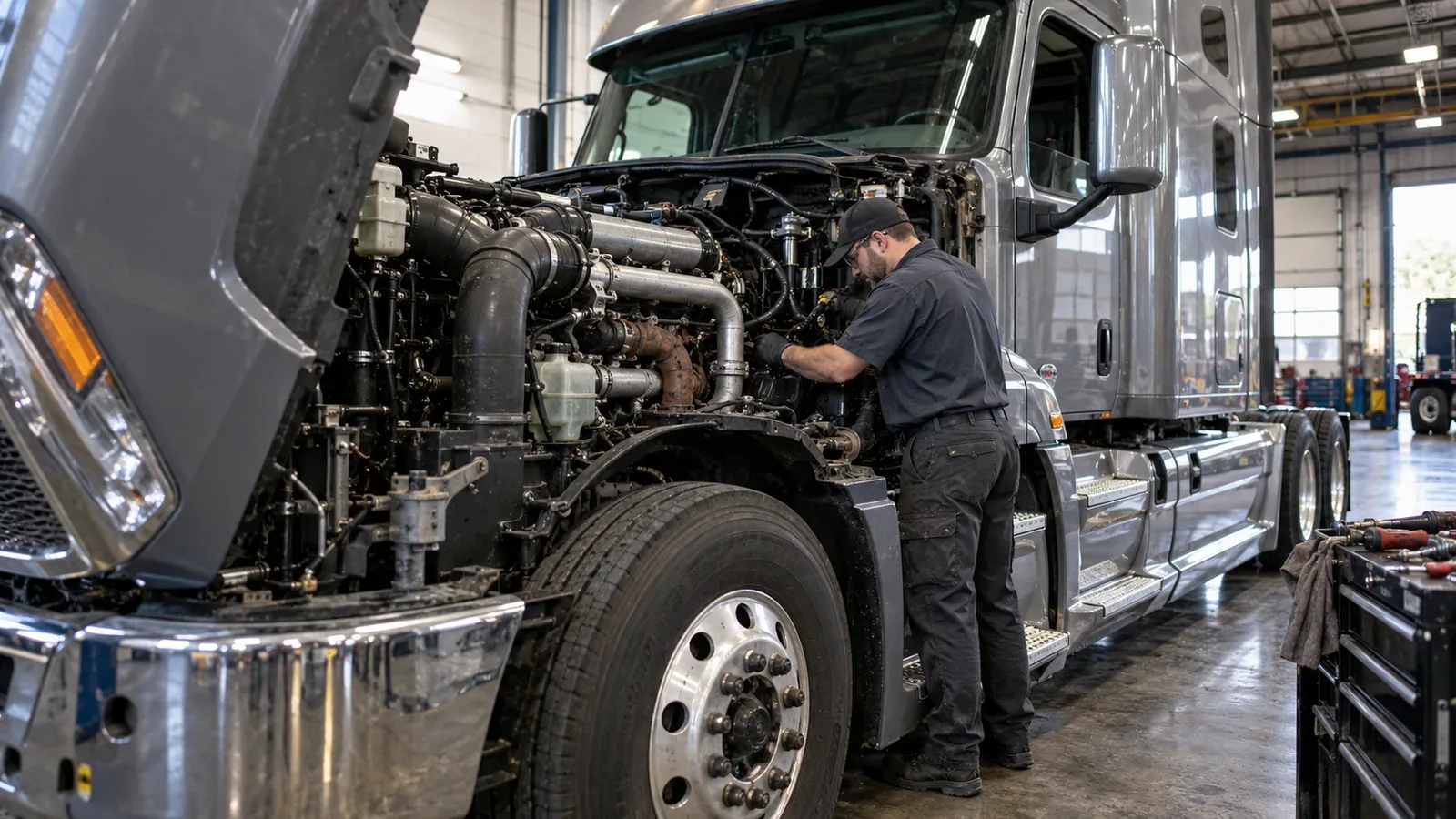
A used highway tractor can look excellent, start immediately and still carry expensive engine risk. Another truck can have more miles, faded paint and a thick folder of service invoices—and be the safer purchase. If you are about to spend money on either one, the odometer is a starting point, not the answer.
So how long does a semi-truck engine last? There is no federal or manufacturer-wide mileage at which all heavy-duty diesels expire. A durable engine may operate for hundreds of thousands of miles and, under suitable conditions, reach seven-figure mileage. But its actual remaining life depends on maintenance, load, route, idle time, overheating, prior repairs, emissions-system condition and the specific design. An engine with problems at 400,000 miles and another working reliably at 900,000 miles are not contradictions: they have different histories.
This guide is about engine longevity and diagnosis, not the question of when to replace an entire truck. For a keep-versus-replace cash-flow comparison, see When to Replace a Semi Truck and the Truck Replacement Calculator. Here we focus on understanding an engine’s health, gathering evidence and choosing among a targeted repair, rebuild and remanufactured replacement.
Quick answer: engine lifespan is a range, not a deadline
The phrase “a million-mile engine” is useful shorthand for the durability possible with some heavy-duty diesel designs, not a guarantee to a buyer. No one can responsibly promise that an unfamiliar tractor with 700,000 miles has 300,000 miles left. A better conclusion is conditional: its health must be supported by operating history, service documentation, diagnostic information and physical inspection.
| What you know | What it can tell you | What it cannot tell you |
|---|---|---|
| Odometer miles | Distance traveled, subject to record integrity | Exact engine wear or hours spent idling |
| Engine hours | Total running time, including much low-speed work | That all hours imposed equal loads and temperatures |
| Maintenance history | Whether specified work was recorded on time | That every procedure was performed correctly |
| Diagnostic/fault history | Repeated abnormal conditions and systems needing examination | That a specific component must be replaced without testing |
| Oil and coolant sampling | Trend changes, contamination and possible wear patterns | A guaranteed date of future failure |
| Qualified mechanical tests | Evidence about defined components and current symptoms | A promise of flawless reliability for the next several years |
An owner’s most useful question is: What evidence supports the next 100,000 miles of operation? If the truck will run 100,000 miles annually, the answer is more urgent than for a tractor driven occasionally around a local yard. These figures are illustrative operating plans, not recommended service intervals.
What does the “one-million-mile” claim actually mean?
You may encounter claims based on a B50 design life in brochures about specific engines. B50 is a statistical term tied to a manufacturer-defined population and conditions; it does not mean that every engine fails at that distance, or that the manufacturer will fund a rebuild at that point. Its technical scope must be checked in the particular engine literature. A design claim for one X15 variant cannot simply be transferred to a different Cummins model, a Detroit DD15, a PACCAR engine or every production year.
The Cummins X15 product literature and the 2024 X15 maintenance information also show why specifying the engine and duty cycle matters. The manufacturer publishes different maintenance schedules for severe, short-haul, normal and light-duty conditions. The published intervals are model-, configuration- and usage-dependent, not a blanket recommendation for every Cummins engine.
A million miles of road distance can represent very different combinations of engine load, starts, temperatures and hours. And it says nothing about the transmission, differential, cooling system or exhaust aftertreatment. An engine may be economically repairable while the rest of the tractor has become expensive to keep in service.
Design life, warranty, service interval and overhaul timing are different
Four terms are regularly mixed together in online discussions:
- Design life describes a manufacturer’s durability objective under specified assumptions.
- Warranty is a contract defining covered failures, exclusions, time limits and mileage or hour limits.
- Maintenance interval tells you when to perform particular service tasks on a specific engine and in a specified duty cycle.
- Overhaul decision is a mechanical and economic judgment about an actual engine, based on evidence and intended future use.
An oil-change schedule is not an engine life expectancy. A warranty expiration is not proof that the engine is worn out. And a brochure’s design-life statement is not a diagnostic result.
Why two engines with the same mileage age differently
Imagine two tractors both showing 600,000 miles. One spent most of its time on long, steady routes, with controlled temperatures and documented service. The other worked construction and city distribution with frequent starts, extended idling, dusty conditions and inconsistent repairs. Even if both are the same year and engine family, they need not have comparable remaining life.
1. Route and duty cycle
Long highway runs and repeated stop-start routes stress vehicles in different ways. Consider load, operating temperature, ambient dust, grades, stop frequency and engine braking. A heavy-duty engine built for vocational work may be suitable for demanding jobs, but suitability does not eliminate the need to follow the appropriate duty-cycle service requirements.
Cummins and Detroit publish model-specific schedules that explicitly differentiate severe and other applications. The Detroit engine operator manual is a useful example of that approach. Never copy a long-haul oil-drain interval into a severe-duty truck merely because both use diesel engines.
2. Idle hours and PTO use
Idling accumulates running time without increasing road miles at the same rate. Power take-off (PTO) work can also load an engine while the odometer barely changes. A tractor with a modest odometer reading may therefore have substantial engine hours, depending on the operation.
A simple miles-per-engine-hour ratio is a description, not a manufacturer-approved conversion to “equivalent miles.” For example, 600,000 recorded miles divided by 15,000 engine hours yields 40 miles per hour across all running hours. A second truck with the same distance but 20,000 hours averages 30 miles per hour. These figures do not measure mechanical wear by themselves, but they explain why inspecting hours adds context.
A buyer should ask for the engine-control-module (ECM) report, not just a photograph of the dashboard. Confirm whether the reported hours, miles and historical information are consistent with the VIN, invoices and ownership history.
3. Oil, filtration and cooling
Engine lubrication protects bearings, cylinder walls, valvetrain and turbocharger components. Poor-quality filtration, unsuitable oil, excessive intervals or contamination can accelerate wear. Equally, low coolant, restricted airflow and overheating can damage components that oil changes alone cannot protect.
A proper service history identifies what fluid and specification was used, not just a sticker saying “serviced.” Ask whether the technician followed the correct engine year, oil classification, severe-duty instructions and filter specification. Cooling-system service matters because a repeated overheating event can dominate otherwise careful maintenance.
4. Small faults that compound
A leaking hose, abnormal crankcase pressure or unresolved fault code may begin as a manageable problem. Continuing operation without diagnosis can turn a limited repair into costly downtime. That does not mean every illuminated warning light is proof of catastrophic wear. A technician must identify the actual cause and severity.
The FMCSA systematic maintenance guidance does not prescribe one mileage interval for all vehicles. It requires an appropriate inspection, repair and maintenance program for covered operations; the carrier and manufacturer decide the right schedules within applicable rules. The federal maintenance regulation is 49 CFR 396.3.
The diagnostic evidence worth collecting before you buy
An experienced seller’s opinion can be useful, but a complete inspection record is worth more than “these engines run forever.” Before buying a high-mileage truck, obtain permission for a qualified independent heavy-duty diesel inspection, preferably by someone familiar with the exact engine and aftertreatment system.
Use this sequence to avoid paying for a long parts list before establishing whether the engine itself has a serious problem.
| Evidence | Ask for | What it helps investigate |
|---|---|---|
| Engine identification | VIN, engine serial number, build year, engine rating | Correct manual, calibration and parts applicability |
| ECM report | Engine hours, idle time where recorded, faults and operating data | Whether reported use is plausible and patterns need investigation |
| Maintenance invoices | Dated mileage, oil grade, filters, coolant, valve and aftertreatment work | Service consistency and expensive omissions |
| Oil analysis history | Multiple samples with oil hours/mileage and laboratory comments | Wear trends, fuel dilution and contamination |
| Cooling-system report | Coolant condition, pressure checks and leak investigation as appropriate | Internal or external coolant-related concerns |
| Mechanical assessment | Targeted tests recommended by the technician | Source and severity of compression, blow-by or other symptoms |
| Major work history | In-frame/out-of-frame scope, machine shop, parts and warranty | Whether an earlier “rebuild” covered what was claimed |
| Emissions work | DPF, SCR, sensors, injectors and relevant fault history | Downtime exposure separate from the core engine |
For a private seller, a refusal to provide inspection access does not prove the engine is bad. It does limit what the buyer can verify, which should influence the purchase decision and the amount of risk the buyer is willing to accept.
Oil analysis: useful when interpreted as a trend
Laboratory sampling can reveal wear metals, contamination, soot, fuel dilution and viscosity changes. Caterpillar’s guidance on fluid sampling describes these uses and also emphasizes cooling-system analysis.
The strongest question is not “Was the last report green?” but “How has this result changed over multiple samples taken consistently?” A single sample can be distorted by sampling technique, fresh oil, an incorrect oil fill, recent engine work or an undocumented operating interval. A satisfactory sample cannot exclude every mechanical defect.
Follow the sample collection instructions, identify the oil hours and service events, and have a qualified professional investigate unexpected results. Oil analysis is not a replacement for mechanical testing when symptoms justify it.
Fault codes, smoke and fluid consumption
Blue exhaust smoke can raise questions about oil consumption; white smoke can have several causes; black smoke can reflect combustion or air-system issues. But color alone is not a diagnosis. Similarly, an aftertreatment fault does not necessarily mean that cylinder liners, bearings or pistons have failed.
Document observed oil and coolant consumption against the manufacturer’s relevant limits, look for external leaks and request diagnostic work that isolates the problem. Ask whether the truck has previously derated, required roadside recovery or repeatedly experienced the same fault after repairs. The pattern is more useful than a dramatic one-time description.
Do not run an engine with an unresolved severe warning or suspected unsafe defect just to complete a test drive. Follow OEM instructions and have the technician decide which diagnostic procedures can be performed safely.
Repair, in-frame overhaul, out-of-frame or remanufactured engine?
These options address different mechanical problems. A targeted repair may be entirely appropriate if diagnostics show one defective external component. It is generally inappropriate to order a full rebuild merely because of high mileage or a fault code without isolating the cause.
| Option | What it means | Ask the shop before authorizing |
|---|---|---|
| Targeted repair | Correct a diagnosed component or system fault | What test isolated the failure, and what additional faults were ruled out? |
| In-frame overhaul | Repair certain internal components while the block remains installed | Which cylinders, liners, bearings and associated parts are included? What is not? |
| Out-of-frame overhaul | Remove the engine for a broader repair and inspection | What measurements, machine work, parts and testing are included? |
| Remanufactured engine | Install an engine processed and tested under supplier procedures | Is it a complete engine or long block? Which accessories, core charges and warranties apply? |
A quote labeled “complete overhaul” may not cover the turbo, injectors, aftertreatment, engine removal, installation, hoses, fluids or related damage. Get an itemized work order before treating a headline number as a comparable price.
Cummins describes its remanufacturing process as involving disassembly, inspection, restoration and testing to defined requirements. That is not automatically what a local shop means by “rebuilt.” Check the exact package and written warranty, including any core-credit terms and what happens if the truck breaks down away from the installing shop.
The warranty questions that change the decision
Ask whether coverage includes parts only or also labor, removal and reinstallation, towing, travel, diagnostics and consequential damage. Confirm limits by time, miles and hours, maintenance obligations, transferable coverage and authorized repair locations.
For example, Cummins describes different National Overhaul Warranty options. These are product- and contract-specific arrangements. They do not establish that every independent rebuild has the same coverage, nor do they set the engine’s remaining life.
A realistic rebuild budget: the invoice is not the whole cost
The following case is a constructed planning example, not a market quote or a report of a specific fleet repair. It illustrates which costs a small carrier may need to compare.
A single-truck owner is offered a hypothetical engine overhaul costing $32,000. The shop anticipates ten working days off the road. The carrier estimates that each lost working day would otherwise produce $450 of contribution after avoidable load expenses, not $450 of gross freight revenue. The owner also expects $3,000 in ancillary work identified in the quote.
| Illustrative cash item | Amount |
|---|---|
| Engine overhaul quote | $32,000 |
| Ancillary hoses, installation items and related work | $3,000 |
| Ten lost working days × $450 estimated contribution | $4,500 |
| Planning exposure before unforeseen work | $39,500 |
If this expenditure supports 180,000 additional working miles, the simple planning exposure is $39,500 ÷ 180,000 = approximately $0.219 per future mile. This is not the truck’s complete operating cost per mile: fuel, insurance, permits, tires, routine maintenance, other breakdowns and financing remain outside the calculation. Nor is 180,000 miles promised by the overhaul.
Now consider a downside case: the shop finds an extra $8,000 issue, the truck is down five additional working days, and the same lost-contribution estimate applies. Total exposure becomes $49,750. Spread over the same hypothetical miles, that is about $0.276 per mile. If useful future mileage is lower, the cost per mile increases again.
These two scenarios demonstrate why a carrier should obtain a written change-order process, set a reasonable contingency and ask what faults the initial assessment cannot exclude. Do not confuse these figures with verified national average rebuild prices. Labor markets, parts, engine family and scope vary too much for a universal quote.
Check the actual cash-flow effect
Even a repair that makes economic sense may exceed the carrier’s near-term cash. Consider the deposit, final invoice, payroll, truck payments, insurance and expenses that continue while the vehicle is unavailable. Use the site’s Carrier Cash Runway Calculator to examine liquidity, and the Cost Per Mile Calculator for the full continuing operation.
If the engine is beyond economical repair, compare purchasing another tractor over the same forecast period using the Truck Replacement Calculator. That is a different, wider decision from engine lifespan and should not be collapsed into one magic mileage figure.
How to choose an engine-life maintenance plan
A responsible plan begins with the engine serial number. Match it to the correct year and family of manufacturer literature, rather than copying an oil interval found for a newer or different-rated engine.
Follow these steps with the fleet’s service provider:
- Document the duty cycle. Record annual mileage, hours, idle/PTO use, routes, typical weight and any severe-service conditions.
- Identify the manufacturer’s schedule. Use the appropriate oil, filter, coolant and valve-service instructions. Observe hours and calendar limits as well as miles where specified.
- Record work by date and mileage or hours. Keep invoices, parts identifiers and the reason for major repairs, including follow-up results.
- Track consumption and recurring symptoms. Oil consumption, coolant loss, overheating events, derates and repeat fault codes deserve explanations—not just cleared dashboard alerts.
- Establish sampling baselines when appropriate. Use a consistent laboratory and collection procedure and interpret results with the service provider.
- Budget for downtime. Planned service and reserve equipment may be less damaging than repeated emergency repairs.
- Reassess at material changes. A new fault, change in route or larger service quotation should trigger a renewed condition and economics review.
The difference between a good maintenance record and a pile of receipts is decision usefulness. A clear chronology lets the next buyer or mechanic understand which issues were resolved and which may still be developing.
Engine-by-engine comparison: what you can and cannot generalize
| Engine family or document | Useful information to verify | What not to infer |
|---|---|---|
| Cummins X15 documentation | Duty-cycle service tables and engine-family specifications | Every Cummins model has the same schedule or life |
| Detroit DD15 family documentation | Defined oil, filter and aftertreatment intervals for specific versions | A 2025 schedule applies to every older DD15 |
| Other heavy-duty engine families | Exact serial-based maintenance, service bulletins and repair scope | One million miles is a guaranteed minimum for all designs |
Avoid brand-ranking claims such as “Engine A always lasts 200,000 miles longer than Engine B” unless high-quality matched data account for service, loading, hours and application. Without those controls, such comparisons often describe fleets rather than engine design.
Three representative decisions—not customer testimonials
Situation 1: high mileage, solid records
A tractor shows a high odometer reading but comes with consistent service invoices, plausible engine hours, stable fluid-sampling trends and a satisfactory independent inspection. The buyer still cannot know its remaining life with certainty. The more useful response is to budget for inspections and repairs and negotiate from a well-defined risk assessment, rather than reject it solely for crossing a round-number mileage.
Situation 2: lower mileage, incomplete history
A newer-looking truck has a lower odometer reading, but the seller cannot document coolant loss, repeated derates or an earlier major repair. That uncertainty can be more relevant than the mileage advantage. The buyer should request targeted diagnostics and a written repair scope before offering a price. If inspection cannot be completed, treating unverified health as a reason to pay a premium is risky.
Situation 3: rebuild quote on a financially tight operation
A one-truck carrier receives a plausible overhaul recommendation but has little cash after payroll and insurance. A shop’s technical conclusion and a carrier’s financing capacity are not the same issue. The owner should quantify the likely downtime, repair contingency and contribution at risk. The decision may be to repair, obtain alternate equipment or replace the tractor, depending on the full business model.
These examples are constructed illustrations of decision-making, not accounts of actual readers or clients.
Used semi-truck engine inspection: a handoff checklist
Before making a deposit or authorizing an overhaul, ask for the following in writing:
- Engine serial and installed equipment identification; confirm they agree with the invoice and intended parts.
- Dated preventive maintenance, fluid specifications, filter and cooling-system records.
- ECM data including reported hours, relevant histories and outstanding codes where available.
- Written independent inspection findings with diagnostic recommendations and limitations.
- Major rebuild records specifying replaced parts, machining, warranties and retained accessories.
- DPF/SCR and fuel-system repair history distinct from the engine’s internal mechanical condition.
- Itemized estimates with taxes, core charges, anticipated downtime, exclusions and change orders.
- A cash reserve plan if the next six months includes unexpected downtime.
When comparing two trucks, put these items side by side rather than judging by the lowest odometer reading alone. For recordkeeping requirements on covered motor carriers, see DOT Vehicle Maintenance Records. The article on Truck Financing Requirements deals with lender readiness, not engine durability.
Bottom line: buy condition, not a mileage slogan
A heavy-duty diesel can operate a long time. But “it should do a million miles” is not an evaluation of the truck parked in front of you. The real evidence includes operating history, engine hours, maintained fluids, diagnostic and mechanical findings, and a workable plan for the next period of service.
If the engine needs substantial work, separate the mechanical question (which components require repair?) from the commercial question (what total cost and downtime can the business absorb?). Use written quotes, realistic uncertainty and the same operating horizon to compare alternatives. That approach is more reliable than replacing every high-mileage engine—or assuming high mileage never matters.