
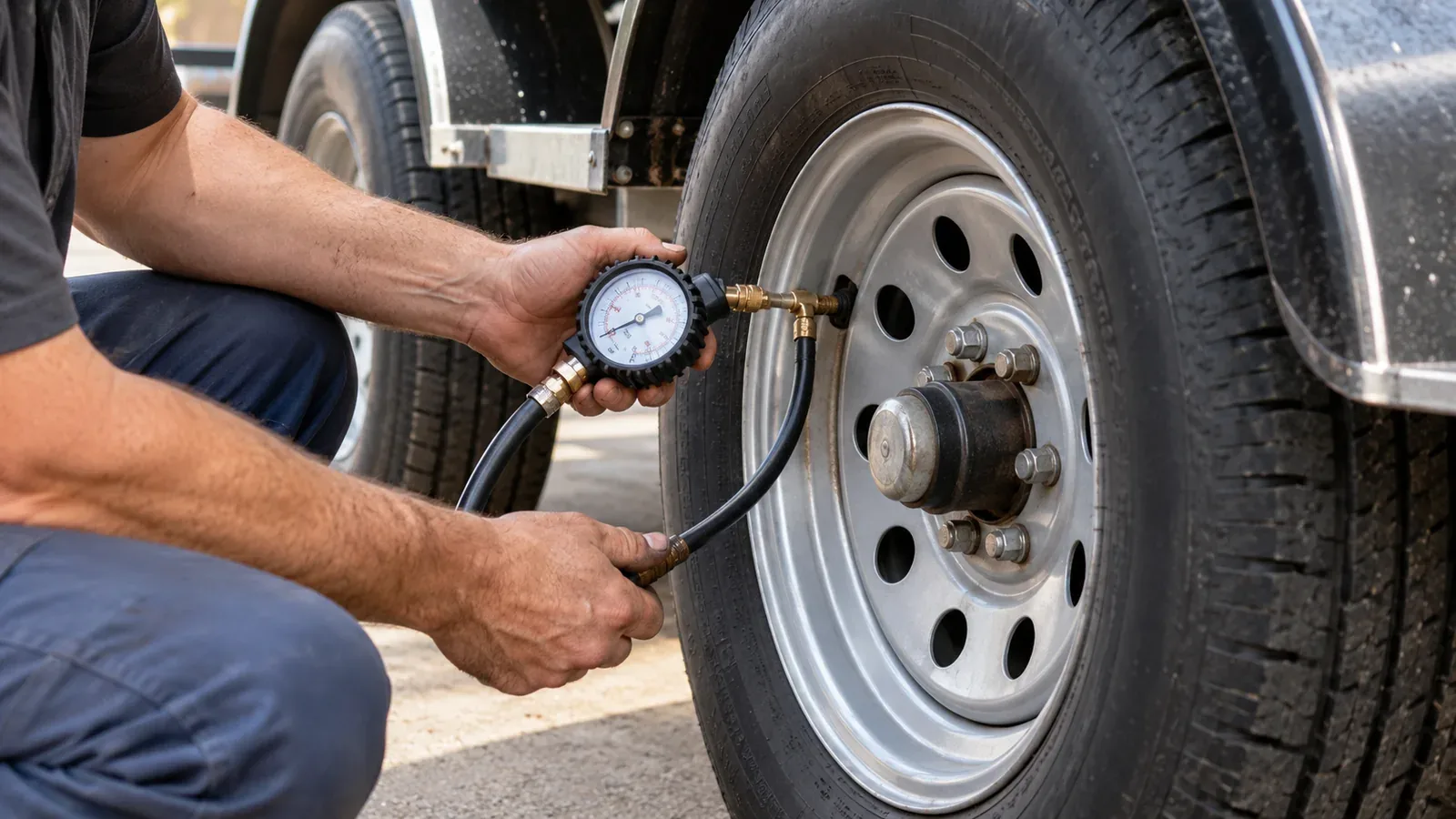
Trailer Tire Pressure: Find the Right PSI and Check It Safely
You have loaded the trailer, checked the hitch and are ready to leave. A neighbor notices the trailer tires and asks, “Are those supposed to have 50 or 65 PSI?” You look at a number molded into the rubber. Is that your answer?
Not necessarily. The useful answer comes from the trailer’s recommended cold tire pressure, confirmed against the tires and wheels actually fitted. A different trailer may need a different setting even when the tires look similar.
This is a practical, U.S.-focused guide for ordinary utility, cargo, boat, equipment and travel trailers. It does not replace your trailer manufacturer’s manual, your tire manufacturer’s load/inflation instructions or a tire technician’s assessment of damaged equipment.
Quick answer: Locate the trailer’s tire-and-loading label, record its specified cold pressure, then measure every tire before you drive. Include the spare. If the tire size, load rating or pressure limit no longer matches the label, stop guessing and confirm the correct setup with the manufacturer. Hankook’s special-trailer tire guide draws a clear distinction between the manufacturer’s recommended inflation and the tire’s marked maximum.
Start here: where to find the correct trailer tire PSI
Before reaching for a compressor, identify which number you are looking at.
| Number or label | What it tells you | How to use it |
|---|---|---|
| Trailer tire-and-loading placard | The trailer maker’s specified tire size and cold inflation pressure for its original configuration | Start here if the equipment still matches |
| Trailer owner’s manual / certification label | Equipment, loading and service instructions | Cross-check the placard and any special instructions |
| Tire sidewall: MAX LOAD / MAX PRESS | The tire’s rated load and associated pressure limit, not automatically your trailer’s setting | Verify you do not exceed its limitations |
| Wheel or rim specification | The rim’s compatibility and pressure/loading limits | Never assume the wheel can handle a tire’s higher rating |
| Pickup door-jamb label | Recommended pressure for the pickup’s tires | Do not copy this to the trailer |
Look for the trailer’s tire-and-loading information sticker near its frame, front or side, or in the owner’s documentation. Its precise location varies by manufacturer. A typical label lists a tire size and the required cold inflation pressure. Photograph it before it becomes unreadable.
If the label is missing, damaged or inconsistent with the installed tires, contact the trailer manufacturer or an authorized dealer with the VIN, tire size and load rating. Ask a qualified tire professional to check the tire-and-wheel combination. A search result claiming all trailer tires need 50, 65 or 80 PSI cannot resolve that mismatch.
Hankook says the recommended pressure for ST tires is on the trailer placard, certification label or owner manual and warns not to exceed the sidewall’s maximum. Goodyear also distinguishes recommended pressure from maximum sidewall pressure. Some trailer makers instruct owners to use the stated maximum cold inflation for their specific setup; follow your actual maker’s documentation rather than treating a slogan as a universal rule.
Check the pressure yourself: a five-step routine
You need a gauge covering your tire’s rated pressure, a working inflator compatible with the valve, and the trailer manufacturer’s cold PSI specification. If you cannot access a valve safely, have a service professional check it rather than reaching beneath a loaded trailer.
- Park and secure the trailer. Choose a level, safe spot away from traffic. Follow the trailer’s parking and wheel-chocking instructions. Measure before the day’s towing, preferably after the tires have been parked for at least three hours.
- Read the sticker, not your memory. Write down the specified cold PSI, tire size and load rating. Check that each mounted tire is an approved fitment. If the equipment differs or the guidance conflicts, get confirmation before using any target pressure.
- Measure every tire cold. Remove each valve cap, press an accurate gauge firmly against the valve and read the PSI. Record individual values. On a tandem axle, do not stop after checking only the convenient wheel. Check the spare, too.
- Correct the pressure only with a verified target. Add air when a tire is below its specified cold pressure. If it reads higher while genuinely cold, check the gauge, placard and approved limits before adjustment. Never exceed the tire, rim or manufacturer’s limits; do not attempt to correct an unknown or incompatible fitment by trial and error.
- Look for damage and confirm the result. Recheck with the gauge, replace valve caps and inspect the tread and visible sidewalls. A crack, bulge, exposed cord, large cut or continuing pressure loss calls for professional attention. Correct PSI does not make a damaged or overloaded tire safe.
Hankook recommends measuring cold tires, checking the spare and not relying solely on a tire-pressure monitoring system. NHTSA’s tire-maintenance guidance also explains why appearances are unreliable and why pressure should be measured with a gauge.
Download the printable trailer tire-pressure inspection log to record the actual readings, the label value, tire condition and unresolved issues. It is a blank worksheet, not a certificate that a trailer is roadworthy.
Three common PSI situations — what would you do?
These are illustrative examples, not accounts from real owners. The pressures are fictional values chosen to show the decision process; use the labels and specifications for your own equipment.
Case 1: The trailer label says 65 PSI, but you read 48 PSI cold
You measured a tire after the trailer sat overnight and got 48 PSI. The trailer label specifies 65 PSI cold, and the installed tire and rim are verified as compatible. The difference is 17 PSI.
What to do: Treat this as a significant underinflation reading, not a reason to start a trip slowly. Check for visible damage or a known leak, use the verified setting to correct the pressure if the tire is serviceable, and remeasure. If it was run underinflated, is visibly damaged or pressure falls again, have it inspected before travel. Adding air cannot undo internal damage caused by prior operation.
Lesson: Record the difference and whether the pressure holds. “I filled it” is not the same as identifying why it was low.
Case 2: The tire says 80 PSI maximum, but the trailer label says 65
You bought a used cargo trailer. A replacement tire displays an 80 PSI maximum, while the trailer’s original sticker specifies 65 PSI cold for a different listed tire. These numbers are not interchangeable. A higher-rated replacement may have different load/inflation characteristics and wheel requirements.
What to do: Check the replacement tire’s complete size and load rating, the wheel’s limits, the trailer manual and the tire maker’s guidance. Have the setup verified before selecting a cold pressure. Do not simply choose 80 because it is the biggest number or 65 because it is on an old label.
Lesson: A pressure decision for altered equipment may require manufacturer data, not a generic online calculator.
Case 3: One tire drops over several days
The trailer has four tires. You recorded the same appropriate cold readings on Monday. By Thursday, one is much lower while the others remain close to their previous readings. The trailer has barely moved.
What to do: Stop treating the reading as a routine seasonal change. Check for obvious punctures or valve damage without attempting an unsafe repair, record the readings, and arrange a professional inspection of the tire and wheel assembly. A leak that returns after inflation is an unresolved fault.
Lesson: Comparing individual positions over time reveals problems that a one-off average would hide.
Symptom chart: what tire wear can tell you
Pressure is only one part of trailer tire health. Dexter’s trailer tire-wear guide describes patterns that can point toward inflation, brakes, bearings or alignment. These are clues, not a diagnosis you can confirm from a photograph.
| What you notice | Possible causes | Practical next step |
|---|---|---|
| Both outer tread edges wearing faster | Underinflation is one possibility | Compare cold readings with the trailer label; inspect load and tire condition |
| Tread center wearing faster | Overinflation is one possibility | Verify the proper cold setting and the entire tire/wheel specification |
| One shoulder or inside edge wearing | Alignment, axle camber, overloading or suspension issues | Request a professional axle and tire inspection |
| Cupping or scalloped patches | Balance or bearing-related problems | Have bearings, wheel balance and suspension inspected |
| A flat spot at one point | Brake lockup or skidding | Inspect brake system with a qualified technician |
| Sidewall bulge, exposed cord, serious cut | Possible structural damage | Do not tow on the damaged tire; arrange proper service |
| One tire repeatedly low | Leak or wheel/valve problem | Have the tire and rim examined rather than repeatedly topping up |
Pressure adjustment may help prevent future wear, but it cannot restore damaged rubber or correct a bent axle. On a trailer that has been stored for months, visible cracking, cuts, unusual tire shape or aging warrant closer inspection even when the gauge looks normal.
Should you use 50, 65 or 80 PSI? Avoid a universal chart
Those numbers appear frequently in shopping listings and forums because trailer tires come in different sizes and load ranges. They are not three settings you select according to trailer length.
A 12-foot utility trailer with a certain ST tire may have a very different tire rating from a travel trailer with heavier axles. Replacing the tires with a higher load range does not increase the trailer’s certified gross vehicle weight rating (GVWR), axle rating or tow-vehicle capacity. Lowering pressure without an approved load/inflation basis can also reduce the capacity available at each tire.
Before changing pressure based on an internet table, confirm all of the following:
- The exact tire size, construction and load rating actually installed.
- Whether the tire maker provides an approved load-and-inflation table for that exact tire.
- The recommended cold pressure and permitted tire options in the trailer manual.
- The wheel or rim’s pressure/load limitations, along with any compatible valve hardware.
- The trailer’s actual loaded weight and axle loading, not only its empty advertised weight.
If the trailer has changed from its original specification, ask its manufacturer and the tire manufacturer to confirm the correct safe combination. Do not infer a new tire pressure or a new trailer capacity solely from a load range letter. For guidance on the difference between empty, loaded and rated weight, read How Much Does a Trailer Weigh?.
A useful way to ask a tire shop: “Here is my trailer VIN, original tire placard, current tire size/load range, wheel rating and loaded axle weight. Can you verify the approved cold inflation pressure for this exact combination?” That produces a more dependable answer than asking whether all trailers use 65 PSI.
Hot tires, cold mornings and a trailer that sat all winter
It is normal for tire pressure to rise after driving because the tire warms up. Do not bleed down a hot tire to the number written on a cold-pressure placard. That can leave it underinflated after cooling. Hankook explicitly warns against this practice. If a hot tire reads at or below the recommended cold pressure, stop safely and investigate; it may be dangerously underinflated.
Similarly, a chilly morning after a warm afternoon can produce different gauge readings without any puncture. Record the temperature and repeat measurements under comparable cold conditions. A large or continuing drop in one tire compared with its neighbors needs closer attention; do not explain it away as weather.
If the trailer has been stored for a season, make time for a full departure check. Look for pressure loss, weather-related cracking, missing valve caps, objects in the tread and deterioration of the spare. A tire can appear correctly shaped while being dangerously low. If you have found significant underinflation or damage after storage, do not assume refilling alone makes it safe.
For travel trailers and equipment haulers with difficult-to-reach inside dual tires, use an appropriate gauge or have a technician perform the inspection. Never crawl under an inadequately supported trailer to reach a valve.
The pre-trip decision table
This is the part to use before deciding whether to leave the driveway.
| Observation | Decision | Why |
|---|---|---|
| Label matches installed tires; all tires cold and at the specified PSI; no damage | Complete the rest of the trailer safety check | Pressure is one condition, not full towing clearance |
| One reading below target with no apparent damage | Check cause, correct with verified pressure and monitor; inspect if significant or recurring | Underinflation can overheat tires and conceal damage |
| Only a hot reading is available | Do not bleed hot tires; recheck cold | Cold and hot readings should not be compared directly |
| Trailer sticker is missing or tire size/load range differs | Pause; obtain verified manufacturer and tire guidance | No defensible cold-pressure target is established |
| Sidewall damage, bulge, exposed cord or recurring leak | Do not tow on that tire; arrange professional service | Air pressure alone cannot cure structural problems |
| Tires appear fine, but load may exceed rated capacity | Weigh and verify limits before towing | Correct inflation does not prevent overloading |
Pressure does not solve other towing hazards. If you are uncertain whether your pickup can tow the trailer as loaded, check How Much Can My Truck Tow?. If it moves side to side on the road, see Why Does My Trailer Sway? — but do not treat correct PSI as the sole fix for sway.
Printable pressure record: how to use it
The trailer tire-pressure inspection log is designed to be useful on your next trip, not merely a page to read and forget. Fill it out with a pen or save a copy for each departure.
First, copy the trailer’s actual cold-PSI specification and tire size. Record the pressure at each wheel location (for example, left-front axle, left-rear axle, right-front axle, right-rear axle) and at the spare. That way, you can identify a particular tire instead of writing “all good.”
Next, mark whether each reading was made cold and whether the installation still matches the original tire specifications. There is space for visible damage, pressure losses, unresolved questions and the source used to confirm the pressure. Never fill the target-PSI field with a guess.
Finally, repeat the record after long storage, a tire replacement, a wheel change or an unexplained pressure loss. The goal is not perfect paperwork; it is noticing a problem before the trailer is loaded and moving at speed.
Five mistakes worth avoiding
1. Using the pickup’s door sticker. That sticker belongs to the pickup’s tires. The trailer needs its own specified pressure.
2. Assuming sidewall MAX PSI always equals the correct setting. The number on the tire is a rating. It may coincide with the trailer maker’s specification for some installations, but equipment and load requirements must be checked.
3. Checking only after reaching the highway. A warm reading is harder to compare with the cold-pressure recommendation. Make the gauge check part of loading day.
4. Forgetting the spare. An unusable spare leaves you without a safe replacement when a trailer tire fails. Verify size, condition and pressure as part of the same routine.
5. Treating the gauge as a safety certificate. Correct pressure does not override damage, overloading, excessive wear, expired or incompatible components, or a faulty bearing or brake.
Bottom line: The best trailer tire pressure is the verified cold setting for your trailer and its fitted tire-and-wheel combination, not a popular number online. Keep a simple record, check every tire before a trip and ask a professional when the labels and equipment do not agree. That is more useful than guessing whether 50, 65 or 80 PSI sounds right.