
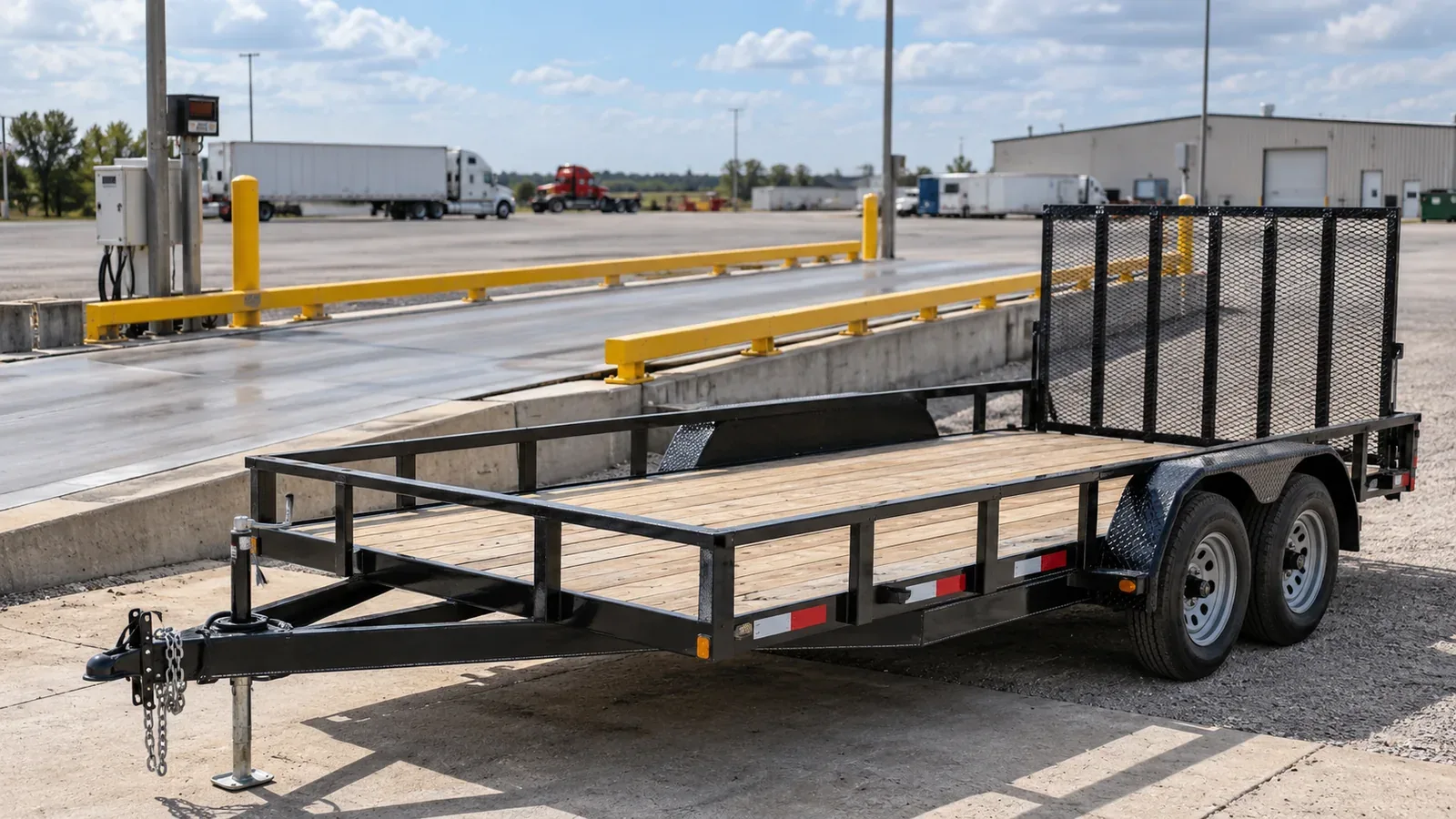
How Much Does a Trailer Weigh? Real Empty and Loaded Examples
You found a trailer that looks just right. The seller says it weighs “about 1,000 pounds,” and your pickup can tow several thousand. Easy decision, right?
Not quite. A trailer has a weight before you load it, a weight after you load it, and a maximum weight it is rated to carry. Those three numbers are not interchangeable. The one that matters most when you head down the road is what the whole trailer actually weighs with your stuff inside.
Here is the quick answer: a small enclosed rental trailer might weigh 900 lb empty; an 18-foot car hauler might weigh 1,910 lb empty; and a travel trailer can already weigh more than 6,000 lb before you pack for a trip. Those are specific manufacturer examples, not averages for every trailer of that type.
You can figure out your own number without learning a textbook’s worth of towing terms.
Real trailer weights you can compare
These are published empty or unloaded weights for named models, as listed by their manufacturers or rental providers. They are examples—not universal weights for an entire category. Compare the exact version before making a decision.
| Trailer example | Published empty / unloaded weight | What it is |
|---|---|---|
| U-Haul 4 × 7 utility trailer | 630 lb | Small open trailer for household or yard loads |
| U-Haul 5 × 8 enclosed cargo trailer | 900 lb | Small enclosed moving trailer |
| Big Tex 35SA-12 utility trailer | 983 lb | 12-foot open utility model |
| Big Tex 70CH-18 car hauler | 1,910 lb | 18-foot tandem-axle car trailer |
| U-Haul 6 × 12 enclosed cargo trailer | 1,920 lb | Larger enclosed rental trailer |
| Grand Design Imagine 2300MK | 6,218 lb UVW | Travel trailer, listed unloaded weight |
Sources: U-Haul’s trailer specifications, U-Haul utility-trailer weights, Big Tex 35SA, Big Tex 70CH, and Grand Design Imagine. Data checked October 22, 2026; specifications may change by model year and options.
Notice something surprising? The Big Tex car hauler and U-Haul enclosed 6 × 12 have almost the same listed empty weight, even though they are made for different jobs. You cannot guess weight reliably from length or appearance.
And if you are shopping for a camper, take extra care: a manufacturer’s UVW (unloaded vehicle weight) isn’t the weight of the trailer after you add food, clothes, batteries, water and travel gear.
Empty weight, loaded weight and GVWR—in plain English
Think about buying a suitcase. It weighs something by itself, something else after you pack it, and the airline may set a maximum. A trailer is similar.
- Empty weight (also called dry weight or unloaded weight, depending on the manufacturer): what the trailer weighs under the manufacturer’s stated unloaded conditions. Check exactly what is included; accessories, fluids and options can change it.
- Loaded weight: the trailer plus what you put in it for the trip. This is the number you need to estimate and, ideally, measure.
- GVWR (gross vehicle weight rating): the trailer manufacturer’s maximum permitted total loaded weight. This is a limit, not a promise that the trailer already weighs that much.
- Cargo capacity: what you can add before reaching the trailer’s own maximum, based on the manufacturer’s stated configuration. Other equipment and towing limits still apply.
A useful way to keep them straight is this: empty weight + added cargo = estimated loaded weight. Then you compare that result with the trailer GVWR. Finally, you check the towing vehicle’s ratings and the hitch.
An example you can do in your head
Suppose you rent the U-Haul 5 × 8 enclosed trailer above to move some furniture. U-Haul lists it at 900 lb empty, with an 1,800 lb maximum load and 2,700 lb maximum gross weight.
You pack an illustrative load of 650 lb: a desk, two chairs, small boxes and a few tools. These cargo weights are invented for this example, not a measured moving inventory.
| What you have | Weight |
|---|---|
| Trailer before loading (published) | 900 lb |
| Your example cargo | 650 lb |
| Estimated trailer weight for the trip | 1,550 lb |
| Trailer’s stated maximum gross weight | 2,700 lb |
The calculation is 900 + 650 = 1,550 lb. That’s 1,150 lb under this trailer’s gross rating. It does not prove your car or pickup is allowed to tow it: you still need to check the vehicle’s towing capacity, tongue weight, receiver and other ratings.
Also, your actual belongings may weigh more than you expect. A large toolbox, spare wheel, added battery or a trailer modification can quietly change the total.
Does adding cargo really make that much difference?
Yes—and it’s often the part people underestimate. A nearly empty cargo trailer can be a manageable load, but the same trailer full of furniture, flooring or equipment is a very different towing job.
Here are two more illustrative calculations built from real published empty weights. The cargo is hypothetical in each case.
A landscaping trip: A Big Tex 35SA-12 weighs 983 lb empty. Add a 1,200 lb mower-and-tool load and the estimated total becomes 2,183 lb. Big Tex lists this configuration’s GVWR at 2,995 lb, leaving 812 lb below that trailer rating in this example. That says nothing yet about whether your tow vehicle is suitable.
A car transport: A Big Tex 70CH-18 weighs 1,910 lb empty. Add a vehicle weighing 3,300 lb, and the loaded trailer is estimated at 5,210 lb, before counting any additional gear. Big Tex gives that model a 7,000 lb GVWR. You would still need to confirm the particular vehicle’s weight, tie-down gear, trailer capacity and truck ratings.
For both situations, the lesson is the same: the cargo changes the number, sometimes more than the size of the trailer itself.
What about travel trailers and campers?
Camper weights can be especially confusing. You may see one number in a floorplan brochure and a different number on a sticker inside the actual trailer.
For example, the Grand Design Imagine 2300MK currently lists an unloaded vehicle weight of 6,218 lb. If you add an illustrative 600 lb of supplies and carried fluids, the estimate becomes 6,818 lb. That is not a recommendation or a verified loaded weight; it is only the math of this hypothetical trip.
A camper can also have equipment installed by a dealer or owner. Check the label for the individual unit, look for its cargo-carrying capacity and GVWR, and account for water, propane, bikes, clothing and added accessories as applicable. Weigh the camper in its real traveling condition if possible.
One detail you shouldn’t skip: the camper’s hitch weight is not automatically the same after loading as it was in the brochure. It can change with the position of gear and fluids, and it affects your tow vehicle’s payload.
Where can I find the weight of my trailer?
You don’t need to guess from a photo or a seller’s estimate. Work through this short check:
- Find the manufacturer’s identification or certification label. Look on the tongue or frame and in the documentation; the exact label location varies. Record the model, VIN and GVWR if shown.
- Find that model’s official specification sheet. Look for its empty or unloaded weight and the definition of that measurement. If the trailer has upgrades, ask what they add.
- List what you’re actually packing. Include the cargo itself and things people forget: spare wheels, tools, equipment, added batteries and fluids when relevant.
- Estimate the loaded total. Add your best cargo figures to the listed unloaded weight. Treat it as an estimate, not a scale measurement.
- Weigh it loaded before a demanding trip. Use an appropriate public or commercial scale and follow the operator’s instructions. Make sure the measurement accounts for weight supported by the truck through the hitch as well as weight on the trailer axles.
- Check every limit for the actual combination. The trailer’s GVWR, the tow vehicle’s verified trailer rating and payload, the hitch, and axle and combined-weight limits must all work together.
If you haven’t yet checked what your pickup can tow, start with our simple truck towing-capacity guide. It explains why passengers and the hitch load can lower the usable towing limit.
Save this five-line trailer weight note
Copy this into your phone before visiting a seller or rental counter:
| What to write down | Your number |
|---|---|
| Exact trailer model and year | __________ |
| Published empty / unloaded weight | __________ lb |
| Cargo you intend to carry | __________ lb |
| Estimated loaded trailer weight | __________ lb |
| Trailer GVWR and confirmed tow-vehicle limits | __________ lb / checked |
Don’t have the empty weight? Ask the seller or operator for the specific model information. If the trailer is modified or the documentation is unclear, a loaded scale measurement and qualified advice are safer than a generic range found online.
Two mistakes that are easy to make
Mistake 1: “It says 7,000 pounds on the trailer, so it must weigh 7,000 pounds.” No. A 7,000 lb GVWR describes the rated ceiling, not the empty weight. Our Big Tex car-hauler example weighs 1,910 lb empty, and what you load determines its actual trip weight.
Mistake 2: “The axles showed 3,000 pounds, so the whole trailer weighs 3,000 pounds.” Not necessarily. When a conventional trailer is hitched, some of its weight is carried by the tow vehicle through the tongue. A trailer-axle scale reading alone can miss that share. Be careful, too, not to add tongue weight twice when comparing a complete loaded trailer weight with a rating: it is already part of the trailer’s total.
These are easy mistakes to avoid once you know which number you’re looking at.
The bottom line
A trailer’s weight isn’t one fixed number that applies to everything with wheels and a hitch. Start with your particular trailer’s empty or unloaded weight. Add the real cargo. Check the trailer’s maximum rating and your vehicle’s towing limits.
The table above gives you dependable examples for comparison, but your trailer’s label and actual loaded scale weight should decide the trip. If a number doesn’t make sense, stop and verify it before you tow.