
How Much Can My Truck Tow? Find Your Real Limit
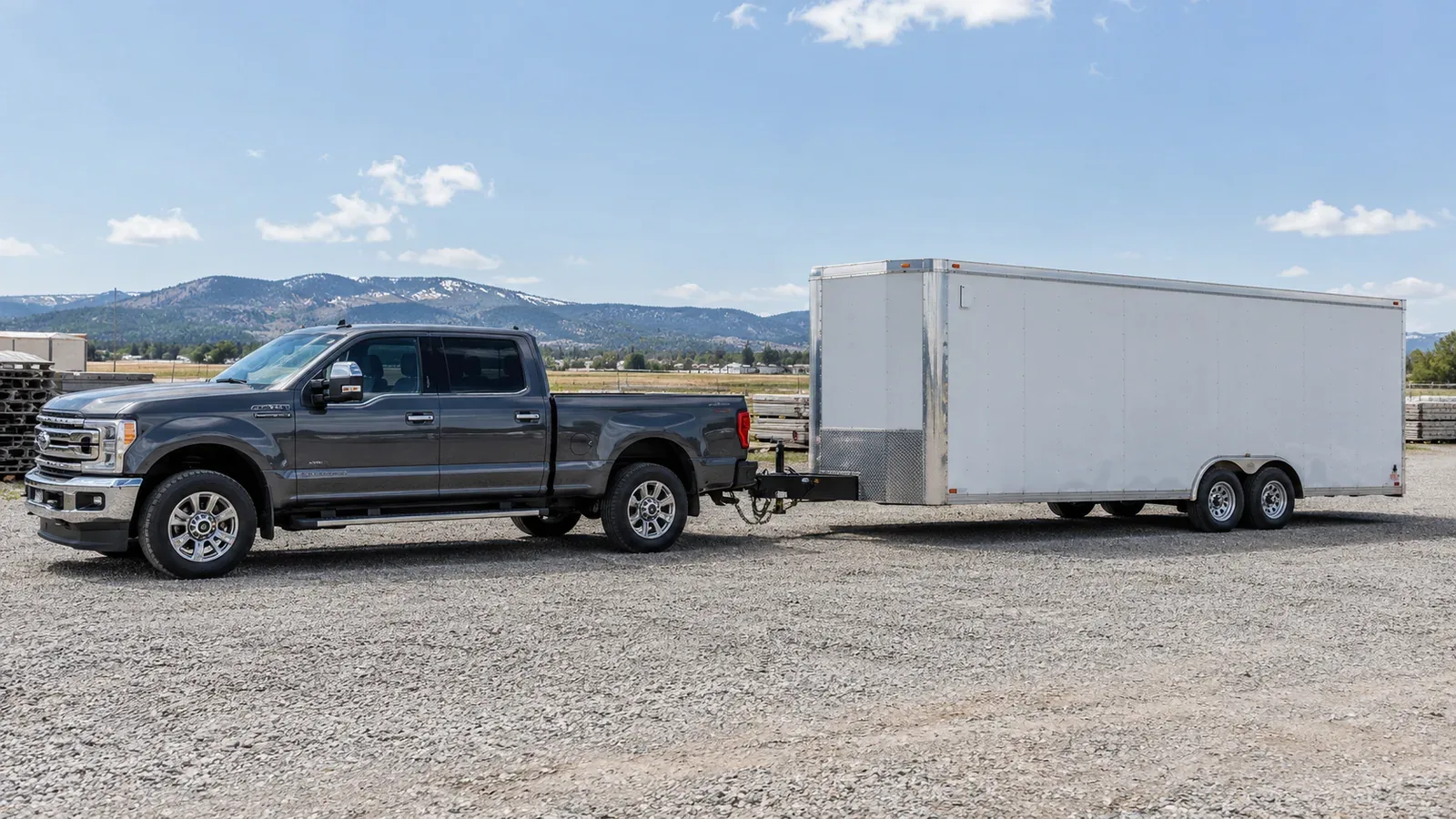
A pickup ad says “up to 13,000 pounds of towing.” Your truck looks like the one in the photo, so does that mean you can pull a 13,000-pound trailer?
Not necessarily. That number might apply to a different engine, axle ratio, cab or towing package. And even when the rating belongs to your truck, the people and gear riding inside it can change what you can safely tow.
The good news: you do not have to become a truck engineer. You need the right numbers, one straightforward check and, ideally, a scale ticket. This guide shows you where to look and how to avoid a costly guess.
First, find the number for your truck
The largest number in an advertisement is a maximum for a particular configuration, not permission for every truck wearing that badge. Chevrolet, for example, explicitly says its maximum published towing figure is for comparison and that passengers, cargo and equipment can reduce what an individual vehicle can trailer. See Chevrolet’s vehicle guidance.
Start here:
- Write down the model year and exact truck. Include engine, drive type (2WD or 4WD), cab, bed, axle ratio and factory towing equipment if known.
- Open the manufacturer’s towing resource or owner’s manual for that year. Ford has a towing-information hub that describes its vehicle-specific tools. Other manufacturers publish their own charts and guides.
- Check the driver’s door jamb. Look for the tire-and-loading label and certification information. Some vehicles also have a dedicated trailering-information sticker. The label tells you important things about the particular truck, but not every sticker contains a tow rating.
- Check the hitch or receiver label and your trailer documents. The truck’s advertised maximum cannot override a lower component rating.
If you bought the truck used, do not assume its current tires, hitch or other accessories are identical to the original configuration. Confirm any modifications with the manufacturer or a qualified professional.
Towing capacity and payload: the difference that catches people out
Think of towing capacity as what the truck may pull behind it. Think of payload as what the truck may carry on it and in it.
People, pets, luggage, tools and cargo in the bed all use payload. So does the downward load from a conventional trailer’s tongue, which presses onto the hitch. That is why having enough horsepower does not automatically mean you have enough carrying capacity.
Here’s the easiest way to picture it:
| Weight | Where it goes | Why you care |
|---|---|---|
| People and bags | Inside your truck | Use the truck’s carrying capacity |
| Cooler and tools | In the bed | Use more carrying capacity |
| Trailer tongue load | Presses on the hitch | Uses carrying capacity and affects axle loads |
| The rest of the trailer | Supported by the trailer axles | Still counts toward the towing and combined-weight limits |
Ford explains this distinction in its towing FAQs. Tongue load also affects handling: too much or too little can create problems, even if the gross trailer weight looks acceptable.
A useful rule of thumb isn’t a rating. For many conventional trailers, a tongue-load planning range of around 10–15% of loaded trailer weight is common. But the correct figure depends on trailer design, loading and the vehicle manufacturer’s instructions. Fifth-wheel and gooseneck trailers have different pin-load considerations. Measure your actual setup rather than treating any percentage as a guarantee.
A real-world-style example: the family, the tools and the trailer
Imagine someone who owns a pickup, wants to tow a small enclosed trailer for weekend jobs and is excited to see “10,000 lb towing capacity” in the specification sheet.
The figures below are invented for teaching the calculation. They are not specifications for any actual Ford, Chevrolet, Ram or other truck.
- The exact truck’s verified conventional trailer rating: 10,000 lb.
- Carrying capacity available on its vehicle-specific label: 1,600 lb.
- Driver and passengers together: 370 lb.
- Toolbox, cooler and luggage in the truck: 180 lb.
- Added hitch equipment carried by the truck: 80 lb.
- Trailer loaded for the trip: 7,000 lb.
- Measured tongue load in this example: 840 lb (12% of 7,000).
Now do the part people often miss:
| What uses the truck’s available carrying capacity? | Example weight |
|---|---|
| Passengers | 370 lb |
| Belongings and tools | 180 lb |
| Additional hitch equipment | 80 lb |
| Loaded trailer’s tongue | 840 lb |
| Total used | 1,470 lb |
| Label’s available carrying capacity | 1,600 lb |
| Remaining in this example | 130 lb |
The trailer weighs 7,000 lb, much less than the truck’s 10,000-lb headline towing rating. Yet the truck has only 130 lb of carrying capacity left in this example. Adding another person or a heavy item in the bed could push it over that limit.
And that still does not prove the combination is ready to tow: we’d also check the rear and front axle ratings, the hitch and ball ratings, the trailer’s own ratings, actual loaded weights and the truck’s gross combined weight rating (GCWR). This example is a starting check, not a substitute for the manufacturer’s specifications.
What if your trailer is heavier than the empty weight on the listing?
This is one of the easiest mistakes to make. A seller may list a trailer at 4,500 lb empty. But you don’t tow it empty after adding shelving, furniture, a mower, batteries, fresh water or equipment for work.
Suppose the empty trailer is 4,500 lb and you load 1,400 lb of gear. It is now 5,900 lb before any other items are added. That loaded weight—not the empty marketing number—is what you compare with the truck’s trailer rating. It also needs to fit within the trailer’s own gross vehicle weight rating (GVWR) and axle/tire capacities.
Practical tip: write down what’s going in the trailer before you leave. If you’re near a limit, don’t guess what a toolbox or water tank weighs. Weigh the loaded trailer at a suitable public scale.
Four numbers worth learning—and nothing more complicated than necessary
You may spot several abbreviations on labels. Here’s what matters for this decision:
- Trailer weight rating: How much loaded trailer your specific truck is rated to tow under the manufacturer’s stated conditions.
- Truck GVWR: Maximum permitted loaded weight of the truck itself, including passengers, cargo and the load transferred onto it by the trailer.
- GAWR: Maximum load allowed on each truck axle. You can exceed a rear axle rating without exceeding truck GVWR.
- GCWR: Maximum loaded weight of truck and trailer together, counting the trailer once. Do not add tongue weight a second time when checking the combined total.
Some other limits can be just as important: the hitch receiver, ball mount, hitch ball, truck tires and the trailer’s ratings. The lowest applicable limit controls—not the most impressive figure in the brochure.
If that sounds like too many numbers, remember the purpose: all of them describe something different that must withstand the same trip. The Chevrolet towing guides and Ford towing hub explain where owners can find their model-specific values.
How to check your actual setup before a trip
You can do this in order, without building a spreadsheet.
- Verify the truck’s exact tow rating using a manufacturer source for your vehicle, not a search result for the whole model line.
- Get your available payload from the vehicle-specific label. Subtract the people and items riding in the truck, including any added hitch hardware not already accounted for.
- Find the trailer’s actual loaded weight, ideally on a scale. Include everything travelling inside it.
- Find the actual tongue or pin load. A trailer tongue scale or an appropriate weighing method is more reliable than a guess; CURT explains practical measuring methods. Keep the manufacturer’s loading guidance in mind.
- Compare the ratings. Check truck GVWR and each axle, GCWR, trailer GVWR and axles, towing rating, and every hitch-component limit. If a limit doesn’t fit, the answer is no until the configuration or load changes safely.
- Check the rest of the setup. Trailer brakes where required, correct connections, lighting, tires, breakaway equipment where applicable, and secure cargo all matter too.
When using a public scale, weigh the combination in a way that lets you distinguish truck axle loads and trailer axle loads; follow the scale operator’s instructions. The total of the measured axle loads is the combination’s actual loaded weight. Remember that the truck’s axle scales already include tongue weight transferred to the truck—don’t add it again.
Copy this six-line towing check into your phone
This is a small original planning worksheet, not a certified towing calculator. Fill it with ratings and measurements for your own equipment:
| Before you tow | Fill in |
|---|---|
| My truck’s verified trailer rating | ____ lb |
| My trailer’s actual loaded weight | ____ lb |
| Remaining truck carrying capacity after people and bed cargo | ____ lb |
| Measured trailer tongue or pin load | ____ lb |
| Truck and trailer axle-weight check | Within every axle rating? ____ |
| Combined weight, hitch and trailer limits | All verified? ____ |
If a value is missing, pause the decision. The missing figure may be the one that changes whether the setup is suitable.
Three common situations, explained plainly
These are illustrative situations, not customer stories or field tests.
1. The truck can pull it, but the family takes up the payload. A driver checks the tow rating and stops there. The passengers, luggage and trailer tongue consume almost all of the truck’s available carrying capacity. The fix is to calculate payload before the trip and choose a safer combination if the ratings do not fit—not assume that a stronger engine solves it.
2. The trailer looked light in the listing. A utility trailer’s empty weight fits easily on paper. After loading tools and materials, its actual weight is much higher. The lesson is simple: compare loaded weight with the truck and trailer limits.
3. The truck and trailer are under the combined limit, but the rear axle isn’t. A combination can have an acceptable total weight yet be overloaded on one axle. Redistributing the load is not a universal fix: it must keep the trailer stable and every rating satisfied. A scale and qualified advice are more useful than moving items at random.
When should you ask for help?
Get professional help before towing if you cannot confirm the rating for an older or modified truck, are using a nonstandard hitch, are close to a truck or trailer limit, or are unsure how to measure tongue weight. A vehicle dealer familiar with the exact configuration, qualified hitch installer or trailer specialist can help interpret the documentation.
For commercial operations, equipment ratings aren’t the only question. Depending on the vehicle, route and business, additional licensing, registration or safety rules may apply. Those are separate from this introductory weight-check guide. Our hotshot trucking authority guide covers one common commercial use case.
The bottom line
You don’t need to memorize every towing abbreviation. You need to know what your specific truck is rated for, what your actual loaded trailer weighs, and what the trailer puts onto the truck. Then check the remaining equipment and axle limits.
A towing figure is useful when it matches your truck and your real trip. When it doesn’t, a smaller trailer, lighter load or appropriately rated towing vehicle is a better answer than hoping the brochure’s biggest number will be enough.