
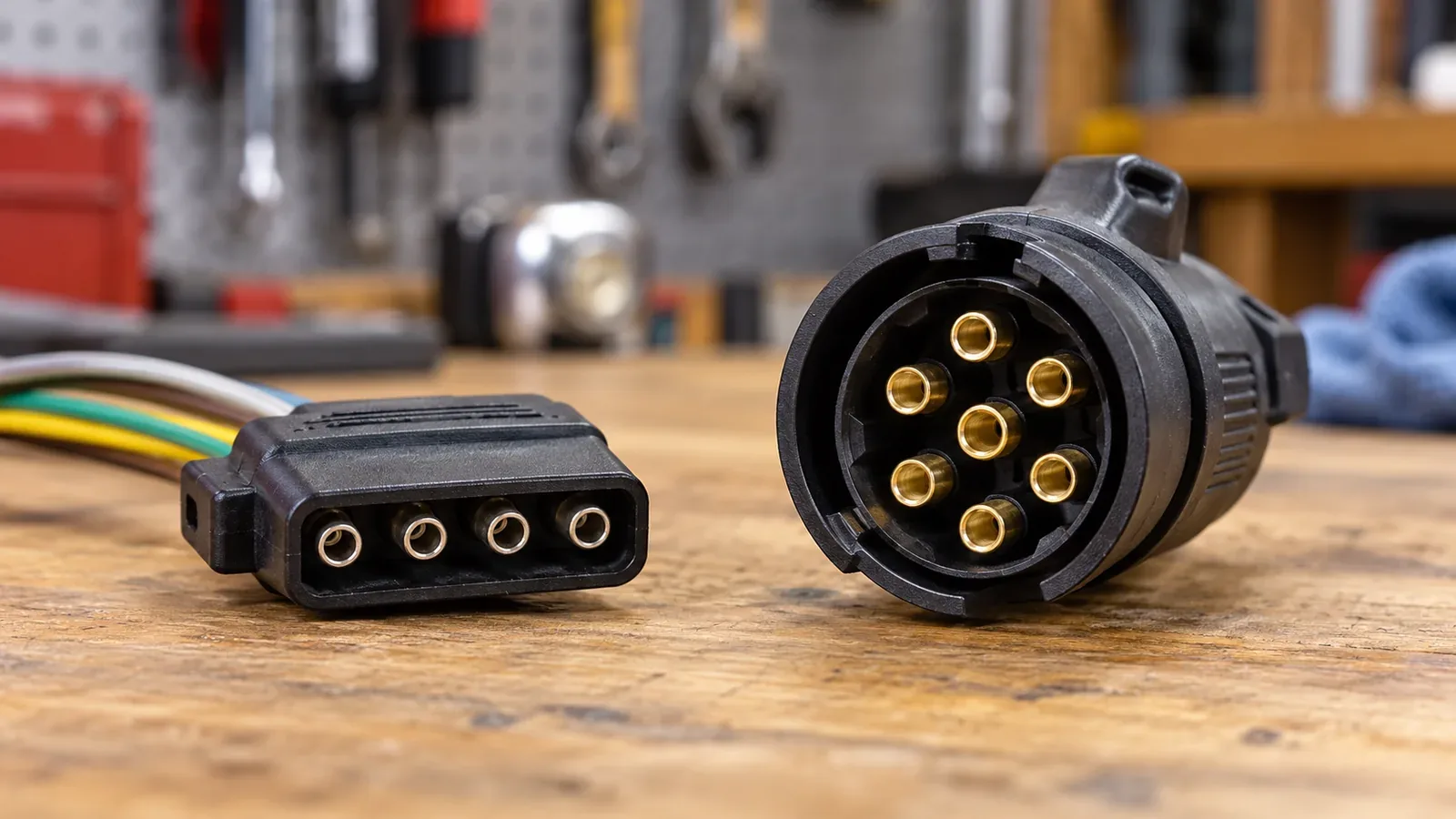
4-Pin vs. 7-Pin Trailer Wiring: Which Plug Do You Need?
You arrive to collect a rented cargo trailer. Your pickup has a flat plug with four contacts. The trailer has a large round-looking plug with seven flat blades. There is an adapter for sale at the counter. Is that all you need?
Maybe for the lights. Not necessarily for everything else. The important question is not whether two plugs can be made to fit. It is whether your tow vehicle supplies every electrical function that trailer actually requires.
This guide focuses on common North American 4-way flat and 7-way RV blade connections used with pickups, utility trailers, cargo trailers and campers. Connector standards in Europe and other regions differ; do not use this article as a wiring diagram for a UK or EU 7-pin or 13-pin plug.
Quick answer: A 4-way flat carries the essentials for typical trailer lighting. A 7-way RV blade can additionally support electric trailer-brake control, reverse lights and auxiliary power, when those circuits are correctly installed and connected. A simple adapter changes the physical connection; it does not automatically add missing vehicle wiring or a brake controller. The CURT trailer wiring guide and etrailer brake-controller installation guide explain the distinction.
4-pin vs. 7-pin: compare the functions, not just the shape
Here is the comparison most people need before a trip. The extra capabilities listed for a 7-way describe what the connector can carry, not proof that your specific truck has them activated.
| Function or question | 4-way flat | 7-way RV blade |
|---|---|---|
| Ground connection | Yes | Yes |
| Running, tail and marker-light signal | Yes | Yes |
| Left stop/turn signal | Yes | Yes |
| Right stop/turn signal | Yes | Yes |
| Electric trailer-brake controller output | No dedicated circuit | Supported when equipped and wired |
| Auxiliary 12-volt feed | No dedicated circuit | Supported when equipped and wired |
| Reverse-lamp / reverse-function circuit | No dedicated circuit | Supported when equipped and wired |
| Typical use | Simple utility and small cargo trailers | Travel trailers and trailers with additional electrical requirements |
| What matters most | Whether basic lighting works | Whether each required extra circuit also works |
A common 4-way flat combines each side’s turn signal and stop-light function into the corresponding circuit. It also has a running-light feed and a ground. That is why you may see four contacts serving more than four lamp functions. CURT’s 4-way explanation provides the underlying layout.
Important distinction: Brake lights tell traffic behind you that you are slowing down. Electric trailer brakes are part of the trailer’s stopping system. They are not the same circuit. Seeing the trailer’s red lamps illuminate does not prove its wheel brakes work.
Start with this three-question connector check
Before buying a replacement plug or adapter, answer these questions in order.
1. What connector is actually fitted to each side? Look at the tow vehicle’s socket and the trailer’s plug with the ignition and lights off. A 4-way flat is a short, flat row of contacts. A common 7-way RV blade has six blade contacts around a central contact in a round housing. But seven-way round-pin also exists and is not the same as RV blade. If you are unsure, use the maker’s part number, trailer documentation or professional identification; do not force anything together.
2. What does the trailer need? Record whether it has electric drum brakes, a reverse-lockout function, reverse lamps, a battery charging feed or only conventional road lighting. The trailer’s connector tells you what it might use, not necessarily what is connected inside. Inspect the trailer specification and equipment list instead of guessing.
3. What is the truck genuinely equipped to supply? A truck may have a 7-way socket without an operational aftermarket brake controller, or it may have factory trailer-brake controls that require setup. Check the owner’s manual, towing equipment and verified circuit operation. Ford, for example, describes both connector types on equipped vehicles and tells owners to use a correctly fitting connector compatible with required functions in its owner-manual towing connector section.
Only after those three questions should you decide whether an adapter is enough.
Vehicle-to-trailer compatibility: a useful decision matrix
This is the section to save when borrowing, renting or buying a trailer.
| Tow vehicle outlet | Trailer plug and equipment | Likely next step | Do not assume |
|---|---|---|---|
| 4-way flat | 4-way flat, basic lights only | Connect and test all required lights | Matching plugs mean working circuits |
| 7-way RV blade | 4-way flat, basic lights only | Use a compatible 7-to-4 adapter, or the truck’s separate 4-way outlet | Every 7-way socket follows the same physical format |
| 4-way flat | 7-way RV blade, basic lights only | Confirm trailer functions; a suitable adapter may provide the lamp circuits | Other 7-way functions will also work |
| 4-way flat | 7-way RV blade, electric brakes required | Check a complete, compatible 7-way and brake-controller installation | A cheap passive adapter enables trailer brakes |
| 7-way RV blade | 7-way RV blade, electric brakes required | Verify controller installation, settings, brake circuit and all lights | Matching connectors guarantee working trailer brakes |
| 7-way RV blade | 7-way round-pin | Identify pin format and use only an appropriate, verified conversion solution | “Seven pins” means plug-and-play |
| Any connector | Trailer uses an unknown fifth/reverse function | Identify the equipment and circuit requirements first | A 4-way can supply a reverse-lockout circuit |
For the last row, note that 5-way flat connectors are used on some boat trailers, often for a reverse-related function such as surge-brake lockout. The actual implementation varies. U-Haul’s wiring overview describes the common configurations. Do not try to solve a five-function installation by choosing an adapter solely on its price or shape.
If the trailer must have operative brakes under its manufacturer guidance or applicable law, read our trailer-brake requirements guide before treating any connection as road-ready.
What an adapter does — and what it cannot do
An adapter can be useful when the truck and trailer have different plug formats but their required electrical functions are already available.
Imagine a truck with a working seven-way RV blade outlet and a small trailer with a four-way flat plug. A properly matched 7-to-4 adapter routes the available basic lighting signals to the trailer. There is no need for the little trailer to use all seven available functions. That is an ordinary use for an adapter.
Now reverse the setup. Your truck has only a working four-way flat. The borrowed travel trailer has a seven-way RV blade plug and electric brakes. A 4-to-7 adapter may physically allow the plug to connect and the lamps to light up. It cannot create a brake-controller output that was absent on the truck. It cannot create an auxiliary 12-volt circuit without appropriate additional wiring, either. etrailer’s ETBC7 guidance describes a conversion that adds the wiring needed for brake-controller installation; CURT’s brake-controller wiring adapter likewise specifies extra wiring and components.
A product sold as a “4-way to 7-way adapter” may have extra loose wires intended for a proper installation, so its final functionality depends on whether those connections are completed correctly. Always read that product’s actual instructions. An adapter is not a substitute for vehicle-specific wiring, a functional brake controller or a brake-system test.
For extra help, use CURT’s electrical-adapter overview to understand why adapters are sold for many different pairs of connector types.
Three situations where this distinction saves a bad purchase
These are illustrative situations, not customer stories or records of actual repairs.
Situation 1: a landscaping trailer that only needs lights
The truck has a 7-way RV blade. The small utility trailer has a 4-way flat connector, conventional road lights and no additional electrical equipment. An appropriate 7-to-4 adapter allows the pair to connect for lighting, provided the truck socket works and all the trailer’s required lamps pass testing.
What to check before driving: connector fit; left and right signal; brake lights; running and marker lamps; a secure, protected cable. Separately verify the trailer’s towing and braking requirements. The pin count is not an exemption from any legal or manufacturer rule.
Why this is useful: The truck does not need rewiring simply because it has more connector functions than a small trailer uses.
Situation 2: the rental camper with electric brakes
The tow vehicle has only a 4-way flat. The camper has a 7-way RV blade, electric brakes and a listed loaded weight that requires further towing checks. The adapter fits and the lights illuminate. It is tempting to call the problem solved.
Not yet. The four-way still lacks the dedicated electric-brake control circuit. First confirm the trailer’s brake-system design, truck towing rating, trailer loaded weight and brake requirements. Then obtain the correctly installed vehicle wiring and brake-controller solution if needed, and verify the brakes before using the trailer. If you cannot make the combination compliant and fully functional, arrange a properly equipped tow vehicle instead.
Why this is useful: A plug can fit while the trailer remains unsuitable or unsafe for the trip.
Situation 3: two seven-contact connectors that refuse to mate
A driver sees seven contacts on the tow vehicle and seven on the equipment trailer, but the plugs are different. One is an RV blade. The other is a round-pin connector. The driver considers forcing the plug or matching wires by familiar colors.
Do neither. Stop, identify both formats and obtain a compatible conversion or wiring assessment. CURT explicitly distinguishes seven-way round-pin and RV blade layouts. A bad match can put the wrong function on a contact and create electrical or braking problems.
Why this is useful: Counting contacts is not an electrical compatibility test.
Wire colors can help, but they are not proof of a circuit
Many US 4-way flat harnesses use white for ground, brown for running lights, yellow for left stop/turn and green for right stop/turn. It is a useful reference when reading product literature, not a promise about every trailer someone has repaired over the years.
Seven-way RV blade connectors can use different wiring color conventions, including traditional arrangements and layouts described by the SAE J2863 convention. That is one reason an internet image labeled “7-pin wiring diagram” can be wrong for the plug in your hand. CURT’s wiring guide illustrates multiple configurations, and Ford’s owner documentation shows its vehicle-specific arrangement.
Do not cut, join or energize wires by color alone. Use the instructions for the specific vehicle, connector and trailer. An electrician or qualified trailer technician should handle uncertain brake-controller wiring, overloaded circuits, damaged grounds or connections showing heat damage.
If the connector is already correct but the lights are failing, use our separate trailer-light troubleshooting guide. That article diagnoses intermittent lamps, grounds and vehicle-versus-trailer faults; this guide helps you choose and verify a compatible connector setup.
A pre-trip test that catches more than a matching plug
After identifying the right connector and completing any required installation, perform this stationary check in a safe area. Secure the tow vehicle and trailer, set the parking brake, keep others clear of moving equipment and use a helper when practical.
- Inspect with electrical power off. Confirm the connector is the correct format and seats securely. Check for corrosion, bent terminals, heat damage, broken locking tabs and loose wires.
- Check cable routing. The cable must not drag, snag on the hitch, become taut during turns or run against sharp or hot components. Do not use a loose cable or frayed insulation.
- Test basic lighting separately. Running lights, left signal, right signal, brake lights and any fitted marker or plate lamps should behave normally. Test hazards as applicable.
- Test any required extra functions by their approved method. If the trailer has electric brakes, follow the vehicle and brake-controller manufacturer’s stationary functional-test instructions or have a qualified professional verify the system. Verify reverse or auxiliary circuits only when fitted and required; a generic lamp check does not prove brake function.
- Record the exact setup. Vehicle model and year, trailer identification, plug format, adapter part number if used, brake-controller details and which functions passed. For rentals, this avoids confusion at the counter and provides a useful starting point if equipment is exchanged.
Download the printable 4-pin vs. 7-pin compatibility worksheet to take to the trailer, rental counter or installer.
Stop rather than improvise if the required trailer brakes cannot be verified, a plug does not match, wiring looks melted or exposed, or required lights fail. Do not tow on public roads until the equipment and required functions are confirmed operational.
Do you need to change the plug, the truck wiring or the trailer?
Use the smallest correct solution, not simply the cheapest part.
| Finding | What it usually means | Next decision |
|---|---|---|
| Only a 4-way trailer with basic lights; truck has 7-way RV blade | More circuits available than the trailer uses | Consider correctly matched 7-to-4 adapter; test lights |
| Trailer has a 7-way but documentation confirms only basic lighting | Physical connector mismatch, maybe no added circuits needed | Confirm function-by-function; choose appropriate adapter |
| Trailer has electric brakes and truck has only a 4-way | Missing dedicated brake-control provision | Vehicle-compatible upgrade plus brake controller/verification, if appropriate |
| Truck and trailer both have 7-way RV blade but brake output not proven | Physical fit, uncertain electrical capability | Diagnose complete brake-controller system before towing |
| Connector is corroded, broken or fails to latch | Hardware damage | Replace/repair the correct type and retest all functions |
| A wiring diagram does not match the connector colors | Unknown configuration | Stop and identify manufacturer-specific function assignments |
Changing the trailer from a seven-way plug to a four-way purely so that it fits the truck may remove the electrical pathway for required equipment. Do not modify connector type without understanding which functions are actually used. The same principle applies to installing a seven-way outlet: the presence of the receptacle does not prove the necessary controller and wiring are there.
The correct tow vehicle must also meet weight and load limits. Use our towing-capacity guide, empty-versus-loaded trailer weight examples and tongue-weight worksheet for those separate checks. Electrical compatibility cannot compensate for an overloaded truck, a missing required brake system or an unsuitable hitch.
A note for readers outside the United States
This comparison assumes common North American trailer connections. Many European vehicles and trailers use 7-pin ISO or 13-pin European formats, which are not interchangeable with the US 7-way RV blade described here. Even within North America, RV blade and round-pin connectors differ. Use your local equipment standard, vehicle handbook and legal requirements rather than adapting US color charts to another system.
The takeaway is simple: match the plug, confirm every required electrical function, test the actual equipment and respect the separate towing limits. Once those conditions are satisfied, a straightforward adapter may be all that a basic four-way lighting trailer needs. When electric brakes or auxiliary functions are involved, a plug alone is not the answer.