
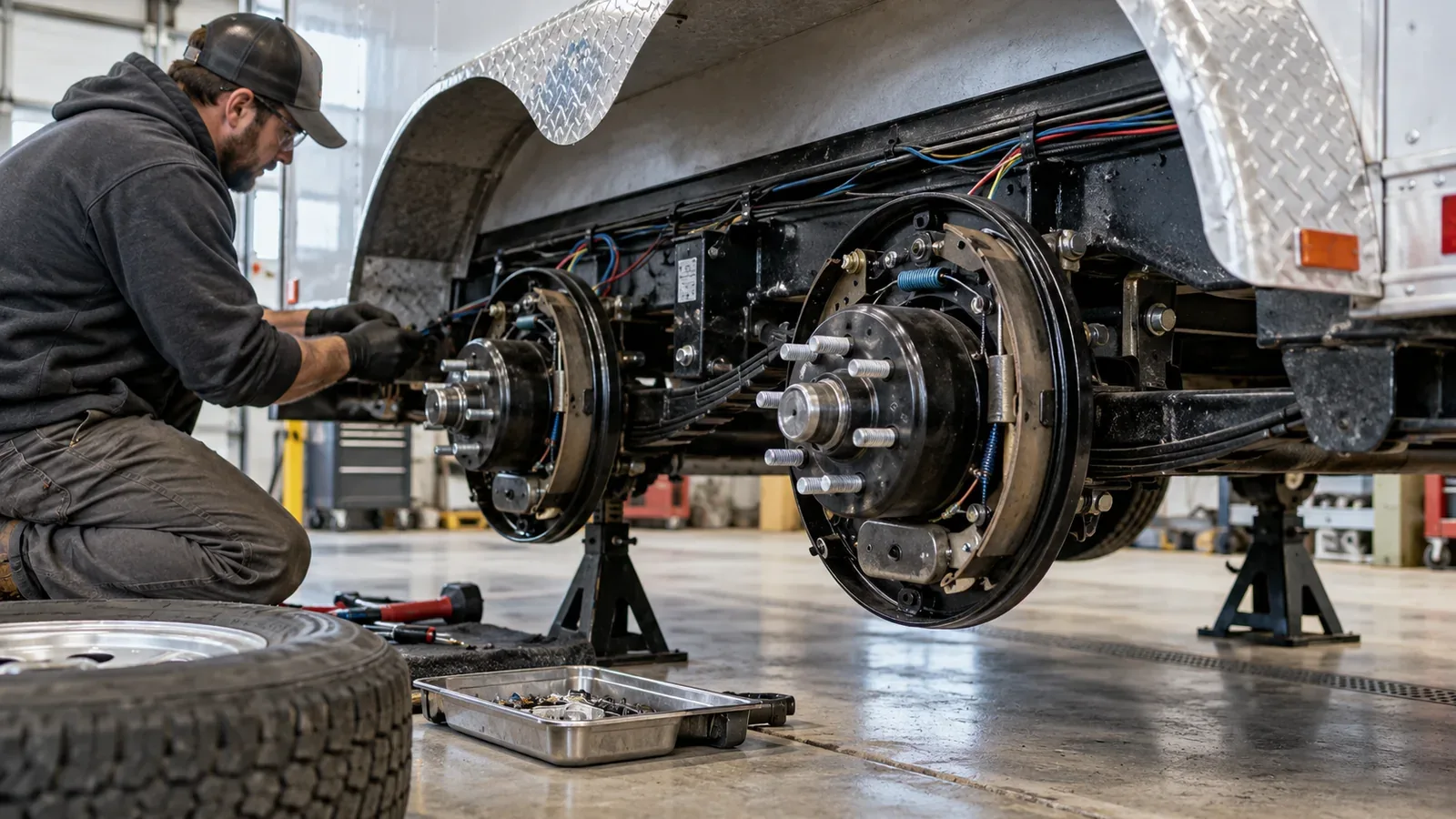
Do You Need Trailer Brakes? A 5-Step Check Before You Tow
You rented a utility trailer for a weekend project. The pickup can tow far more than the trailer weighs, the lights come on, and the hitch is secure. So you are good to go without trailer brakes, right?
Not necessarily. Whether a trailer needs its own brakes depends on the law where you drive, the trailer’s weight and rating, and the requirements of your particular truck and trailer. And even when brakes are fitted, you still have to confirm they actually work.
The internet often gives one simple answer: “Trailer brakes are required over 3,000 pounds.” That is not a safe nationwide rule. For example, Texas has a different statutory structure, while Washington includes an exception tied to both trailer weight and the weight of the towing vehicle, plus braking performance.
Here is a five-step method you can use before buying, renting or loading a trailer. It is designed for everyday U.S. towing; if you are operating a regulated commercial combination, check the applicable federal rules as well. This is a research and safety checklist, not a certification that your specific combination is legal or safe.
Your answer in five checks
| Check | What you need to know | What to do if you don’t know |
|---|---|---|
| 1. Trailer weight | Empty, loaded and rated maximum are three different figures | Find the data plate and weigh your loaded trailer |
| 2. State rules | Brake requirements may vary along your route | Read the actual DMV/DOT/state law, not just a generic chart |
| 3. Truck manual | Your truck may call for brakes at a lower weight than you expected | Look up the specific model, year, configuration and towing section |
| 4. Brake equipment | Brakes fitted to the trailer are not the same as brakes connected and controlled | Identify electric, hydraulic surge or electric-over-hydraulic equipment |
| 5. Working condition | A broken controller, connector, battery or brake assembly can defeat the system | Stop and obtain the correct inspection or repair |
If any required answer is missing, pause the towing plan. You can use our printable trailer-brake decision worksheet to record the result of every check before you hit the road.
1. Start with the weight you will actually tow
A trailer’s empty weight is not the same as its weight with a motorcycle, tools, water, furniture or landscaping equipment inside. Its GVWR is the manufacturer’s maximum permitted loaded weight for that trailer, not a scale reading and not the weight you can automatically tow.
For example, imagine a utility trailer with these illustrative figures:
| Item | Weight |
|---|---|
| Trailer empty | 1,200 lb |
| Lawnmower and equipment | 1,100 lb |
| Fuel, ramps and accessories | 200 lb |
| Estimated loaded weight | 2,500 lb |
| Trailer’s labeled GVWR | 3,500 lb |
The trailer is estimated to weigh 2,500 lb on the trip, but it is rated for 3,500 lb. Some laws refer to gross/actual weight; others consider maximum rated weight or other criteria. Do not substitute one number for the other.
If the trailer is already loaded, a suitable certified scale is better than adding up guesses. Our separate guide, How Much Does a Trailer Weigh?, shows how to make that estimate and why it can change quickly after loading.
2. Look up the states on your route—not a single national cutoff
A search result saying “3,000 pounds” may describe a rule in one state and omit an exception in another. These two real examples show how different the answer can be. They are not a substitute for reading the complete, current statute.
Texas: The Texas Department of Public Safety says that a trailer generally does not need brakes at 4,500 lb gross weight or less. Its published rule also describes a separate limited-speed exception for some trailers over 4,500 lb and up to 15,000 lb. That does not mean a driver can take an unbraked 10,000-lb trailer onto the highway at normal speeds. Check the exact operating conditions and other applicable requirements in the Texas DPS guidance.
Washington: RCW 46.37.340 generally requires brakes on all wheels but includes an exception for certain trailers of 3,000 lb gross weight or less. That exception also depends on the weight carried on the trailer’s wheels being no more than 40% of the gross weight of the towing vehicle, and the vehicle combination meeting stopping-performance rules. It is not simply “anything below 3,000 lb is legal without brakes.”
| Same illustrative 3,200-lb loaded trailer | What the published state rule suggests | What you still must check |
|---|---|---|
| Texas, traveling at ordinary highway speed | Below Texas DPS’s 4,500-lb gross-weight exception threshold | Other requirements; truck manual; actual brake setup; loaded weights |
| Washington | Above the specific 3,000-lb exception described in RCW 46.37.340(3)(a) | Full statute and requirements for the particular trailer and use |
The takeaway isn’t that one state is safer than another. It is that a state border can change the applicable legal test for the same trailer. Check departure, destination and any states you will pass through, plus exceptions, breakaway rules and commercial-use requirements.
What about federal law? Certain commercial vehicles are subject to the Federal Motor Carrier Safety Regulations. For example, FMCSA’s §393.42 guidance addresses a narrow exception involving light trailers and a 40% axle-weight comparison. Do not apply a commercial-regulation exception to a personal trailer without confirming that it actually governs your trip.
For use outside the United States, do not apply any U.S. threshold. Consult the regulations for that country or jurisdiction.
3. What does the truck manufacturer require?
Your pickup may have a high maximum towing rating. That figure does not mean its own brakes were designed to stop every trailer it can pull without the trailer helping.
For example, Ford’s owner’s-manual brake precautions explain that the tow vehicle’s brake system is rated at the vehicle’s GVWR, not its gross combined weight rating, and recommend separate functioning brakes for a loaded trailer over 1,500 lb. Ford also warns not to tow a trailer fitted with electric brakes without a compatible electronic brake controller.
That 1,500-lb figure is Ford’s recommendation in the cited guidance, not a nationwide legal cutoff. Your own truck’s year, equipment and owner’s manual take priority, including any stricter restrictions.
A sensible order is to check the law, then the truck manual, then the trailer instructions—and meet all applicable requirements, rather than selecting whichever number lets you tow more.
4. Identify the brakes you actually have
It’s easy to mistake a connector or a dashboard menu for proof that the trailer has operational brakes. These three setups behave differently:
| System | How it works in plain English | What the driver checks |
|---|---|---|
| Electric trailer brakes | A compatible controller in the tow vehicle commands the trailer brakes through a wired circuit | Controller installed, correct settings and connections, system tested per manuals |
| Hydraulic surge brakes | The hitch-mounted actuator uses the trailer pushing against the slowing tow vehicle to operate hydraulic brakes | Correct actuator and hydraulic system condition; vehicle compatibility |
| Electric-over-hydraulic brakes | An electrical command activates a hydraulic pump on the trailer | Controller specifically compatible with the pump, wiring and actuator |
Ford’s towing guidance describes these arrangements. Surge systems, for instance, do not simply become compatible with an electric brake controller because the truck has one.
A 7-way plug does not guarantee working brakes. It tells you something about the electrical connection, not whether the trailer has functioning wheel brakes or the right controller. A 4-way plug likewise does not settle the legal requirement; a trailer can have hydraulic surge brakes that operate without an electronic controller. Identify the actual system before making a decision.
What does the breakaway system do?
On many braked trailers, a separate breakaway switch and battery are intended to apply the trailer brakes if it accidentally separates from the tow vehicle. That is not the same as the normal brake controller. CURT explains the breakaway components and their purpose.
Check whether your trailer must have such a system, whether it is installed and whether the battery and switch are in working order. Follow the manufacturer’s inspection procedure; do not improvise electrical tests, tow with a detached breakaway pin, or rely on a breakaway battery as a parking brake. Some manufacturer procedures require disconnecting the tow-vehicle electrical plug before a breakaway test to protect the controller.
5. Make a practical go / no-go decision
Before the trip, ask yourself:
- Can I document the trailer GVWR and estimate or measure the loaded weight?
- Have I checked the requirements in every state on the route and whether commercial rules apply?
- Does my tow vehicle manual require or recommend a separate braking system for this load?
- If brakes are required or fitted, can I identify the type and confirm the controller and wiring are compatible?
- Have the brakes and any required breakaway system been inspected and tested as the manufacturer directs?
If a required system is missing, faulty, disconnected or of uncertain compatibility, do not depart. Arrange inspection or correction by a qualified trailer service technician. Never treat a successful short test drive or a dashboard light as proof of compliance.
Three realistic decisions, without pretending every case has one answer
Case A: A light rental trailer for a short local move. You estimate 1,800 lb with the furniture loaded. The rental company confirms the trailer has no separate brakes. The next step is not to assume that low weight settles it: check the truck’s specific towing instructions, the state law and the rental conditions. If those checks cannot be completed, select a suitable braked trailer or an approved alternative.
Case B: A landscaping trailer that crosses a state line. The loaded trailer weighs an estimated 3,200 lb. A Texas-only internet summary isn’t enough if the trip enters Washington or another jurisdiction. In the Washington example above, the simple 3,000-lb exception would not apply. Verify route laws and the full setup before departing.
Case C: An enclosed trailer with electric brakes, but the truck says “trailer disconnected.” The hardware being present does not mean it is working. Safely park and inspect the connector, wiring and controller according to their manuals. If a required brake circuit remains unavailable, stop and have the fault corrected rather than treating the tow rating as permission to continue.
All three cases are illustrative scenarios, not accounts of actual customers, original road tests or legal determinations.
The record you can save before towing
Print our trailer-brake requirement and readiness worksheet. It has blanks for vehicle and trailer IDs, three separate weight numbers, the states on your route, direct legal references, owner-manual requirements, the type of brake system and who verified that it works.
Why keep this record? Because saying “I checked it” is less useful a month later than knowing which law and manual you read, which weights you used, and what remains unresolved. It also makes conversations with a rental counter or service shop more specific.
This worksheet is a record of your research, not a permit, inspection certificate or substitute for applicable law. For capacity questions, also check how much your truck can tow and how to calculate the trailer’s loaded weight. If the trailer behaves unpredictably during travel, see our separate trailer-sway safety guide.
Bottom line
You shouldn’t have to study trailer engineering to answer a simple question. But “Is this trailer light enough?” is only part of the answer. Confirm the loaded weight and rating, check every applicable rule, follow your truck manual, and make sure any necessary brake system truly works.
When the result is uncertain, the right next step is to verify it—not to guess which online weight cutoff sounds most convenient.