
Trailer Tongue Weight: How to Measure It and Load Safely
Your pickup may be rated to tow 7,000 pounds. Your trailer may weigh only 4,200 pounds. Yet when you hook everything up, the back of the truck sinks and the steering suddenly feels different.
The missing number may be tongue weight: the downward force that the trailer puts on the hitch. It isn’t the same as total trailer weight, and it isn’t something you can reliably guess from the size of the trailer.
Quick answer: For many conventional bumper-pull trailers, a common starting point is 10–15% of the actual loaded trailer weight, according to Chevrolet’s 2026 trailering guide and CURT. A 4,000 lb loaded trailer suggests roughly 400–600 lb at the coupler. But your particular trailer and vehicle manuals decide the appropriate range, and the truck still needs enough payload, rear-axle capacity and hitch rating. Certain boat trailers and other designs may follow different recommendations.
This guide is about checking your own setup, not learning a list of towing abbreviations. You can save our one-page trailer tongue-weight trip worksheet and use it with a scale reading before a trip.
First, find the right number for your trailer
Don’t start with the tow rating printed in an advertisement. Gather three things:
- Loaded trailer weight: the trailer with its actual cargo, equipment and fluids. A trailer’s GVWR label tells you a maximum rating, not what it weighs today. If you’re unsure, read how to find your trailer’s actual weight.
- Measured tongue weight: what the coupler pushes down onto the hitch at the correct towing height, with the trailer loaded for the trip.
- Your combination’s limits: the tow vehicle’s remaining payload, GVWR, rear gross axle weight rating, and the tongue-weight capacity of the receiver, ball mount and other hardware. Use the lowest applicable limit; consult the manuals for your configuration.
For conventional trailers only, here’s what 10–15% would look like as an initial planning range—not a certification that a combination is safe:
| Actual loaded trailer | 10% at the tongue | 15% at the tongue |
|---|---|---|
| 2,000 lb | 200 lb | 300 lb |
| 3,500 lb | 350 lb | 525 lb |
| 4,000 lb | 400 lb | 600 lb |
| 5,000 lb | 500 lb | 750 lb |
| 6,000 lb | 600 lb | 900 lb |
You might notice that 900 lb at the hitch is a large amount of truck payload, even if the trailer itself is well below the pickup’s maximum tow rating. That is why a truck’s advertised towing capacity isn’t the whole decision. Our separate truck towing limits walkthrough explains the other ratings.
How to actually measure tongue weight
You don’t need to infer it from how low the rear bumper sits. Pick a measurement method appropriate for the expected load.
Option 1: Use a rated tongue-weight scale
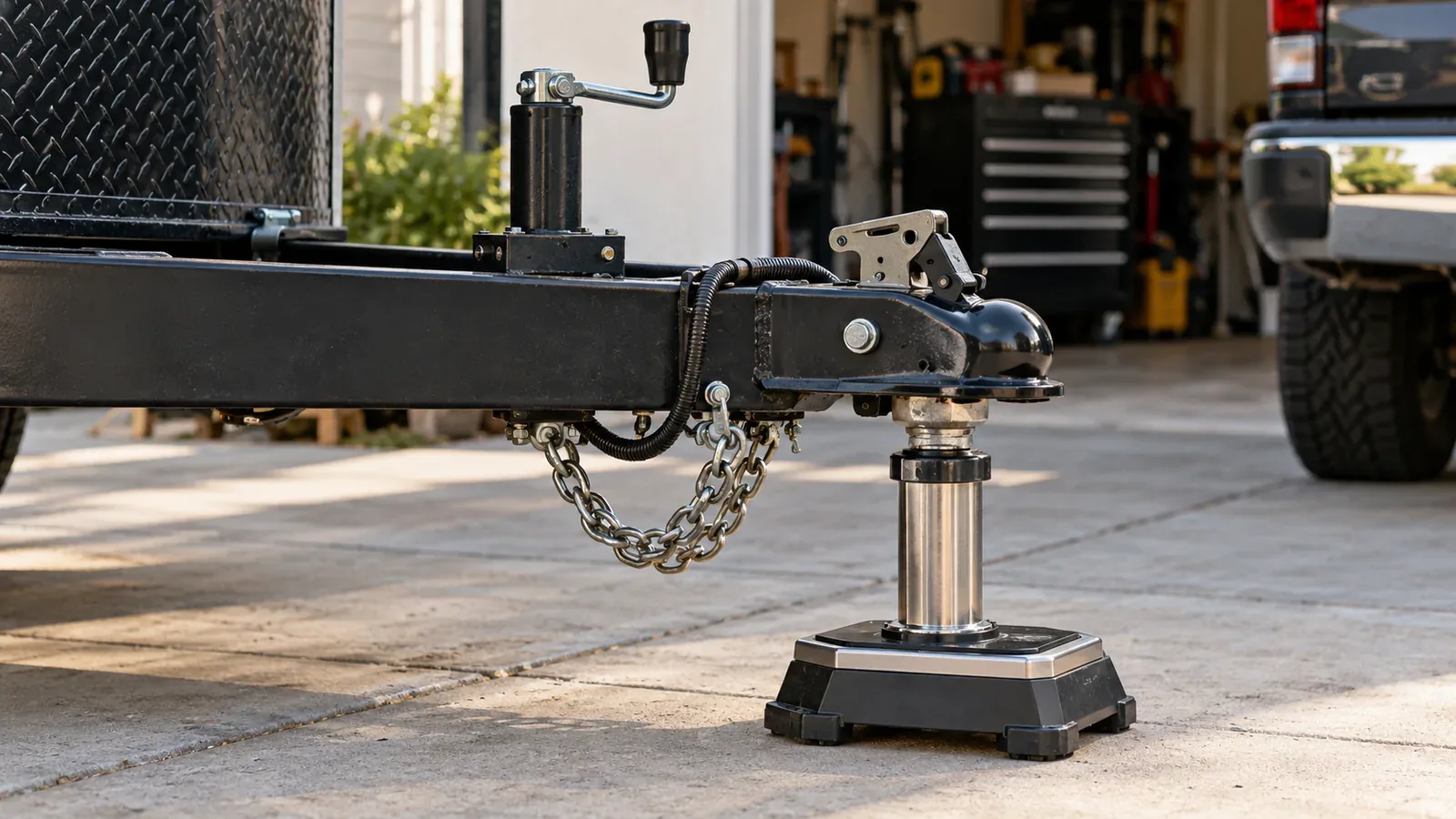
This is often the most straightforward approach for a conventional trailer. CURT describes using a dedicated tongue-weight scale positioned to support the trailer jack or coupler according to the device instructions.
- Park on level, firm ground. Secure the trailer against movement with appropriate wheel chocks.
- Load the trailer as you expect to travel. Include the extra tools, batteries and other gear you might otherwise forget.
- Support the tongue at approximately its normal towing height, using a scale, jack or adapter that is designed and rated for this job. Follow the equipment manufacturer’s exact setup instructions and keep hands and feet clear of moving supports.
- Record the reading in pounds. If the load shifts or you move equipment, repeat the measurement.
- Compare the measured number with the permitted tongue-weight range for the trailer and the actual ratings of the tow vehicle and hitch.
Never improvise a support that could tip, buckle or overload a consumer scale. For a high-load combination or when you’re unsure about the setup, use a suitable commercial weighing service or trailer professional instead.
Option 2: Use a vehicle scale and keep the tickets
A public truck scale or other suitable vehicle scale can help you check the combination’s actual axle loads. Follow the scale operator’s procedure, especially if a weight-distribution hitch is fitted. A correct sequence may require multiple readings with the truck alone, with the trailer attached, and—with safe operator guidance—an appropriate tongue-weight or trailer-weight measurement. Do not treat the trailer’s axle reading as its full loaded weight, because some of that weight is carried through the hitch.
CURT’s measurement guide explains vehicle-scale measurements, and the Chevrolet guide emphasizes actual combination, vehicle and axle weights. Keep the tickets; they make the next loading check easier.
What about using a bathroom scale?
CURT also describes a bathroom-scale method for comparatively light tongue loads and a carefully arranged lever method for heavier loads. This is not a reason to put an unknown 700 lb tongue directly onto a household scale or to copy a makeshift setup without verifying the loads and stability. A purpose-built rated tongue scale is the simpler choice for many owners. If you use CURT’s lever instructions, check every dimension, support and scale rating against their original guidance rather than guessing.
Three real decisions, not just three percentages
These are original hypothetical scenarios, not field tests or actual customer experiences. Each illustrates a question you can answer with your own scale readings and vehicle labels.
Case 1: The tongue percentage looks right, but the pickup is already too full
You have a 5,600 lb loaded trailer. At the low end of the conventional 10–15% guideline, that’s 560 lb of tongue weight. Your pickup has 550 lb of payload remaining after its passengers, bed cargo and other equipment are counted.
The problem: even 560 lb is more than the 550 lb remaining. If your specific trailer requires at least 10%, reducing its tongue weight to fit this truck is not a safe workaround. You need to reduce the truck’s other load, select a suitable vehicle or change the towing plan after verifying all ratings. A 7,000 lb tow-rating claim does not solve a payload shortage.
Case 2: The arithmetic works, but you still need an axle check
Now imagine a 4,200 lb loaded cargo trailer with 540 lb measured at the coupler.
- Tongue share: 540 ÷ 4,200 × 100 = 12.9% (rounded).
- Remaining payload in the truck before hitching: 620 lb.
- Verified tongue limit of the relevant hitch setup: 600 lb.
The tongue weight is within that hypothetical 600 lb hitch limit and leaves 80 lb of simple payload headroom before any not-yet-counted equipment. But it is not an automatic green light. Confirm that all hitch hardware, vehicle and trailer ratings apply, and weigh the actual truck axles to check whether the rear axle is overloaded or the front axle has been unloaded improperly.
Case 3: The trailer is lighter, yet the cargo sits too far back
A third trailer weighs 3,200 lb loaded, but its measured tongue weight is 256 lb. That’s 8%. For many conventional trailers whose manuals call for 10–15%, that’s below the manufacturer’s recommended range, even though the total trailer is relatively light.
Don’t simply add random weight to the pickup bed: that does not correct the trailer’s load balance. Follow the trailer’s loading instructions, move secured cargo appropriately within the trailer if the manufacturer permits it, and remeasure. A changed tongue reading does not by itself verify sway behavior, axle ratings or tire loading; all of those deserve a check before towing.
The five-minute load-check routine
The helpful part of this guide isn’t memorizing 10% or 15%. It’s building a repeatable routine:
Before loading: Write down the tow vehicle’s actual remaining payload, receiver/hardware tongue limit, trailer loading recommendation and, if available, its recent axle readings. Avoid using a brochure’s maximum figure when your trim, hitch or passenger load differs.
After loading: Record the trailer’s current total weight and measured tongue weight. Divide tongue weight by total loaded trailer weight. Compare it with the range given for your exact equipment—not a universal rule. Record any trailer cargo changes and whether the load is secured.
Before leaving: Verify the rear and front axle loading, hitch connection and all ratings, using a scale if necessary. Confirm chains, lights, brakes where applicable, tires and the breakaway equipment. If a reading is close to a limit or contradicts the manual, resolve that problem before departure rather than assuming it will be fine.
When something changes: A second passenger, a full water tank, a large toolbox or a cargo move can change your measurements. Recalculate and reweigh as needed.
Trip sheet: save it once, use it every time
Download the printable tongue-weight trip worksheet. It’s a simple text file—not a calculator that guesses your capacities. Open it on a phone or print it, fill in the actual figures and keep the scale ticket number. It deliberately leaves a separate space for “not yet verified”. A missing rating should never become a guessed pass.
| Your trip | Record this |
|---|---|
| Trailer model / date / load description | ________ |
| Actual total loaded trailer weight | ________ lb |
| Measured tongue weight | ________ lb |
| Tongue share = tongue ÷ loaded trailer × 100 | ________ % |
| Remaining truck payload before tongue weight | ________ lb |
| Hitch/ball mount tongue capacity for this configuration | ________ lb |
| Manufacturer trailer tongue recommendation | ________ |
| Truck GVWR, rear/front GAWR, GCWR and trailer GVWR checked | Yes / No / Not yet |
| Scale receipt reference and final decision | ________ |
If you have all the numbers but still don’t know whether they’re the right numbers, show the filled-in sheet and rating labels to a qualified towing professional. It is more useful than asking someone to guess from your truck’s badge.
Two mistakes worth catching before the highway
“I have a weight-distribution hitch, so my payload limit no longer matters.” It can redistribute loads when correctly installed and permitted. It does not change the manufacturer’s ratings. Check whether the tow vehicle permits weight distribution and the appropriate weight-carrying or weight-distributing hitch ratings before relying on it. For setup requirements see CURT’s weight-distribution guide.
“My trailer is rated for 5,000 lb, so tongue weight must be 500 lb.” That assumes the trailer is currently loaded to its GVWR and happens to be at 10%. If it actually weighs 3,600 lb loaded and you’ve measured 450 lb at the hitch, its current tongue share is 12.5%. The measured figure is the one to use, subject to the manufacturer and hardware limits.
Before you tow
The useful takeaway isn’t a magic percentage. It’s this: weigh the loaded trailer, measure what pushes down on the hitch, then compare the real numbers with the actual limits of the truck, trailer and equipment. If any number is missing, don’t fill the gap with a generic online estimate.
The downloadable trip sheet makes the process repeatable. For the two other questions you will probably have next, read how much your trailer weighs and how much your truck can tow. These articles solve different parts of the same towing decision.