
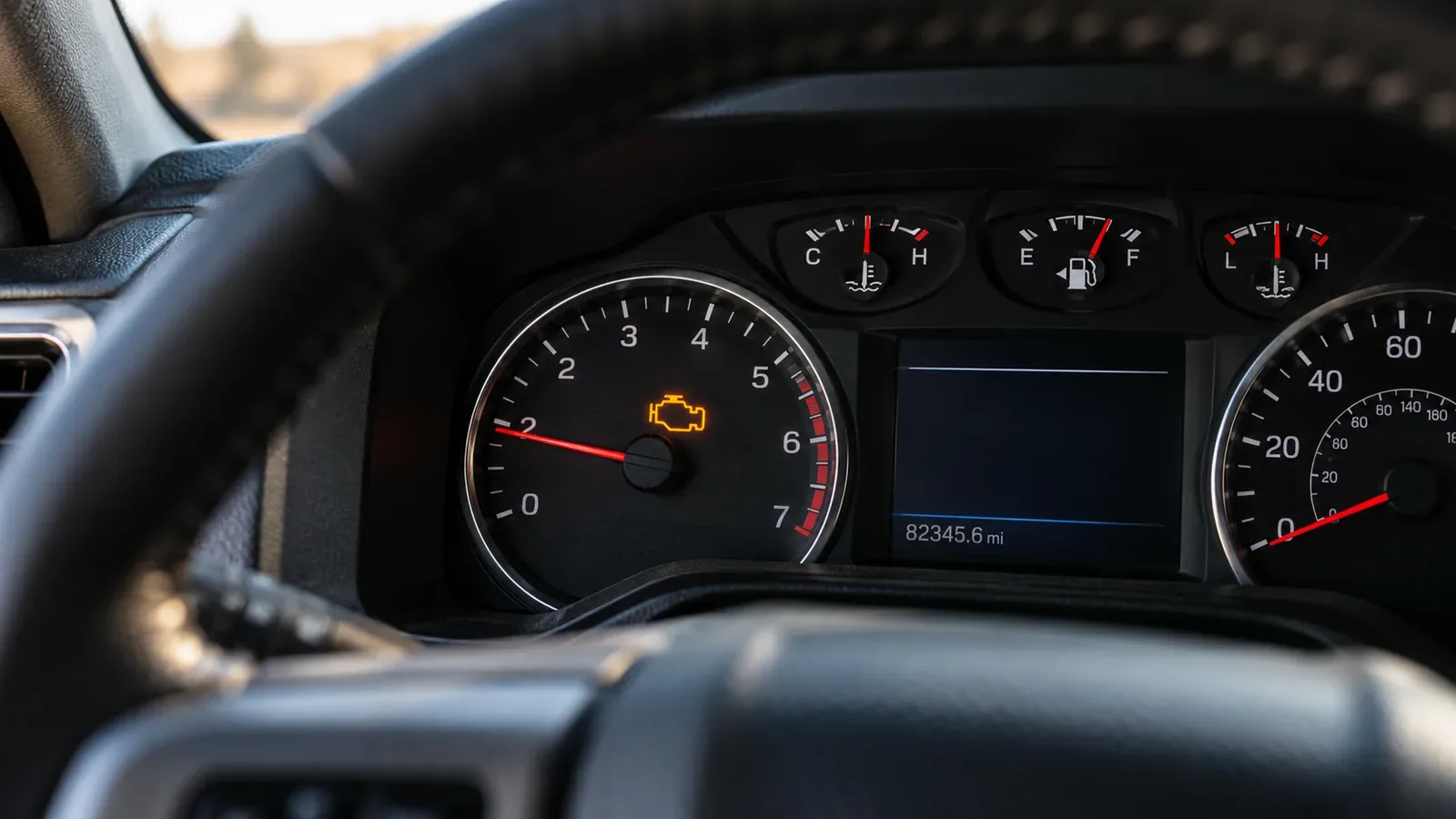
The pickup is already loaded when the yellow engine-shaped light appears. There is no smoke, the engine sounds normal, and you have a job across town. Do you turn around, call a tow truck, or finish the trip? The temptation is to search for “check engine light fix” and hope the answer is a loose gas cap. But a light that appears while the engine runs is a request to assess the situation, not a diagnosis and not permission to keep driving regardless of symptoms.
The useful first questions are more specific: Is the light steady or flashing? Is the truck running normally? Are there additional warnings, unusual noises, smells, overheating or reduced power? Only after those observations does an OBD scan become helpful. A diagnostic trouble code describes something the computer observed; it does not automatically identify the part to replace.
This guide covers gasoline pickups, light work trucks and, where explicitly noted, heavy-duty diesels. Diagnostic connectors, warning combinations and fault-code formats differ by vehicle and engine. Your model-year owner’s manual, vehicle-specific warnings and professional advice take priority over any general checklist.
Quick answer: what should you do when the check engine light comes on?
- Flashing while the engine is running: Treat this as urgent. In many gasoline vehicles it can indicate a serious misfire that threatens the catalytic converter. Reduce demand, pull over at the next safe location and arrange prompt assistance or service. If the engine shakes, loses substantial power, overheats, emits smoke or smells abnormal, stop safely and shut it down rather than continuing the trip. Do not tow a load as an experiment.
- Steady, with otherwise normal operation: Check for other warning lights or messages and consult the manual. Arrange diagnosis promptly; a short, gentle trip to a suitable workshop may be reasonable if the manufacturer allows it and nothing abnormal develops. A steady light is not a guarantee that driving is safe.
- Steady with oil-pressure, temperature, red STOP, severe reduced-power or other urgent warning: Follow the more serious warning. Find a safe place to stop and seek assistance; do not use the yellow lamp alone to judge urgency.
- Appears briefly with ignition on, before starting: This may be the normal bulb/system check. A warning that remains illuminated after starting is a different condition. Some models also flash a specific sequence with the engine off to report inspection readiness; consult the manual before interpreting it as an active misfire.
AAA advises reaching a safe place promptly if the lamp flashes. Ford’s owner documentation similarly warns that flashing can mean misfire and potential catalyst damage. See AAA’s code and warning explanation and an example Ford owner’s-manual warning description.
One light, four situations: decide by warning and symptoms
| What you see while the engine runs | What it may mean | Sensible next move |
|---|---|---|
| Steady check-engine light, no unusual behavior | An emissions- or powertrain-related issue has been recorded | Check manual, document conditions and book diagnosis promptly |
| Flashing check-engine light | Potentially severe misfire on many gasoline vehicles; risk of emissions-component damage | Reduce load; get safely off the road and arrange urgent assessment |
| Check-engine light plus shaking, smoke, overheating or major loss of power | A potentially unsafe or damaging operating condition | Stop safely, switch off as indicated and seek roadside help |
| Brief illumination during ignition-on self-check, engine not started | May be normal system self-test | Verify whether it goes out after start; follow manual-specific guidance |
These are decision categories, not remote diagnoses. A flashing warning in a gasoline pickup should not be treated as interchangeable with an amber emissions warning, an active regeneration message, a red STOP engine lamp or a derate instruction on a diesel commercial truck. Different systems may use distinct indicators and strategies. Never override a manufacturer’s command to stop or limit operation because a generic table calls the light “amber.”
A heavy load changes the practical decision. If the truck is already malfunctioning, pulling a trailer uphill can increase engine demand and makes stopping options harder. Find a safe location and ask for help rather than testing whether the problem will disappear under load.
What the check-engine light actually monitors
The warning is often called the malfunction indicator lamp, or MIL. The onboard diagnostics system monitors components and operating conditions that may affect emissions and engine or powertrain operation. When its criteria are met, it may request illumination and store one or more diagnostic trouble codes (DTCs). Some faults are detectable before the driver notices any roughness or power loss.
A typical modern light-duty vehicle has standardized OBD-II functions. Its diagnostic system can report codes and the status of checks it has performed. A code reader communicates with the relevant control unit; it does not directly inspect a leaking hose, check fuel pressure under load or verify the health of a catalytic converter. The U.S. EPA’s OBD overview explains this monitoring purpose, while Oregon DEQ describes how stored codes are used in diagnosis.
The most important distinction: the computer detects a condition outside a defined range, not necessarily the defective physical part. A lean-mixture code, for example, can be associated with air entering where it should not, fuel delivery, measurement errors or other operating conditions. Replacing the first sensor named by an internet article may leave the underlying problem untouched.
Three things the lamp does not tell you
First, it does not provide a reliable repair price. A fault that sounds expensive may turn out to involve a connection; a symptom that seems minor may require careful testing. Second, it does not establish that every vehicle with the same code has the same cause. Third, turning the lamp off does not prove the defect has been repaired. A code may reappear only when the system repeats its check under suitable conditions.
Steady versus flashing: why the distinction matters
A steady lamp typically means a fault has been detected that warrants diagnosis, though urgency depends on symptoms and the manufacturer’s guidance. On certain gasoline engines, a flashing lamp while driving can signal misfire severe enough to threaten the catalytic converter. The engine may be sending unburned fuel into the exhaust, creating excess heat. The exact warning strategy is vehicle-specific; a flashing lamp with a visibly rough-running engine deserves particular caution.
Ford’s manuals advise moderating driving and obtaining immediate service when the lamp flashes. AAA says a flashing light, smoke, unusual odors or abnormal running justify pulling over safely and shutting the engine off. The practical implication is not “drive gently for fifty miles”: it is reduce demand while you reach a safe place, then arrange an appropriate assessment. On a busy highway, roadside safety remains the first priority; do not stop in an exposed traffic lane to read fault codes.
What about a steady light with a truck that feels fine? A few owners complete a short trip to a garage without incident, but you cannot infer mechanical safety from the lamp alone. Look for additional messages, temperature and oil-pressure warnings, changes in throttle response and the manual’s instructions. Book the scan and diagnosis without indefinite delay. If the truck begins misfiring, losing power, producing smoke or overheating, reclassify the situation immediately.
Six useful checks that do not involve dismantling the truck
The aim here is to gather information a workshop can use. Perform observations only when safely stopped and without distracting yourself while driving.
1. Capture the exact warning
Record whether the lamp was solid or flashing while the engine was running. Note any message in the instrument cluster, including reduced-power, service emissions system, coolant temperature or stop engine. Take a photo when parked. Do not confuse a blinking symbol during ignition-on self-test with a blinking symbol under load. Some Ford instructions, for example, describe a separate engine-off readiness blink sequence.
2. Describe how the truck actually behaved
Was idle smooth? Did the engine hesitate, shake or lose power? Did the warning appear during acceleration, after a cold start, on a steep hill or at a stop? Was the truck towing? Could you smell fuel, notice exhaust smoke or hear unusual knocking? These facts influence urgency and help reproduce intermittent faults. Do not deliberately recreate a severe symptom to complete your notes.
3. Check the manual before touching anything
Identify the exact model year, engine and trim. Read the dashboard-warning entry in the owner’s manual. If it describes a stop-engine command, follow it. A light-duty gasoline pickup, a diesel pickup with aftertreatment warnings and a Class 8 tractor may all display engine-related indicators but require different operating decisions.
4. Think about recent work, fuel and conditions
Did the warning follow refueling, a battery change, a recent repair, a dusty worksite or heavy towing? A loose fuel cap can be relevant on some gasoline vehicles with that type of system, but it does not explain every check-engine light, and many vehicles do not have a conventional removable cap. Checking a cap in accordance with the manual is different from concluding the light is harmless. Never open hot components or disconnect electrical plugs to “reset” the fault.
5. If appropriate, preserve the scan information
A compatible reader may display the code, whether it is stored or pending, and sometimes freeze-frame information about engine conditions when the fault was recorded. You can record this information without clearing codes. However, a basic reader may show only part of the picture. Some workshop tools also access manufacturer-specific modules, live values and tests that a simple app cannot provide.
If the truck is operating abnormally or an urgent warning is present, do not keep it running just to complete a scan. Leave diagnosis to roadside support or the workshop.
6. Keep the diagnostic history intact
Avoid pressing “erase codes” or disconnecting the battery to extinguish the warning before a technician sees it. Erasing may destroy relevant diagnostic context and reset emissions readiness monitors. The Ohio EPA’s readiness guidance explains why cleared data and incomplete monitors matter. Make a note of the mileage, date and exact code so the repair can later be verified.
How to read an OBD-II code without buying the wrong part
Generic codes are often written as a letter and four digits. The first letter broadly identifies a system category: P for powertrain, B for body, C for chassis or U for a network-related issue. But not all useful codes are generic. Manufacturer-specific interpretations may require service information, and a single generic description can cover many root causes. The EPA describes the standardized code structure in its OBD research material.
Here are examples that illustrate what codes do and do not prove:
| Example code | Broad indication | What not to assume |
|---|---|---|
P0300 |
Random or multiple-cylinder misfire detected | Every affected engine needs new spark plugs |
P0420 |
Catalyst-system efficiency below threshold on bank 1 | The catalytic converter has definitely failed |
P0455 |
Large leak detected in an evaporative-emissions system | It is certainly the fuel cap; applicable to every diesel truck |
P0171 |
System too lean, bank 1 | An oxygen sensor must be replaced |
These are illustrative light-duty gasoline-vehicle examples, not a universal truck fault chart. Some of these systems are absent or fundamentally different on diesel applications. The technician should use the exact vehicle service procedure to confirm the fault, investigate supporting measurements and distinguish cause from consequence.
Codes may be stored, pending or permanent
A pending code can signal a condition observed before all criteria for a confirmed fault have been met. A stored/confirmed code reflects a condition for which diagnostic criteria were met; the lamp status and code state are related but are not always identical. A permanent code, where supported, is intended to remain until the vehicle’s prescribed monitoring conditions confirm that the fault is no longer present. The implementation differs by model and regulation.
A scan might also show freeze-frame data—a snapshot of certain operating conditions when the code was set. These details may help a shop determine whether the problem occurred at idle, on the highway or under a particular load. Not every scanner exposes every field. Ask for the code and relevant context to be retained rather than buying a component because a parts-store reader displayed its description.
“No codes found” does not always settle it
A generic reader can miss manufacturer-specific or non-emissions information, communication issues and intermittent faults that did not meet the conditions for recording. If a warning remains visible but the basic reader sees nothing, that is reason for a better diagnostic session—not a reason to ignore the instrument cluster. Confirm the scanner is compatible with the vehicle and that it interrogated the appropriate modules. If it reports no communication, the workshop should diagnose the connection or network instead of randomly replacing an engine control unit.
Pickup OBD-II versus heavy-duty diesel fault systems
The word “truck” spans vehicles with very different electronic architectures. A gasoline F-150 and a Class 8 highway tractor should not be assumed to share diagnostic connectors or fault-code conventions. In heavy-duty fleets, technicians may work with SAE J1939 messages and SPN/FMI identifiers, and some equipment requires specialized interfaces rather than a common consumer OBD-II dongle. The California Air Resources Board describes both 9-pin J1939 and 16-pin J1979/OBD-II connections in its Clean Truck Check equipment guidance.
On a heavy diesel, an amber engine warning may coexist with an emissions/aftertreatment warning, a red stop-engine lamp, a fault-related derate or an active regeneration message. The distinction affects the next action. A regeneration warning is not automatically a check-engine-light diagnosis; do not initiate a stationary regeneration or manipulate emissions equipment based on a generic OBD article. Follow the engine and chassis maker’s manual, as well as fleet procedures where applicable.
If you are contacting a heavy-truck workshop, provide the engine make and model, vehicle identification, lamp colors and messages, active and inactive fault details if available, and whether a torque or speed limitation is present. A basic P-code screenshot alone may be insufficient.
Before paying for repairs: ask for a test, not a guess
A fair diagnostic fee buys technician time, appropriate tools and an explanation of the evidence. The garage should connect the symptom to a verified fault rather than use the code description as a shopping list. The FTC’s auto-repair guidance recommends understanding diagnostic charges, asking for an estimate and agreeing on authorization limits.
A useful workshop request is: “Please record all relevant codes and freeze-frame details before clearing anything, identify which tests confirmed the failed part or system, and provide an itemized repair estimate.” This is more valuable than asking the shop to “replace the oxygen sensor” because an app mentioned one.
For an intermittent problem, ask whether the technician could reproduce it. If not, the estimate should distinguish a confirmed repair from a proposed next diagnostic step. In either case, consider the age, mileage, warranty and total ownership cost of the truck. A recurring fault may deserve a second diagnosis before major replacements are authorized; a failure that threatens safety or further engine damage should not be put off just to compare prices.
A practical estimate checklist
| Question for the shop | Why it matters |
|---|---|
| Which codes were active, pending and historical? | Separates current evidence from older events |
| Was freeze-frame or live data available? | Helps reproduce the condition |
| What test confirmed the defective part? | Distinguishes a measured failure from a guess |
| Does this estimate include diagnosis, parts, labor and calibration? | Makes competing estimates comparable |
| Are related leaks, wiring or mechanical problems ruled out? | Avoids repeating the same repair |
| What will be checked after the repair? | Gives a way to verify the complaint has actually been resolved |
A diagnostic invoice may list tests without a neat one-line answer. That can be legitimate on intermittent electrical faults, where finding a loose terminal takes time. The key is whether the proposed next step follows evidence. Do not pressure a shop to give a certainty it does not have; ask it to be clear about what is confirmed and what remains uncertain.
Why clearing the light can backfire before an emissions inspection
Many U.S. emissions inspections read onboard readiness monitors in addition to the lamp and trouble codes. A Ready monitor has completed its relevant self-check; a Not Ready monitor has not yet completed it. Not Ready alone is not proof of a faulty component. Clearing codes or disconnecting the battery can reset these monitors, and the vehicle may need suitable operating conditions before they complete again. Some state programs permit a limited number of incomplete monitors; the rules vary by jurisdiction, model year and vehicle class.
That makes it a mistake to clear a check-engine light the night before an inspection in the hope of “passing.” You may hide useful evidence and arrive with incomplete readiness status. Texas DPS and Ohio EPA describe the distinction and possible retest consequences; CARB’s heavy-duty testing guidance explains related checks for eligible commercial vehicles.
After a legitimate repair, a workshop may clear codes as part of the prescribed service procedure. The important follow-up is to confirm the symptom is resolved, relevant monitors or vehicle-specific verification routines have run, and the applicable inspection requirements are satisfied. No single “drive 50 miles” rule works for every model or fault.
Three representative situations
These cases are illustrative decision examples, not interviews or claims of completed repairs.
Case 1: steady light after refueling, no change in driving
A contractor finishes fueling a gasoline pickup. A steady lamp appears the next morning, but the engine runs normally and no other warning is present. He checks the manual and, where applicable, the fuel-cap seal and closure. Rather than assuming that is the answer, he schedules a scan and saves the code. An EVAP-related fault might justify checking the cap and vapor system, but the repair decision follows testing, not timing alone.
Better decision: preserve the code and book diagnosis, rather than immediately replacing sensors or erasing the warning. If the truck begins running poorly, the risk assessment changes.
Case 2: light flashes while towing uphill
A driver feels repeated shuddering during acceleration with a trailer attached. The check-engine light flashes while the engine is running. Rather than pushing through the hill or stopping in the travel lane, she reduces load, reaches a safe pull-off, shuts down when safe and contacts roadside assistance. The workshop may investigate misfire-related causes, but no specific part is assumed from the flashing lamp alone.
Better decision: prioritizing a safe stop over delivering on time can prevent avoidable secondary damage and reduce roadside risk. The trailer may require separate recovery arrangements.
Case 3: a code comes back after a sensor was replaced
A work-truck owner pays for a sensor after a generic code-reader description appears. The light returns days later. A second shop documents operating conditions, checks relevant wiring, compares data with specifications and finds that the earlier repair was never proven. The final diagnosis could involve a connection, a leak, a measurement problem or another subsystem; the point is not which component wins, but what testing established.
Better decision: compare the evidence on the first and second invoices, ask the original shop about its diagnosis and warranty, then authorize a verified repair rather than an escalating series of guesses.
Printable workshop handoff: the information that matters
Record when the warning appeared, whether the light flashed or stayed steady, and any other symptoms. Ask the technician to document exact fault codes, available freeze-frame data, test results, the agreed repair, and how the problem was verified afterward. Keep those notes with the service invoice.
Filling in the worksheet does not require a scan tool. Leave diagnostic fields blank if you do not know them. You are recording observations, not certifying the truck safe to drive. A properly documented complaint is useful because intermittent failures often disappear by the time a technician gets behind the wheel.
Frequently asked questions
Can I drive with a steady check engine light if the truck runs normally?
Sometimes a short and gentle trip for service is reasonable, but only if the manufacturer’s guidance allows it and there are no other warnings or abnormal symptoms. A steady lamp does not establish that it is safe to continue indefinitely, especially under heavy load. Obtain a diagnosis promptly; stop safely if the vehicle shakes, overheats, emits smoke or loses significant power.
What is the difference between a flashing and steady check engine light?
On many gasoline vehicles, flashing during engine operation can mean a serious misfire and possible catalytic-converter damage, so it requires urgent attention. Steady illumination usually indicates a recorded malfunction that still needs diagnosis. Model-specific warning strategies vary, especially on heavy-duty diesels, so confirm against the owner’s manual and any accompanying messages.
Does a P0420 code mean I need a catalytic converter?
No. It indicates that the monitoring system detected catalyst efficiency below a threshold; it does not independently prove the converter itself is defective. A technician may need to investigate operating conditions, exhaust leaks, mixture control and relevant measurements before recommending replacement. A code is a diagnostic clue, not a purchase order.
Should I erase an OBD-II code before visiting the garage?
Usually not. You may lose useful information about when the problem occurred, and code clearing can reset emissions readiness monitors. Record the code and related data, then let a technician decide when clearing is appropriate within a repair procedure. Disconnecting the battery is not a substitute for diagnosis.
Why is the light on if my scanner shows no codes?
A basic tool may not read the correct module or manufacturer-specific information, and some faults are intermittent or handled through another diagnostic system. Verify tool compatibility; a qualified shop may need a more capable scan tool and model-specific procedures. Do not ignore a dashboard warning because an inexpensive reader returned nothing.
Will a check engine light make a truck fail an emissions test?
It can, depending on the jurisdiction, applicable test and vehicle type. Inspection programs may examine whether the MIL is commanded on, stored faults and whether readiness monitors are complete. Clearing the light immediately before an inspection can leave monitors Not Ready and does not constitute a repair. Verify the rules applicable to your truck and inspection location.
The practical takeaway
The check-engine light gives you a starting point, not the name of a failed part. Begin with urgency—flashing, steady, or accompanied by serious symptoms—then collect the warning messages and scan information without erasing evidence. Expect the workshop to explain which observations and tests led to its recommendation, what the work will cost and how success will be checked afterward.
That approach is not guaranteed to make a repair inexpensive. It can, however, stop an ordinary warning from turning into avoidable parts purchases, lost diagnostic context or a roadside decision that puts people and equipment at risk.