
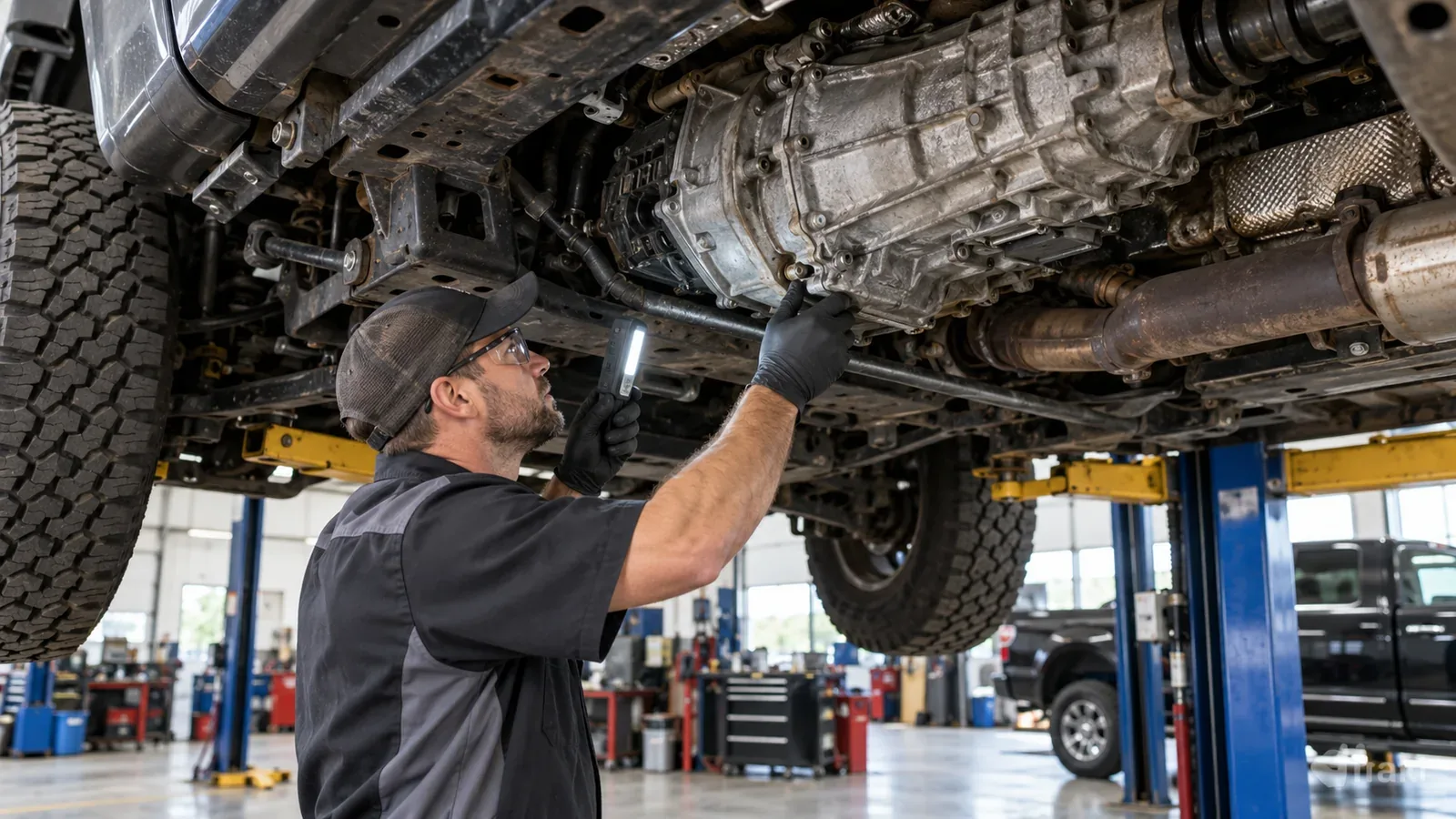
Truck Transmission Slipping? Signs, Causes, and Next Steps
You press the accelerator to merge onto the highway. The engine revs rise, but the truck does not gain speed as expected. A second later, the drivetrain catches up. It can feel as if the truck briefly lost its connection to the road.
Drivers often call that sensation transmission slipping. Sometimes they are right. Other times the cause is a delayed shift, a torque-converter issue, an engine performance problem, or something elsewhere in the drivetrain. The difference matters because the repairs—and the urgency—are not the same.
This article covers pickups and work trucks, particularly automatic transmissions. Some observations also apply to manual transmissions, but their clutch problems require a different diagnosis. Heavy-duty automated manual and commercial transmissions have their own operating procedures, so use the correct manual for your model.
Quick answer: If your truck’s RPM jumps but road speed does not increase with it, a transmission or clutch problem is possible. Note whether it happens in a particular gear, after warming up or while towing. Avoid heavy loads and stop safely if engagement becomes unpredictable, a serious warning appears, or the transmission overheats. Have the shop confirm fluid condition, diagnostic data and mechanical function before authorizing expensive repairs.
What does a slipping transmission actually feel like?
A true slip means the drivetrain is not transferring torque as intended at that moment. On an automatic truck, that can involve internal clutch application or hydraulic control. On a manual truck, a worn or contaminated clutch can allow the engine to speed up without matching vehicle acceleration.
But not every change in RPM is abnormal. Automatics intentionally unlock their torque converters, downshift and change ratios as speed and load change. A small RPM increase while the transmission selects a lower gear on a hill is not enough to diagnose a failure.
The useful question is whether the truck has unexpected, repeated engine-speed flare without corresponding acceleration, particularly in conditions when it previously drove normally.
Common signs to record
- The engine revs suddenly while acceleration lags or pauses.
- A selected gear seems to take unusually long to engage after shifting from Park into Drive or Reverse.
- A change between gears is delayed, followed by a noticeable jolt.
- The truck hesitates under load, particularly once warmed up.
- A transmission warning or temperature message appears.
- A new leak or strong burnt-fluid odor is present.
None of those symptoms identifies an internal clutch pack, torque converter or solenoid by itself. They are the starting points for testing.
Is it transmission slip or engine power loss?
This is the most useful comparison to make before paying for a major transmission diagnosis. Both problems can make a truck slow to accelerate.
| What you observe | Transmission or clutch concern | Engine-power concern |
|---|---|---|
| RPM rises noticeably but speed barely follows | More suggestive | Less typical, though not impossible |
| Engine struggles to rev, runs roughly or misfires | May be secondary | More suggestive |
| Delay after selecting Drive or Reverse | Worth investigating transmission controls and engagement | Not usually an engine-only symptom |
| Problem appears mainly on a steep hill with warning messages | Transmission, engine or protection strategy may be involved | Engine or electronic power limitation may be involved |
| One distinct shift feels late or harsh | Could involve shift control or transmission operation | Sometimes drivability faults imitate a shift issue |
For the engine side of the comparison, see why a truck loses power when accelerating. A shop should verify the pattern using operating data, not diagnose by table alone.
The main causes mechanics investigate
Incorrect fluid level or a leak
Many automatic transmissions rely on fluid not only for lubrication and cooling but also for hydraulic control. An incorrect level or loss of fluid can affect engagement and shift quality. Low fluid needs an explanation: the system is not supposed to consume it like fuel.
A leak could come from a seal, line, cooler connection or another part. The location needs to be confirmed. Also, fluid color by itself is not a reliable pass-or-fail test; fluids vary by manufacturer, type and service history. Smell, condition, fault data and the correct maintenance specification all matter.
Worn internal friction components
Automatic transmissions use clutch elements to hold or connect different rotating parts. If they are worn, overheated or cannot apply properly, certain gears may slip. Persistent slip can create additional heat and wear. A mechanic should identify which operating condition fails and rule out relevant control and pressure problems before proposing a rebuild.
Valve-body, solenoid or electronic faults
Modern transmissions use electronically controlled hydraulic circuits. An electrical fault, a valve that sticks, or incorrect sensor information can affect shifting. Stored diagnostic codes may point toward an electrical circuit or detected condition, but a code is not an instruction to replace that component. The shop should check wiring, control data and the manufacturer’s test procedure.
Torque-converter trouble
A torque converter connects the engine to many conventional automatic transmissions and can lock mechanically during appropriate driving conditions. Certain lockup faults cause shudder or abnormal RPM behavior. However, converter lockup is not meant to stay engaged in every gear or driving condition, so normal changes should not be mistaken for failure.
A manual clutch that slips
If you drive a manual transmission truck, clutch wear, adjustment issues where applicable, or contamination can make the engine rev without strong acceleration. It is a different repair path from an automatic’s internal clutch packs. The transmission type is essential information to give the shop.
What to do first—without making damage worse
Step 1: Follow serious warnings. If a display reads Transmission Over Temperature—Stop Safely or shows a stop-driving instruction, find a safe location and follow the model-specific manual. Do not try to “test it one more time” with hard acceleration. Some Ford owner information explicitly directs the driver to stop safely during transmission overheating.
Step 2: Stop towing or hauling until the cause is assessed. Extra load increases stress and may worsen an existing fault. If the truck will not move predictably or is making loud new noises, arrange a tow instead of driving it to a shop.
Step 3: Check for visible evidence. When parked safely, note any new fluid beneath the vehicle and whether a warning appears. Do not lie beneath a truck supported only by a jack or attempt to open a hot sealed transmission.
Step 4: Check the owner’s manual—not a generic internet dipstick procedure. Some trucks have a transmission dipstick; many do not. Where a vehicle offers a user-checkable fluid level, the procedure can require a specific temperature and engine or selector condition. A wrong method can lead to a wrong reading. For sealed systems, leave the check to a qualified shop.
Step 5: Record the circumstances. Which gear? Cold or hot? Loaded or empty? During acceleration, coasting, shifting, or selecting Reverse? A short factual account is far more useful than “the transmission is shot.”
Ford’s automatic-transmission fluid guidance illustrates why vehicle-specific advice matters: some models have no dipstick and direct owners to have slipping or slow shifts inspected rather than adding a universal fluid treatment.
What tests should a repair shop perform?
A sound estimate begins with evidence. Depending on the transmission, the shop may check stored codes and live data, fluid level and condition using the specified method, leak sources, operating temperature, shift behavior and applicable electrical or hydraulic tests. It should also consider engine performance if the symptom is ambiguous.
Ask a few specific questions before approving repairs:
- Which symptom did you reproduce? Was it a particular shift, delayed engagement, or measurable slip?
- What test supports the diagnosis? Ask for the fault code and the test result, not just one or the other.
- Is the recommended work a service, component repair, or replacement? What alternatives were ruled out?
- What are the warranty terms? Include labor, parts, programming, fluid and any core or disposal charges.
- How will you verify the fix? A post-repair check should reproduce the original operating conditions safely.
The FTC’s repair guidance specifically notes that transmission complaints can have relatively simple causes and recommends checking those before expensive work.
Is a fluid change or flush enough?
Possibly, but it depends on the diagnosis. Correcting a documented low level or leak may be necessary. A service at the manufacturer’s interval can also be appropriate. A flush is not a guaranteed repair for slipping, and adding a product marketed as a transmission “stop slip” is not a substitute for identifying worn components or incorrect hydraulic control.
If a shop recommends a complete flush, ask whether it is approved for your exact transmission and whether there is evidence of damage or contamination. Some manufacturers warn against supplemental cleaners or additives. Paying for a service that does not address the cause may simply delay a more important repair.
What about towing and heat?
A transmission can run hotter while towing, climbing grades or maneuvering slowly under load. Excessive heat can contribute to drivability changes, but it does not identify the failing part. Record the load, weather, speed, hill conditions and warning text. The towing guide and the vehicle manual take priority for load limits and permitted operating conditions.
Even if the truck behaves normally without the trailer, a repeatable slip under load deserves evaluation. Do not recreate a dangerous hill or heavy-tow scenario simply to obtain a better description.
Getting a fair repair decision
Transmission work can range from a minor external fault to an expensive internal repair. Avoid comparing two estimates until both refer to the same diagnosis and scope. A lower price may omit fluid, programming, removal and installation, a cooler inspection, or warranty coverage.
A rebuilt or remanufactured unit can be appropriate in some circumstances, but replacement is not the automatic answer to one RPM flare. Get a written explanation of the confirmed problem, what parts or services are required, and the expected verification step.
If your truck keeps slipping, do not simply adapt your driving style around it. Unreliable engagement can become a safety issue, especially when merging, crossing traffic or hauling a load.
Frequently asked questions
Why does my truck rev up without accelerating?
That pattern can suggest transmission or clutch slip, but engine, converter and other drivetrain conditions can feel similar. Record the gear, temperature and driving situation and have the fault confirmed.
Can low transmission fluid cause slipping?
Yes, on certain transmissions. The proper fluid-level check is model-specific; many newer trucks have no owner-accessible dipstick. A low reading also calls for finding the leak or other cause.
Does a slipping transmission always need replacement?
No. Fluid-level, control, electrical or external issues may sometimes be repairable without replacing the whole unit. Internal friction damage may require more extensive work. Testing determines the difference.
Can I keep driving if the slip is intermittent?
Do not assume intermittent means harmless. If engagement is unpredictable, there is overheating, or a serious warning appears, stop safely and arrange professional assistance. Otherwise, schedule prompt diagnosis and avoid towing or hard acceleration.
Will an OBD-II code tell me which part is bad?
Not by itself. Codes describe detected conditions and may require a scan tool that can read the transmission module. A shop must correlate data and testing before recommending parts.
Is a transmission flush the first thing to try?
Not without a diagnosis. Fluid service may be appropriate, but a flush or additive is not a universal fix and can conflict with manufacturer recommendations for a particular transmission.