
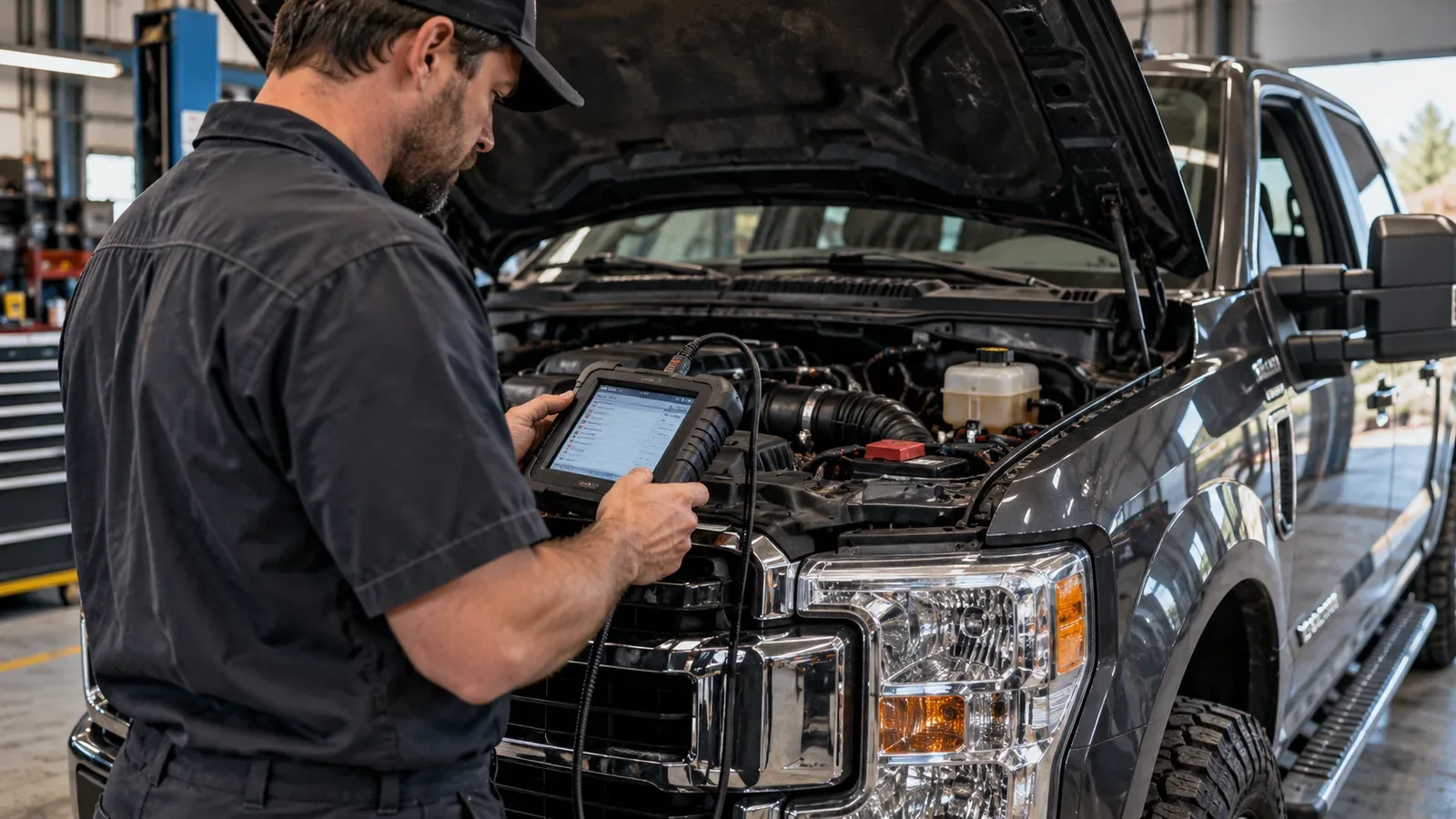
Your truck feels fine pulling out of the driveway. Then you merge onto a highway, climb a grade, or pull a loaded trailer and it suddenly feels as though someone took half the engine away. You press the accelerator harder, but the pickup barely responds. Sometimes it shakes; sometimes the engine revs without giving you the road speed you expect. Sometimes the problem disappears after you stop.
A truck losing power when accelerating is a symptom, not a diagnosis. The most useful first step is to separate an engine that cannot produce power from a transmission that cannot transfer it, and from an electronic system that is deliberately limiting performance. Each requires a different test. Buying a fuel pump, turbocharger, catalytic converter, or transmission on the strength of a vague symptom can be an expensive mistake.
This guide focuses on U.S. gasoline and light-duty diesel pickups, with a separate note for medium- and heavy-duty diesels. Vehicle responses vary by engine, transmission, emissions equipment, model year, and load. Consult the owner’s manual for your exact vehicle and follow dashboard instructions over general advice.
Safety first: If the truck abruptly loses enough power to create a hazard, stalls in traffic, displays Stop Safely, overheats, shows a low-oil-pressure warning, flashes the check-engine light while running roughly, produces smoke, or makes serious mechanical noises, signal, move to a safe location when possible, and stop driving. Call roadside assistance or arrange towing. Do not keep accelerating to “clear it out,” override a power limitation, or attempt a full-throttle road test.
Quick answer: why is my truck losing power when accelerating?
A truck can lose acceleration because its engine is not getting the correct air, fuel, ignition, or boost; because exhaust flow is restricted; because the transmission or driveline is slipping or not transferring power; or because the vehicle’s control system has entered a reduced-power mode. The pattern matters more than any single suspected part. Note whether the engine hesitates, misfires, surges, revs without road speed, or displays a specific warning. Save diagnostic codes and freeze-frame data if available, and have a technician confirm the fault under safe, vehicle-appropriate conditions before authorizing repairs.
A sluggish truck after adding a trailer is not automatically broken. Payload, grade, altitude, heat, and selected drive mode influence performance. An abrupt change compared with the same truck in similar conditions is more concerning.
First: separate five different acceleration symptoms
People use “won’t accelerate” for several distinct problems. Answer these questions before naming a component.
| What you notice | Useful distinction | What the shop should investigate first |
|---|---|---|
| Engine struggles and RPM barely rises | Engine output or a control-system limit may be involved | Active warnings, available torque, electronic throttle, air/fuel delivery, exhaust restriction |
| RPM rises but road speed does not follow | Transmission or driveline may not transfer engine power as expected | Transmission slip, clutch condition where applicable, gear selection, torque converter, driveline |
| Truck bucks, shakes, or misfires under load | Combustion may be interrupted, particularly on a gasoline engine | Misfire counters, ignition condition, fuel delivery, appropriate fault codes |
| Power falls after several minutes uphill or towing | Demand, temperature, cooling, charge air, or protective control may matter | Load and temperature history, charge-air/boost control, transmission temperature, fault data |
| Truck shows Reduced Power / limp mode | The controller has detected a condition that warrants restricting output | Exact warning, stored/active codes, freeze-frame values, manufacturer diagnostic procedure |
These rows are clues, not proofs. For example, high RPM with weak acceleration can also involve traction loss or a misinterpreted gear reading. A dashboard message may describe how the truck is responding rather than identify the failed part.
One practical example: Your 5.0-liter gasoline pickup idles normally and pulls away smoothly, then starts shuddering only when climbing a grade. That observation is more useful than “it needs a new fuel pump.” It tells the shop to investigate faults that appear under load, including ignition and fuel delivery, while keeping other possibilities open.
What to do immediately if the truck loses power on the road
- Prioritize control and a safe stopping point. Ease off the accelerator, switch on hazard lights if appropriate, and avoid unsafe overtaking or hill climbs. Do not stop in a live lane unless you have no safer option.
- Read the dashboard rather than guessing. Photograph any warning after you are safely stopped. A flashing malfunction indicator, a low-oil-pressure warning, overheating, or a manufacturer Stop Safely message requires more urgent action than an unexplained reduction in throttle response.
- Do not force a regeneration or restart to make the symptom disappear. A reboot may temporarily remove a warning without repairing the cause, and it can erase useful context from an intermittent fault.
- If towing, consider the full combination. A loaded trailer changes stopping distance and the risk of being unable to maintain traffic speed. Do not continue a marginal trip simply because the unloaded truck might feel acceptable.
- Arrange help if safe operation is uncertain. A normal-looking engine temperature gauge does not prove the engine or transmission is healthy. Do not repeatedly attempt to reproduce a potentially dangerous failure.
Ford’s owner documentation distinguishes powertrain/reduced-power messages from stop-safely warnings and calls for prompt service; the exact wording and severity depend on the model. A modern power limitation can be intentional protection, not a diagnosis of a single bad sensor.
A simple decision tree before you spend money
A. Did the engine stall, or did power fall so severely that traffic safety was compromised? Treat this as a recovery and diagnosis situation, not a trial-and-error driveway repair.
B. Did the RPM increase normally but road speed fail to rise? Explain that mismatch to the shop. Transmission or driveline investigation belongs earlier in the process than an engine “tune-up.”
C. Did it hesitate or shudder, especially when the engine was under load? Ask whether the engine logged misfires, fuel-trim deviations, boost inconsistencies, or other engine-performance data. The presence or absence of a warning light is not enough.
D. Did the dashboard display Reduced Power, Service Engine Soon, Stop Safely, a diesel emissions warning, or transmission-temperature alert? Save the exact message. Manufacturer-specific codes and service information can change the priority of tests.
E. Does the problem happen only with a heavy load or sustained grade? Record trailer weight, approximate cargo and passengers, outside temperature, elevation or grade where known, speed, and whether the symptoms were new. Never exceed the vehicle’s rated limits as a diagnostic experiment.
Common causes of weak acceleration in a gasoline pickup
1. Misfire under load: plugs, coils, and their circuits
On gasoline engines, the mixture must ignite reliably as cylinder pressure and demand rise. Worn spark plugs, a failing ignition coil, wiring faults, or other combustion issues can cause a stumble that is mild at idle and severe under acceleration. A rough engine or a flashing check-engine warning increases concern for a misfire. Continued driving with an active, severe misfire can damage emissions components.
What to request: Save any pending and confirmed codes, cylinder-specific misfire counts where supported, and data captured under the conditions of failure. Have a technician inspect relevant ignition components and rule out fuel, compression, or control issues. A code suggesting misfire is not an automatic instruction to replace every coil.
For a more complete explanation of warning lights and code interpretation, see Truck Check Engine Light On? for a separate explanation. This article concentrates on why acceleration changes, not on decoding every warning lamp.
2. Fuel supply that cannot meet demand
An engine may idle normally yet lack sufficient fuel delivery during heavy acceleration. Depending on design, a restriction, low pressure, damaged pump control, injector problem, or contaminated fuel can create hesitation. Some modern engines use high-pressure direct injection, so a casual roadside fuel-pressure check is not safe or adequate.
What to request: The correct manufacturer-specified fuel-pressure and fuel-delivery measurements, assessed safely under the relevant operating conditions. A technician should distinguish low fuel supply from a faulty command, electrical connection, sensor input, or other cause. Never crack open high-pressure fuel lines, especially on diesels.
What not to assume: “It feels fuel-starved” does not prove the pump is bad. A shop that recommends replacement solely because the truck bogs down has not established the cause.
3. Airflow measurement or intake restriction
A heavily restricted engine air filter, intake duct problem, or incorrect airflow measurement can contribute to poor engine response. But not every discolored air filter causes power loss; visual appearance is not a calibrated restriction test. An airflow sensor fault can also result from wiring, air leaks, or contaminated measurement rather than a sensor that simply needs replacing.
Safe owner observation: With the engine off and cool, follow the manual for any accessible inspection; do not dismantle an unfamiliar intake or disturb hot or moving components. Leave sophisticated sensor and leak testing to a shop. A cabin air filter affects interior ventilation and does not explain a truck that cannot accelerate.
4. Throttle-control or powertrain-protection fault
Modern pickups use electronic throttle and coordinated powertrain controls. If the system detects certain faults, it may command reduced torque, illuminate a wrench symbol, or display a reduced-power message. The trigger can differ widely, and the message itself does not identify a throttle-body failure.
What to request: The full set of relevant powertrain codes, diagnostic test results, freeze-frame information, and any applicable manufacturer procedure. Ask whether the fault affects the engine, transmission, or other monitored system before buying a throttle body.
5. Restriction in exhaust flow
A severely restricted exhaust path can reduce available engine power, but it requires evidence, not guesswork. The exhaust system becomes dangerously hot, and modifications or removal of emissions equipment can be unlawful. Do not attempt to disconnect an exhaust component to “see if it runs better.”
What to request: Vehicle-specific evidence such as appropriate backpressure or related system testing, plus an explanation of why the proposed repair addresses the demonstrated restriction.
Diesel trucks: different reasons for the same complaint
A diesel pickup may lose power because of fuel supply, charge-air leaks, boost control, temperature-related protection, sensors, or emissions-system issues. Diesel engines generally do not use spark plugs for combustion; advice to replace ignition coils or perform a gasoline-style tune-up will not apply.
Turbo boost and charge-air problems
A turbocharged diesel may feel normal at light throttle, then become weak when pulling a grade. A disconnected or leaking charge-air hose, a boost-control fault, or another system problem can be involved. A hiss, warning lamp, or sudden power change may be helpful observations, but none alone establishes a turbocharger failure.
What to request: A comparison of commanded and actual boost under the proper conditions, leak testing where appropriate, and relevant actuator, sensor, and charge-air inspection. Replacing an entire turbocharger without confirming the source of the problem can be very costly.
Water-in-fuel and diesel filtration warnings
Some diesel vehicles warn about water in the fuel separator or filtration conditions. Manufacturer instructions govern the response and service procedure. Diesel high-pressure injection is hazardous; leave pressurized-component work to qualified technicians. Do not keep driving through an active warning hoping the engine will recover.
Emissions warnings and engine derate
Many newer diesels use selective catalytic reduction (SCR), diesel exhaust fluid (DEF), and other emissions controls. Some detected conditions can trigger derate, an intentional reduction in available engine speed or power. The EPA has discussed the real-world impact of DEF-related derates and guidance for manufacturers. This does not mean every loss of diesel power is caused by DEF, and it does not authorize defeating emissions controls.
What to request: The exact emissions warning, distance or countdown if displayed, relevant diagnostic codes, fluid-quality/testing findings if appropriate, and manufacturer-approved service action. A generic “delete” or bypass is not an appropriate diagnostic solution.
Heavy-duty commercial trucks may use different diagnostic protocols, service tools, voltage systems and emissions-control strategies. A Class 8 tractor’s derate procedure is not interchangeable with a gasoline F-150 procedure.
When RPM climbs but the truck will not pick up speed
Sometimes the engine is producing revs, yet the wheels are not receiving power efficiently. That raises a different set of questions: transmission slip, torque-converter issues, an unsuitable gear or drive mode, clutch slip on a manual gearbox, or a driveline fault. The relationship between engine RPM, selected gear, and road speed is an important clue.
A slipping transmission may also create a flare between shifts, unusual shift quality, overheating warnings, or delayed engagement. These observations still need confirmation. An external sensor fault or control condition can imitate an internal mechanical failure.
Do not approve a full transmission replacement just because the truck “won’t accelerate.” Ask what data or inspection distinguishes an internal failure from a control issue and what less-invasive steps were ruled out. Avoid accelerating hard to provoke a slip, especially while towing.
Why the problem appears uphill, towing, or in hot weather
A truck asked to move more weight uphill must deliver more power than the same truck cruising on level pavement. That makes marginal fuel supply, ignition, boost, cooling, and transmission performance more noticeable. It may also activate legitimate thermal or protective power-management strategies.
Before treating every hill as a breakdown, compare equivalent conditions: Did the truck always slow on this grade with this load, or did it suddenly perform worse? Was the trailer loaded differently? Was a warning displayed? Did the temperature rise abnormally? These distinctions help the shop decide where to look.
Document: approximate trailer weight from a reliable source, load condition, road grade and weather, any towing or drive modes, warning messages, fuel level, whether cruise control was engaged, and how performance returned. Do not guess the truck’s rated tow capacity from a badge; consult the vehicle-specific ratings.
If the engine temperature actually climbs into a warning condition, the next decision is not continued acceleration; see Truck Overheating While Driving for that separate safety problem.
Symptoms that can mimic a true engine-power loss
- Dragging brakes or rolling resistance. The engine may be working harder to move the vehicle; a shop can check for abnormal brake heat, tire condition and mechanical resistance safely.
- Traction or stability intervention. On a slippery surface, a stability system may temporarily reduce delivered torque. The indicator and driving conditions matter.
- Transmission slip. RPM and road speed diverge even though the engine can rev.
- Incorrect or changing gear selection. Tow/haul and shift strategies affect response, but should not create unsafe or severe new hesitation.
- Excessive load or aerodynamic drag. This affects normal performance, especially on a grade, yet does not automatically explain sudden misfire or reduced-power warnings.
- An intermittent electrical or sensor connection. May appear after heat soak or vibration, with or without an immediately visible code.
A useful workshop question is: “What observation tells you the engine itself is under-producing torque, rather than the truck failing to transmit or use it?” That question often prevents expensive, unfocused repairs.
What a competent diagnostic appointment should include
You do not need to tell the technician which part to change. You need to hand over the pattern and ask how the cause will be proven.
| Your observation | Reasonable diagnostic evidence to request | Decision it supports |
|---|---|---|
| Misfire or shudder under load | Relevant codes, misfire data, appropriate ignition/fuel checks | Repair confirmed combustion issue rather than replace unrelated parts |
| Gradual or sudden lack of torque | Comparison of requested/actual outputs; fuel, air or control tests as indicated | Distinguish restriction, supply and electronic limitation |
| Reduced Power / wrench message | Exact codes, freeze-frame data, manufacturer service diagnostic | Identify the fault that caused protective mode |
| Diesel truck weak on grade | Boost/charge-air evaluation, fuel supply findings, emissions-warning context | Avoid treating every diesel derate as a failed turbo |
| RPM increases without speed | Shift data, slip evidence, transmission/driveline inspection | Establish whether drivetrain repair is necessary |
| Only happens towing in heat | Verified load, temperature, mode and warning history | Separate expected demand from thermal fault or protection |
Keep the original diagnostic report, even if the repair is postponed. If the mechanic proposes multiple parts, ask which finding justifies each one. A written explanation is especially valuable if another shop needs to continue the diagnosis.
Example 1: a pickup shakes only during an uphill merge
Illustrative scenario, not a diagnosed vehicle. A driver reports that a gasoline pickup is smooth in city traffic but shakes and has little power when merging onto a highway. The dashboard light flashed briefly. A shop sees recorded misfire activity and tests the relevant ignition system under its approved procedure. It finds a defective ignition component and verifies normal operation after the repair.
Lesson: The pattern directed the shop toward combustion under load. Ordering a fuel pump simply because the truck lost power would have added cost without establishing a cause. Severe flashing-light conditions should not be recreated on a public road as a do-it-yourself test.
Example 2: power disappears towing a camper
Illustrative scenario. A diesel pickup is pulling a camper uphill when the power drops and a reduced-performance warning appears. The owner assumes the turbocharger has failed. The shop captures manufacturer-specific data and finds a charge-air system problem that can be tested and repaired without replacing the turbo assembly.
Lesson: Under-load loss and a turbo-equipped engine do not automatically mean the turbocharger is bad. The correct repair is the one supported by actual measurements.
Example 3: RPM rises, but the truck barely accelerates
Illustrative scenario. The driver presses the pedal and hears the engine rev. Road speed barely changes, especially during a shift. No consistent misfire appears. A technician investigates transmission operation and documents why the selected repair is necessary.
Lesson: This is a different diagnostic path from a weak-running engine. If the vehicle is unable to maintain speed safely, arrange recovery rather than an improvised driving test.
How to compare repair estimates without being misled
You cannot responsibly estimate the cost of “fixing loss of power” without knowing the cause. A filter, an electrical connection, a fuel-system repair, an emissions fault and a transmission overhaul have radically different labor and parts requirements. Online averages often combine different truck models and unrelated defects.
Use a decision-based comparison instead of treating a vague estimate as a diagnosis:
- What exactly failed? Ask for a test result or inspection finding, not merely the symptom repeated back to you.
- What is included? Diagnostic labor, parts, programming, fluids, disposal and tax may be listed separately.
- Are repair alternatives credible? Some faults allow a localized repair; some genuinely require a larger assembly. Ask why.
- What warranty applies? Separate parts coverage, labor coverage and exclusions.
- How will success be proven? Request a post-repair scan and an appropriate, safe verification procedure.
- What happens if the symptom returns? Document who will recheck the work and whether that incurs new charges.
The U.S. Federal Trade Commission advises consumers to ask about diagnostic fees, written estimates, authorization for additional work and complete repair orders. If a proposal is expensive or poorly explained, a second opinion can be rational. A shop’s diagnostic labor is not automatically wasted money: testing can prevent an incorrect parts purchase.
A simple estimate comparison
Illustrative numbers only; not quotes or current market prices. Shop A proposes a $900 parts replacement based only on a generic code. Shop B proposes $180 for a structured diagnosis and, if testing proves a particular repair, estimates a further $350. If Shop B verifies the issue, its total would be $530 instead of $900, a $370 difference. But if its diagnosis identifies a more serious fault, that total changes. The example shows why verification matters; it does not promise that diagnostics always produce the cheaper repair.
For businesses, add the real cost of vehicle downtime: missed work, substitute-vehicle rental, rearranged appointments, and towing. Do not double-count these figures in multiple comparison categories. If the final repair is significant, use your longer-term ownership data when deciding whether to keep the vehicle; see Repair or Replace a Work Truck? as a separate capital decision.
Five mistakes that often waste money
Mistake 1: Replacing the fuel pump first. Low power is not a pump test. Restrictions, ignition faults, sensors, drivetrain issues and control decisions can feel similar.
Mistake 2: Buying an inexpensive sensor because its name appears in a code description. A code identifies a monitored condition; wiring, air leaks and other inputs can trigger it.
Mistake 3: Assuming all diesels have the same derate logic. DEF/SCR and other protection strategies vary by truck and calibration. Use manufacturer-approved diagnostics.
Mistake 4: Calling high RPM plus low speed an engine tune-up problem. That pattern may point toward the transmission or driveline and needs a different test.
Mistake 5: Repeated full-throttle runs to reproduce the issue. This increases safety risk and may worsen an active failure. Give the shop your observations instead.
A seven-minute symptom log before visiting the shop
When safely parked, capture this information without disassembling anything:
- Make, model, model year, engine, approximate mileage and whether the truck is gasoline or diesel.
- Exact warning wording; photograph dashboard alerts when safe.
- Does RPM rise, hesitate, surge, or behave normally while road speed changes?
- Does it happen cold, hot, only after driving, only on grades, or only with a trailer?
- Are there unusual noises, shaking, smoke, overheating or a flashing check-engine lamp?
- Recent refueling, known maintenance, towing changes, or prior repairs. Note timing without assuming causation.
- Stored, pending and manufacturer-specific codes supplied by a scan, if available. Do not erase them before a professional review.
Keep a simple record of when power drops, engine speed, road grade, load, warning messages, and the shop’s findings. A clear symptom history can help the technician choose appropriate tests before recommending parts.
Frequently asked questions
Why does my truck lose power when I press the gas?
Loss of power under throttle can arise from insufficient engine output, powertrain protection, or poor transfer of power through the transmission. Identify whether the engine hesitates, revs, shudders or displays warnings before choosing a diagnostic route. No one symptom proves a particular failed part.
Can a bad fuel filter cause a truck to lose power uphill?
On some engines a severely restricted fuel filter can limit supply when fuel demand rises. But modern fuel and injection systems differ, and an uphill problem can involve ignition, boost, temperature, transmission or controls. Have the filter and delivery system evaluated according to the exact vehicle rather than replacing components speculatively.
What does Reduced Engine Power mean on a truck?
It usually means the vehicle has detected a powertrain or control condition requiring attention and may limit output. The cause depends on model-specific codes and tests. A severe loss of speed or a Stop Safely warning demands an immediate safety-first response; do not assume a reset fixes the underlying problem.
Why does my diesel pickup lose power when towing?
Added load may expose problems with charge-air or boost control, fuel supply, cooling, or emissions systems, or trigger a documented protective strategy. Record exact messages and conditions. Do not bypass emissions equipment or attempt dangerous high-load tests to find the cause.
Can a transmission make it feel like the engine has no power?
Yes. If engine RPM climbs without a corresponding increase in road speed, a transmission or driveline issue is a possibility. Ask the shop for diagnostic evidence of slip, shift or control problems before consenting to a major replacement.
Is it safe to drive a truck with reduced power?
There is no universal safe mileage. Sudden power loss can be hazardous when merging, climbing or towing. Stop safely and seek recovery if the truck cannot operate safely, stalls, flashes a warning while misfiring, overheats or reports Stop Safely. For less severe symptoms, follow the manufacturer’s instructions and arrange prompt professional diagnosis.
Can a truck lose power without a check-engine light?
Yes. Some intermittent or mechanical conditions may not immediately illuminate the light, and some faults use other warnings. A technician may find pending codes or useful vehicle data; absence of a check-engine light is not proof that the powertrain is healthy.
Should I replace the turbo if my truck loses power under load?
Not without testing. On turbocharged engines, leaks in charge-air plumbing, boost control, fuel delivery, sensor inputs and protective strategies can produce similar symptoms. Ask for commanded-versus-actual boost and appropriate leak or control tests before replacing an expensive assembly.
Bottom line
The next dollar should go toward evidence, not a guessed part. First record how the truck loses acceleration: weak RPM response, shudder, reduced-power alert, failure only under load, or RPM climbing without road speed. Stop driving when safety is in doubt. Then ask the technician to show how the proposed repair follows from the observed fault and how success will be verified. That approach is more useful than a universal list of parts or a fictional “typical” repair price.
Technical and consumer references
The references below support the distinctions between engine hesitation, fuel and air restriction, misfire, reduced-power warnings, diesel emissions derates, recall checks and written repair estimates. They are background guidance, not evidence that a particular vehicle has a particular fault.
- Firestone Complete Auto Care — Why Is My Car Losing Power While Accelerating?
- Firestone Complete Auto Care — Engine Misfiring: Symptoms and Causes
- Firestone Complete Auto Care — Fuel and Air Filter FAQs
- Ford Motor Company — Warning Lamps (Powertrain and Stop Safely)
- U.S. EPA — Diesel Exhaust Fluid and Engine Derate Guidance
- U.S. FTC — Auto Repair Basics
- NHTSA — Investigation and Recall Resources
- Firestone Complete Auto Care — Sputtering During Acceleration
- AAA Northeast Car Doctor — Pickup Loses Power During Highway Acceleration