
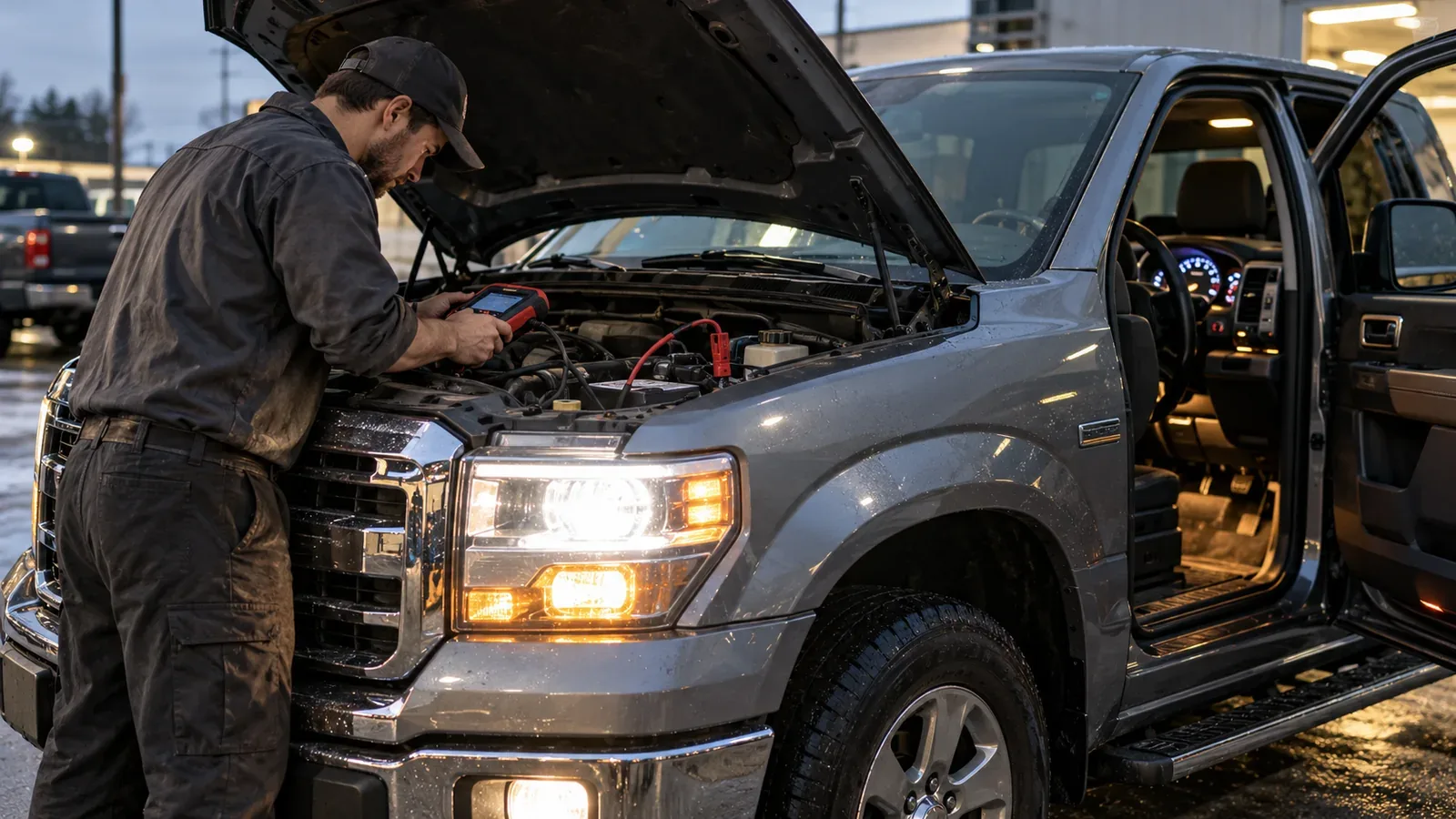
You climb into your truck, press the start button, and the dashboard lights up. The radio works. The screen wakes up. Yet the engine does not start. It is tempting to declare the battery “good” because something electrical still works, or to order a starter because you heard a click. Neither conclusion is reliable by itself.
The first useful question is whether the engine turns over. A truck that stays silent, one that clicks without turning, and one that cranks normally but never fires need different tests. This guide helps you describe the symptom accurately, make a handful of safe observations, and decide what to ask a technician before approving parts.
It primarily covers conventional 12-volt gasoline pickups and light-duty diesel pickups in the United States. Starting procedures differ by model year, engine, transmission, battery layout, hybrid system, and aftermarket equipment. Follow your exact owner’s manual when it conflicts with general advice. Heavy-duty commercial trucks may use different voltage arrangements and diagnostic systems.
Safety first: If you smell strong fuel, see smoke, notice damaged or swollen batteries, suspect an electrical fire, or the truck stopped suddenly while moving, stop attempts to start it, keep people clear and seek professional help. Do not use starting fluid, bridge starter terminals, bypass a neutral-safety switch, reach into moving components, or work on high-voltage hybrid systems. Never crank repeatedly to “see if it catches.”
Quick answer: why won’t my truck start if it still has power?
Dashboard lights use far less current than an engine starter. The truck can therefore illuminate its screen while its battery or cables cannot supply the high current needed to crank. Other possible causes depend on what you hear: rapid clicking often points to inadequate starting voltage or a high-resistance connection; one click or silence may involve the starter, starter circuit, gear-position input, brake or clutch interlock, or key recognition; normal cranking without the engine firing sends the diagnosis toward fuel delivery, engine timing, ignition (on gasoline engines), or control signals. These are starting hypotheses, not confirmed faults.
A road-service provider may be able to perform a battery and starting-system check on-site. If an exact warning message appears, photograph it before cycling the ignition again. When safety is uncertain, arrange recovery rather than experimenting.
Step 1: identify the sound before diagnosing the part
Park securely, apply the parking brake and make one normal start attempt following the owner’s manual. Listen from inside the cab; do not ask someone to stand near belts or moving mechanical parts. Observe whether the dashboard dims dramatically, whether a warning appears, and whether the engine physically turns.
| What happens when you attempt to start? | What it suggests | Best next action |
|---|---|---|
| Nothing turns, dashboard stays bright | Start command may be inhibited, or starter/control circuit may not operate | Check displayed key, brake, clutch and gear messages; request starter-command testing |
| Rapid repeated clicks, lights fade or reset | Battery current delivery or cable/ground resistance may be inadequate | Request battery load or conductance testing and voltage-drop checks |
| One heavy click, no rotation | Starter/solenoid, high-current connection, seized component or weak supply are possibilities | Have the shop test the circuit under load before replacing the starter |
| Slow, labored turning | Weak supply, excessive resistance, high mechanical drag, cold-weather conditions | Stop repeated attempts; test starting voltage and current draw |
| Normal cranking, no engine start | The starter is turning the engine; investigate fuel, ignition, timing, sensors and immobilizer status | Preserve codes and request a structured no-start diagnosis |
| Engine starts briefly, then stalls | Different from no-crank; can involve security authorization, fuel or engine controls | Record the duration and messages; avoid repeated restart cycles |
| Grinding or harsh mechanical noise | Potential starter engagement or mechanical damage | Stop attempts and arrange professional inspection |
Do not treat these patterns as a parts list. A bad cable can imitate a bad starter. A new battery can still be poorly charged, defective or installed with an inadequate connection. A truck that cranks can have a separate battery or starting issue along with another fault.
Step 2: try these safe, no-tool checks first
The aim is to rule out straightforward operator or security conditions, not to repair electrical components at the roadside. Perform only checks compatible with the manual and location.
Confirm Park, brake, clutch and the starting sequence
For an automatic transmission, verify the display shows P (Park) and follow the manual’s brake-pedal instruction. A manual transmission may require the clutch fully depressed. Do not shift or test a vehicle that could roll. A malfunctioning range switch or brake/clutch input can prevent a start command even if the dash powers up. Ford’s owner documentation explicitly lists insufficient battery charge, missing pedal input, invalid key recognition and gear-position conditions as possible reasons for no-crank behavior.
If the dashboard displays a “starting system disabled” or “cranking time exceeded” message, obey its waiting period. Some vehicles limit attempts to protect the starting system. Repeatedly pressing the button can make diagnosis harder rather than improving your odds.
Read key-fob and anti-theft messages
If the display reports Key Not Detected, consult the model-year manual for the passive-key backup starting location or spare-key procedure. Do not assume the engine starter has failed. A depleted key-fob battery or unrecognized key can affect authorization. A truck that starts and immediately stops also warrants documentation of any theft-deterrent warning.
Confirm the fuel level from reliable information
A gauge that reads near empty or a truck parked on a severe slope may complicate fuel delivery. Record the fuel reading and recent refueling; do not attempt to prime high-pressure fuel lines or open a diesel common-rail system. If you added fuel and the truck still will not run, your next step should be diagnosis, not an assumption that every start failure is a fuel-pump problem.
Look for obvious hazards, not hidden electrical faults
From a safe location, note visible terminal corrosion, damaged wiring, leaking battery fluid, belt debris, smoke or abnormal odors. Do not touch swollen, leaking, excessively hot or damaged batteries. Do not remove covers to reach unfamiliar cables, bridge terminals, remove relays at random or probe wiring without a service procedure. A visual observation can support a technician’s test; it cannot certify a circuit healthy.
Record the exact sequence
Write down whether the problem appeared overnight, after a drive, after service, after refueling or intermittently. Photograph any warning message. Note if this is a push-button or keyed ignition, and whether accessories were recently added. A repeatable history is often more valuable than another unsuccessful attempt.
Why lights and radio power do not prove the battery is good
A screen may run on a relatively small current, while cranking requires a much larger burst. A weak battery can support accessories but fail under load. Excess resistance at a positive cable, ground strap or terminal can produce the same effect; a battery test alone may not find the resistance in the vehicle wiring.
The correct diagnostic question is not merely, “Does it have 12 volts?” It is, “What happens to voltage and current delivery during a start request, and where is excessive voltage being lost?” A workshop may measure battery state of charge, battery health or conductance, cranking voltage, charging performance once running, and voltage drop through main supply and ground paths.
Do not interpret one voltage number as a universal pass/fail result. Battery chemistry, temperature, recent use and vehicle systems affect readings. The guide on a truck battery that keeps dying covers repeated discharge and charging faults in detail. This article is about deciding why the truck will not start on this occasion.
Does a jump start prove the battery was the problem?
No. If a vehicle starts after outside power is supplied, it indicates that the added power changed the starting conditions, not which part originally failed. A discharged battery, poor connection, charging-system fault or another intermittent issue may still require testing. If a jump is appropriate, follow the exact owner’s-manual sequence and equipment requirements or use roadside assistance. Some hybrid, high-voltage and modern electronically controlled vehicles require special precautions.
A successful jump followed by another failure is evidence to collect, not permission to buy a battery without testing. If there is a swollen battery, leaking electrolyte, smoke or suspected cable damage, do not jump-start it.
No crank but power: how a shop narrows the fault
When you turn the key or press Start and the engine does not rotate, the technician should first establish that a valid start request is reaching the appropriate control system, and then verify the high-current electrical supply and starter response.
Battery under load and cable resistance
A shop may compare voltage at the battery and at the starter during the attempt, including voltage drop on ground and positive paths. A heavily corroded ground or loose connection can behave like a failed starter even while the lights remain on. A visible clean terminal is not proof that the hidden connection is sound.
Starter motor and solenoid
A click can come from a solenoid or another relay, but the sound alone does not justify replacing a starter. Technicians can test the circuit, confirm the starter has appropriate power and ground under load, assess current draw, and consider whether a mechanical obstruction exists. Do not lie underneath an unsecured truck or attempt to tap or bridge starter wiring.
Ignition, relay, fuse and control request
A valid ignition switch or push-button request, a relay circuit, an electronic module and other interlocks may all be involved. An open circuit can make the dash appear normal while no starter command is delivered. Fuse inspection must follow the manual; repeatedly fitting fuses when one blows is unsafe and does not explain the root cause.
Park/Neutral or clutch interlock
A transmission range, brake, or clutch input may prevent engagement. There is a difference between the system intentionally refusing to crank and the starter being asked to crank but failing. The shop should identify which is happening. Do not bypass interlocks to force the starter on.
Security and key authorization
On newer pickups, immobilizer or passive-key issues can inhibit starting. A “no key detected” warning should be recorded exactly. Manufacturer-specific diagnostic data may be necessary: a generic reader may not show every relevant module fault.
Engine cranks but won’t start: a different decision path
If you hear the engine turning at its usual cranking speed, the starter has done at least part of its job. You are now asking why combustion does not sustain. On a gasoline pickup, the shop may need to check controlled fuel delivery, ignition, engine synchronization, compression and sensor inputs. On a diesel pickup, the checks differ: high-pressure fuel systems, glow or intake preheat under some conditions, engine speed signals, immobilizer authorization and other model-specific requirements may apply.
Never spray starting fluid into a modern engine as an improvised test. It can cause fire, mechanical damage or uncontrolled ignition; certain manufacturer instructions prohibit it entirely. Leave fuel-pressure measurements, spark testing, injector diagnosis and timing verification to qualified personnel.
Fuel delivery and pressure
Running out of fuel is one explanation, but not the only one. A fuel pump may fail, or a control, wiring, pressure or injector condition may interrupt delivery. Hearing a pump sound does not prove that the system achieves required pressure under the correct conditions. A technician should test according to the exact engine’s procedure before suggesting an expensive pump.
Ignition and misfire systems — gasoline trucks
An engine may crank without firing because it is not producing spark at the proper time, but a no-start is not automatically a spark-plug job. Coils, related wiring and engine position information can be involved. Ask what measurement or diagnostic evidence confirms the proposed repair.
Crankshaft and camshaft position information
The engine computer needs accurate position signals to coordinate combustion. A sensor fault, wiring issue or mechanical timing problem may prevent a start. Diagnostic codes such as a crankshaft-position-sensor circuit fault can be useful clues, but the correct response is to test the affected circuit and mechanical context, not automatically to order the named sensor.
Mechanical compression or timing
An abnormal fast cranking sound, prior noise or a sudden stop may warrant mechanical checks. Severe timing faults or internal damage are possible and could make repeated cranking harmful. If the engine sounded markedly different from normal, stop and arrange diagnosis instead of trying several more times.
Heavy-duty and diesel distinctions
This article is written chiefly for pickups. A Class 8 tractor, diesel work truck or hybrid uses different diagnostic conventions and potentially multiple batteries, 24-volt circuits, air-start equipment, engine control networks or high-pressure systems. Diagnostic codes and test equipment may be different from consumer OBD-II. A heavy-duty specialist should use the manufacturer-approved starting and fault-finding procedure.
Troubleshooting by specific symptom
Truck won’t start but has power and makes one click
A single click plus no engine rotation often shifts attention toward the starter-command and high-current paths. Do not skip the battery load test or cable voltage-drop test; those can reveal a failure that looks like a starter problem. The shop should establish whether the solenoid operates and whether the motor receives sufficient power during an attempted start.
Truck won’t start but has power and makes rapid clicks
Repeated clicking with dimming lights commonly accompanies inadequate current delivery. A low-charge battery, defective battery, ground connection or cable resistance are among the candidates. If a fresh battery still produces this behavior, inspect installation and wiring before buying the next part.
Truck won’t start but lights don’t dim
Steady dashboard lights may indicate that little starter load was applied, but they do not prove the battery is healthy. A missing start authorization, failed relay, starter circuit problem or disconnected supply can all be considered. Exact display messages and a technician’s circuit measurement carry more weight than the fact that the screen stays bright.
Truck cranks but won’t start after fueling
Record the fuel type, station visit and amount added. Do not conclude that the fuel pump failed solely because the problem happened after refueling. Contaminated or incorrect fuel is a serious possibility in some situations; if you suspect a misfuel, stop cranking and seek model-specific advice. A gasoline engine with unusual evaporative-system behavior is another diagnostic question for a technician, not a reason to replace a canister valve without testing.
Truck won’t start intermittently when hot
The fact that starting works cold but fails after a short stop is useful evidence. Heat-sensitive electrical components, poor connections, starter behavior or sensor faults are possible, but no single component can be identified by temperature alone. Record ambient conditions, engine temperature if displayed, elapsed time and exact sound. Do not deliberately heat the vehicle or keep driving to reproduce a dangerous symptom.
Truck won’t start after battery replacement
A new battery may be discharged, incompatible, improperly installed or connected through a weak cable. Some modern vehicles also have battery registration or management procedures. Ask the installer to verify suitability, connections and vehicle-specific procedures, and to test the starter circuit if the fault persists. The new part is not a guarantee that the entire starting system is sound.
A seven-step diagnostic conversation with the repair shop
You do not need to diagnose electrical circuits yourself to get a better repair decision. A useful work order begins with observable facts and requests evidence before parts replacement.
- Define the complaint. “Dashboard powered, one click, no engine rotation” is more precise than “truck won’t start.” Include intermittent patterns.
- Document warning messages. Include immobilizer, battery/charging and starter-system messages, even if they disappear later.
- Ask for battery and connection checks under load. If no-crank is reported, request a measurement appropriate to the vehicle, not just a voltage glance.
- Separate start-command issues from starter performance. Did the truck request a start? Was a signal delivered? Did the circuit supply enough current?
- For cranks/no-start, ask which required condition was actually missing. Fuel delivery, ignition where applicable, control timing and mechanical condition need evidence.
- Request a written estimate with diagnostic findings. Specify a limit on work that requires additional authorization.
- Ask how the repair will be verified. The original complaint should be retested, including the operating conditions that caused an intermittent failure when safely possible.
The Federal Trade Commission’s repair guidance recommends asking about diagnostic charges and obtaining a written estimate before authorizing work. That is particularly useful when the first diagnosis is an expensive starter, fuel pump or control module.
Three realistic examples: same complaint, different decisions
These are representative scenarios assembled to explain a method. They are not actual customer cases, verified repair records or current price quotations.
Example A: lights on, repeated clicking at the job site
A contractor returns to a pickup after several short trips. The display lights, but the start attempt produces repeated clicks and the dash resets. The immediate guess is a starter motor. A professional test instead finds that available starting power collapses under load. The right next step is to identify whether the battery itself or a cable/ground path is responsible. Ordering a starter before that check risks paying for a part that was never shown to be defective.
Example B: one click after a long drive
A driver stops for a delivery; twenty minutes later, the truck makes one heavy click without rotating. The dash remains bright. The shop documents voltage at the battery, measures the high-current paths during a start request, and checks whether the starter actually receives a command. The findings may support a starter repair, but the sound alone would not. The customer approves the replacement only after the circuit and supply are verified.
Example C: starter turns, engine never fires
A pickup’s starter spins at normal speed, but the engine does not run. Replacing the starter would not address what is observed: the motor already turns the engine. Instead, the shop captures available codes and tests the relevant fuel/ignition/control conditions for that exact powertrain. The confirmed cause determines the repair. The difference between cranks and starts prevents a false diagnosis.
How to compare repair estimates without relying on invented prices
Prices vary with truck model, local labor, access difficulty, diagnosis time, parts quality and whether the fault is intermittent. A general online “starter replacement cost” figure cannot establish what your truck needs. Ask for the following components on one estimate so two proposals can be compared fairly.
| Estimate field | Why it matters | Question to ask |
|---|---|---|
| Confirmed test result | Separates evidence from theory | “What measurement shows the component failed?” |
| Diagnostic labor | Intermittent electrical problems can take time | “How much diagnosis is included and what is extra?” |
| Parts and specification | Different trims may use different components | “Is this exact part correct for my VIN and engine?” |
| Installation labor | Access and secondary work change time | “Does this include all associated work?” |
| Authorization limit | Prevents an open-ended invoice | “Will you call before exceeding this amount?” |
| Warranty and verification | A new part is only useful if the symptom is resolved | “What is covered and how was the start checked?” |
Where a shop cannot yet identify the failure, an estimate for diagnostic time may be more credible than a firm parts quote. Do not pressure a technician to guess a repair solely to get a number.
What to avoid while the truck is stranded
- Repeated starting attempts. They can overheat a starter, discharge the battery further, and sometimes increase mechanical risk.
- Assuming illuminated accessories mean a healthy battery. The starting load is substantially different.
- Swapping relays, fuses or cables at random. It obscures evidence and may introduce a new fault.
- Using starting fluid or manipulating fuel-pressure lines. Those procedures can be hazardous, especially with diesels.
- Attempting to bypass a brake, clutch or Park interlock. It creates a vehicle-movement hazard.
- Ordering a starter, alternator or fuel pump without tests. The same symptom has several causes.
- Clearing codes before recording them. Fault history and conditions can help the workshop diagnose an intermittent failure.
If the truck is in an unsafe location, move people away from traffic and contact roadside assistance. If the vehicle unexpectedly stalled while driving, if major mechanical noise preceded the stop, or if there is fuel odor or smoke, do not assume a roadside restart is a safe goal.
Free printable: truck no-start symptom and repair record
Make a short note for the workshop: whether the dashboard lights up, whether the starter clicks or cranks, the vehicle and key type, any warnings, recent service, and how the problem developed. Ask the shop to document test results and the reason for any proposed repair. Avoid repeated starting attempts just to demonstrate the sound.
Use it to write the exact sound once, rather than trying the starter over and over to demonstrate the problem. Record whether the dash powered up, the model-year, key type, gear indication, warnings, temperature, previous service and any battery assistance. A technician can then link those observations to measurements.
Frequently asked questions
Why won’t my truck start if the radio and dashboard work?
A radio or dashboard needs far less current than cranking. A weak battery or cable connection can still be responsible. If the starter is not commanded at all, key recognition, gear position, brake/clutch input and starting-circuit faults are additional possibilities. Record whether the engine rotates before choosing a diagnosis.
Can a bad starter cause one click with the lights still on?
Yes, but so can insufficient current delivery, a bad connection or a different starting-circuit condition. The click by itself does not prove the starter failed. Ask for battery, voltage-drop and starter-command tests before approving replacement.
Why does my truck crank but not start?
If the starter turns the engine normally but it never runs, diagnosis moves toward controlled fuel delivery, ignition for gasoline engines, engine-position information, mechanical timing and other powertrain-specific conditions. A qualified shop should confirm the missing condition rather than guessing from a general symptom.
Can a new battery still leave my truck unable to start?
Yes. It could be discharged, unsuitable or poorly connected, and a separate starter, security or engine-management problem can remain. Test the replacement under load and verify wiring and required battery-management procedures before buying another part.
What does it mean if my truck won’t start when hot?
It describes a useful pattern but not a single failed component. Heat-sensitive electrical faults, starter behavior and sensor or control issues are possibilities. Note whether the engine cranks, the exact temperature conditions and how long the truck was parked; stop repeated attempts and ask for tests.
Should I keep trying to start a truck that makes a grinding noise?
No. Harsh grinding can indicate mechanical or starter-engagement trouble. Repeated attempts may increase damage. Stop and arrange professional assessment, especially if the engine sounded unusual or stalled abruptly.
Does an OBD-II code tell me what part to replace?
No. A code identifies a detected condition or circuit problem, not necessarily the failed component. Save the code and related warning information. Vehicle-specific tests should establish the cause before replacement; see our Check Engine guide for how to interpret trouble-code evidence.
Sources and scope
This guide synthesizes public consumer and manufacturer troubleshooting guidance, not a diagnosis of any particular vehicle. The most useful primary references are Ford owner-manual starting-system FAQs, AAA’s no-start troubleshooting overview, Interstate Batteries’ explanation of starting problems beyond the battery, and FTC advice on estimates. Each vehicle’s official service information takes priority for measurements, component access and safety warnings. No search-volume figures, repair-price quotes or unverified customer experiences are presented as facts.
Bottom line: Before replacing anything, tell the shop whether your truck does not crank, clicks, or cranks without starting. That single observation usually improves the next diagnostic decision more than another random start attempt.