
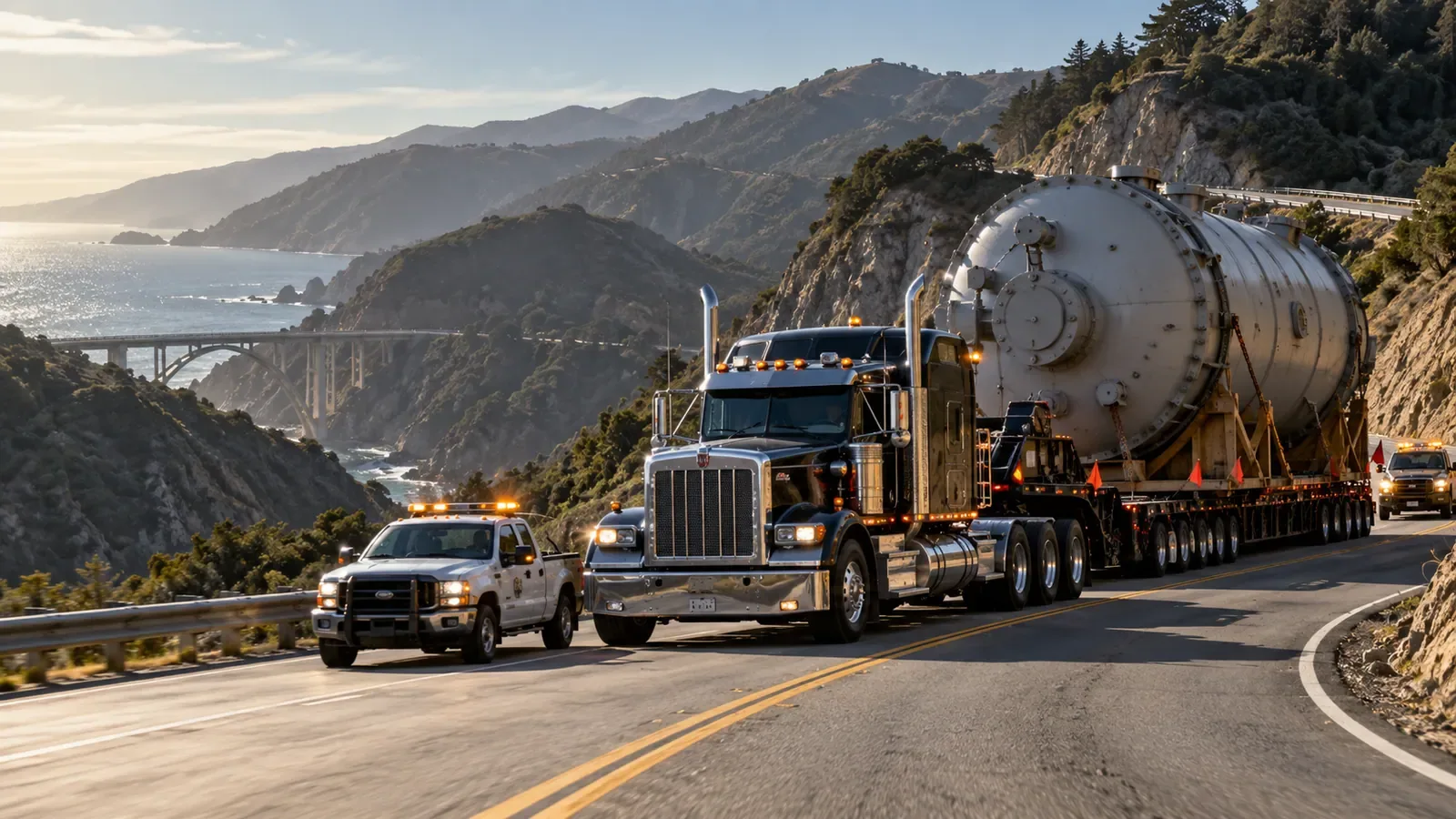
A load that exceeds standard vehicle or route limits is not just a more expensive version of a routine trailer trip. In California, the dimensions of the full combination, axle weights, reducibility of the commodity, bridge limitations and exact roads all matter. Even an experienced dispatcher can underestimate the work involved if they focus only on the load’s total gross weight.
This California Trucking Hub chapter concentrates on Caltrans transportation permits for oversize or overweight movements. It does not issue permits, certify a route, or replace the carrier’s own load measurement. Use the Load Profitability Calculator after the route and required escort or permit costs have been confirmed.
State transportation permits and their limits
Caltrans is the state transportation agency that administers specified permits for loads exceeding applicable legal limits on roads under its jurisdiction. Caltrans uses the term extralegal for size or weight outside ordinary legal limits. The official permit application guidance states that a principal eligibility test is whether the load is nonreducible: it cannot reasonably be divided into smaller loads carried using legal configurations.
That criterion is significant for carriers trying to treat ordinary bundled cargo as an oversized load. A carrier cannot assume it will receive permission simply because a customer prefers to move several smaller items on one large vehicle. Nor is a posted maximum axle weight automatically waivable. Certain combinations or loads may be ineligible even for permits and must be changed before traveling.
California interstate highways, state highways and local roads can have different authorities and constraints. The location where freight is picked up may use city streets, while the long-distance movement uses Caltrans roads. A Caltrans permit should not be interpreted as local authorization for every municipal or county street on the journey. Verify each applicable road authority before quoting a complete move.
Gather real dimensions and axle information
Collect the full measured loaded configuration: overall width, height, length, weight, tractor and trailer details, axle count, axle spacing and distribution. An empty equipment brochure does not show the final measurements once machinery is secured. Height must account for the trailer, load, attachments and all fixed projections.
Axle weights are particularly important because a combination may satisfy a nominal gross total while exceeding a legal or permit-controlled axle or group limit. If a customer provides only cargo weight, the carrier still needs the equipment tare weight and the practical distribution across the assembly. Where uncertainty is material, obtain a suitable scale measurement and professional load plan.
Identify the precise origin, all loading locations, planned roads, destination and proposed transport window. Permit applications can require equipment information and supporting inspections depending on the type of load. Caltrans may need to evaluate the route if the carrier cannot submit an approved route. This is not equivalent to choosing a truck route in a standard navigation application.
| What to capture | Why it matters |
|---|---|
| Total height | Bridges, overhead utilities and clearance restrictions |
| Total width | Lane use, escorts, restrictions and traffic conditions |
| Overall length | Turning geometry, intersections and restricted segments |
| Gross and axle weights | Pavement, bridge and axle-specific authorization |
| Exact origin and destination | State/local jurisdiction and permit coverage |
| Equipment and reducibility | Permit category and eligibility |
| Travel dates | Permit validity and time-of-day limitations |
Common Caltrans permit categories
Caltrans guidance discusses categories including single-trip, annual and other specialized permit applications. An annual authorization is not a universal permit for any combination or route; its conditions and applicable limits still control. Some unusual moves require a more tailored review, route selection or special approval. The correct choice cannot be determined from a one-sentence online quiz without the trip data.
A single-trip application may carry more operational details and lead time, especially when route research or resident-engineer review is required. For a carrier selling an urgent industrial movement, the realistic dispatch date must include that processing time. If a permit is not approved yet, the route and schedule remain proposed rather than authorized.
Consult the Caltrans transportation permit application page for current routes to submission, the category definitions, vehicle inspection requirements and contact details. Avoid outdated third-party fee tables that omit route services, insurance or special conditions.
Route restrictions and last-mile work
A state-approved route is not a blanket declaration that every possible lane is safe for the load. Bridge capacities, structures, construction, highway closures and clearance geometry can affect the precise movement. Each permit may prescribe routes and restrictions that must be followed. Local authorities may impose additional rules on city or county roads, particularly for access to factories and job sites.
Before dispatch, assign responsibility for checking permits issued for the full origin-to-destination movement. The driver should know which copy of the permit to carry, the approved travel period, which roads are authorized and the required equipment or escort arrangements. Record who validated the last-mile segment; otherwise the permit review can stop at the state route while the last five miles remain unresolved.
If an interstate trip also enters Nevada, Arizona or Oregon, California paperwork should not be copied forward as though it authorizes movement elsewhere. Each jurisdiction may need separate review or documentation. A customer asking for a single all-inclusive quote should understand that multiple permits may be involved.
Escorts, timing restrictions and operational delays
Some movements involve pilot/escort vehicles, special signage, lighting, time restrictions, or conditions tied to visibility, traffic or daylight. Requirements depend on the permit, dimensions, roadway and surrounding rules. Do not advertise a fixed minimum escort configuration as though it applies to every California load.
Dispatch planning should account for the availability of escorts and the customer’s loading site, not only road speed. If an approved permit restricts travel to certain windows, driver hours and hotel arrangements may be affected. Likewise, a construction closure or a last-minute change of route can require new approval and additional service fees.
Model at least one contingency: an extra day of trailer or driver time, an additional escort day, or a permitted detour that increases fuel and operating costs. That is a business planning scenario, not a claim that Caltrans imposes a universal dollar amount. The Carrier Cash Runway Calculator can show how a delayed special load strains cash even if the eventual freight rate is attractive.
Build a defensible special-load quote
Start with linehaul revenue and every revenue and non-revenue mile required by the authorized route. Add permit fees only from the actual application or verified agency estimate. Include escort services, route surveys, possible utility coordination, loading cranes or riggers, securement and inspection work, and driver and equipment time. Insurance riders or customer-required limits are a separate cost question.
Assume a fictional approved load pays $8,000. The route contains 950 loaded miles plus 150 repositioning miles. If full equipment operating cost is $2.10 per actual mile, trip mileage alone costs $2,310. Add hypothetical permits of $350, escorts of $1,600, loading support of $500 and a planned $250 contingency. Total direct modeled cost is $5,010 and remaining contribution is $2,990 before other expenses not included in the model.
| Illustrative special-load calculation | Amount |
|---|---|
| Customer revenue | $8,000 |
| 1,100 actual miles × $2.10 | −$2,310 |
| Permits | −$350 |
| Escorts | −$1,600 |
| Loading support | −$500 |
| Contingency | −$250 |
| Modeled contribution | $2,990 |
These figures are made-up planning inputs, not published California rates. If the carrier omits the 150 empty miles or a required escort, the headline margin can be materially misleading. Use the Load Profitability Calculator to test your own trip data and non-revenue movements before accepting the freight.
Documents to retain after a permitted move
Retain a copy of the issued permit and all attachments, route notes, dimension and weight evidence, escort bookings, inspection reports, customer quote and final invoice. Document any approved route modifications and the party who authorized them. It is also useful to preserve dates of movement and a signed loading or delivery record so that a later dispute can be traced to the actual permit.
The carrier should maintain a separate Motor Carrier Permit record and applicable federal credentials. A special-load permit is not a substitution for ordinary motor carrier authorization or insurance. The relevant emissions status for the tractor may also remain important if the route uses California public roads.
Frequent planning failures
A dispatcher may quote a special load from Google Maps mileage without validating legal truck access. Another may assume an overweight permit cures a width or bridge issue. A third may get a Caltrans permit but forget local road authorizations. A fourth may use last year’s fee from a different category or submit the wrong combination details. Finally, a carrier may book an escort before knowing whether the state route is approved.
The practical correction is to make dispatch conditional on a documented permit package and route approval. Update the rate only after the actual permission, anticipated travel window and services are confirmed. Our California Trucking Hub provides the related registration and CARB checks.
Official California transportation permit source
- Caltrans — How to Apply for Transportation Permits.
- California DMV — Commercial Vehicle Registration.
- California DMV — Motor Carrier Permits.
Editorial information reviewed October 17, 2026. All load examples are illustrative. Actual movement must follow the current issued permit, exact route and all applicable authorities.