
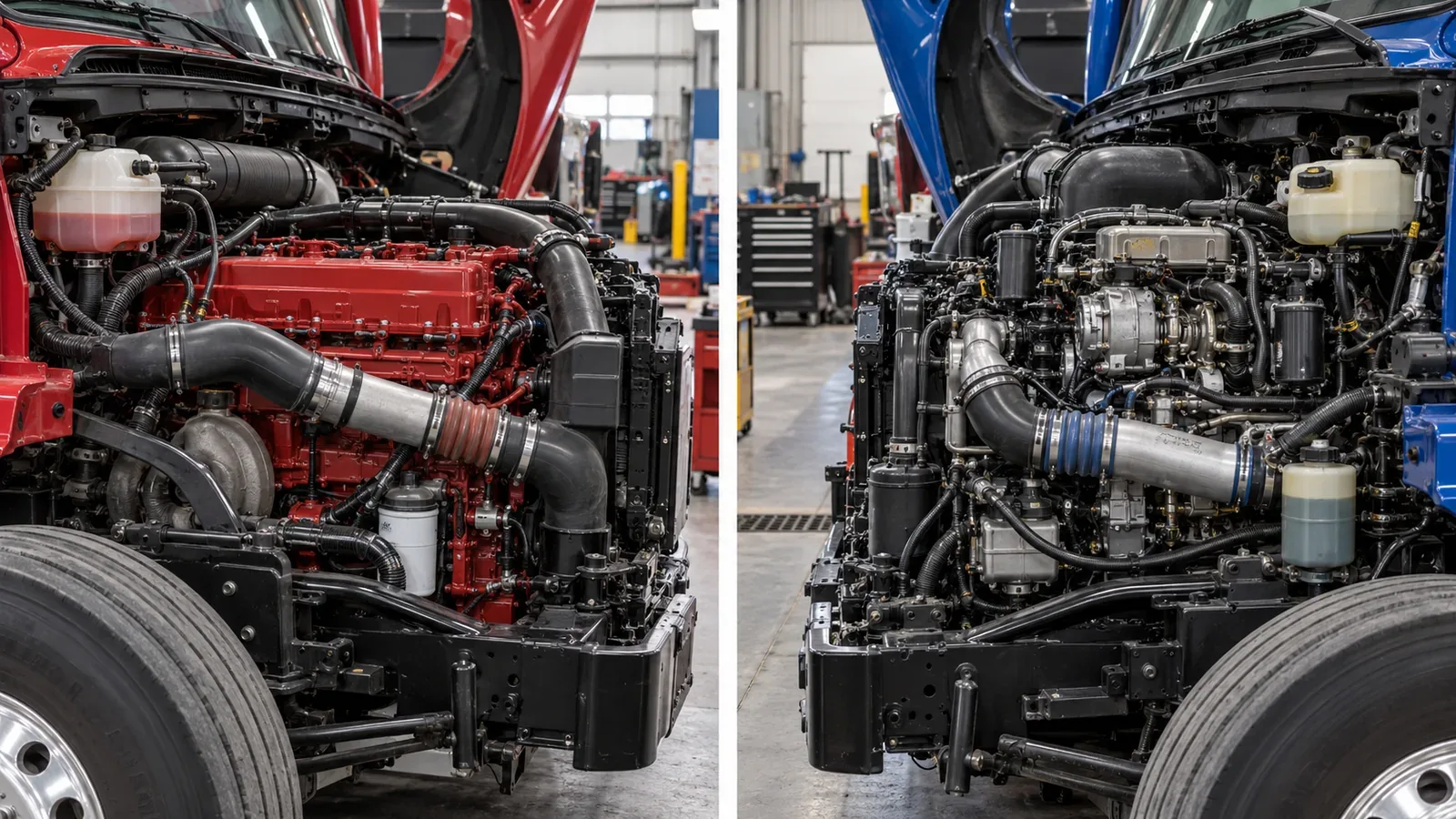
You have narrowed your next highway tractor down to two promising trucks. One has a Cummins X15. The other has a Detroit DD15. A driver at the truck stop says the X15 is easier to repair; another says the DD15 makes better fuel mileage. Both sound confident. Neither has seen the maintenance files, engine ratings, axle ratios or the routes you intend to run.
That is why “Cummins X15 vs. Detroit DD15” is a buying question, not a contest of engine badges. These are well-established North American heavy-duty diesel families, yet a fair choice requires details that disappear from generic online rankings. A 2024 X15 Efficiency rating is not the same thing as every X15 Performance engine. A Detroit DD15 Gen 5 is not the newly announced Gen 6, which is scheduled to begin production in 2027.
This guide compares what the manufacturers actually publish, explains what those numbers do and do not tell you, and provides a repeatable ownership-cost worksheet. It does not pretend to measure fleetwide failure rates where controlled comparative data have not been supplied. For engine longevity and rebuild decisions, see our separate Semi-Truck Engine Lifespan Guide.
Quick answer: which engine should an owner-operator choose?
Choose the engine-and-truck combination with the best documented fit for your freight, service territory, support network and budget. The Cummins X15 offers multiple applications and rating families, including a high-output Performance range. The Detroit DD15 Gen 5 is a 14.8-liter engine offered in Freightliner and other compatible Daimler Truck configurations. Neither brand alone predicts your repair invoice or fuel bill.
If two trucks perform similarly on the route, the deciding factors may be comparatively ordinary: the shop that can see you this week, a usable warranty, known service records and whether the transmission and axle ratio suit your work. If one truck comes with extensive documentation and the other only a verbal promise, that evidence gap should affect the purchase decision before any argument about horsepower.
Cummins X15 vs. Detroit DD15 specifications: compare the right versions
The table below uses Cummins X15 Efficiency Series (EPA 2024) and Detroit DD15 Gen 5 as specific reference families, rather than merging ratings from different generations. Published ranges indicate available calibrations; they are not claims that every truck can be ordered with every number. The sources are Cummins’ 2024 X15 Efficiency page and Detroit’s DD15 Gen 5 product page.
| Specification | X15 Efficiency (2024) | DD15 Gen 5 |
|---|---|---|
| Advertised displacement | 15 liters (engine family) | 14.8 liters |
| Configuration | Inline six-cylinder diesel | Inline six-cylinder diesel |
| Published horsepower range | 400–500 hp | 425–505 hp |
| Published peak torque range | 1,450–1,850 lb-ft | 1,550–1,850 lb-ft |
| Ratings to check | Exact X15 Efficiency calibration, including available SmartTorque options | Gen 5 on-highway vs. vocational rating and exact truck configuration |
| Main limitation | Do not treat the Performance Series ratings as Efficiency Series ratings | Do not substitute announced Gen 6 specifications for Gen 5 |
| Buying evidence | Engine identification, vehicle spec sheet, rated torque curve, software configuration | Engine identification, vehicle spec sheet, rated torque curve, software configuration |
Important generation difference: the X15 Performance Series has separately advertised ratings extending beyond the Efficiency family, including a 565-hp offering. That does not make every X15 a 565-hp engine. Likewise, Daimler Truck announced in February 2026 that production of Detroit’s Gen 6 DD13 and DD15 is scheduled to start in January 2027. Gen 6 data belongs in a future-model comparison, not in the table for an existing Gen 5 truck.
Why horsepower alone is a weak comparison
Horsepower matters for sustained work at speed and grade, but the usable performance of a Class 8 tractor also depends on torque at operating rpm, transmission ratios, axle ratio, tire size, shift strategy, gross weight and grade. Two trucks with a similar advertised horsepower can behave differently on steep routes because the drivetrain moves them through different rpm bands.
Cummins’ 2024 Efficiency literature includes different torque configurations, such as its SmartTorque strategy that allows an additional torque level in certain upper gears. Detroit markets its DD15 Gen 5 around downspeeding, combustion efficiency and quick torque response. These are different engineering and calibration approaches; they are not a measured victory for either engine in your exact haul.
Ask the dealer for a complete build sheet, not merely “450 horsepower.” A useful sheet identifies both the rated horsepower and torque, governed speed, transmission model and programming, rear-axle ratio, tire specification and any fleet speed limits. Make sure the quote actually describes the truck you will receive.
Dry engine weight is not truck payload
Manufacturer brochures may publish a dry-engine weight or engine-plus-aftertreatment system weight. Those numbers often use different definitions and do not prove that one complete tractor has a particular payload advantage. Cooling system, fuel tanks, sleeper, frame, emissions installation and optional equipment all matter.
For weight-sensitive work, request actual configured vehicle weight, axle information and the applicable limits. A few hundred pounds on an isolated engine specification cannot be treated as an automatic increase in your legal payload.
Maintenance intervals: there is no single X15-versus-DD15 oil-change number
Maintenance is one of the most frequently misrepresented parts of engine comparisons. A website may say the X15 goes 75,000 miles between oil changes, while another claims the DD15 needs service every 50,000 miles. That is not a controlled comparison unless the duty cycles, engine generations, lubricant specifications and calendar or hour limits match.
Cummins’ published X15 2024 maintenance table gives these example maximum standard oil-drain mileage intervals for different duty-cycle categories:
| Cummins X15 EPA 2024 duty category | Published standard oil-drain mileage |
|---|---|
| Severe, below 5.0 mpg | 25,000 miles |
| Short-haul, 5.0–5.9 mpg | 50,000 miles |
| Normal, 6.0–6.9 mpg | 60,000 miles |
| Light, 7.0+ mpg | 75,000 miles |
The Cummins EPA 2024 quick-reference document also includes 12-month limits and other application-specific conditions. For example, its vocational guidance lists a much shorter interval with a 500-hour element. Cummins also gives a special rule for high combined idle and PTO time and describes conditional extensions with certain lubricants or its oil-analysis monitoring program. The table is not permission to run every truck to 75,000 miles.
For the DD15, use the specific Detroit Gen 5 operating and maintenance documentation applicable to the engine serial number and emissions configuration. Detroit publishes service tables keyed to lubricant specification and duty category, with mileage and in some cases operating-hour limits. Its Gen 5 maintenance manual should be consulted for the correct schedule; an older EPA07/EPA10/GHG17 table is not a substitute for the appropriate Gen 5 schedule.
The practical comparison to request from both service departments
Have each shop fill in the following for the actual engine, not a marketing example:
| Maintenance question | What to record for X15 | What to record for DD15 |
|---|---|---|
| Engine ID | Serial, EPA family, rating, software | Serial, emissions generation, rating, software |
| Oil and filter | Specified product; miles/hours/months | Specified product; miles/hours/months |
| Fuel filtration | Primary/secondary schedule and total installed cost | Primary/secondary schedule and total installed cost |
| DPF / SCR | Inspection, ash-service triggers and parts availability | Inspection, ash-service triggers and parts availability |
| Coolant and valve work | Relevant service schedule and exclusions | Relevant service schedule and exclusions |
| Typical shop downtime | Booking lead time plus estimated service duration | Booking lead time plus estimated service duration |
| Documentation | OEM service bulletin/manual references | OEM service bulletin/manual references |
A long theoretical service interval may not save money if the truck is routinely doing severe-service city work or spends weeks waiting for an unrelated repair. Conversely, a documented interval extension can be economically meaningful if the truck and maintenance program satisfy the manufacturer’s conditions. Use whichever limit applies first under the exact instructions, not the most optimistic value found online.
Fuel economy: measure the truck and route, not the brand story
Cummins and Detroit both make design and efficiency claims about their own engines. Detroit’s DD15 product literature refers to fuel-economy improvement versus its preceding model. That is not a direct test against a Cummins-equipped truck. Likewise, statements about X15 Efficiency are not a controlled head-to-head fleet trial against the DD15.
Fuel use is influenced by aerodynamics, load, speed, terrain, wind, tires, axle ratio, cruise behavior, idling, aftertreatment operation and driver inputs. A driver who spends the day at 72 mph on steep terrain has not performed the same fuel test as a driver running 63 mph over relatively flat highways.
For a meaningful comparison, gather information from the same work pattern: preferably the same trailer type and routes, matched loading, similar ambient conditions, reliable fueling or telematics records, and enough trips to reduce one-off noise. If you compare quotes instead of physical trucks, ask for powertrain simulations with the same duty-cycle assumptions and request the limitations in writing.
Original example: how a small mpg difference affects a year’s fuel bill
Consider a carrier planning 120,000 annual miles and using $4.00 per gallon as a hypothetical planning price. The following values are illustrative assumptions, not fuel-economy claims for either brand.
| Planning scenario | 6.0 mpg truck | 6.2 mpg truck |
|---|---|---|
| Annual road miles | 120,000 | 120,000 |
| Diesel gallons = miles ÷ mpg | 20,000 | About 19,355 |
| Fuel at assumed $4.00/gallon | $80,000 | About $77,419 |
| Difference from 6.0-mpg scenario | Baseline | About $2,581 saved |
The point is not that one brand gets 6.2 mpg. Either engine could occupy either column depending on its truck configuration and operating conditions. The point is to quantify how a measured difference affects your cost estimate: about $2,581 a year, in this specific constructed example. If your verified data show a smaller gap—or none—there is no evidence-based fuel premium to award.
If actual diesel prices, idling or annual mileage change, the figure changes too. For a full operation forecast, use the Cost Per Mile Calculator and our broader Real Cost Per Mile Guide. Do not combine the calculator’s total fuel expense with a second copy of these illustrative dollars.
Reliability: what evidence would justify a winner?
Online discussions often say one engine “never breaks” or that the other “always has emissions problems.” These statements often draw from a handful of older trucks with mixed miles, repairs and driver habits. They may identify useful questions but are not reliable population-level rankings.
An honest brand comparison would need, at minimum, comparable engine generations, engine hours or distance, operating conditions, maintenance compliance, repair categories, severity and reporting methods. Ideally it would distinguish scheduled maintenance from unscheduled repairs, and engine-core failures from emissions and accessory faults. Without that evidence, claiming that one model is categorically more durable risks misleading a buyer.
For an individual truck, the useful evidence is available closer to home:
- Engine serial number and verified installation history; check for any non-original engine and associated documentation.
- ECM report and recent fault history, including repeated derates rather than one cleared warning light.
- Dated records for oil, fuel filters, coolant, valve work and emissions components.
- Major repairs specifying whether the scope was a targeted fix, overhaul, remanufactured replacement or accessory work.
- Written results of a qualified inspection with recommendations and remaining uncertainties.
- Any recall, service campaign or warranty action confirmed against the exact engine and VIN.
A lower-mileage truck with missing records may carry more uncertain risk than a higher-mileage unit with coherent service history. Our Engine Lifespan and Rebuild Signs Guide examines that condition question in depth rather than duplicating it here.
Emissions systems deserve their own line on the budget
Modern on-highway diesels use aftertreatment systems whose sensors, DPF, SCR, DEF supply and related components can affect uptime. A DPF service event is not necessarily an internal engine failure, and a failed sensor is not evidence that the short block requires replacement.
Before buying, ask for the maintenance and fault history of the emissions system separately from the engine. Look for repeat derates, incomplete repair attempts and repairs pending reinspection. For a truck that will spend considerable time idling or operating short, cool trips, discuss the expected duty cycle with a qualified service provider. Never treat removal or disabling of required emissions equipment as a legitimate cost-saving strategy.
Service networks, support and warranty: location can change the result
Suppose a carrier based in one state runs the same long-haul lane every week. Its nearest qualified Cummins-capable shop may have appointments available in two days, while the nearest Detroit dealer may have a longer backlog—or the reverse may be true. The manufacturer name alone does not tell you the local answer.
Build a simple service map around your home terminal and your most frequent lanes. Ask both service providers whether they can work on the specific engine generation and calibration, whether they stock typical items, and what happens when a larger repair is needed. Be explicit about roadside support, after-hours procedures and warranty authorization.
Warranty comparisons require more than a brochure headline. Review the actual contract for engine components, injectors, turbo, aftertreatment, diagnosis, labor, removal, towing, coverage territory, exclusions and maintenance obligations. If a used truck is marketed as having “engine warranty left,” verify coverage against the VIN/serial and confirm whether it transfers to you.
For trucks that require financing, the purchase and service decision also interact with liquidity. Read the site’s Truck Financing Requirements to plan lender documentation, and use the One-Truck P&L Template to record fixed costs separately from route-sensitive expenses.
A five-year comparison: the model that prevents a false winner
A comparison of two complete trucks should use the same forecast horizon and operating assumptions. Start with the truck purchase cost, not an isolated engine price. Estimate resale, fuel, maintenance, financing, insurance, taxes and a repair reserve. Do not assume you can buy a DD15 engine at the same standalone price as an X15 and simply swap them in a tractor: OEM integration makes that a different project altogether.
A useful simplified total cost of ownership model is:
Five-year ownership exposure = initial net purchase cost + interest/financing charges + fuel + routine service + unscheduled repairs + downtime-related contribution lost + other operating expenses − estimated resale proceeds.
Use that as an economic model, while keeping the associated cash-flow model separate. Loan principal is part of the cash payments and repayment structure; purchase price less sale value is an economic capital-cost view. Do not count the full purchase price, every loan principal payment and full depreciation again as three separate costs in a single total.
Original example: the service advantage that reverses a purchase decision
Consider two hypothetical otherwise comparable used tractors, one with an X15 and one with a DD15. Suppose Truck A costs $6,000 more upfront but comes with verifiable records and service arrangements expected to avoid five lost operating days per year. Suppose each lost day would forgo $450 in contribution after avoidable trip expenses, and both trucks are expected to be kept for four years.
| Hypothetical assumption | Amount |
|---|---|
| Truck A extra purchase cost | $6,000 |
| Potential days avoided annually | 5 |
| Contribution lost per day | $450 |
| Four-year theoretical downtime difference | $9,000 |
| Difference after $6,000 purchase premium | $3,000 in favor of Truck A, before other differences |
The arithmetic is 5 × $450 × 4 = $9,000. That is a useful illustration of how uptime can dominate a purchase premium. It is not evidence that Cummins or Detroit achieves five fewer downtime days, and it excludes discounting, taxes, differing residual values and the possibility that the predicted days never materialize. If the expected downtime gap cannot be substantiated, do not price it as a guaranteed saving.
Also test a negative case: Truck A may need unexpected repair work while Truck B does not. If the choice collapses when one extra repair is added, your expected savings may not be robust enough to justify a higher purchase price. The Truck Replacement Calculator is useful for evaluating larger keep-versus-replace economics, not for inventing component reliability probabilities.
Three representative buyer situations
These are constructed cases showing different decisions, not actual fleet testimonials or claims that a particular brand performs better in a named market.
Situation 1: regional hauls with frequent stops
A small fleet runs regional deliveries that involve idling, congestion and changing load weights. The manager initially selects an engine using its light-duty highway oil-drain interval. A careful service adviser points out that the actual duty cycle may qualify for different maintenance guidance. The right response is to request the serial-specific schedule and estimate service work under the fleet’s real hours and usage, then compare the transmission, emissions configuration and available maintenance slots. The advertised long-haul interval is not the correct shortcut.
Situation 2: one owner-operator, long fixed highway lanes
An owner-operator has a predictable route and two similarly priced tractors in good condition. The X15 truck includes detailed engine and emissions-system invoices; the DD15 truck offers a strong dealer relationship along the route but less complete paperwork. Neither feature alone determines the choice. An independent inspection, documented warranty, normalized fuel records and a realistic plan for breakdowns give the owner information that the engine badges cannot supply.
Situation 3: a newer engine offered at a premium
A sales brochure advertises future-generation DD15 numbers alongside a used truck that actually has a Gen 5. The buyer checks the engine identification and learns that the new generation was announced for a future production date. The quoted performance figures may be real for the future engine but are not proof of what is installed today. The correct action is to compare the exact truck as delivered, not whichever specification produces the most attractive comparison table.
Before you sign: a 12-point X15-versus-DD15 worksheet
Use this as a practical handoff to a dealer, shop or independent inspection provider. Keep the documents with your purchasing records.
- Identify both vehicles: VIN, model year, mileage, engine serial, EPA/emissions generation and truck build sheet.
- Verify actual ratings: horsepower, torque, governed rpm, transmission programming, axle ratio and tire size.
- Confirm the intended work: annual miles, hauling weight, city/highway split, idling, PTO, climate and terrain.
- Get serial-based maintenance plans: the correct oil, filter, coolant, valve and emissions service intervals, with hour/month limits.
- Collect real invoices: dated service, oil and coolant work, recurring faults and follow-up repairs.
- Request ECM evidence: engine hours, idle hours if available, derates, fault histories and calibration version.
- Inspect aftertreatment separately: DPF, SCR, DEF system, sensors, observed faults and warranty status.
- Request a qualified independent examination: focus tests on symptoms rather than guessing from mileage.
- Price scheduled service locally: parts, labor, bookings, shop hours and likely downtime.
- Verify support along your routes: authorized service options, road service and typical parts lead time.
- Read warranty limitations: transferable coverage, parts, labor, towing and emissions exclusions.
- Compare full truck economics: price, financing, fuel, repair reserve, lost contribution and resale over the same period.
For federally regulated motor carriers, the underlying duty to systematically inspect, repair and maintain covered vehicles is addressed in 49 CFR 396.3. The specific content and retention of vehicle maintenance records is handled separately in DOT Vehicle Maintenance Records. Neither regulation provides a rule that one engine manufacturer is safer or more durable than the other.
Bottom line: compare actual trucks, not engine reputations
The Cummins X15 and Detroit DD15 both have legitimate roles in Class 8 trucking, but the strongest buying decision is rarely a single horsepower number or a slogan about a million-mile engine. Different generations, calibrations and duty cycles can change the specifications and the service schedule before you even consider the condition of a used vehicle.
For an owner-operator, prioritize the documented truck, matched operating costs, credible repair support and clear warranty. Use manufacturer sources to establish what each engine is, then use your own route and cost data to determine what it is worth to your business. That is a comparison you can explain to a lender, a mechanic and yourself after a difficult repair bill—not just one that sounds persuasive online.