
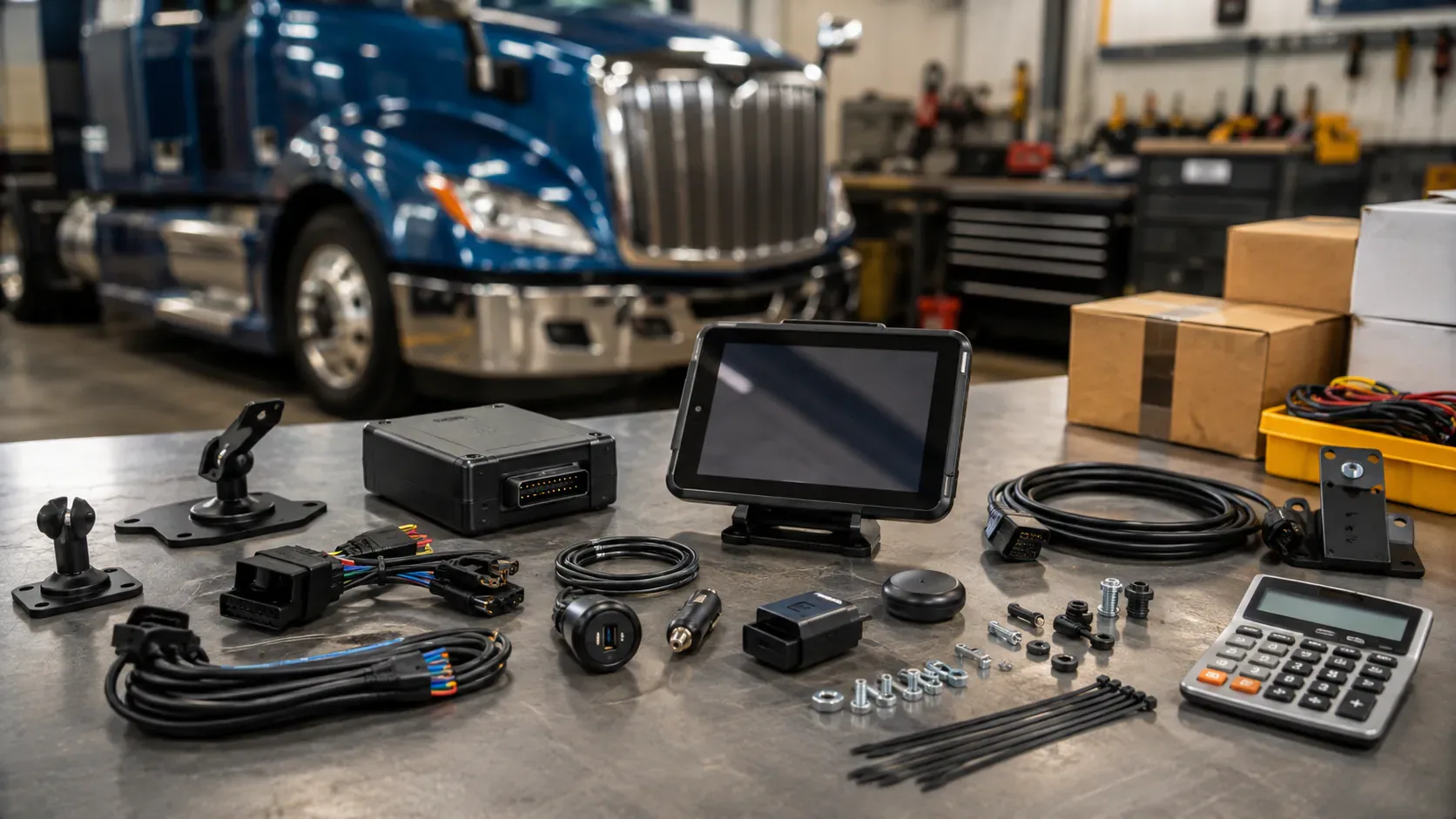
An ELD advertised at $20 per month can cost more than one advertised at $35.
The lower price can exclude:
- hardware;
- the correct vehicle cable;
- cellular data;
- activation;
- shipping;
- replacement;
- IFTA reporting;
- roadside support;
- record export.
The higher price can include all of them.
The only reliable comparison is the amount the carrier will pay from installation through cancellation.
For a one-truck business, calculate two numbers:
- first-year cash cost;
- total committed cost over the complete contract.
Then evaluate the cost of leaving.
That third number is where many weak ELD deals become expensive.
The ELD market uses four different pricing models
A carrier will usually encounter one of four commercial structures.
| Model | How the carrier pays | What requires attention |
|---|---|---|
| Hardware purchase plus subscription | Upfront device cost and recurring software fee | Ownership, warranty and continuing service cost |
| Free or discounted hardware with service | Hardware is bundled with annual payment or contract | Minimum commitment and cancellation liability |
| Subscription-free device | One-time hardware purchase | Current support, compatibility and future software availability |
| Quote-based fleet platform | Negotiated hardware, licenses and optional modules | Feature bundle, term, renewal and add-on pricing |
None is automatically better.
The correct model depends on:
- expected years of use;
- cash available today;
- support required;
- likelihood of changing trucks;
- need for fleet features;
- tolerance for a long contract.
What publicly advertised prices show in July 2026
Many ELD providers do not publish a complete fixed price.
Some display starting prices.
Others require the carrier to request a quote.
The examples below are useful for understanding pricing structures, not for selecting a provider without further review.
Low advertised monthly entry
HOS247 publicly advertises plans beginning at $17 per month.
Its pricing page also states that the logging device can be free with annual service payment, while a customer paying monthly can pay a separate hardware amount.
This illustrates a common trade:
- lower or free hardware;
- larger upfront service payment.
The carrier must calculate the total rather than recording the hardware as zero.
Public no-contract monthly offer
Blue Ink Technology publicly advertises BIT ELD at $30 per month with no contract.
Its terms state that recurring fees continue until cancelled and that cancellation generally leaves access through the end of the paid billing period without a prorated refund.
This structure is easier to compare because the provider publishes:
- monthly price;
- cancellation approach;
- contract status.
The carrier should still verify:
- hardware terms;
- shipping;
- compatibility;
- current registered status;
- data access after cancellation.
Subscription-free hardware
Garmin describes Garmin eLog as a subscription-free ELD.
A no-monthly-fee product can reduce recurring expense, but the carrier should confirm:
- whether the product is currently available from an authorized seller;
- current support;
- phone compatibility;
- vehicle compatibility;
- software updates;
- exact FMCSA listing.
A historical suggested retail price does not establish the current purchase price.
Quote-based platforms
Broader fleet platforms commonly require a quote based on:
- vehicle count;
- modules;
- hardware;
- contract term;
- implementation;
- support;
- negotiation.
Motive uses a $40-per-month example in its cost explanation rather than publishing one universal plan.
Samsara directs buyers through a pricing request and governs the commercial package through the executed quote and order documents.
A quote-based product is not necessarily expensive.
It is simply impossible to compare from the homepage alone.
Build the total-cost equation
The real ELD cost has three layers.
Acquisition cost
This is what the carrier pays before the first compliant trip.
It can include:
- hardware;
- cable or adapter;
- tablet or phone;
- mount;
- installation;
- activation;
- shipping;
- tax;
- first service payment;
- deposit.
Operating cost
This is what the carrier pays while using the device.
It can include:
- monthly or annual subscription;
- mobile data;
- premium support;
- GPS tracking;
- IFTA reporting;
- maintenance tools;
- document storage;
- additional users;
- dashcam integration;
- replacement warranty;
- taxes and regulatory fees.
Exit cost
This is what the carrier pays or risks when leaving.
It can include:
- remaining contract balance;
- early-termination fee;
- hardware return;
- damage fee;
- final month;
- data export;
- professional removal;
- replacement installation;
- overlapping service;
- driver retraining.
A cheap acquisition price can be offset by a high exit cost.
Normalize every quote into the same period
Never compare:
- one monthly price;
- one annual prepayment;
- one three-year total
as though they were equivalent.
Convert all offers into:
- first-year total;
- 36-month total;
- cost per truck per month;
- cost to exit after 12 months.
Basic calculation
Use:
Total cost = upfront cost + required recurring payments + expected add-ons + transition cost
Then:
Effective monthly cost = total cost ÷ number of committed months
The effective monthly cost should include mandatory charges, not optional features the carrier will not purchase.
Three illustrative one-truck offers
These examples are hypothetical.
They show why the advertised monthly number can mislead.
| Cost item | Offer A | Offer B | Offer C |
|---|---|---|---|
| Advertised price | $18 per month | $30 per month | $42 per month |
| Hardware | $99 | Included | Included |
| Activation and shipping | $45 | $20 | $0 |
| Required term | 24 months | Month to month | 36 months |
| Cellular data | Driver provides phone | Driver provides phone | Included |
| First-year cash cost | $360 | $380 | $504 |
| Total committed cost | $576 over 24 months | No fixed long-term commitment | $1,512 over 36 months |
Offer A appears cheapest.
It also requires a two-year commitment and the carrier’s own connected device.
Offer B costs slightly more in year one but preserves flexibility.
Offer C costs more because it can include a broader connected platform.
The correct choice depends on business value, not only the total.
Hardware is not one line item
An ELD can require more equipment than the adapter shown in the advertisement.
Engine-connected hardware
Verify whether the price includes:
- ELD adapter;
- correct 6-pin, 9-pin or OBD-II cable;
- Y-cable;
- replacement connector;
- installation material;
- warranty.
A cable change can be necessary after:
- changing trucks;
- replacing an engine;
- moving from heavy-duty to medium-duty equipment;
- installing another diagnostic device.
Driver display
A BYOD product normally uses a phone or tablet.
The true cost can include:
- compatible device;
- case;
- mount;
- charger;
- mobile plan;
- replacement after damage;
- operating-system updates.
Using an existing phone is not automatically free.
The phone is now operational equipment.
Installed hardware
A hardwired device can add:
- professional installation;
- downtime;
- removal;
- transfer to another truck;
- replacement labor.
Ask whether installation is:
- required;
- optional;
- mobile;
- included;
- warrantied.
The free-hardware trap
Free hardware can be a reasonable deal.
The problem is treating it as free without reading the conditions.
The cost can be recovered through:
- annual prepayment;
- multi-year commitment;
- higher monthly subscription;
- nonrefundable activation;
- mandatory add-ons;
- return obligation;
- replacement charges.
Questions that reveal the structure
Ask:
- Do I own the hardware?
- When does ownership transfer?
- Must it be returned?
- What happens if I cancel?
- What is the lost-device price?
- What is the damaged-device price?
- Is the cable included?
- What happens if I change trucks?
- Is replacement included during the entire contract?
The provider should answer each question in writing.
The monthly-fee trap
The displayed monthly fee can exclude mandatory services.
Common examples include:
- data connection;
- administration portal;
- additional driver;
- IFTA mileage;
- DVIR;
- GPS history;
- document storage;
- compliance reports;
- premium support.
Per vehicle or per driver?
Clarify the billing unit.
A provider can charge:
- per truck;
- per driver;
- per active device;
- per administrator;
- per module.
A one-truck team operation can therefore cost more than a one-truck solo operation.
Active and inactive months
Seasonal carriers should ask:
- Can service be paused?
- Is there a reduced inactive rate?
- Does hardware remain assigned?
- Are records accessible while paused?
- Does the contract term continue?
- Is reactivation charged?
The answer affects annual cost more than a small monthly discount.
The data-plan trap
Some ELDs include cellular connectivity.
Others use the driver’s phone or tablet.
The carrier should identify exactly which functions require internet access.
Possible costs include:
- new mobile line;
- hotspot;
- roaming;
- device replacement;
- data overage;
- international use.
A provider can advertise no data charge because the carrier supplies the data.
That is a cost transfer, not a cost elimination.
Test remote operation
A low-cost phone-based system can be a good option when it:
- continues recording offline;
- synchronizes reliably;
- displays records without service;
- completes roadside transfer appropriately;
- uses little mobile data.
Do not estimate this from the monthly price.
Test it on the carrier’s routes.
The feature-bundle trap
ELD compliance is often bundled with:
- live GPS;
- IFTA;
- fault codes;
- maintenance;
- routing;
- dispatch;
- safety scoring;
- dashcam;
- fuel tools.
Bundles can save money when the carrier would buy those services separately.
They waste money when the carrier already has them.
Separate required from optional
Create three groups:
Required
- compliant ELD;
- record display and transfer;
- retention and backup;
- support.
Operationally useful
- IFTA mileage;
- GPS history;
- maintenance reminders;
- document capture.
Not currently needed
- AI camera;
- multi-level dispatch;
- advanced driver coaching;
- enterprise analytics.
Ask the provider to price only the first two groups.
The contract-term trap
Long contracts can reduce the monthly price.
They can also create liability when:
- truck is sold;
- authority closes;
- device fails;
- provider support deteriorates;
- FMCSA revokes the product;
- carrier changes operating model.
Read the order form and master terms together
The quote can state:
- monthly price;
- hardware;
- term.
The master agreement can control:
- renewal;
- cancellation;
- warranty;
- data;
- liability;
- payment acceleration;
- disputes.
Both documents matter.
Contract start date
Determine whether the term begins on:
- signature;
- shipment;
- delivery;
- activation;
- first invoice;
- installation.
A carrier can lose part of a prepaid term while waiting for hardware or installation.
Automatic renewal
Record:
- renewal date;
- required cancellation notice;
- renewal term;
- future price method.
A 30- or 60-day notice requirement can convert a missed calendar reminder into another year of service.
The early-termination trap
Ask for the exact amount due after cancellation at:
- month 3;
- month 12;
- month 24.
Possible structures include:
- flat fee;
- remaining subscription balance;
- percentage of balance;
- hardware repayment;
- no cancellation right;
- fee plus hardware return.
FMCSA revocation clause
The agreement should explain what happens if FMCSA removes the device from the registered list.
Seek clarity on:
- replacement hardware;
- substitute product;
- refund;
- cancellation;
- data migration;
- shipping;
- installation;
- transition support.
The carrier should not assume ordinary warranty language covers regulatory revocation.
The record-access trap
The carrier must generally retain ELD RODS and required supporting documents for six months.
The provider’s portal is not the carrier’s legal defense when access disappears.
Before signing, request a demonstration of:
- PDF export;
- CSV or spreadsheet export;
- ELD output file;
- date-range selection;
- bulk driver export;
- unidentified-driving history;
- edits and annotations.
Ask about post-cancellation access
The contract should state:
- how long access remains;
- which formats are available;
- whether export costs extra;
- whether support is required;
- whether inactive driver records remain;
- how the separate backup is handled.
A provider should not become the only practical holder of the carrier’s required records.
The replacement-cost trap
Hardware pricing should include failure scenarios.
Ask for the cost of:
- replacement adapter;
- cable;
- mount;
- tablet;
- expedited shipping;
- technician visit;
- lost device;
- damaged device.
Warranty scope
Review:
- duration;
- normal wear;
- cable damage;
- water;
- vibration;
- electrical damage;
- shipping;
- advance replacement.
A free replacement that arrives in ten business days can still create expensive downtime.
The support trap
Some plans include standard support but charge for:
- implementation;
- training;
- priority service;
- roadside hotline;
- after-hours support.
A one-truck carrier should test support before signing.
The cost of poor support can be:
- missed load;
- paper-log transition;
- roadside delay;
- out-of-service exposure;
- hours spent rebuilding records.
Price support as part of the ELD, not as a separate luxury.
Taxes, shipping and invoice drift
Two quotes with the same subtotal can produce different invoices.
Review:
- sales tax;
- regulatory recovery fee;
- shipping;
- handling;
- payment-processing fee;
- annual price increase;
- minimum quantity;
- prorating;
- invoice timing.
Match invoice to quote
After the first invoice, compare:
- product name;
- device quantity;
- driver quantity;
- subscription dates;
- add-ons;
- hardware;
- tax;
- discounts;
- contract end date.
Resolve errors immediately.
Silence can make incorrect billing difficult to challenge later.
Calculate one-year, three-year and exit cost
A serious comparison should contain four totals.
| Cost category | Provider A | Provider B | Provider C |
|---|---|---|---|
| Hardware and cable | Enter amount | Enter amount | Enter amount |
| Activation, shipping and tax | Enter amount | Enter amount | Enter amount |
| Required monthly service | Enter amount | Enter amount | Enter amount |
| Required data plan | Enter amount | Enter amount | Enter amount |
| Required add-ons | Enter amount | Enter amount | Enter amount |
| First-year total | Calculate | Calculate | Calculate |
| Thirty-six-month total | Calculate | Calculate | Calculate |
| Exit cost after twelve months | Calculate | Calculate | Calculate |
| Records available after exit? | Yes or no | Yes or no | Yes or no |
Do not award a price score until every mandatory row is complete.
Four realistic buying strategies
Strategy 1: lowest first-year cash requirement
Best suited to:
- new authority preserving startup cash;
- one truck;
- existing compatible phone;
- carrier comfortable with BYOD.
Accept only when:
- total contract is clear;
- support is adequate;
- record export works;
- hardware conditions are understood.
Strategy 2: month-to-month flexibility
Best suited to:
- uncertain business duration;
- truck likely to change;
- carrier testing a provider;
- owner avoiding long liability.
The monthly rate can be higher.
The option to leave can be worth more than the discount.
Strategy 3: one-time subscription-free purchase
Best suited to:
- carrier wanting no recurring fee;
- simple operation;
- confirmed device availability and support;
- compatible truck and phone.
Main risk:
- buying an older or unsupported product because the long-term price looks attractive.
Strategy 4: broader fleet platform
Best suited to:
- carrier that will use GPS, IFTA, maintenance, dispatch or safety features;
- planned growth;
- need for integrated hardware and support.
Main risk:
- paying for a fleet system when the business needs only legal logs.
The quote questions that matter
Ask every provider the same questions.
Price
- What is due today?
- What is due every month?
- What is due every year?
- Which fees are not shown in the advertised price?
- Does the price increase during renewal?
Hardware
- Is the device sold, leased or loaned?
- Is the correct cable included?
- Who pays for replacement?
- What happens after a truck change?
- What must be returned?
Contract
- What is the complete term?
- When does it begin?
- Does it renew automatically?
- What is the cancellation notice?
- What is due after early termination?
Records
- Can I export six months without support?
- Which formats are available?
- How long is the portal available after cancellation?
- Is there an export fee?
- What happens if the provider closes?
Revocation
- What happens if FMCSA revokes the exact device?
- Can I cancel without penalty?
- Who pays for replacement and shipping?
- How are records migrated?
A provider refusing to answer in writing is not offering a complete price.
The cheapest defensible ELD
The least expensive acceptable product is the one that passes all five conditions:
- exact device is currently registered;
- hardware works reliably in the truck;
- driver can display and transfer records;
- carrier can export and preserve records;
- contract can be exited without destroying the business case.
Only then should the carrier select the lowest total cost.
A $10 monthly saving is not valuable when it creates:
- two-year liability;
- inaccessible records;
- weak support;
- replacement delay;
- roadside uncertainty.
What to do before signing
- Obtain the complete quote and contract.
- Verify the exact ELD identifier on FMCSA’s list.
- Confirm truck, cable and phone compatibility.
- List every required add-on.
- Calculate year-one and 36-month cost.
- Calculate exit cost after 12 months.
- Review automatic renewal.
- Review device-revocation treatment.
- Test record export.
- Save the signed commercial documents and cancellation deadline.