
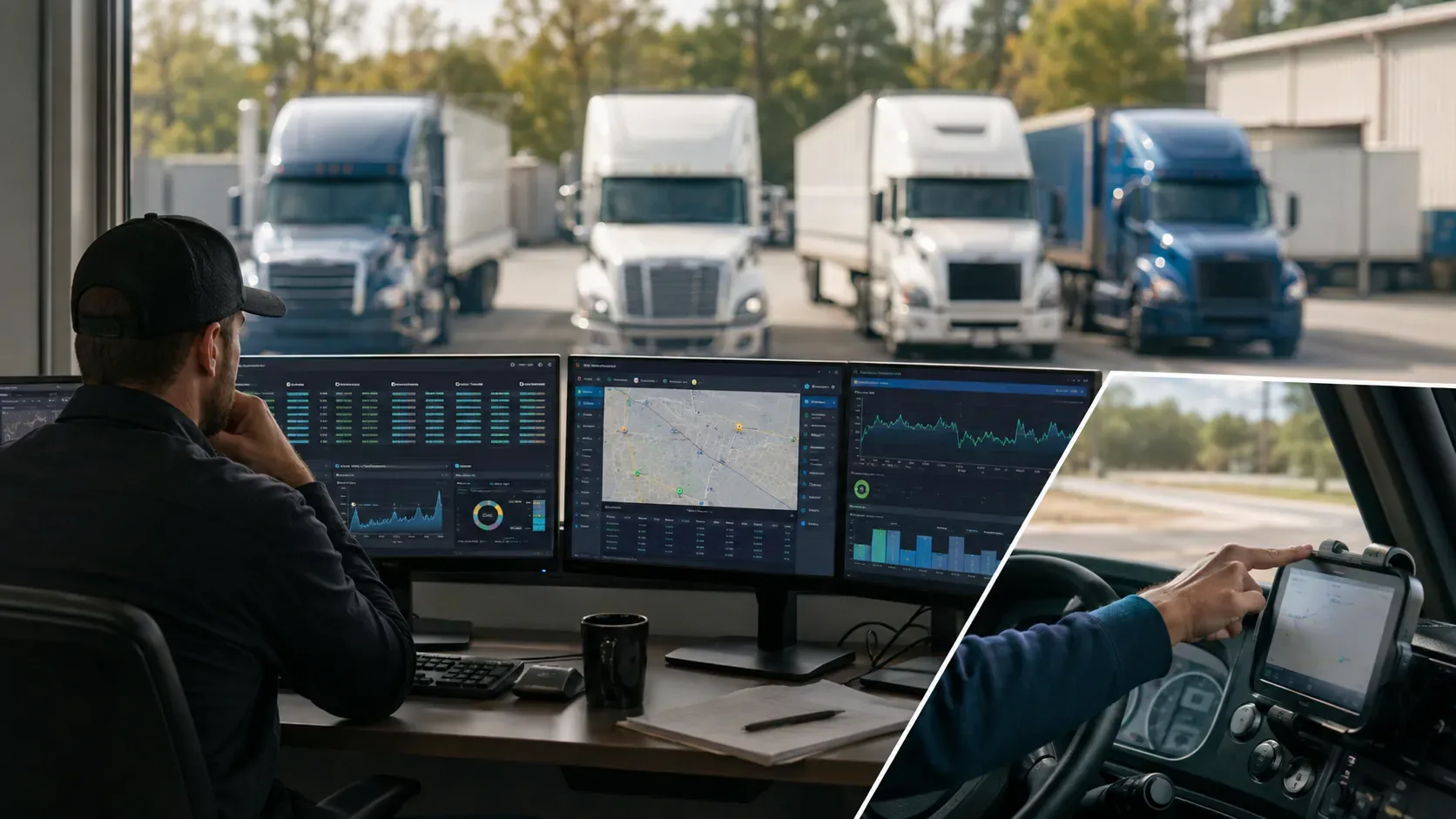
An ELD and a fleet management system can appear to be the same product.
Both can show:
- trucks;
- drivers;
- maps;
- hours;
- alerts;
- reports.
The similarity is commercial, not regulatory.
An ELD has a narrow legal purpose:
Create and preserve an accurate electronic record of the driver’s hours of service and make that record available to authorized safety officials.
Fleet management software has a broader business purpose:
Help the carrier control vehicles, loads, maintenance, documents, fuel, communication and operating performance.
A provider can place both functions in one application.
A carrier can also buy them separately.
The right question is not whether an integrated dashboard looks more professional.
It is whether the additional software removes enough real work to justify:
- higher cost;
- longer implementation;
- more training;
- larger data exposure;
- harder provider exit.
The dividing line
FMCSA’s carrier checklist makes the distinction directly.
Many ELDs can be part of a fleet management system or contain fleet-management functions.
Those additional functions are not required for ELD compliance.
| Issue | ELD | Fleet management software |
|---|---|---|
| Primary purpose | Hours-of-service compliance | Operational control and business efficiency |
| Federal technical standard | Yes, under Part 395 | No single general FMCSA FMS standard |
| FMCSA device list | Exact ELD must be listed | Not required unless product is also the ELD |
| Automatic driving record | Core function | Can receive data from ELD or telematics |
| Roadside display and transfer | Required | Not a general FMS requirement |
| Live GPS map | Not federally required | Common optional function |
| Dispatch and load planning | Not required | Common function |
| Maintenance management | Not required | Common function |
| IFTA support | Not part of required ELD data | Common add-on |
The distinction matters because a carrier can pay for an expensive fleet platform and still have a weak ELD experience.
It can also buy a basic ELD and expect it to manage operations it was never designed to manage.
What the ELD must own
The compliance system should reliably control the records that affect driver hours.
That includes:
- individual driver accounts;
- automatic driving events;
- duty-status changes;
- vehicle and carrier identification;
- locations;
- engine synchronization or permitted alternative;
- edits and annotations;
- driver certification;
- unidentified driving;
- diagnostic and malfunction events;
- display and data transfer;
- six-month carrier retention;
- separate backup.
These functions should work even when the carrier does not purchase:
- dispatch;
- cameras;
- fuel analytics;
- maintenance;
- route optimization.
The ELD is judged at roadside
A beautiful office dashboard has little value when the driver cannot:
- display the current day;
- display the previous seven days;
- enter the inspection comment;
- transfer the output file;
- explain an edit;
- identify a malfunction.
The compliance test occurs in the cab.
The business-value test occurs in the office.
A strong integrated system must pass both.
What fleet management software can add
Fleet software usually grows around the vehicle and dispatch process.
Common modules include:
- live vehicle location;
- route history;
- geofences;
- dispatch;
- load status;
- estimated arrival time;
- driver messaging;
- document capture;
- DVIR workflow;
- preventive maintenance;
- fault-code alerts;
- fuel reporting;
- IFTA mileage support;
- dash cameras;
- safety events;
- customer tracking links;
- utilization reports.
None of those features is automatically necessary for a small fleet.
Each one should remove a defined problem.
Live GPS
Real-time tracking can help with:
- customer updates;
- theft response;
- dispatch decisions;
- detention evidence;
- estimated arrival;
- route deviation.
FMCSA does not require real-time tracking under the ELD rule.
The ELD records location data for its regulatory functions.
Continuous business tracking is an added service.
IFTA support
A provider can use location and mileage information to support fuel-tax reporting.
FMCSA states that mileage tracking for tax reporting is not part of the mandatory ELD data.
The carrier should therefore evaluate IFTA output separately.
Check whether the system:
- separates jurisdiction mileage;
- identifies missing trips;
- handles odometer corrections;
- exports audit records;
- reconciles fuel purchases;
- preserves source data.
An “IFTA report” button does not transfer tax responsibility to the vendor.
Maintenance
A fleet platform can connect:
- odometer;
- engine hours;
- fault codes;
- inspection reports;
- service intervals;
- work orders.
The value comes from closing the loop between a defect and its repair.
A reminder alone is not a maintenance file.
The carrier still needs:
- completed work evidence;
- inspection reports;
- repair documentation;
- vehicle history;
- retention.
Dispatch
Dispatch modules can remove:
- duplicate load entry;
- text-message confusion;
- missing addresses;
- manual status calls;
- lost bills of lading.
For a one- or two-truck carrier with simple brokered loads, a shared calendar and document folder may already solve the problem.
For five trucks and several drivers, manual coordination can become the expensive choice.
Three possible software stacks
A small fleet usually fits one of three architectures.
Stack 1: standalone ELD
The carrier buys a registered ELD and keeps the rest of the business simple.
Other operations are managed through:
- email;
- spreadsheets;
- calendar;
- accounting software;
- maintenance folders;
- broker portals.
Best fit
- one truck;
- owner is the driver;
- simple freight;
- limited dispatch volume;
- no dedicated office employee;
- low tolerance for long contracts.
Strengths
- lower cost;
- simpler training;
- easier replacement;
- fewer integrations;
- smaller data footprint.
Weaknesses
- duplicate entry;
- separate maintenance reminders;
- manual IFTA work;
- fragmented documents;
- limited visibility when another driver operates.
Stack 2: ELD plus selected specialist tools
The carrier uses separate products for separate jobs.
Example:
- registered ELD;
- accounting system;
- maintenance application;
- fuel-card portal;
- cloud document storage;
- optional GPS.
Best fit
- two to five trucks;
- carrier wants flexibility;
- existing tools already work;
- different people own different functions;
- integrations are available.
Strengths
- best product for each function;
- easier replacement of one weak module;
- less dependency on one provider;
- gradual implementation.
Weaknesses
- multiple subscriptions;
- inconsistent vehicle names;
- duplicate driver and load data;
- separate passwords;
- difficult reporting;
- integration failures.
This stack works when the carrier has discipline.
It becomes chaotic when every system uses a different version of the truth.
Stack 3: integrated ELD and fleet platform
One provider controls most functions.
The system can connect:
- HOS;
- tracking;
- dispatch;
- maintenance;
- documents;
- cameras;
- fuel;
- reports.
Best fit
- growing fleet;
- several drivers;
- dedicated dispatcher or safety manager;
- repeated manual processes;
- need for shared operating visibility.
Strengths
- fewer duplicate entries;
- common vehicle and driver records;
- centralized alerts;
- faster office workflow;
- combined reporting.
Weaknesses
- higher total cost;
- longer contract;
- harder implementation;
- larger provider dependency;
- difficult data migration;
- one outage affects several functions.
An integrated platform is valuable only when integration changes the work.
Buying five modules and using one is not integration.
The source-of-truth problem
Small fleets often make a software decision without deciding which system owns each fact.
Then the same truck can appear as:
Truck 1;Unit 01;T-001;- a VIN;
- a license plate.
The same driver can have:
- legal name in the ELD;
- nickname in dispatch;
- email address in accounting;
- payroll ID in maintenance.
This causes:
- duplicate records;
- unmatched mileage;
- incorrect reports;
- missing maintenance;
- driver-account confusion.
Assign one source of truth for each data category.
| Data | Recommended owner | Other systems should |
|---|---|---|
| Legal driver identity | Compliance and driver records system | Use the same legal identifier |
| ELD duty-status record | Registered ELD | Display or receive without altering source history |
| Vehicle identification | Vehicle master record | Match unit number and VIN |
| Load assignment | Dispatch system | Reference the dispatch load number |
| Maintenance completion | Maintenance record | Use telematics only as a trigger or input |
| Financial transaction | Accounting system | Provide supporting operational data |
A fleet platform can become the master for several categories.
It should not silently replace the original regulatory record.
Integration is valuable when it removes a handoff
An integration should remove an actual manual step.
Good examples:
- dispatch sends truck and trailer assignment to the driver’s workflow;
- odometer triggers a maintenance due date;
- driver uploads bill of lading directly into the load record;
- GPS supports detention arrival and departure evidence;
- fuel transactions reconcile against trip mileage;
- ELD driver list synchronizes with active-driver administration.
Weak integrations merely place two logos in one menu.
Measure the handoff
Before buying a module, write:
- current task;
- person doing it;
- minutes per occurrence;
- number of occurrences;
- error rate;
- cost of error.
Then determine whether the software:
- removes the task;
- shortens it;
- moves it to someone else;
- creates another review queue.
A new alert is not automatically time saved.
The one-truck break-even test
Suppose an integrated platform costs $45 more per month than a basic ELD.
Annual additional cost:
- $45 × 12;
- equals $540.
The platform should save at least $540 in:
- administrative time;
- tax preparation;
- detention recovery;
- maintenance prevention;
- eliminated subscriptions;
- reduced errors.
If the owner’s administrative time is valued at $30 per hour, the software needs to save approximately 18 hours per year to cover the difference.
That is about:
- 90 minutes per month;
- or roughly 20 minutes per week.
The target can be realistic.
The carrier should still identify where those 20 minutes disappear.
Do not count unused theoretical savings
A maintenance feature has no value when service is still recorded on paper and ignored in the application.
A dispatch feature has no value when every load is still managed by text message.
The business case begins after adoption, not after purchase.
When the integrated platform is worth it
Integration usually becomes more valuable when the carrier experiences several of these conditions:
- more than one active driver;
- frequent truck and trailer changes;
- dedicated dispatcher;
- repeated customer ETA requests;
- maintenance intervals missed;
- IFTA preparation consumes several hours;
- documents arrive late;
- unidentified driving grows;
- office staff re-enters the same load repeatedly;
- owner cannot see operations while away.
The platform does not need to solve every issue.
It should solve the most expensive cluster.
When standalone tools are better
Separate tools can be the stronger choice when:
- one owner drives the only truck;
- current maintenance system is reliable;
- accounting system already handles documents;
- carrier changes equipment frequently;
- long contract is unacceptable;
- provider’s ELD is weaker than its fleet dashboard;
- integrated exports are poor;
- carrier needs only one optional feature.
Do not purchase an integrated platform merely to obtain one IFTA report.
A specialist IFTA process or fuel-card tool can be easier to replace.
Compliance risk inside an integrated system
An integrated product can create a false sense that every record is compliant because the data sits in one dashboard.
The carrier must still distinguish:
- regulatory ELD record;
- dispatch record;
- GPS breadcrumb;
- camera event;
- maintenance alert;
- tax estimate.
GPS data is not automatically the ELD record
FMCSA states that ordinary GPS cannot substitute for required engine-synchronized data.
The ELD component must meet the technical requirements independently.
A map showing that the truck moved does not prove that the RODS file is compliant.
IFTA output is not automatically audit-ready
A mileage estimate needs:
- jurisdiction detail;
- source records;
- reconciliation;
- corrections;
- retention.
Maintenance alert is not repair evidence
An engine fault or due-date alert starts a process.
The maintenance file should show what happened next.
Camera event is not a driver qualification decision
Safety scores can help identify coaching needs.
They do not replace a documented review of:
- license;
- MVR;
- medical qualification;
- disqualification;
- training.
Driver monitoring and harassment
Connected fleet systems can collect substantially more data than the ELD requires.
Examples include:
- real-time location;
- inward-facing camera;
- audio;
- harsh events;
- speed;
- messaging;
- biometric or fatigue indicators.
The ELD rule prohibits motor-carrier harassment of drivers based on ELD information or connected technology.
Software capabilities should therefore be matched with:
- lawful purpose;
- written policy;
- controlled access;
- driver notice;
- review standards;
- escalation process.
More alerts can create worse decisions
A dispatcher receiving dozens of safety or HOS alerts can begin pressuring drivers to:
- change status;
- shorten rest;
- accept an edit;
- continue during fatigue;
- use personal conveyance incorrectly.
Technology does not remove management responsibility.
It creates evidence of how the carrier used the information.
Data access matters more in an integrated platform
Leaving a basic ELD requires migrating hours-of-service records.
Leaving an integrated platform can involve:
- ELD records;
- driver profiles;
- dispatch history;
- documents;
- maintenance;
- GPS;
- camera video;
- fuel data;
- customer information.
The carrier should test exports before signing.
Export questions
For each module, ask:
- Can I export without customer support?
- Is the format readable?
- Is structured data available?
- Are attachments included?
- Does the export include inactive drivers and sold vehicles?
- How long is data retained?
- What happens after cancellation?
- Is there a fee?
- Can another provider import it?
Six-month ELD retention is only one layer
The carrier can need longer periods for:
- maintenance;
- accidents;
- driver files;
- tax;
- contracts;
- litigation.
A provider retention setting should not determine the carrier’s legal schedule.
Revocation risk inside a larger platform
FMCSA has removed multiple devices from the registered list during 2026.
When the ELD component of an integrated platform is revoked, the carrier can face a complicated choice.
It may need to:
- replace only the ELD;
- keep the provider for dispatch or cameras;
- migrate the entire platform;
- run overlapping systems temporarily.
Contract questions
Ask:
- Can the compliance module be removed separately?
- Can another registered ELD integrate with the platform?
- Does ELD revocation permit cancellation?
- Who pays for new hardware?
- Are dispatch and camera contracts independent?
- How are RODS exported during transition?
A bundled price can hide the fact that each module has a different replacement risk.
The small-fleet buying sequence
Do not begin with demos.
Begin with operating problems.
Step 1: identify the required compliance layer
Determine:
- drivers subject to ELD;
- exact vehicles;
- roadside needs;
- record retention;
- support hours.
Choose only products whose ELD component passes those requirements.
Step 2: identify repeated administrative work
List tasks such as:
- entering loads;
- sending addresses;
- locating trucks;
- collecting documents;
- scheduling maintenance;
- calculating IFTA;
- answering ETA calls.
Step 3: price the current process
Estimate:
- staff time;
- owner time;
- errors;
- missed maintenance;
- duplicated subscriptions;
- lost billing;
- detention not recovered.
Step 4: compare three architectures
Price:
- standalone ELD;
- ELD plus selected specialist tools;
- integrated platform.
Use the same contract period and required features.
Step 5: test with one truck
Run a real workflow:
- dispatch a load;
- record HOS;
- upload document;
- create maintenance alert;
- export data;
- complete roadside transfer.
Step 6: test departure
Before committing, request:
- full ELD export;
- dispatch export;
- document export;
- maintenance export;
- cancellation calculation.
The exit test is part of the purchase test.
A decision matrix for small fleets
| Fleet situation | Likely starting point |
|---|---|
| One owner-driver, simple brokered loads | Standalone ELD |
| Two trucks, reliable accounting and maintenance tools | ELD plus selected specialist tools |
| Three to five trucks with repeated dispatch handoffs | Light integrated platform |
| Growing fleet with dispatcher and safety role | Integrated ELD and fleet platform |
| Carrier primarily needs one feature such as IFTA | Keep ELD and add the specialist function |
| Carrier needs cameras, GPS, maintenance and dispatch together | Compare integrated platforms carefully |
Fleet size is not the only factor.
Operational complexity matters more.
A one-truck carrier with specialized freight and extensive customer reporting can need more software than a four-truck family operation with stable routes.
Two comparison scenarios
The seven traps to avoid
Buying fleet features before solving ELD compliance
The exact ELD must be registered and usable.
Assuming live GPS is part of the legal minimum
It is an optional business function.
Paying twice for the same feature
Fuel card, accounting, ELD and dispatch products can all sell overlapping IFTA or GPS tools.
Allowing every system to create its own driver and vehicle names
Assign a source of truth.
Treating alerts as completed work
A maintenance alert is not a repair and a missing-document alert is not the document.
Bundling without an exit plan
Integrated data is harder to migrate.
Choosing enterprise complexity for a one-truck workflow
A larger system can consume more time than it saves.
The practical rule
A small fleet needs one compliant ELD layer.
It needs fleet management software only for the operational problems worth paying to remove.
Choose the architecture that answers these questions best:
- Can every driver pass a roadside inspection?
- Can the carrier control and export the regulatory records?
- Which repeated office tasks disappear?
- Which data is entered only once?
- What is the complete cost over the contract?
- What happens when one module fails or is revoked?
- Can the carrier leave without losing its operating history?