
Ford F-250 vs. F-350 (2026): Payload, Towing and Which to Buy
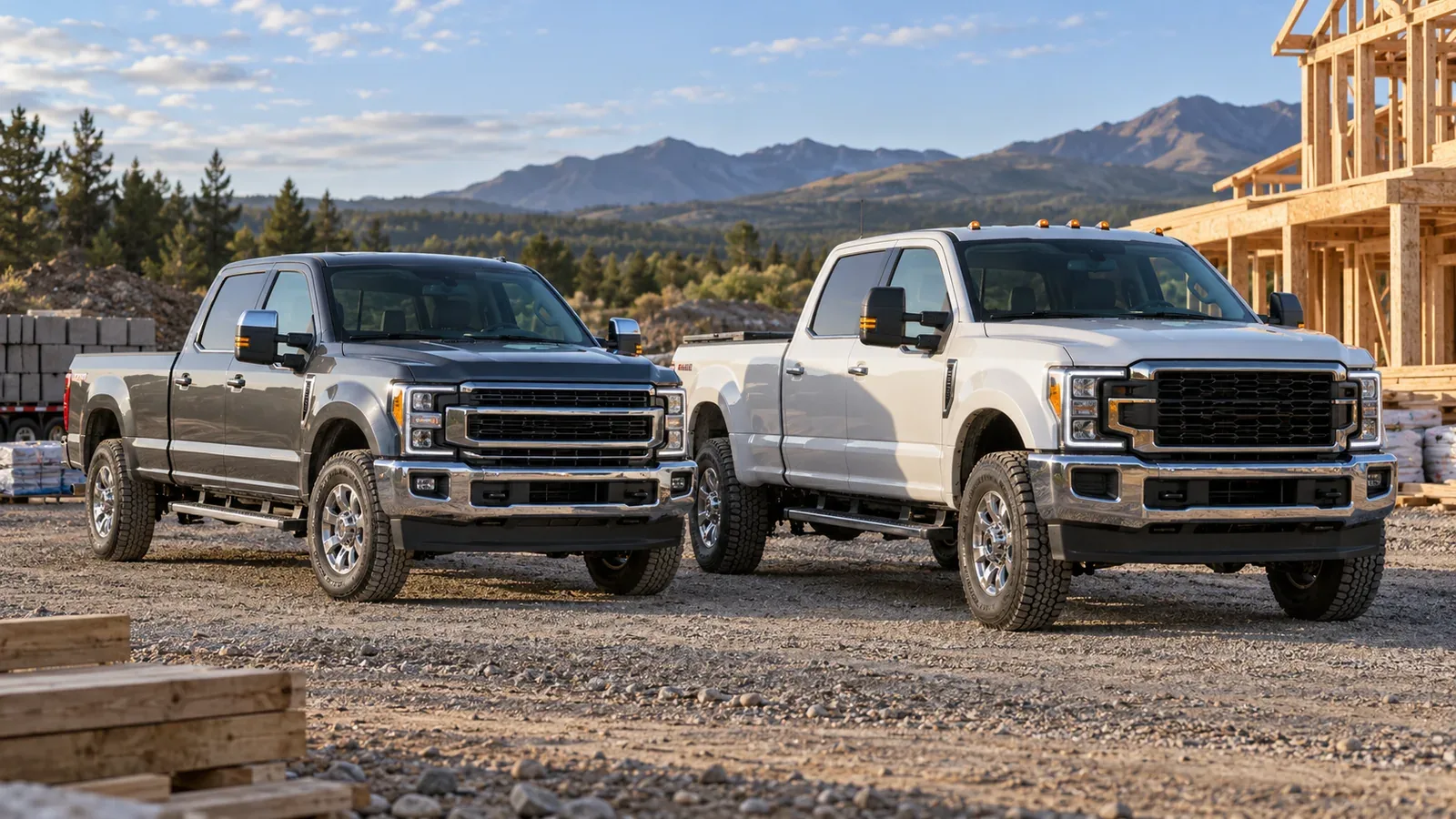
You’re standing in front of two nearly identical-looking Super Duty pickups. The F-250 is cheaper. The seller says the F-350 is “the one you need for real work.” Both have four doors, a full-size bed and the same engine badge. Which one should you actually buy?
Start with your load, not the badge. A truck that can pull a heavy trailer may run out of available payload because of people, tools and the trailer’s weight on the hitch. Another truck may have plenty of bed capacity but the wrong towing equipment for your trailer. A useful F-250 vs. F-350 comparison looks at both limits and the actual trucks you can buy.
This guide compares U.S.-market 2026 Ford Super Duty pickup models, not chassis-cab commercial trucks or every older model year. Ford has also introduced 2027 models; don’t apply the 2026 tables to a 2027 or used 2022 truck without checking its own documentation.
Short answer: For everyday work and moderate loads, an appropriately rated F-250 may do everything you need. Choose a specific F-350 when its higher available ratings, equipment or dual-rear-wheel layout solve a load problem the F-250 cannot. Neither badge overrides the limits on the actual truck.
Download the F-250 vs. F-350 buyer comparison worksheet before visiting a dealer. You can fill it in for two actual VINs rather than relying on brochure maximums.
F-250 vs. F-350 at a glance: what really changes?
| Question | 2026 F-250 | 2026 F-350 | Why it matters |
|---|---|---|---|
| Rear-wheel configurations | Single rear wheel (SRW) | SRW or dual rear wheel (DRW) | DRW can help with high rear loads but is wider |
| Gas or diesel engines | Multiple configurations offered | Multiple configurations offered | The same engine type does not guarantee the same payload |
| Maximum payload | Depends on cab, tires, engine and ratings | Higher maximum in some configurations | Check this truck’s door label |
| Conventional towing | Equipment- and configuration-dependent | Equipment- and configuration-dependent | Highest advertised tow number may not apply |
| Fifth-wheel/gooseneck use | Possible when properly equipped | Possible when properly equipped | Loaded pin weight often becomes the deciding issue |
| Cab and bed options | Several lengths and cab choices | Several lengths and cab choices | Choose the body you can actually use |
| Purchase and operating cost | Depends on actual quote | Depends on actual quote and SRW/DRW | Compare insurance, tires, taxes and downtime |
Ford’s 2026 technical specification tables list the two truck families by equipment, not a single number for each. Both can use gas and diesel powertrains, but availability changes with cab, drivetrain, package and trim. A fully equipped luxury truck may carry less than a comparatively basic work truck because equipment itself adds weight.
A quick distinction: The F-250 and F-350 are model names. “Three-quarter-ton” and “one-ton” are conventional market labels, not promises that a truck can carry only 1,500 lb or exactly 2,000 lb. Use the factory ratings for the specific vehicle, not the nickname.
Real Ford data: why maximum payload numbers can fool you
Here is a revealing example from Ford’s official 2026 Super Duty technical specification PDF, page 10. These are manufacturer maximum ratings with minimum equipment, not the payload stickers of two vehicles on sale.
| Published configuration | 2026 Ford maximum payload |
|---|---|
| F-250 SRW, 4x4 Crew Cab, 159.7-in wheelbase, 6.8L gas, 17-in tire specification | 4,008 lb |
| F-350 SRW, 4x4 Crew Cab, 159.7-in wheelbase, 6.8L gas, 17-in tire specification | 3,994 lb |
| F-350 SRW, 4x4 Crew Cab, 159.7-in wheelbase, 6.8L gas, 18-in all-terrain tire specification | 4,829 lb |
In this narrow set of published configurations, the first F-350 entry is 14 lb lower than the F-250 entry. Change the F-350’s tire/rating configuration and Ford’s listed figure increases by 835 lb. None of those differences means every truck on the road matches the table, and this is not proof that changing tires by itself raises an existing truck’s certified ratings. The manufacturer configurations and their factory labels are what matter.
Ford’s broader 2026 model page advertises up to 8,000 lb of payload for the Super Duty family. That is a maximum for a specially configured truck, not a value to apply to all F-350s. In the same technical PDF, for example, the F-350 DRW 4x2 Regular Cab 6.8L with an available gas heavy-duty payload package is listed at 7,774 lb before individual vehicle options (page 11).
Takeaway: If a dealer quotes a family maximum instead of sending the payload label for the VIN you are considering, you do not yet have enough information to choose.
The four numbers you must verify on each truck
You can inspect these before comparing packages or discussing monthly payments.
| Label or rating | What it tells you | What it does not tell you |
|---|---|---|
| Payload / occupant-and-cargo label | Combined weight allowance for people and cargo on that particular truck | How much the hitch or rear axle can take on its own |
| GVWR | Maximum permitted loaded weight of the truck | Maximum trailer weight |
| Rear GAWR | Maximum permitted weight on the rear axle | How much you can add without first knowing current axle load |
| GCWR / tow rating | Combined vehicle-trailer limit and tow capacity for the specified setup | Available payload after passengers and gear |
The vehicle Safety Compliance Certification label and tire/loading information are normally on the driver’s-side door area. Ford explains GVWR and GAWR in its owner guidance. For an actual tow rating, consult Ford’s towing selector using model year and configuration, and verify hitch and equipment ratings too.
Write down the labels, or take photographs. If a truck has an aftermarket service body, toolbox, fuel tank, snowplow or other added equipment, record that weight and any relevant upfit ratings. Do not treat the original marketing payload as unused capacity after installing equipment.
For a broader explanation of the towing numbers themselves, see How Much Can My Truck Tow?. This article is about choosing between two models, not repeating every towing definition.
A five-minute payload check that could change your choice
Before you sign anything, make one list for your normal busiest day—not an empty truck on its best day.
- Start with the actual door-label payload for the F-250 and F-350 you are viewing. If you don’t have it, mark the number unknown; don’t substitute a brochure maximum.
- Count people. Include the driver and everyone who rides, using realistic travel weights.
- Count truck-borne equipment. Tools, bed covers, racks, aftermarket tanks, cargo, equipment and anything else that adds to the truck’s loaded weight.
- Add hitch or pin load. A conventional trailer’s tongue weight or a fifth-wheel/gooseneck’s pin load is weight borne by the truck. It is not the trailer’s entire weight added again.
- Calculate the remainder, then check axles. Subtract the total truck-borne load from the available payload. Also verify GVWR and actual rear GAWR using appropriate scale weights; a positive payload remainder alone is not proof that every rating is respected.
Illustrative calculation (not Ford’s actual label figures):
| Load item | Pounds |
|---|---|
| Two adults | 350 |
| Tools and bed supplies | 480 |
| Installed hitch equipment not already counted | 100 |
| Measured loaded fifth-wheel pin weight | 1,900 |
| Total added to the truck | 2,830 |
Imagine an F-250 listing whose actual label says 2,750 lb payload. That example is 80 lb over its allowance, even if a tow chart appears to permit pulling the trailer. A different F-350 listing with an actual 3,600 lb label would have 770 lb left by the payload arithmetic, but you would still need to verify its rear axle, tire, hitch, GVWR, GCWR and trailer ratings.
These 2,750- and 3,600-lb stickers are invented to teach the comparison, not claims about an F-250 or F-350 for sale. The numbers could change dramatically with equipment. Use our tongue-weight measuring guide to record the load the trailer actually places on the truck.
Towing a camper or equipment trailer? Ask a better question
Many buying conversations begin with “Which truck tows more?” The useful question is “Which specific truck can carry the hitch load, people and equipment and pull this loaded trailer within every limit?”
For a conventional equipment trailer, confirm its real loaded weight and tongue load. For a fifth-wheel camper, the pin weight after loading can be a major payload consumer. A brochure’s empty “dry pin weight” is not a substitute for what the truck bears when the camper is ready to travel.
Ford’s 2026 towing information explicitly warns that tongue or pin load plus people and cargo must fit within GVWR and rear GAWR, not only the trailer rating. Depending on the configuration, an axle upgrade or specific towing package may be necessary. The hitch and receiver can also impose lower independent limits.
Example, conventional towing (illustrative): A loaded 12,000-lb trailer has a measured 1,440-lb tongue load. You also have 360 lb of people, 600 lb of work equipment and 80 lb of hitch equipment not otherwise counted. That is 2,480 lb on the truck’s payload calculation. If its label says 2,600 lb, only 120 lb remains before checking axle limits. Loading an extra heavy toolbox without recalculating could erase that margin.
If you have not yet weighed the trailer, How Much Does a Trailer Weigh? explains why an empty trailer specification is not the number to use. Use the actual manufacturer limits and properly obtained scale weights for the final decision.
F-350 single rear wheel or dually: when does DRW make sense?
For many buyers, the most consequential jump isn’t F-250 to F-350 SRW. It’s the possibility of an F-350 dual-rear-wheel (DRW) configuration.
An F-350 dually has two rear wheels on each side and can be configured for substantially higher rear loads. This may be useful when carrying heavy fifth-wheel pin weight or work equipment. But it also changes how the truck fits into real life: wider rear fenders, more tire positions to maintain and more space needed for parking and narrow access roads.
Ask two separate questions:
- Capacity: Does the loaded job require an F-350 DRW’s actual ratings, or will an appropriately equipped SRW truck meet every limit?
- Practicality: Can you comfortably park, maintain and operate the wider truck where you work and live?
Do not buy a dually solely because a dealer says it “feels more stable.” Stability and control depend on the entire properly loaded and maintained combination. Always stay within individual axle, tire, vehicle, hitch and trailer ratings.
Three realistic decisions, not three generic recommendations
Situation 1: The mobile contractor with tools, but no heavy trailer. One vehicle carries a crew and a moderate amount of supplies around town. The actual F-250 label has enough unused capacity for the busiest day, including shelving and equipment. The F-350 costs more to buy and insure in the quotes obtained. The F-250 is a reasonable candidate because higher possible maximums would go unused. Get quotes, not assumptions.
Situation 2: The fifth-wheel owner who is already close to the limit. A loaded camper produces a substantial pin load, and passengers and gear push the F-250 past its real payload. An F-350 with higher actual remaining payload and suitable rear-axle and fifth-wheel ratings becomes worth investigating; a DRW may be necessary depending on measured weights. Do not solve this by shifting cargo to create another overload.
Situation 3: The landscaping team buying for growth. Today’s load fits an F-250, but a second trailer or heavier equipment is planned. A properly specified F-350 could reduce the risk of buying twice. Compare written prices, added running costs, realistic loads and expected usage. If the future work is only speculative, paying for the largest configuration might not be economic.
These are representative decision scenarios, not reports from verified owners or endorsements. They show how the same choice can be right for one buyer and wrong for another.
Cost comparison: the right way to price the extra capacity
Do not publish or trust a “F-350 costs exactly $X more” claim without specifying trim, engine, cab, incentives, location and date. The difference can move substantially between two actual quotes.
Use your printable vehicle comparison sheet with two real out-the-door prices and a common ownership period. Record:
| Cost to compare | F-250 | F-350 |
|---|---|---|
| Dealer out-the-door price | Actual quote | Actual quote |
| Insurance and registration | Local quote | Local quote |
| Fuel based on your own route and load | Estimated from your use | Estimated from your use |
| Maintenance and tire replacements | Estimated/quoted | Estimated/quoted |
| Upfits, hitch and equipment | Itemized | Itemized |
| Expected downtime and resale | Scenario, not guarantee | Scenario, not guarantee |
Simple illustration: If two otherwise comparable offers differ by $4,600 up front (an invented example, not current Ford pricing), and you keep the truck for five years, the additional purchase price alone averages $920 per year before financing, taxes, fuel, maintenance, insurance and resale. That doesn’t prove the F-350 is expensive or cheap. It tells you what additional value the unused or needed capacity must justify.
If one truck cannot do the work legally and safely, a cheaper price is not an economic advantage. If both fit, compare their actual total costs. That’s the decision, not who has the bigger number in an advertisement.
Before paying: ten things to ask the dealer or seller
Bring this list to the dealership or used-truck lot:
- Can I photograph the specific vehicle’s tire/loading label and safety certification label?
- What is the exact VIN, model year, trim, engine, axle ratio and drivetrain?
- Does the listed GVWR reflect an optional capacity package?
- What are the actual rear GAWR and current axle loads with its equipment?
- What is its exact factory tow rating for my trailer type and required packages?
- Does it have the correct hitch, receiver and fifth-wheel/gooseneck prep, if needed?
- How much have upfits, toolboxes, spare tires and other accessories changed its remaining capacity?
- If it is used, what are its maintenance, accident, tire and upfit records?
- How do insurance, annual registration and tire costs differ for these two trucks in my location?
- Can I take the numbers away and verify them before signing?
For commercial use, also check whether the vehicle, trailer and combination introduce state- or federal-specific licensing, registration or operating requirements. An F-250 or F-350 badge alone doesn’t answer that legal question.
The simplest way to make your choice
If you remember only one thing, remember this: a properly equipped truck that stays inside every real limit wins over a badge and a brochure maximum.
An F-250 can be the sensible buy if it handles your actual work with adequate verified margins. An F-350 SRW can be worth it if a specific configuration provides the capacity you need. An F-350 DRW deserves attention when heavy pin or rear-axle loads make SRW configurations unsuitable.
Complete the F-250 vs. F-350 comparison worksheet, get two real door labels, and check the Ford tow selector before committing. If the axle or hitch limits are unclear, arrange a competent truck-and-trailer weighing or professional assessment rather than guessing.
Editorial note: All numerical buying scenarios that are not explicitly linked to Ford’s 2026 technical tables are fictional teaching examples. The article is not an individual tow-rating certification, cost quotation or substitute for a manufacturer or qualified professional’s inspection.