
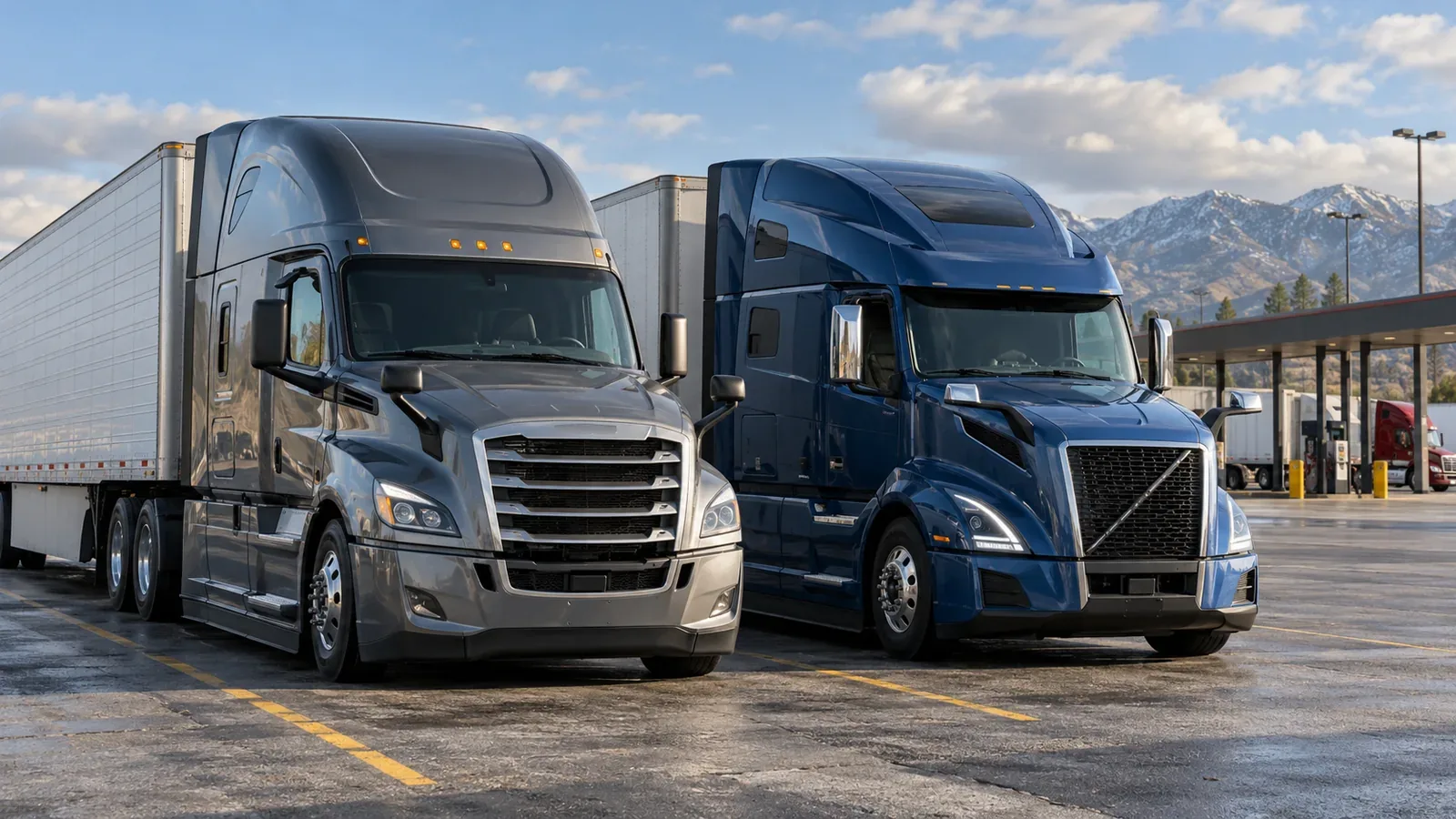
Two tractors are parked at a dealer lot. Both are attractive. Both salespeople have impressive numbers and an answer for every objection. One is a Freightliner Cascadia; the other is a Volvo VNL. You will pay for whichever one you choose over years of freight runs, breakdown risks and nights in the sleeper. Which one deserves your signature?
Start with the job, not the emblem. For a small-business owner who drives the truck, the right tractor needs to match the route, cover the annual mileage economically, keep you comfortable and have repair support when something breaks. A feature you rarely use can be less valuable than a service center that actually has an appointment available.
This comparison focuses on the Fifth Generation Freightliner Cascadia and the all-new North American Volvo VNL, as described in their current manufacturer materials. It is a whole-vehicle selection guide—not a repeat of our Cummins X15 vs. Detroit DD15 engine comparison or a ranking of engine rebuilds. Used examples from earlier generations need their own build sheets and maintenance records.
Quick answer: Freightliner Cascadia or Volvo VNL?
Choose the tractor that best fits your lane, load, driver and verified ownership budget. The modern Cascadia emphasizes an integrated Detroit powertrain, aerodynamic improvements, driver comfort, safety systems and digital service tools. The new VNL pairs Volvo’s D13 and I-Shift with a newly designed cab, connected uptime services and a range of day-cab and sleeper models.
Neither set of features establishes an across-the-board winner in fuel economy, reliability, comfort or repair cost. Ask for actual vehicle specifications and written dealer quotes, then test how the differences affect your work.
| Buyer priority | What to check on a Cascadia | What to check on a VNL |
|---|---|---|
| Day cab vs. sleeper | Cab length and roof option on the exact order | VNL 300 day cab or specified VNL sleeper configuration |
| Engine and transmission | Installed Detroit/Cummins option, generation and DT12/other available transmission | D13 rating, torque package and I-Shift configuration |
| Fuel cost | Aero option, axle ratio, tire specification and verified MPG | Aero configuration, I-Torque package, axle ratio and verified MPG |
| Rest and living space | Sleeper dimensions, upper bunk and available parked HVAC | Sleeper model, bed/storage access and parked HVAC or idle management |
| Safety package | Detroit Assurance ABA6 functions and optional equipment | Volvo Active Driver Assist and separately specified Plus features |
| Uptime | Actual Freightliner/Detroit repair availability on your lanes | Actual Volvo-certified repair availability on your lanes |
| Total cost | Written finance, warranty, service and resale assumptions | Same inputs and measurement period |
The entries above describe areas to compare, not guaranteed features on every vehicle. A brochure is a starting point; the factory build sheet and sales order are the source for your individual truck.
First, compare the correct truck generations
Freightliner calls its latest version the Fifth Generation Cascadia. Volvo’s all-new VNL began entering North American service after its 2024 unveiling. Both models have predecessors still available in the used market. This creates a common trap: one listing is priced as a current-generation model while the specification copied into the ad belongs to an older version.
Before comparing price, record model year, build date, VIN, cab configuration, engine series, emissions generation, transmission, axle ratio and actual installed options. The model year alone may not identify every mid-cycle feature or engine availability change.
A particularly important timing detail: Freightliner’s Cascadia specification page includes Detroit Gen 6 DD13/DD15 engines with a January 2027 availability note. As of October 2026, do not assume that an advertised future Gen 6 rating is already installed in a truck on a dealer’s lot. The current manufacturer page also distinguishes Gen 5 engines from Gen 6 entries. If an order is scheduled for a future build, obtain a dated confirmation of the planned hardware, delivery and potential specification changes.
There is a similar trap on the Volvo side. The new VNL uses a D13-based powertrain, but ratings, torque packages and available variants differ. Volvo has also announced a D13 VGT option for specified new VNL day-cab applications. That is not evidence that every sleeper includes the same engine option. Ask for the actual powertrain code rather than accepting a generic ‘D13’ label.
Engines and transmissions: what the manufacturers publish
The current Freightliner Cascadia specification lists a 370–525 hp overall range and a maximum stated 1,850 lb-ft of torque in its base specification. Its separately listed Detroit Gen 6 options have future availability notes and different rating details. Volvo’s VNL model page lists 405–500 hp and 1,650–1,950 lb-ft of peak torque, dependent on the D13/torque package configuration.
| Published comparison point | Freightliner Cascadia | Volvo VNL |
|---|---|---|
| Vehicle class | Class 8 | Class 8 highway tractor family |
| Manufacturer’s listed broad hp range | 370–525 hp | 405–500 hp |
| Manufacturer’s current model-page torque statement | Up to 1,850 lb-ft in base specs; generation-specific entries differ | 1,650–1,950 lb-ft, depending on package |
| Central integrated powertrain offering | Detroit DD family with Detroit DT12 automated manual | Volvo D13 with I-Shift automated manual |
| Additional details | Selected Cummins and alternate transmission options depend on configuration | I-Torque and axle ratios depend on selected configuration |
| Major caution | Future Gen 6 entries cannot describe a Gen 5 truck already built | A day-cab D13 variant should not be assumed standard on sleepers |
These are product-family figures, not equivalent tested configurations. A maximum torque entry is not proof of faster acceleration with an 80,000-pound combination. Transmission ratios, tire sizes, actual horsepower rating, grade, vehicle weight, torque management and driver behavior all affect the result.
When does the engine choice change the buying decision?
Suppose you regularly climb mountain grades with heavy loads. Ask both dealers for a gradeability and cruise-speed estimate for your actual combined weight, road gradient, tire size and rear axle ratio. For another business moving general freight over rolling interstate routes, low-rpm efficiency and service access may deserve more weight than the highest available peak horsepower.
An integrated powertrain may also make troubleshooting more coherent: engine, transmission, axle and vehicle-control systems are designed together. That is still not evidence that one truck will cost less to repair. For engine-only issues and service intervals, our separate X15 vs. DD15 guide covers the model-specific distinctions without confusing an engine choice with a whole-truck purchase.
Cab and sleeper: compare how you actually live in the truck
A truck can be mechanically excellent and still be a poor home for a driver who sleeps in it six nights a week. Test the seat, visibility, entry steps and storage while wearing your everyday work clothes. Consider whether you can prepare food, move from the driver’s seat to the sleeper, access personal gear, and sleep comfortably without blocking exits or sacrificing safe equipment storage.
Freightliner advertises multiple day-cab and sleeper roof/length combinations, an interactive touchscreen and configurable interior details. The Fifth Generation Cascadia overview includes options such as a telescoping upper-bunk ladder and parked HVAC. Option availability must be checked against the specific truck; a marketing photo can depict a premium interior that is absent from a base quote.
Volvo lists the VNL 300 day cab and several sleeper sizes, including the 440, 640, 660, 840 and 860. The new VNL overview illustrates different driver displays, living-space layouts and storage solutions. Again, a VNL 860 image should not be used to judge a VNL 640 being offered at a very different price.
The ten-minute showroom exercise
Compare both physical vehicles in the same order. Adjust the seat and steering wheel, then mimic a long driving session. Check sight lines to mirrors or cameras, blind-spot awareness, reach to frequently used controls and HVAC outlets. Move to the sleeper and imagine finishing a late delivery in rain: where will you put boots, paperwork, a wet jacket and a week’s groceries? Is it easy to reach the bed, climb safely, charge electronics and use the auxiliary climate system?
For a two-driver operation, check the actual bunk and storage arrangement rather than relying on the word “sleeper.” Ask how an equipment failure affects the parked climate controls. Driver comfort is not a fixed brand score; the specific cab and your personal fit determine most of the answer.
Safety equipment: compare active systems feature by feature
The Fifth Generation Cascadia publishes a Detroit Assurance with Active Brake Assist 6 (ABA6) suite that includes automatic emergency braking and various driver-assistance functions. Some visibility and camera features depend on configuration or options. Freightliner also markets MirrorCam on the new Cascadia; confirm whether the quote actually includes that system and whether drivers are trained for its operation.
The Volvo VNL offers a Volvo Active Driver Assist package and a Plus package with further capabilities, as described on its manufacturer page. Volvo highlights lane-centering, steering-assist and pedestrian-oriented safety technology in the new generation. Do not assume every assist feature is fitted to every trim, and do not equate similarly named systems across brands without comparing their functions and operating limitations.
| Safety question | Ask each dealer for written confirmation |
|---|---|
| Forward collision avoidance | Supported vehicle and vulnerable-road-user scenarios; braking limitations |
| Lane support | Warning only, active correction, or lane-centering on the quoted truck? |
| Side detection | Side guard and blind-spot detection coverage; optional cameras? |
| Adaptive cruise | Operation in stop-and-go traffic, limits and driver responsibilities |
| Camera-based systems | Hardware included, display placement, calibration and repair costs |
| Repairs | Sensor calibration access, lead time, and warranty responsibility |
These systems assist a qualified professional driver; they do not change the driver’s obligation to maintain attention and control. A safer specification on paper can lose practical value if the driver does not understand when the technology disengages.
Fuel economy: do not turn an OEM claim into a head-to-head victory
Volvo states that the redesigned VNL can deliver up to 10% better fuel efficiency than the previous VNL, combining aerodynamic and powertrain changes. This is an intra-brand manufacturer comparison. Freightliner similarly emphasizes efficiency improvements and optimized aerodynamics on the Fifth Generation Cascadia. Neither statement proves that a VNL uses 10% less fuel than a current Cascadia—or the reverse.
A fair decision uses similar route, trailer, combined weight, tires, speed, season, idle time and driver behavior. Request both OEMs’ specification-based fuel projections under one common duty-cycle input. Once a truck is operating, verify fuel consumption with repeat fill records or reliable telematics, rather than a single best-mileage trip.
Original fuel sensitivity example, not a brand MPG claim
Assume an owner-operator drives 110,000 miles per year at an illustrative $4.15 per gallon. Compare two hypothetical trucks with 6.5 and 6.8 mpg. These numbers are chosen solely to demonstrate the cost of a measured difference; neither mpg value is assigned to Freightliner or Volvo.
| Planning input | Truck A: 6.5 mpg | Truck B: 6.8 mpg |
|---|---|---|
| Annual miles | 110,000 | 110,000 |
| Gallons consumed | 16,923.08 | 16,176.47 |
| Annual fuel expense | $70,230.77 | $67,132.35 |
| Difference | Baseline | About $3,098.42 less |
The calculations use miles divided by mpg and then multiplied by $4.15. Rounded figures are shown; values are hypothetical. If both candidate tractors return the same verified mpg under your duty cycle, this line produces no fuel advantage. Also check whether any quoted efficiency improvement already includes an idle reduction so it is not counted twice.
Our Cost Per Mile Calculator helps translate a real mpg figure into a whole-business estimate. For the mechanics of the calculation, read How to Calculate Your Real Cost per Mile. This article’s purpose is to select between truck configurations, not to teach the entire accounting framework again.
Maintenance, breakdowns and the value of a service appointment
Parts availability and qualified diagnostic coverage can vary sharply by corridor. Freightliner promotes its dealer and service support network and Detroit Connect tools for vehicle diagnostics and remote functions. Volvo promotes Volvo Connect, remote diagnostics, service contracts and Volvo Action Service for the new VNL.
Instead of declaring one network “better,” mark the service locations on the lanes you actually run. Call two providers for each brand and ask whether they can diagnose the quoted engine and emissions generation, carry commonly replaced parts, handle warranty authorization and schedule work in a predictable period. A service center on a map may be a sales-only location or may not repair your particular configuration.
The Volvo launch documentation describes its Blue service contract as an optional, dealer-managed program supported by connected services. Evaluate the actual contract scope and price rather than assuming it includes every repair. The Freightliner digital-service package also deserves a line-by-line check of included subscriptions, data access and paid renewals.
For a covered commercial vehicle, 49 CFR 396.3 requires systematic maintenance. No federal rule says that one of these brands has a universally longer oil-drain interval or is more reliable. Use serial-specific OEM schedules for the exact tractor, and keep service evidence in the form required for your operation.
A missed-load example: small scheduling details become real money
Imagine Truck A has an estimated routine-service invoice $150 lower than Truck B, but the operator expects to lose one extra revenue-producing day while waiting for a slot. If that lost day normally contributes $420 after avoidable trip costs, the apparent $150 saving becomes a $270 disadvantage in that constructed event. The math is $420 minus $150.
This is not measured downtime for either make. It explains why a meaningful quote asks for price, appointment availability, parts lead time and opportunity cost together. If neither shop can support the claimed time difference, do not assume it as a guaranteed annual saving.
Buying costs: financing, equipment, resale and the cash-flow trap
A Cascadia and VNL with apparently similar base prices can differ in their installed options, sleeper equipment, tires, warranty, maintenance plan, incentives and delivery terms. Compare written out-the-door prices on the same terms, not a generic internet price that omits freight or accessories. Prices fluctuate, and there is no verified universal price winner.
To compare five-year economics, collect the following for each actual tractor: purchase and financed amount, interest, delivery and tax treatment, annual mileage, fuel consumption, routine maintenance, repair reserve, insurance, tire costs, lost operating contribution, subscription and connected-service charges, and expected resale proceeds. Treat resale as an uncertain estimate, not an amount that can be guaranteed by a dealer slogan.
Original five-year decision model: when a premium might repay itself
Assume Truck P costs $15,000 more at purchase than Truck Q. You forecast a $3,098.42 annual fuel saving using verified data comparable to the hypothetical fuel case above, with no other differences. Over five years, that nominal saving is $15,492.08. Against the extra $15,000, it leaves only $492.08 before financing, discounting, taxes, maintenance, resale differences or projection error.
| Hypothetical five-year comparison | Amount |
|---|---|
| Extra upfront cost of Truck P | $15,000 |
| Estimated annual fuel difference | $3,098.42 |
| Five-year nominal fuel difference | $15,492.08 |
| Net difference before other variables | $492.08 in favor of Truck P |
This does not establish that either brand is Truck P. It illustrates why even a modest forecasting error could reverse the result. If the observed fuel difference is closer to $1,000 annually, the price premium is not justified by fuel alone. If the higher-priced tractor will sell for more, residual value may change the analysis—but estimate it from actual comparable transactions rather than wishful thinking.
Keep an economic total-cost comparison separate from the cash-flow and loan amortization schedule. Do not add the entire purchase price and all loan principal payments as independent costs in the same equation. Use our Truck Loan vs. Lease Calculator for financing structures and Truck Replacement Calculator for broader fleet-capital questions. Our Truck Financing Requirements Guide explains the paperwork to organize before approaching a lender.
Used Cascadia vs. used VNL: age and records dominate the badge
Used-truck comparisons need even more care because the model names span multiple generations. A discounted earlier Cascadia is not the same purchase as a Fifth Generation truck, and an older VNL may not have the redesigned cab, powertrain or connected systems shown on the current Volvo website.
Start with a VIN-specific build sheet, verified mileage and engine hours, then reconstruct the documented maintenance history. Check for emissions-system faults, repeat derates, collision history, structural repairs, trailer-coupling wear, brakes, tires, suspension, HVAC and electrical faults. Request an independent mechanical inspection from someone qualified to work on the exact model and emissions generation.
If a seller advertises remaining warranty, verify coverage and transfer terms in writing. Used vehicle condition cannot be inferred from a brand’s current marketing claims. Our Engine Life and Rebuild Guide goes further into engine health; this comparison deliberately concentrates on the whole truck and business fit.
Three representative owner-operator situations
These are constructed illustrations, not real driver interviews or customer testimonials. They show how the better decision changes with the business, even if each brand has attractive features.
Situation 1: Long-haul solo operator sleeping in the cab
A solo operator spends six nights per week in the sleeper. Both trucks meet the required load and power needs, but one offers a layout that works better for the operator’s storage and climate preferences. The operator physically inspects both cab configurations, checks parked-power systems and determines whether premium options add enough daily value to justify the financed difference. The best choice is the sleeper specification that the driver can actually live in, not the truck with the larger marketing photograph.
Situation 2: Regional business with tight delivery windows
A small carrier runs predictable lanes with narrow delivery appointments. One quoted tractor has stronger available local repair support; the other has a lower modeled service invoice. The carrier records booking lead times, after-hours coverage and alternative shops before assigning a downtime risk. It values real service availability rather than turning a claimed nationwide dealer count into a guaranteed local advantage.
Situation 3: A tempting used listing with missing records
One used truck has a clean interior and a persuasive salesperson, but missing invoices and incomplete emissions repair history. The competing vehicle has higher documented mileage yet detailed service records and a current independent inspection. The buyer requests fault logs and engine identification on both, then prices the unresolved uncertainties. Appearance, brand loyalty and odometer reading alone cannot replace verified condition.
The 15-point dealer comparison checklist
Print or copy this checklist into the buying file. Request the same evidence from both sellers.
- Identify the exact truck: VIN, model year, build date, generation, cab style, sleeper model and trim.
- Record the actual engine: manufacturer, serial, emissions generation, horsepower and torque calibration.
- Confirm driveline details: transmission, axle ratio, tire size, ratings and software limitations.
- Describe the operation: annual miles, freight type, average gross weight, grades, weather, idling and typical speed.
- Request matched projections: fuel/route model using the same trailer, load, roads and driver assumptions.
- Inspect in person: seat, sight lines, cab steps, sleeper access, storage, cooking and climate-management provisions.
- List installed safety functions: standard versus optional features, driver training and sensor repair/calibration support.
- Verify maintenance schedule: serial-specific OEM service requirements, including time and engine-hour limits.
- Price scheduled work: filters, fluids, labor, shop lead times and common service items.
- Map emergency service: qualified locations on regular routes, after-hours contacts and warranty process.
- Read the warranty: engine, transmission, aftertreatment, labor, towing, geographic and maintenance exclusions.
- Check connectivity charges: included subscriptions, remote diagnostics, telematics access and renewal fees.
- Get an itemized purchase quote: trade-in, tax treatment, delivery, options, fees and incentives.
- Model cash and economic costs separately: purchase/resale, financing, insurance, fuel, tires, maintenance, downtime.
- For used units, commission independent checks: fault histories, repairs, structural/mechanical condition and title documentation.
For insurance comparisons, request coverage on the specific VIN and usage profile. Our Commercial Truck Insurance Quote Guide explains how to normalize coverage differences rather than choosing solely on premiums.
Bottom line: choose a configuration, not a slogan
The Fifth Generation Cascadia and all-new VNL are serious Class 8 alternatives for North American owner-operators. Both have modern integrated powertrains, safety technology, driver-focused interiors and connected service capabilities. But a brochure cannot predict your lane’s mpg, your home shop’s queue or how comfortable you will feel after a long week.
Treat the purchase as a documented business decision: confirm the engine and generation, inspect the cab you will really buy, request matching route data, verify nearby support and compare all costs on the same basis. Either tractor can be the better fit when the evidence supports it; neither should win by default.