
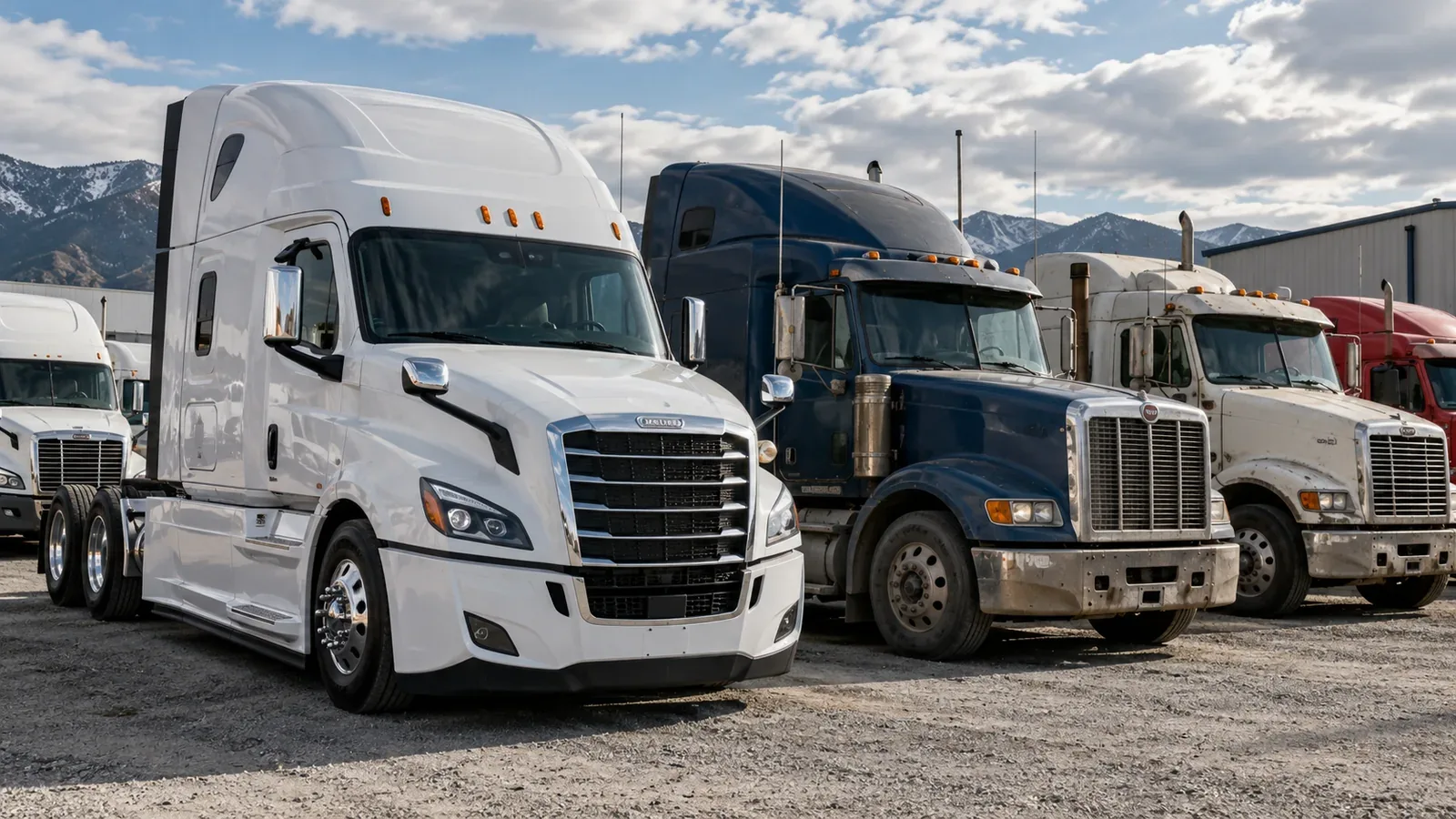
How Much Does a Semi Truck Cost in 2026? New vs. Used Prices
You search for a semi truck and see one listed for $45,000. Two clicks later, another one is $190,000. They both look like trucks that can haul a trailer. So what are you actually supposed to budget?
Here’s the short version: in August 2026, used Class 8 trucks sold at dealer retail averaged $64,367, according to ACT Research. For new trucks, two publicly advertised 2026 Freightliner Cascadias were priced at $159,900 for a day cab and $194,600 for a sleeper when their listings were consulted in October 2026.
Those numbers tell you what part of the market looks like. They do not tell you what your truck should cost. The difference is the truck’s age, miles, cab, engine, equipment, condition—and sometimes a repair the ad doesn’t mention.
If you’re thinking about buying your first truck, here’s how to make sense of the price tags without turning it into a research project.
New vs. used: what the prices really say
| What you’re looking at | Published price | What that number actually means |
|---|---|---|
| Used Class 8 truck | $64,367 | Average retail selling price in August 2026, across ages and configurations reported by ACT Research |
| New 2026 Cascadia day cab | $159,900 | One dealer’s advertised asking price; not a market average |
| New 2026 Cascadia sleeper | $194,600 | Another dealer’s advertised asking price; not a market average |
Sources: ACT Research’s used-truck report, new day-cab listing and new sleeper listing. Listing prices can change or disappear. These are real published observations, not a promise that similar trucks are available at those prices today.
One important catch: ACT’s used average covers Class 8 trucks of different ages and body styles, not just road-ready sleeper tractors. A clean, late-model sleeper can be far above that average. An older truck with many miles can be far below it. That’s why comparing your $75,000 listing to the $64,367 average won’t tell you, by itself, whether it’s a bargain.
Why two semi trucks can cost so differently
Think of a semi truck like a work tool rather than a regular car. Two trucks with the same badge may be built for completely different days on the job.
The cab changes the job it can do. A day cab is commonly used for work where the driver goes home after a shift. A sleeper has living and sleeping space for longer trips. The extra space may be useful—or money and weight you don’t need.
Age and miles tell only part of the story. A truck that spent its life hauling steady highway miles is not necessarily in the same condition as one that spent years idling or making short, demanding trips. Ask for service history, not just the odometer.
The spec sheet matters. Engine, transmission, axle gearing, emissions equipment, wheelbase and factory options can change the buying price. But you don’t have to memorize every specification. Start with this question: Will this truck do the work I plan to take?
A cheap listing may include an expensive surprise. New tires, a neglected emissions system or unresolved engine faults can erase the difference between a low-price truck and a more expensive, better-maintained one.
For a plain-language checklist of what to look at, see our used semi-truck inspection guide.
What a used semi truck might really cost you
Imagine you find a used sleeper advertised for $65,000. You have driven it around the lot, it starts well, and the dealer says it is ready for work.
Instead of thinking “I need $65,000,” ask “How much cash might I need before I can take my first load?”
Here’s an illustrative budget, not a market price quote:
| Item | Example amount |
|---|---|
| Used truck’s purchase price | $65,000 |
| Down payment (20%) | $13,000 |
| Amount financed | $52,000 |
| Independent inspection and initial repairs reserve | $5,000 |
| Cash set aside for early operating surprises | $6,000 |
| Illustrative cash to arrange or retain upfront | $24,000 |
The $24,000 figure is not an extra charge added to $65,000. It combines the $13,000 down payment with $11,000 that this hypothetical buyer keeps available for inspections, repairs and operating cash. It does not include licensing, insurance deposits, taxes or other transaction fees, which vary and must be quoted separately.
That distinction matters. A buyer might have enough cash to make the down payment but not enough to handle a repair in the first month.
Before you agree to buy, ask an independent qualified shop to inspect the truck—not only the engine, but the brakes, tires, transmission, fault history and emissions system. Ask the seller to provide maintenance records and documents for major recent repairs. If you cannot get reasonable answers, walking away may be cheaper than the attractive sticker.
What does a brand-new semi truck actually cost you?
Now picture a new tractor advertised at $190,000. That’s a hypothetical rounded price, chosen to make the math easy—not another dealer quote.
There may be a federal tax that surprises first-time buyers. Under IRS rules for qualifying highway tractors, the first retail sale generally carries a 12% federal excise tax (FET), subject to exemptions and rules about the taxable base.
If all $190,000 were included in the taxable price, the simple illustration would be:
| Example | Amount |
|---|---|
| Hypothetical truck price | $190,000 |
| Illustrative FET at 12% | $22,800 |
| Illustrative combined amount | $212,800 |
This is not a final invoice. Whether FET has already been included, exactly which amounts are taxable, and whether any exception applies require checking the actual deal. State taxes, registration, dealer charges, financing and insurance are not added here. Ask the seller for an itemized, written out-the-door quote—including a clear answer on FET—before comparing offers.
A new truck may offer warranty coverage and fewer unknowns from previous owners. It also ties up more money and can carry a bigger payment. New is not automatically the right choice for an owner-operator, and used is not automatically the risky one.
How much would the monthly payment be?
The purchase price isn’t the monthly payment. What you finance, how long you take to repay it and the interest rate all matter.
Here are two made-up financing scenarios. They are calculations only; they are not loan approvals, advertised rates or estimates of the APR a reader will qualify for.
| Used-truck example | New-truck example | |
|---|---|---|
| Hypothetical vehicle price | $65,000 | $190,000 |
| Down payment | $13,000 | $38,000 |
| Principal financed | $52,000 | $152,000 |
| Assumed APR | 11% | 9% |
| Term | 60 months | 72 months |
| Approximate monthly loan payment | $1,131 | $2,740 |
Both calculations assume a fixed-rate, fully amortizing loan with equal monthly payments and no additional financed charges. The new-truck scenario does not finance the FET or other fees; if those charges are financed, the actual payment will be higher. Rounding also changes the last few dollars. The Consumer Financial Protection Bureau’s explanation of loan amortization describes why early payments contain more interest.
Try our truck loan-versus-lease calculator with your actual terms. For a fuller walk-through, read what lenders look for when financing a first truck.
What about insurance, fuel and repairs? They come on top of these loan payments. That is why somebody can afford a truck payment and still struggle to keep the truck earning money. Our cost-per-mile guide explains how to account for those operating expenses without mixing them into the price of the vehicle itself.
So should you buy new or used?
There isn’t one winner. You can make the choice easier by matching it to your situation.
A used truck may make more sense when: you have limited purchase cash, can afford a qualified pre-purchase inspection, and are prepared to set aside money for repairs. You also know the kind of freight and routes you’ll run, rather than hoping the truck will somehow create demand.
A new truck may make more sense when: you have dependable contracts, a clear fit between the truck’s specification and your work, and enough cash to manage a larger financing commitment. Warranty terms and dealer service access can matter more than one feature on the brochure.
Wait before buying when: you don’t yet know your expected revenue, insurance quote, likely miles or operating cash requirement. Waiting to collect those numbers is not the same thing as giving up on the business.
If you want to compare specific vehicles, our Cascadia versus Volvo VNL guide focuses on the work each model is configured to do. If you are wondering whether keeping your current tractor is cheaper than replacing it, see when to replace a semi truck. Those are different decisions from establishing the first purchase budget.
Five questions to ask before putting down a deposit
- What is the total written price? Get purchase price, tax treatment and every dealer fee on one document. Ask what happens to the deposit if the deal does not close.
- What work will this truck actually do? A day cab and sleeper can both be excellent purchases for different jobs.
- Can I see the records? Ask for service invoices, inspection results, warranty terms where applicable and any major repairs. Independently verify what matters.
- What’s left in my bank account after purchase? Think about insurance, the first fuel bill, registration and repair reserves—not just the down payment.
- Can my business support the whole truck? A loan payment is not the same thing as total ownership cost. Run a realistic budget using expected revenue and actual quotes.
Three situations that make the choice feel real
These are illustrative scenarios, not stories submitted by readers or customers.
The first-time owner-operator. Maya sees a $58,000 tractor and a $92,000 tractor. The cheaper one looks tempting, but its service records are incomplete. She pays for an independent inspection and prices out the issues before deciding. Lesson: compare ready-to-work cost, not just two listings.
The local carrier. Ben works regular routes and returns home each evening. A big sleeper looks comfortable, but he realizes he would pay for sleeping space he rarely uses. He compares suitable day-cab quotes instead. Lesson: buy for the route, not the photograph.
The growing two-truck business. A company can qualify for a larger loan but wants cash available if one truck is down. The owner tests the monthly budget with slower weeks and higher repair spending before deciding on new or used. Lesson: a financing approval does not guarantee the business can absorb a bad month.
The bottom line
A semi truck is a major purchase, but your first decision can be surprisingly simple. Start with a real price from a comparable truck. Add the cash required to get it ready for work. Then check whether the payment and running costs fit the jobs you actually have.
For an October 2026 starting point, used Class 8 retail transactions averaged $64,367 in August, while two advertised new-2026 Cascadias asked $159,900 and $194,600. Those figures are useful orientation—not an appraisal, a guaranteed offer or a reason to skip the inspection.
The best-priced truck for you is the one you can safely put to work and afford to keep on the road, not necessarily the one with the lowest number in the ad.