
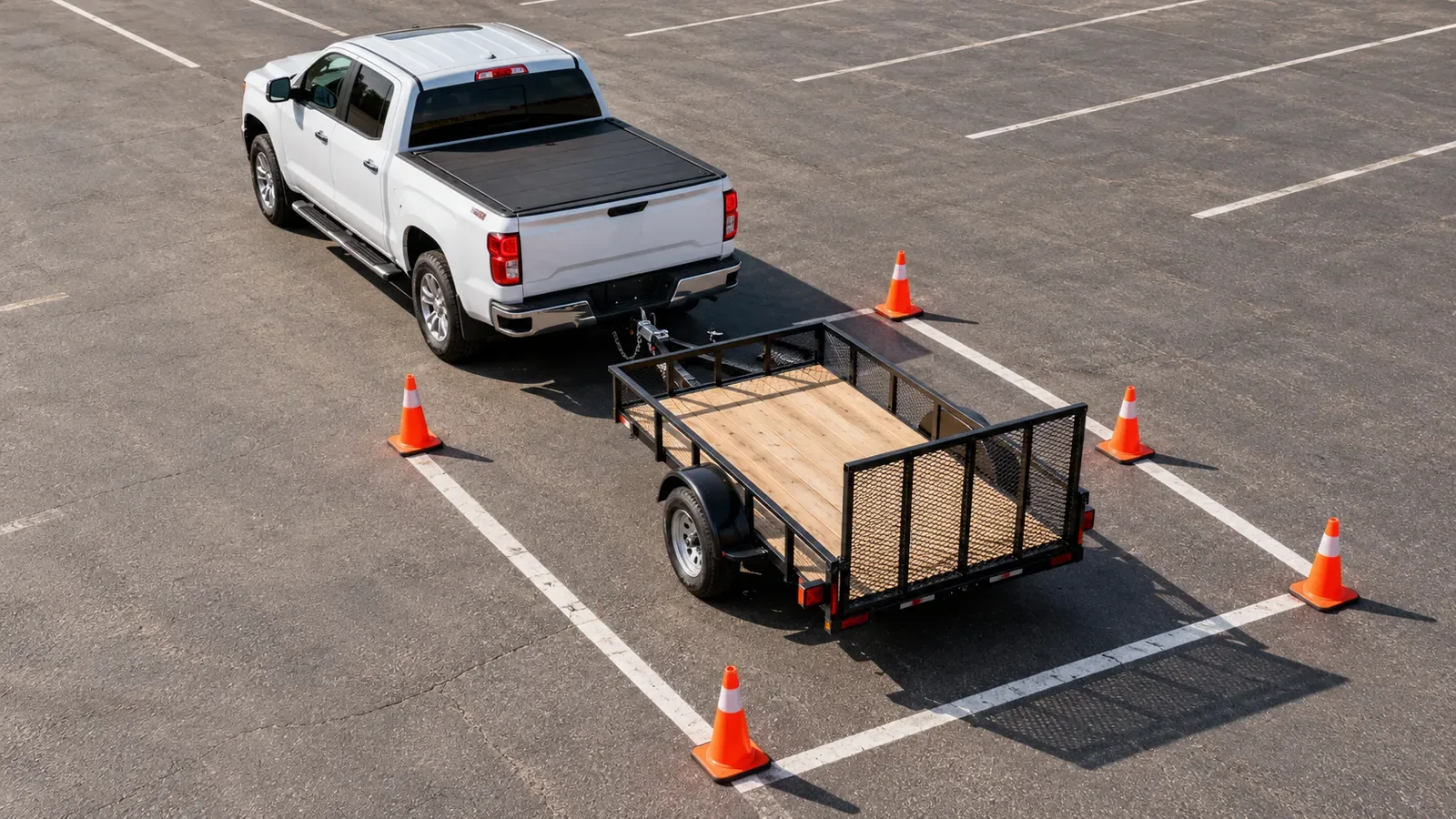
How to Back Up a Trailer: 3 Easy Practice Drills for Beginners
Your first attempt might look like this: the driveway is right behind you, but the moment you turn the wheel, the trailer starts heading toward the fence. You correct it. Now it points toward the other fence. You stop, wondering how something that follows your truck so easily going forward can be so awkward in reverse.
Here’s the short answer: start with your truck and trailer nearly straight, back up slowly, and make tiny steering changes. A useful beginner trick for a conventional bumper-pull trailer is to hold the bottom of the steering wheel: move that hand left to guide the trailer’s rear left, or right to guide it right. Stop and pull forward to straighten things whenever the bend gets too tight. U-Haul recommends this same bottom-of-the-wheel method in its trailer user instructions.
But knowing that trick isn’t the same as being able to park a trailer. Below is a three-drill practice plan, a troubleshooting table and a scorecard you can take to an empty practice area. No fabricated driving tests or personal towing experience are being claimed; these are instructional exercises assembled from manufacturer and towing-safety guidance.
Before you try: make the practice area safe
Do not learn this maneuver in a busy campground, on a public roadway, beside children or next to parked cars. Find a large, level lot where you have permission to practice and can create a clear area with soft cones. Choose daylight, good visibility and calm conditions. Avoid using hard posts, shopping carts, people or other vehicles as targets.
Walk the entire reversing path before entering the truck. Check for low branches, posts, drop-offs, people, pets and places where the trailer’s front corner could strike the truck. Check the route above and behind the trailer too—mirrors and cameras have blind spots.
Confirm that the hitch is properly connected, safety chains and electrical connections are correct, the jack is stowed, and the trailer and tires are roadworthy. Your specific tow vehicle, hitch and trailer manuals take priority. Some weight-distribution or sway-control hardware must be adjusted or disconnected before reversing; etrailer notes this equipment-specific caveat. Don’t unhook anything without following the manufacturer’s instructions.
If you use a spotter: agree on one clear STOP signal before moving. Ask the spotter to remain in a safe place where you can see them—not directly behind the trailer, between the truck and trailer, or between the trailer and a fixed object. Stop immediately if they disappear from view, anyone enters the path or instructions become confusing. U-Haul explicitly recommends help when backing and tells drivers to get out and check when they cannot see the path.
The one steering trick to remember
Imagine the steering wheel as a clock. Put one hand at 6 o’clock. To send the rear of a conventional bumper-pull trailer toward the driver’s side, move that hand left. To send it toward the passenger side, move the hand right. Now watch how the trailer reacts rather than continuing to turn blindly.
| You want the trailer’s rear to go… | Move your hand at 6 o’clock… | Then watch for… |
|---|---|---|
| Toward the driver’s side | Left | The trailer starting to angle that way |
| Toward the passenger side | Right | The trailer starting to angle that way |
| Straight back | Make very small corrections | The trailer staying nearly in line with the truck |
This is a memory aid, not a command to make a large steering turn. Once the trailer begins changing direction, you must reduce or reverse your steering input to keep the angle manageable. CURT warns against exaggerated turns and explains that shorter trailers react more quickly to small adjustments (CURT backing guide).
If the trailer is going the wrong way, do not speed up. Stop, pull forward to straighten, check your space, and restart. There’s no prize for getting it into a space in one attempt.
A three-drill practice plan you can actually follow
Use soft cones and a helper where practical. All three drills assume a conventional bumper-pull trailer in a clear, permitted lot. They’re not a training course for commercial combinations, fifth-wheel or gooseneck trailers, which handle differently.
Drill 1 — Back straight without chasing the trailer
Set two cones far apart as a visual reference for a generous, unobstructed lane. Start with the truck and trailer straight, wheels aligned and plenty of room behind you.
- Walk behind the trailer and confirm the lane is empty. Return to the driver’s seat, adjust mirrors, fasten your seat belt and agree on the stop signal.
- Select reverse, release the brake gently and move at walking pace or slower. Keep your foot ready to brake.
- Watch both mirrors. Make only a small correction if the trailer begins drifting toward one side.
- Stop while you still have plenty of room. If it is no longer nearly straight, pull forward and restart.
How to judge it: Could you keep the trailer inside the wide lane without frantic steering? Did you stop whenever you lost a clear view? Record a reset as a good decision, not a penalty.
Drill 2 — Put the trailer into a wide marked space
Make a generously sized parking bay with soft cones; keep its opening much wider than your trailer. Start in a position that lets you make a shallow turn toward the bay instead of a sharp, last-second swing.
- Walk the route, including the front corner of the trailer and the tow vehicle’s own swing.
- Pull the truck forward so the trailer has room to turn gradually toward the open bay.
- Back slowly while watching the trailer’s wheels and rear corner in your mirrors. Use the bottom-of-wheel cue if it helps.
- As the trailer begins to line up, gradually unwind the steering and straighten the tow vehicle.
- Stop when the trailer is fully inside the marked area. If the angle closes too quickly, pull forward and reset.
How to judge it: Did you create enough setup room? Did the trailer enter without crossing a cone line? Most importantly, did you keep the route clear and stop before the angle became dangerous?
Drill 3 — Recover from a bad angle without jackknifing
This is not an exercise in deliberately creating a dangerous jackknife. Instead, practice recognizing a small but unwanted angle early, with large clearance and no objects nearby.
- Begin a gentle turn while backing in the same open practice area.
- When the trailer starts drifting outside your intended path, stop rather than adding more steering.
- Check that the way ahead is clear. Pull forward slowly to reduce the angle and bring the combination into line.
- Pause, confirm the path is still clear, and try again from a better starting position.
How to judge it: Did you recognize the mistake while the correction was still easy? Could you reset calmly? This recovery habit is more valuable than forcing a crooked trailer into position.
U-Haul’s guidance is explicit: if the combination starts to jackknife or heads somewhere you didn’t intend, stop and pull forward to straighten before starting again (U-Haul instructions).
Spotter signals: agree on these before moving
One spotter should give instructions. More than one person calling directions at the same time makes the situation harder to control. Agree on signals such as these before the maneuver, and check that the spotter will stay visible in the driver’s mirror throughout.
| Signal | What it means | Driver action |
|---|---|---|
| Raised palm / agreed STOP call | Stop immediately | Brake, secure the vehicle, confirm what’s happening |
| Small left or right indication | Trailer needs a gradual change of path | Make a small input only while visibility is clear |
| Forward-reset signal | Current angle isn’t working | Stop, verify the forward path, pull ahead and straighten |
| No visible signal or spotter disappears | You no longer have clear guidance | Stop; do not guess or continue toward a blind area |
Important: a spotter must never put themselves in the path of the trailer or between moving equipment and a fixed obstacle. If the spotter cannot remain in a safe visible location, stop and reassess the maneuver. A rear camera is useful, but it doesn’t show every low or overhead hazard.
What went wrong? Use this troubleshooting table
| What you see | Likely explanation | Safer next move |
|---|---|---|
| Trailer darts sideways immediately | Steering input was too big, or a short trailer reacted quickly | Stop, pull forward, restart with a smaller input |
| Trailer heads toward the opposite side of the bay | You used normal car-steering intuition instead of watching trailer movement | Stop; use the bottom-of-wheel cue and restart slowly |
| Truck is getting close to the trailer’s corner | Angle between truck and trailer is closing too fast | Stop before contact, pull forward and straighten |
| The bay stays too far to one side | Approach was poorly lined up | Pull ahead and make a better initial setup |
| You cannot see the trailer’s rear or a cone | Blind spot or insufficient spotter/camera coverage | Stop, secure the combination and get out to check |
| You keep making quick left-right corrections | You’re moving too fast to observe the trailer’s response | Stop; slow the maneuver and make one correction at a time |
These are possible explanations, not a mechanical diagnosis. If handling suddenly changes despite the same setup, inspect tires, hitch and trailer components rather than assuming every problem is a steering error. Read our separate guide on trailer sway while driving for a different kind of problem.
A 10-minute practice scorecard you can print
We made a printable trailer-backing practice card with space for the vehicle, trailer length, drill, stop signals and notes. You can also copy this mini-version onto your phone or paper before practice:
| Drill | Stayed within the clear area? | Spotted hazards before moving? | Stopped when needed? | Next adjustment |
|---|---|---|---|---|
| Straight backing | Yes / No / Not tried | Yes / No | Yes / No | ______ |
| Wide bay | Yes / No / Not tried | Yes / No | Yes / No | ______ |
| Pull-forward reset | Yes / No / Not tried | Yes / No | Yes / No | ______ |
This isn’t a license, certification, or safety guarantee. The ten-minute format is simply a convenient practice session; more time and instruction may be needed. Stop early if the area becomes crowded, you feel rushed, visibility worsens or something doesn’t seem safe. Never practice while someone stands near the trailer’s blind spots.
Real situations: which skill transfers where?
A rental trailer at a self-storage unit. The lane looks wide when you’re standing outside, but the door is close to a wall. Your best improvement is the setup: get out and check the approach, then try a wider angle of entry instead of correcting every foot while reversing. If there isn’t enough room, ask staff for a safer space.
A small utility trailer in a driveway. It reacts quickly to even modest inputs. Focus on Drill 1 and small corrections before trying a tight driveway. If there are children, pedestrians, vehicles or a sidewalk crossing you cannot control, don’t practice there.
A camper arriving at a crowded campground. Other people may be watching, but that doesn’t change the safest process: inspect the site, agree on a visible spotter, and pull forward as many times as needed. Camping World’s campsite-backing guide also stresses walking the site and using a spotter.
These are illustrative situations, not reports of real customer experiences.
Before your next trip
Practice on an open lot until you can back straight, approach a wide space and recover early without rushing. The moment you lose visibility, lose your spotter or lose control of the angle, stop. If you haven’t confirmed your setup’s ratings and cargo loading, use our guides on how much your truck can tow, loaded trailer weight and tongue weight before the trip.
Safe reversing is not about memorizing a clever wheel trick. It’s about setting up well, keeping the area clear, noticing small changes and being willing to reset.