
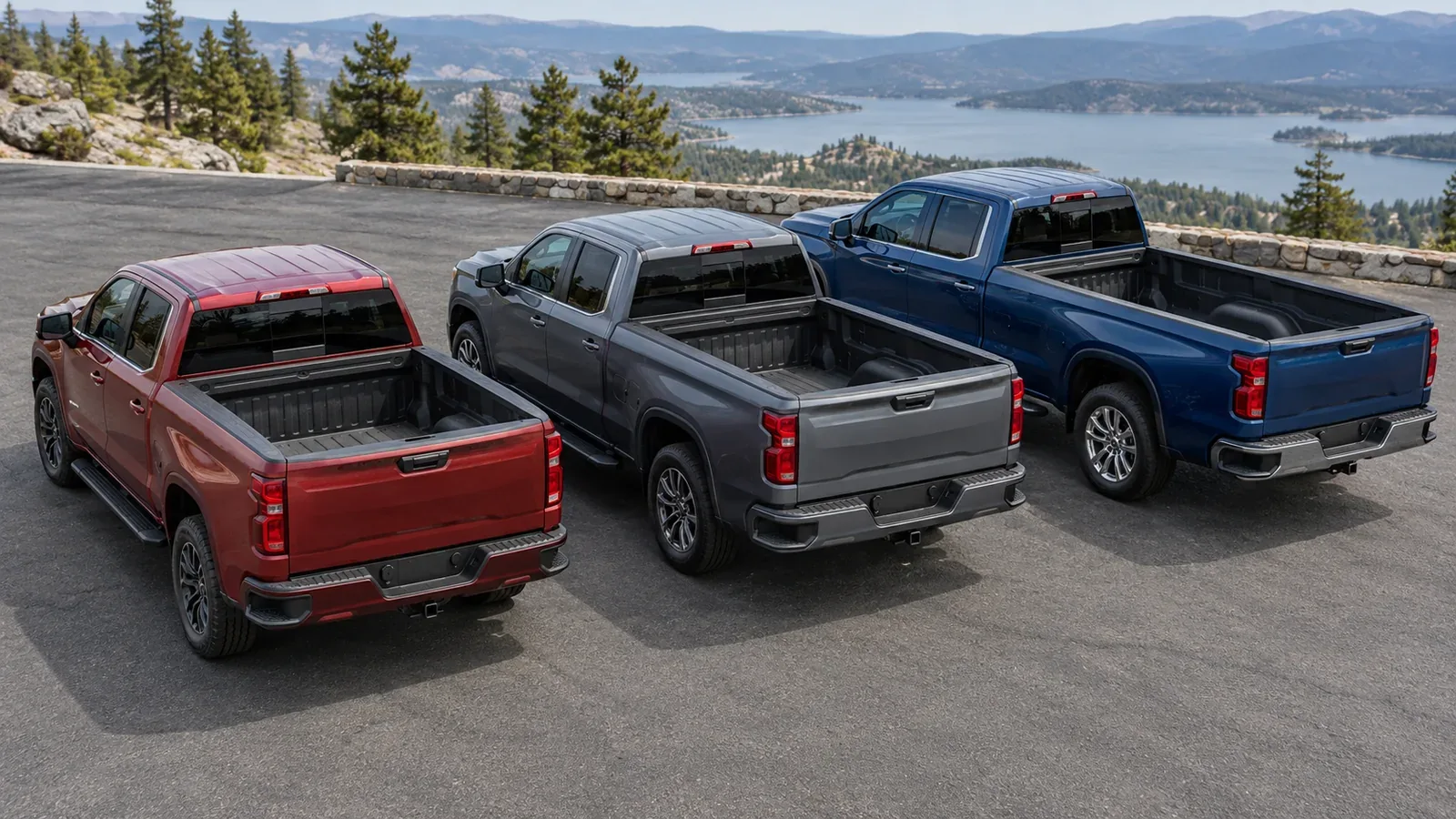
Pickup Truck Bed Sizes: What Actually Fits?
Picture this: you drive to the hardware store for a 4-by-8-foot sheet of plywood. Your truck has a “6.5-foot bed.” It sounds roomy until the sheet reaches the tailgate. The plywood is 96 inches long. The inside floor of a representative 2026 F-150 6.5-foot bed is only 78.9 inches. The numbers, not the badge or brochure photo, decide whether it fits with the tailgate closed.
For most owners, the best bed is not automatically the longest. It is the shortest usable bed that handles their actual cargo without unsafe overhang, excessive weight or constant rental-truck trips. This guide uses published 2026 pickup dimensions, straightforward packing examples and a worksheet you can take to a dealer or lumberyard. It does not substitute for the vehicle’s owner manual or a professional load assessment.
Quick decision: measure the cargo first; compare inside floor length, narrowest clear width and available payload second. If any one of those fails, a nominally bigger bed or a lowered tailgate does not automatically solve the problem.
Short bed vs. standard bed vs. long bed: the plain-English answer
A short bed emphasizes passenger space and manageable overall length. On many full-size light-duty trucks, that means something in the neighborhood of five and a half feet. A standard bed is often around six and a half feet, though a Ram 1500 also offers a nominal 6-foot-4-inch box. A long bed is commonly called eight feet and is especially useful when transporting long materials with the tailgate closed.
But these are names, not engineering tolerances. An eight-foot model needs more than 96 inches of usable floor length to surround a 96-inch item with the tailgate closed. If a bed liner, ladder rack, toolbox or tonneau hardware takes up space, published bare-bed dimensions may no longer describe the usable area.
The cabin choice matters too. A short crew-cab truck can already be lengthy in a parking garage. Adding a longer bed may increase overall vehicle length, turning and parking demands. Buy for the streets, job sites and driveways you actually use—not just for the one largest item you might someday carry.
2026 Ford, Chevrolet and Ram bed-size comparison
The table compares inside cargo floor measurements, not exterior dimensions. Published figures describe specific 2026 models or configurations and must be checked on the truck you intend to buy. Sources: Ford’s 2026 range, the F-150 cargo-box specification recap, Chevrolet’s short-bed specification, Chevrolet’s standard-bed specification and Ram’s 2026 specification brochure.
| 2026 pickup bed | Nominal name | Floor length, tailgate closed | Width between wheelhouses |
|---|---|---|---|
| Ford F-150 | 5.5 ft | 67.1 in | 50.6 in |
| Ford F-150 | 6.5 ft | 78.9 in | 50.6 in |
| Ford F-150 | 8 ft | 97.6 in | 50.6 in |
| Chevrolet Silverado 1500 | Short | 69.92 in | 50.63 in |
| Chevrolet Silverado 1500 | Standard | 79.44 in | 50.63 in |
| Ram 1500 | 5 ft 7 in | 67.4 in | 51.0 in |
| Ram 1500 | 6 ft 4 in | 76.3 in | 51.0 in |
These rows are useful illustrations, not a promise that every trim has every box option. Ram’s 2026 brochure is Canadian-market documentation; U.S. model availability and option combinations should be checked separately. Likewise, Silverado and F-150 configurations differ by cab and trim. The 2026 Ram US FAQ confirms a maximum 76.3-inch bed cargo length for that lineup.
Three easy-to-miss observations follow from the chart:
- A Ford “6.5-foot” box has a little more than 78 inches of floor length, while a Silverado standard box approaches 79.5 inches. The label is not the useful measurement.
- The 2026 Ram 1500 6-foot-4-inch box is 76.3 inches long at the floor. Never assume the Ram’s label means it must be exactly two inches shorter than every Ford or Chevrolet alternative.
- All the examples have at least 50 inches between wheelhouses, wide enough in principle for a 48-inch-wide flat panel. The hard question then becomes length, support and restraint, not simply width.
Do not mix these light-duty dimensions with F-250/F-350 or Silverado HD cargo boxes: those have their own configurations. For weight limits and the trade-off between heavy-duty classes, see 3/4-ton vs. 1-ton pickups.
The four measurements that decide whether cargo fits
You do not need engineering software. Bring a tape measure, the actual item’s dimensions and a few minutes.
1. Usable floor length with the tailgate closed. Measure from the inside front wall to the inside surface of the closed tailgate, at the height where your item will actually rest. A sloping or bulky item can touch the upper part of a panel before the bottom does. Confirm that protective liners and toolboxes are included in your measurement.
2. Narrowest width. Measure between the wheel wells for anything that must sit flat on the floor. A truck may have a much wider bed at the top and still have a narrow path at the bottom. Measure any built-in drawer system and tie-down protrusions too.
3. Height and opening. A refrigerator, equipment case, stacked lumber or covered load can clear the bed floor yet fail to pass under a tonneau cover or through the tailgate opening. Height above the bed floor is not identical to overall vehicle clearance under a parking structure.
4. Safe carrying capacity. Check the door-jamb tire/loading label and the vehicle’s owner manual. Subtract people, tools, accessories and any other loads counted against the truck’s available payload. The truck’s gross vehicle weight rating (GVWR), rear gross axle weight rating (GAWR) and individual components may constrain a load even when a simple total appears acceptable. A large empty bed can still belong to a truck with little payload remaining.
A quick geometric rule is cargo length ≤ verified usable inside length, and cargo width ≤ verified clear width at its resting height. If either fails, mark it as not enclosed-fit. This rule answers only the dimension question; it says nothing about securing a load or weight safety.
Will a 4x8 sheet of plywood fit in a pickup bed?
A standard 4-by-8-foot sheet is 48 inches wide and 96 inches long. That is an ideal test because both dimensions are easy to verify.
Consider the Ford examples above. The 5.5-foot (67.1-inch) bed is 28.9 inches shorter than the sheet; the 6.5-foot (78.9-inch) bed is 17.1 inches shorter. Neither can enclose that sheet flat with the tailgate closed. The 8-foot Ford bed has a stated floor length of 97.6 inches, so the 96-inch sheet may fit geometrically in a bare-bed configuration with the gate closed; real clearance must still be measured and the sheet must be properly restrained.
The wheelhouse test is separate: 48 inches of plywood is narrower than Ford’s cited 50.6-inch clearance. If you slide a 48-inch panel flat between wheelhouses, the width can work. But moving it above the wheelhouses, propping it on angled lumber or raising the tailgate creates new support and securement questions that the width table does not answer.
Do not treat a tailgate as an unlimited loading platform. The safe position and allowable loading of a tailgate or extender depend on the exact vehicle and equipment. Long or flexible sheets can lift, flex and shift under wind. If you cannot follow the manufacturer’s support, restraint and overhang instructions, choose a suitable trailer, rented work truck or delivery instead.
Worked example: the standard bed that is almost long enough
Your plywood is 96 inches long. A Silverado standard bed lists a 79.44-inch floor. The difference is 96 − 79.44 = 16.56 inches. You have established only that the sheet does not fit entirely inside the closed bed. You have not established an approved amount of rear overhang, tailgate load, number of straps or safe driving speed. Those require separate checks.
That is a more useful conclusion than a generic statement that “plywood fits in most pickups.”
What about furniture, appliances, motorcycles and pallets?
These loads are harder than plywood because shape, center of gravity and loading process matter. Here are four cases worth checking before you leave home.
| Cargo | First measurement | Commonly missed issue | Better decision |
|---|---|---|---|
| Sofa or furniture box | Longest packed edge and full width | Arms, feet or upholstery snag at wheel wells | Verify narrowest cross-section and protect the item |
| Fridge or tall cabinet | Height and approved transport orientation | Manufacturer may require upright transport; cover may not clear | Check appliance instructions and secure upright if required |
| Motorcycle or riding mower | Wheelbase and widest point | Ramp rating, bed height and tie-down locations | Plan an approved loading method; use help when needed |
| Palletized boxes or heavy masonry | Loaded pallet footprint and total weight | Pallet fits but payload/rear axle does not | Obtain true load weight and axle check before loading |
The commonly quoted 48-by-40-inch pallet is a footprint, not a guarantee that a forklift can place it into a pickup bed. The wheelhouses, bed sides, tailgate, lifting equipment and load weight may make the operation inappropriate. Do not infer a safe pallet capacity by dividing bed area by 1,920 square inches.
If you routinely need full pallets, compare a delivery vehicle or a properly loaded box truck rather than assuming an open pickup bed is an equivalent cargo platform.
Bed length does not tell you how much weight you can haul
Suppose you have two hypothetical pickups. Both have enough space for the same load. Truck A has 1,400 pounds available on its own verified tire/loading label after factoring in permanently installed accessories; Truck B has 2,000 pounds available under the same assumptions. Your trip adds two adults totaling 340 pounds, another 110 pounds of tools and 900 pounds of cargo.
That is 1,350 pounds to account for. Under those simplified assumptions, Truck A shows only 50 pounds remaining and Truck B shows 650 pounds. Neither number independently proves the trip is safe: rear axle weight, tire ratings, cargo placement and tie-down limits still matter. Real weight labels and scale readings take precedence over this hypothetical example.
The point is simple: you cannot buy extra payload by adding a longer cargo box. Larger volume and higher permitted weight are different specifications. For an example of exact-truck capacity checks, see the F-250 vs. F-350 comparison, but do not reuse those heavy-duty ratings for an F-150 or Ram 1500.
A simple method to choose your next pickup bed
Try this before you book a test drive. It takes less effort than finding a parking space for the wrong truck.
- List three real loads. Include the longest thing you carry monthly, the widest equipment you use and the heaviest typical trip. Record the packed measurements, not bare product dimensions.
- Add how often you carry each. A once-a-year 8-foot board does not carry the same weight in the decision as a ladder you move every morning.
- Eliminate beds that fail the enclosed-fit test. If your top-priority item must ride flat with the gate shut, compare actual interior length and wheel-well clearance—not the nominal model name.
- Check payload and axle limits separately. Use the specific truck’s labels, accessory information and a certified scale as appropriate.
- Check the whole truck. Measure garage depth, parking space, loading ramp angle and job-site turning room. Compare cab layouts and the vehicle’s overall dimensions.
- Price the alternatives. An occasional trailer rental or lumber delivery may be less expensive than owning and parking a longer pickup year-round.
- Choose the smaller viable configuration. If both satisfy your work, buy on total use and cost, not the largest advertised bed.
Printable field worksheet: Pickup Bed Cargo Fit & Load Decision Sheet. It lets you record two truck candidates, three loads, measurements and follow-up safety checks before purchase. The worksheet is a decision aid, not a load certification.
Three realistic buying situations
1. A family pickup used for weekend renovations
Illustrative situation: most driving involves school runs, parking garages and short trips. The owner wants to move plywood three times a year. A shorter crew-cab truck may be the better daily choice; delivery or a suitable trailer can solve the infrequent oversized-sheet problem. But check the all-in rental cost and a safe towing setup first. Buying a longer truck only because “I might need eight feet once” can be an expensive assumption.
2. A contractor carrying ladders and lumber every week
Here the long-material trip is routine. Fewer stops for pickup trailers, simpler loading and a verified longer enclosed bed can save time. The contractor should measure the actual rack setup, tie-down design, tailgate instructions and site parking before committing. A long bed also does not excuse an unsafe load or an overloaded rear axle.
3. A buyer choosing between two similarly named standard beds
One truck advertises 6.5 feet; another is marketed as 6 feet 4 inches. The buyer’s 77-inch toolbox-and-rail assembly fits within a published Ford 78.9-inch bare floor but exceeds the cited Ram 76.3-inch bare floor. Neither brochure accounts for the exact liner, attachment clearances or mounting hardware. The buyer should measure both physical trucks with the full assembly dimensions, not purchase based on the nominal labels alone.
These are constructed examples, not reports from real customers or verified sales cases.
Securing cargo: the check after it fits
A fitted load is not automatically a secure load. Use the truck owner’s manual for tie-down point ratings, appropriate restraints and tailgate limits. Ford’s owner-manual section on anchor points illustrates why anchor geometry and capacity cannot be guessed from appearance.
If you are operating in commercial transport, FMCSA cargo-securement rules may also apply according to the vehicle and operation. Those federal commercial rules are not a universal residential pickup checklist or a substitute for checking state laws. In every case, stop if a load could slide, shift, tip or obscure required lights. Never rely on a hand holding cargo or an improvised cord.
A careful loading plan considers the weight of accessories, safe placement, driver visibility, door and tailgate closure, and how the item will be unloaded. If a loading decision feels marginal, a professional hauler or appropriate trailer is often the safer and cheaper choice than damaged cargo or a collision.
What to check before you pay for a truck
Bring your measurements and ask to inspect the exact truck. Verify the box has not been shortened by a toolbox, fixed cover, bed divider or other accessory. Photograph the inside floor dimension and manufacturer tire/loading label for your own records, keeping private identifying data out of public postings. Check your parking space and test the loading approach. Confirm the equipment required to safely transport your real cargo actually exists and is appropriately rated.
Then write down the result in one sentence: “This bed fits [specific load] with the gate [closed/open only under verified instructions], within verified weight and restraint limits.” If you cannot honestly complete that sentence, you have not finished the comparison.
The next purchase is less about getting the biggest truck and more about avoiding a truck that makes every real job difficult.