
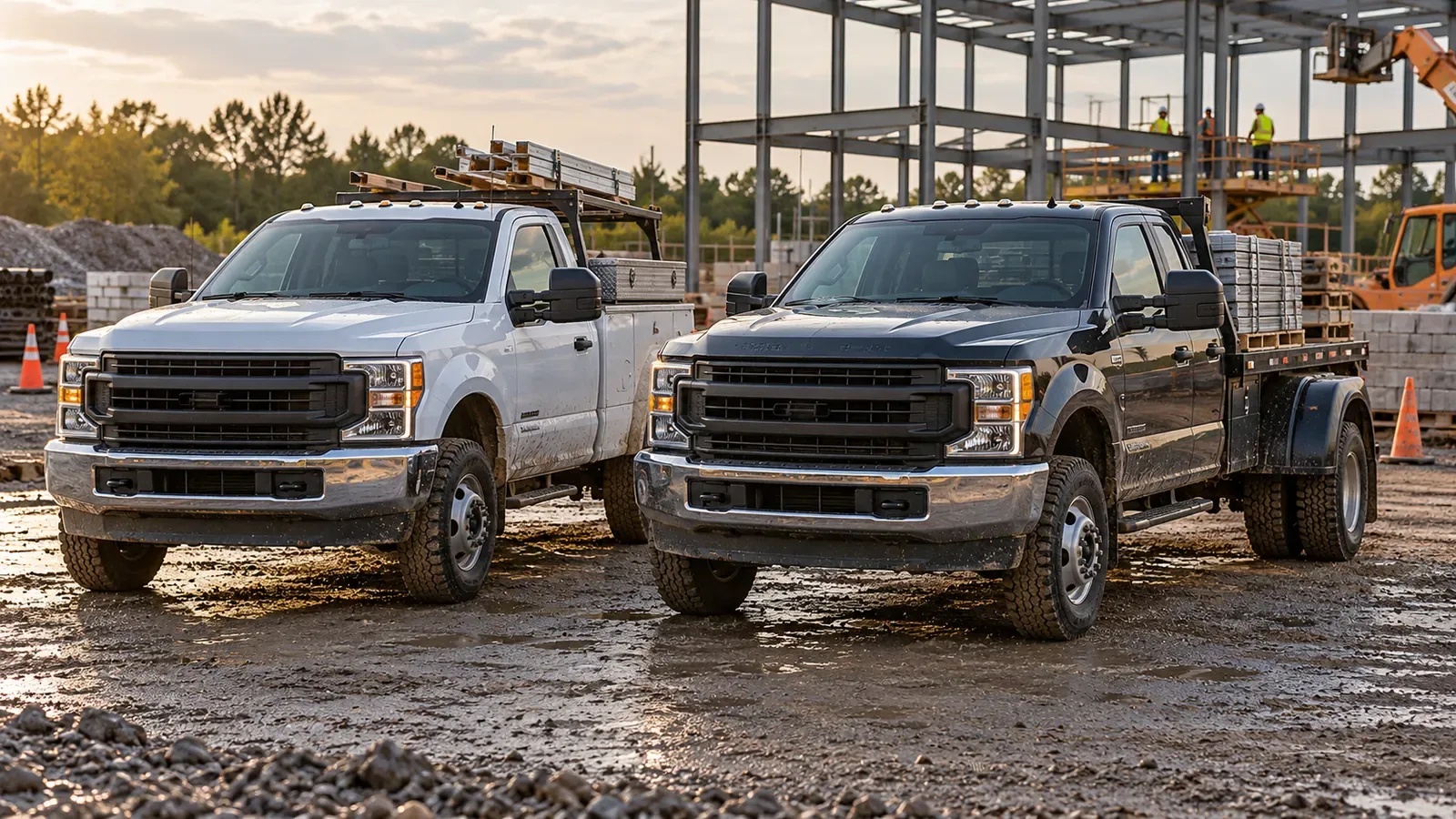
3/4-Ton vs. 1-Ton Truck: What You Actually Get
A three-quarter-ton pickup and a one-ton pickup can look almost identical in a dealership parking lot. Both might have a crew cab, four-wheel drive and a diesel engine. The one-ton costs more. Is it worth paying extra?
Here is the question to ask instead: What does your truck need to carry on a normal working day or when the trailer is fully loaded? A truck may have an impressive tow rating yet have surprisingly little room left for passengers, tools and the trailer’s weight pressing down on its hitch.
This guide explains the two labels in plain English, compares real 2026 manufacturer information from Ford, Chevrolet and Ram, and gives you a repeatable method for comparing two actual vehicles. It covers U.S.-market pickups; it is not a guide to chassis-cab ratings or licensing law.
Quick answer: A one-ton model family usually offers configurations with more payload and higher rear-axle ratings, including dual-rear-wheel choices. But you cannot determine the useful capacity of a particular truck from “2500” or “3500” alone. Look at the driver-door labels, match the manufacturer’s exact towing table, and do the load math.
Open the two-truck buyer worksheet (printable PDF). Enter your actual door-label figures rather than a brochure maximum.
What does 3/4 ton vs. 1 ton mean today?
The names came from older ways of describing a pickup’s intended carrying class. Three-quarter of a U.S. short ton is 1,500 lb; one short ton is 2,000 lb. Those numbers are not today’s payload ceilings. The nicknames stayed even as frames, engines, tires and vehicle weight ratings changed.
Modern badges roughly map to these families:
| Informal label | Typical U.S. pickup models | Look for |
|---|---|---|
| Three-quarter-ton | Ford F-250, Chevrolet Silverado 2500HD, Ram 2500 | Specific payload label, GVWR, rear GAWR and tow equipment |
| One-ton | Ford F-350, Silverado 3500HD, Ram 3500 | The same labels, plus whether the truck is SRW or DRW |
SRW means one rear wheel at each side. DRW or dually means two at each side. A DRW version can offer a significantly different rear-load capacity; it is also wider and involves more tire maintenance. It is not automatically the sensible choice for every driver.
Do not confuse these retail nicknames with regulatory vehicle classes or automatic CDL requirements. Those depend on weight ratings, actual use and relevant jurisdiction. A badge is not a legal answer.
What a one-ton truck may add — and what it does not guarantee
| Buying consideration | 3/4-ton family | 1-ton family | What decides the purchase |
|---|---|---|---|
| Bed and truck-borne load | Often ample for tools and smaller loads | More high-payload configurations typically available | Actual loaded payload and rear axle load |
| Trailer pulling | Can have a high published tow rating | Often higher family maximum on selected builds | Exact tow rating, hitch and trailer weight |
| Fifth-wheel or gooseneck | May fit some loaded trailers | More choices for heavy pin loads | Pin weight + people + cargo within every rating |
| Rear wheels | Commonly SRW | SRW or DRW in these model families | Rear load, width, tires, parking |
| Everyday use | Capacity may be sufficient at lower cost | Extra capacity may remain unused | Your real duty cycle and ownership costs |
| Price and upkeep | Compare actual quotes | DRW tires, options and taxes can change cost | Quotes, downtime and maintenance records |
There are no guarantees in the right-hand column. A well-specified F-250 and a differently configured F-350 can even have overlapping payload numbers, as our 2026 F-250 vs. F-350 comparison shows. Manufacturer tables describe builds, not every truck that happens to carry the badge.
Real 2026 manufacturer examples — maximums are not your door sticker
To see how different the model families can be, compare the maximum available figures published by manufacturers. These are not matched configurations and must never be assigned to a truck without checking its VIN and equipment.
| 2026 manufacturer example | Official maximum available figure | Important limitation |
|---|---|---|
| Ram 2500, gasoline maximum payload | 3,930 lb | Published class maximum, not a diesel or optioned truck’s label |
| Ram 3500, gasoline maximum payload | 7,590 lb | Requires an eligible configuration; not true for every 3500 |
| Chevrolet Silverado 2500HD, maximum trailering | 22,420 lb | Requires a specific engine, equipment and trailer type |
| Chevrolet Silverado 3500HD, maximum trailering | 36,000 lb | Manufacturer specifies a particular diesel DRW configuration |
Sources: Ram 2500 capability, Ram 3500 capability, and Chevrolet Silverado HD 2026. Figures are from different builds and illustrate the range of available equipment, not a like-for-like comparison.
That distinction is the entire point. A maximum is useful to understand what could be configured. It is a poor shortcut for deciding whether the truck at a nearby dealership can safely carry your camper or equipment.
The 2026 Stellantis Fleet buyer guide provides further specification context. Ford’s 2026 Super Duty towing guide similarly breaks down limits by cab, engine, axle and wheelbase. Neither source supports using a single towing number for every example of a model.
The five numbers to check on the truck — in this order
Before paying a deposit, ask the seller to photograph the actual vehicle’s door labels and give you its VIN and factory equipment list.
- Available payload. Find the yellow-and-white tire/loading label where present. It gives the combined occupant-and-cargo carrying allowance for that vehicle. Check whether aftermarket equipment added after delivery is already accounted for; don’t subtract something twice.
- GVWR. Gross Vehicle Weight Rating is the maximum permitted loaded weight of the truck itself. Drivers, tools, accessories and the trailer’s downward hitch or pin load all matter.
- Rear GAWR. The rear axle has its own rated maximum. A truck can have payload remaining yet overload the rear axle when heavy weight sits behind the cab. A scale check is needed to verify loaded axle weight.
- Exact towing and GCWR rating. Match engine, axle ratio, cab, drivetrain, wheelbase and tow package. The manufacturer’s actual towing table and combined-weight rating are distinct from payload.
- Hitch, tires and trailer limits. The receiver or fifth-wheel hardware, tires, trailer GVWR and trailer brakes each impose additional constraints. A bigger truck badge does not upgrade the hardware automatically.
If the dealer gives you only a screenshot of “max towing” from an advertisement, you still do not have the information needed for this decision. Ford explicitly directs buyers to vehicle-specific carrying-capacity labels.
Try the load math before you compare prices
Consider two hypothetical trucks from a dealer. These numbers are made up for teaching the calculation; they are not Ford, Chevrolet or Ram model ratings.
| Input from a planned trip | Truck A: 3/4-ton example | Truck B: 1-ton example |
|---|---|---|
| Payload shown on that particular truck’s label | 2,900 lb | 4,300 lb |
| Driver and passengers | 450 lb | 450 lb |
| Tools and cargo | 700 lb | 700 lb |
| Actual measured trailer tongue or pin load | 1,250 lb | 1,250 lb |
| Total truck-borne load | 2,400 lb | 2,400 lb |
| Preliminary payload balance | 500 lb | 1,900 lb |
The math is simple: payload left = the truck’s actual payload label minus passenger, cargo, hitch/pin and other added truck-borne weight. In this example, both have a positive payload balance. That does not mean both are cleared for the trip. Rear-axle, GVWR, GCWR, trailer and hitch limits still need to be checked. The remaining 500 lb is not a license to ignore those limits.
If Truck A carried 900 lb of tools rather than 700 lb, its preliminary balance would fall to 300 lb. If you later add a toolbox, extra passenger and equipment, that margin changes again. Load math makes tradeoffs visible before money changes hands.
For a more detailed explanation of truck ratings, read how much your pickup can tow and how to measure trailer tongue weight.
Three buying situations that call for different answers
1. A small business with tools and no regular trailer
An electrician carries a ladder rack, tools and parts every day. They rarely tow. They compare two labeled trucks, include the weight of the rack and occupants and calculate that both have enough carrying allowance. In this illustrative scenario, the more expensive one-ton has no clear load-related benefit. Compare purchase price, tires, insurance, parking and service access instead.
A useful decision is not always “buy the bigger truck.” The right truck is the one that safely performs the actual job at an acceptable operating cost.
2. A fifth-wheel camper with a heavy loaded pin
A buyer knows the camper’s advertised empty weight but does not yet know the loaded pin weight with water, batteries and camping supplies. Neither a 3/4-ton badge nor a 1-ton brochure is enough. The next step is to obtain realistic loaded weights, evaluate truck-borne pin load, and check rear axle, hitch, GVWR and GCWR before choosing the vehicle.
The article how much a trailer weighs helps distinguish empty from loaded weight. A positive payload calculation alone is still not approval to tow.
3. A contractor offered an inexpensive diesel
Two used trucks appear to have similar towing capability. One diesel has substantial accessories, a crew cab and off-road equipment. The other, a lighter-equipped gas truck, displays a higher payload allowance. The example is hypothetical, but the lesson is real: engine torque and payload are not the same measurement. Read both door labels. Do not assume the diesel wins every capability comparison.
What does the more capable truck really cost to own?
There is no reliable universal price difference between three-quarter-ton and one-ton pickups. You have to compare the actual trims, engines and quotes. A bigger truck might cost more to buy, while a specific used one-ton might be cheaper than a highly optioned three-quarter-ton.
Build a cost comparison using the same planned ownership period:
| Cost or constraint | What to record |
|---|---|
| Purchase | Dealer out-the-door quote, sales tax and fees |
| Insurance and registration | Quotes for each VIN and your actual use |
| Fuel | Realistic annual distance and consumption; no unverified mpg promise |
| Tires | SRW or DRW replacement count, correct load rating and local prices |
| Maintenance | Documented service needs; diesel system costs where applicable |
| Equipment | Hitches, racks, toolboxes, suspension-ready options and installation |
| Downtime | Whether missed work is costly if the truck is being repaired |
| Parking | Garage width, turning space and daily access constraints |
The worksheet lets you compare those figures side by side. It deliberately leaves prices blank rather than presenting invented national averages. If an additional payload margin saves you from overload or frequent rental of another truck, that value matters. If you never use the capacity, paying for it may not make sense.
A simple buyer decision in five minutes
Use this process at the dealership or when reviewing two listings.
- Write down the heaviest normal workday or camping trip, not the empty truck’s intended use. Include people, add-ons and realistically loaded equipment.
- Ask for the actual VIN, payload label and rear axle rating for each candidate. If the seller refuses to provide ratings or label photos, do not rely on the listing’s maximum claims.
- Work out truck-borne load for each candidate using the same assumptions. Get measured weights when the use is close to a limit.
- Check the other separate ratings: GVWR, rear GAWR, exact tow chart, GCWR, hitch, tires and trailer. Unverified is not a pass.
- Compare full ownership quotes after ruling out trucks that cannot meet the job. Pick the option that safely covers the load and costs the least for the way you use it.
Stop and verify: a truck with an unreadable or missing certification label, unclear towing equipment, altered suspension or unexplained modifications deserves additional investigation before a purchase. No spreadsheet can certify an altered vehicle.
Buyer checklist: questions to ask before the test drive
- Do the VIN and equipment record match the photos, labels and listing?
- Can the seller show the payload and tire/loading label clearly?
- What are the exact GVWR, front/rear GAWR, and GCWR values?
- Which tow package and hitch are installed? Are those ratings documented?
- Will tools, passengers and hitch/pin load fit with a sensible allowance?
- Has the truck been modified, and what changed after the factory label was issued?
- Is there enough space for the truck at the places you park and work?
- Do you have insurance, registration, tire and maintenance estimates for both candidates?
Print the 3/4-ton vs. 1-ton vehicle comparison PDF. If you cannot answer a weight-limit question, mark it UNVERIFIED rather than guessing.
How we prepared this guide
This guide uses 2026 U.S.-market manufacturer publications from Ford, Chevrolet and Ram to explain the distinctions; the illustrative load calculations are explicitly labeled examples, not real vehicle tests. It does not claim hands-on testing or individual VIN inspections. Before purchasing, verify the vehicle’s current official labels and any applicable technical service or regulatory requirements. For direct references, see the manufacturer sources listed above and in the article metadata. The temporary lead image and author attribution require review before release.