
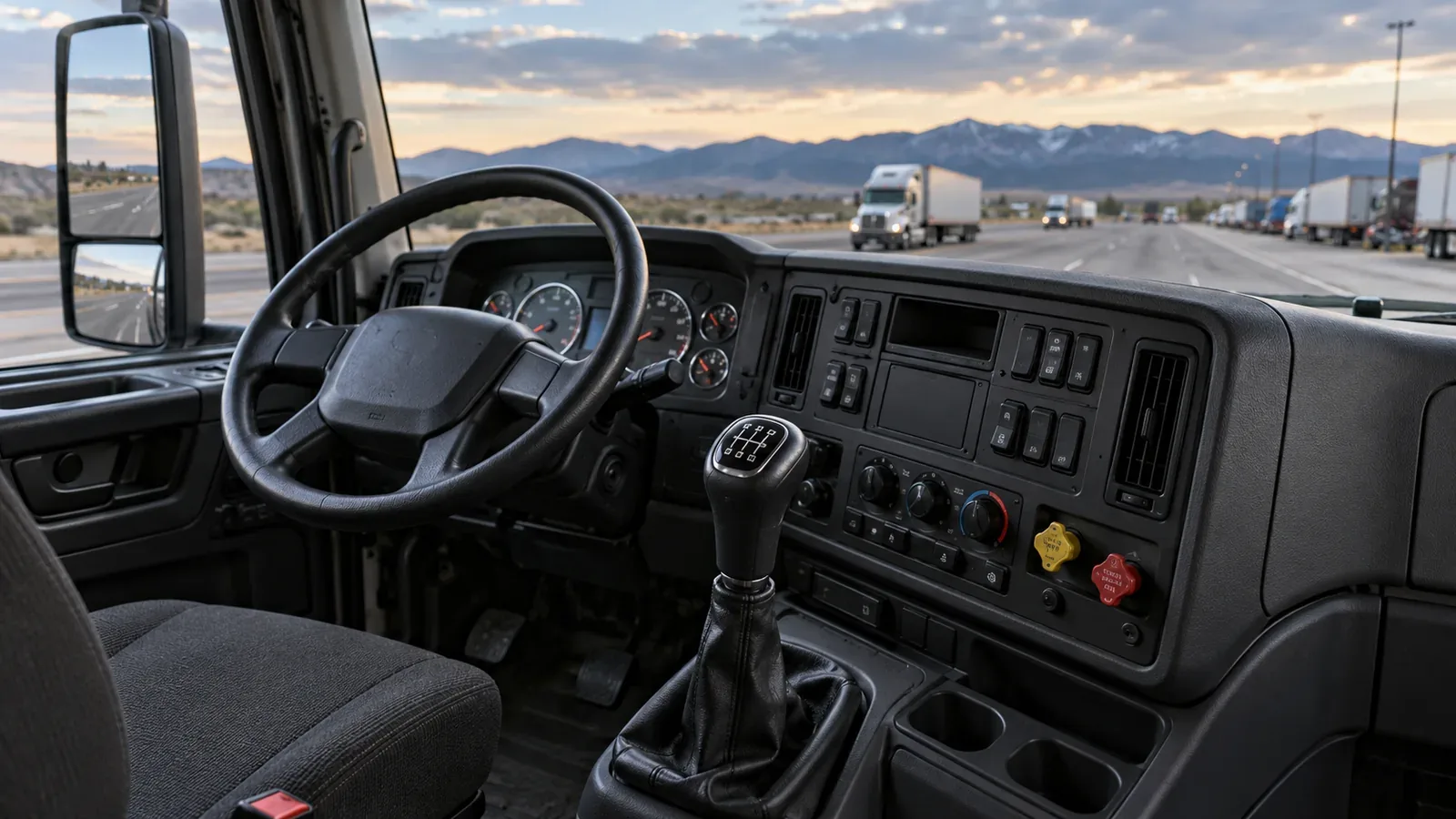
A used semi-truck listing may say automatic, yet the driveline beneath the cab could be an automated manual transmission. Another truck advertises an 18-speed manual with a recently replaced clutch. Which one will cost less to run for the next 400,000 miles?
That is not a question the gear count can answer. The first truck might offer easier driving and more predictable shifting, but could have undocumented actuator faults. The second may have a familiar, serviceable gearbox, but an experienced driver can still inherit worn synchronizing or driveline components. The meaningful comparison is the transmission model, the work it will perform and the evidence you can inspect—not a stereotype about “manual versus automatic.”
This guide is written for U.S. Class 8 tractor buyers and owner-operators. It compares driver-operated manuals with automated manual transmissions (AMTs) using manufacturer documentation, a used-truck inspection process and original ownership-cost scenarios. It does not attempt to choose the best engine: that is covered separately in our Cummins X15 vs. Detroit DD15 guide. And our Cascadia vs. Volvo VNL comparison considers complete trucks, not transmission mechanics alone.
Quick answer: manual or automated for your operation?
| Your operating priority | A manual may suit you when… | An AMT may suit you when… | Verify before committing |
|---|---|---|---|
| Long highway routes | You prefer direct shift control and already own a well-maintained manual tractor | You value consistent shift selection and less driver input | Engine/axle matching, cruise speed, fault and service records |
| Repeated urban stops | The driver is skilled and accepts frequent clutch/gear work | Reducing shift workload matters to daily operation | Launch behavior, clutch heat, creep and parking maneuvers |
| Steep grades or heavy loads | Appropriate low ratios, clutch capacity and driver technique are available | The selected AMT is rated and calibrated for the specific load and grade | Gross combination rating, startability, engine torque, downhill strategy |
| Used-truck purchase | Manual service evidence and a thorough drive test support the price | Diagnostic logs, clutch status and software calibration can be verified | Exact part/model number, shop support, written estimates |
| Multiple drivers | You can train drivers consistently on the manual shift pattern | A standardized automated control may reduce shifting variability | Training requirements, license restrictions and safe operation |
Practical default: If two trucks are otherwise equally suitable, buy the one whose drivetrain condition, repair access and total price you can verify. A cheap manual with hidden clutch damage or an appealing AMT with unresolved control faults can each defeat the expected savings.
First, what does “automatic” actually mean in a semi-truck?
Three different architectures are often grouped under one word. The distinction changes the components a mechanic must diagnose.
| Type | How gears change | Is there a clutch? | What the driver normally operates |
|---|---|---|---|
| Conventional manual | Driver selects gears and manages engine/vehicle speed | Yes, driver-controlled through a clutch pedal | Shift lever, clutch pedal and gear/range/splitter controls |
| Automated manual transmission (AMT) | Electronic controls operate mechanical gear changes | Yes, typically managed by an actuator and computer | Drive/neutral/reverse selector; may request manual shifts |
| Fully automatic | Hydraulic/electronic transmission architecture, often with a torque converter | Not the same driver-style launch clutch architecture as an AMT | Drive/neutral/reverse selector; converter and internal clutches managed automatically |
Detroit describes its DT12 as an AMT with a clutch instead of a torque converter: computer-controlled air systems manage clutch operation and changes of gear. Its New Cascadia driver documentation also explains that the DT12 can accept some driver-requested shifts, with the control unit deciding whether conditions permit them.
A fully automatic, such as a product in Allison’s commercial-vehicle portfolio, is a different comparison. Allison’s manufacturer discussion of automatics and AMTs identifies torque-converter operation as a central difference; its performance claims are marketing from a manufacturer and not independent comparative testing of all semis. This article keeps the decision focused on the manual and AMT units commonly found in highway tractors.
Why “no clutch pedal” does not mean “no clutch repair”
A computer can engage a clutch with consistent control logic, but it cannot eliminate the mechanical parts that transmit torque. Clutch friction surfaces, release components, actuators, sensors and software-related calibration may all matter. Eaton’s Endurant clutch and parts literature distinguishes transmission and clutch warranty coverage, even where an assembly is described as maintenance-free during normal scheduled service.
On a used truck, ask for clutch replacement and calibration documentation, not merely a claim that the truck “shifts like an automatic.” A driver should not attempt transmission-control programming or clutch adaptation without the correct service procedures and equipment.
Real product examples: check model, generation and rating
A useful comparison must be specific enough to verify. The following are examples, not interchangeable options available on every truck or model year.
| Transmission family | Type and gear count | Verified illustrative specification | What it means for the buyer |
|---|---|---|---|
| Eaton Fuller RTLO-18918B | 18-speed manual | Eaton lists a 1,850 lb-ft capacity and 18 forward ratios | Check vehicle application, ratio choice, wear and service records |
| Eaton Endurant HD | 11-speed direct-drive or 12-speed overdrive AMT | Eaton Cummins lists up to 110,000 lb gross combination weight for the family | Confirm the exact configuration, torque rating and maintenance schedule |
| Detroit DT12-HE | 12-speed AMT | Detroit’s January 2026 sheet lists 2,250 lb-ft maximum input torque, 160,000 lb max GCWR | High ratings do not mean every compatible tractor is approved for that weight |
| Detroit DT12-H / DT12-HL | 12-speed AMT | Different listed torque, GCWR and oil-change intervals from the HE variant | Verify the version before copying a DT12-HE specification into a purchase decision |
The Eaton 18-speed brochure covers several RTLO models with capacities from 1,650 to 2,250 lb-ft, depending on version. Detroit’s DT12 specifications (January 2026) distinguish HE, H and HL units. Eaton Cummins also distinguishes Endurant HD from the Endurant HD V, which has its own vocational specifications.
A transmission rating is not the truck’s legal hauling limit. The approved engine pairing, chassis, axles, brakes, vehicle labels, operating authority and applicable weight laws must also be considered. A rating copied from a product brochure cannot replace the actual tractor’s configuration sheet.
A word about used trucks and model years
Trucks of the same nameplate may have different transmission generations, calibrations or axle ratios. A seller might advertise a “Detroit automatic” without identifying which DT12 unit is fitted; a buyer might assume an older Eaton AMT has the same features as a current Endurant.
Before relying on a table, obtain the chassis build sheet, transmission tag/model and serial number, engine identification and any applicable software or campaign history. If the seller cannot supply them, document the uncertainty in the offer rather than filling it with a guess.
Highway driving, hill starts and repeated stops
Driver experience is not just a comfort question. In the real operating environment, it affects workload, clutch use, downhill control and the likelihood that a symptom will be noticed early.
Interstate linehaul
An automated shift program can select gears according to engine speed, load and grade. Eaton Cummins describes predictive shifting and powertrain coordination on its Endurant HD product page. But those features do not establish a specific percentage of fuel savings versus every manual truck. An owner-operator with a favorable axle ratio, steady speed and disciplined manual shifting may obtain excellent economy too.
What to compare: similar trailers, routes, gross weights, tire condition, idle hours and measured fuel purchases. A single downhill leg or an onboard MPG display cannot establish a fuel advantage. Our semi-truck MPG guide explains how to construct a fair real-world fuel test.
City deliveries and maneuvering at docks
A manual requires frequent driver clutch and gear inputs in stop-and-go traffic. An AMT generally reduces that workload, but creeping and repeated low-speed starts can still generate clutch heat. Features such as hill-start aid or controlled creep depend on the transmission version and software. They do not override parking-brake, wheel-chock or loading-dock safety practices.
For this duty cycle, test loaded low-speed behavior if it can be done legally and safely with the seller’s permission. Smooth forward cruising alone says little about reverse engagement, clutch response after warm-up, intermittent warnings or maneuvering under a realistic load.
Mountain grades and engine braking
Neither an 18-speed gear count nor an AMT label proves superior downhill control. What matters is selecting suitable ratios, using the service and engine brakes as instructed, observing speed/grade limitations and confirming the relevant shift programs. Detroit documents how DT12 shift choices consider engine braking and operating conditions; the driver remains responsible for controlling the vehicle.
For specialist heavy haul, review approved startability, GCWR and torque ratings for the exact build with a competent dealer or fleet engineer. Do not use the headline capacity of a different transmission family as permission to tow a heavier load.
Reliability and repair: which parts actually fail?
No independent, comparable failure-rate dataset covering all manual and AMT models and operators is supplied by the manufacturers cited here. Consequently, claims like “manuals always last longer” or “AMTs need less repair” cannot be defended as universal facts.
| Symptom or concern | Manual-transmission possibilities | AMT possibilities | Sensible next step |
|---|---|---|---|
| Difficult or delayed gear engagement | Clutch adjustment/wear, linkage, shift mechanism or internal damage | Clutch actuator, selector/control issue, adaptation or internal damage | Record conditions; inspect clutch and retrieve relevant diagnostics |
| Noise under torque or coast | Bearings, gears, driveline or mounting | Similar mechanical faults, alongside control-related events | Reproduce safely and isolate source before buying parts |
| Shudder when starting | Clutch surface, driveline or mounting problems | Clutch engagement control, wear or related mechanical condition | Inspect and test warm, loaded if safe and approved |
| Lubricant leak | Seals, case or connections | Comparable mechanical leak points | Verify fluid type and level using the correct service manual |
| Warning lamp / stored fault | May arise elsewhere in truck electronics | Gearbox, clutch, sensors, harness or associated network faults | Save complete codes and freeze-frame/operating context |
| Hill-start or reverse inconsistency | Driver technique plus mechanical condition | Model-dependent clutch control, sensors and shift programming | Obtain OEM diagnosis, not an improvised adjustment |
Do not use smell, a quick test-drive or a single code scan as a definitive diagnosis. An AMT can have intermittent faults that appear only after heat soak or low-voltage conditions, and a manual can hide wear until it pulls a load. A qualified shop should interpret evidence with the correct troubleshooting manual.
Clutch and actuator work are not the same invoice
An automated clutch replacement may involve removal labor, appropriate clutch and flywheel components, relearn or calibration procedures and post-repair checks. Eaton’s Endurant product information lists separate coverage for the transmission and clutch, a reason to verify warranty eligibility by serial number, in-service date and duty classification.
On a manual, a clutch job is not automatically cheaper: access, ancillary parts, flywheel condition and shop rates can alter the result. Conversely, an electronic fault on an AMT is not proof the entire transmission requires replacement. Demand an itemized scope of work and the diagnostic finding that supports it.
Maintenance intervals: do not mix specifications
Transmission-fluid schedules are model-specific. This is one of the easiest ways for a used-truck article to become misleading if it presents a manufacturer maximum as the interval for every box or every vocation.
| Example | Manufacturer-documented interval | Essential qualification |
|---|---|---|
| Eaton Endurant HD (certain North American on-highway configurations) | Driver instructions list up to 750,000 miles or 5 years | Application, loading and service literature can call for shorter intervals |
| Eaton Endurant HD V | Its current product page lists 250,000 miles for lubrication | Different variant and intended applications from ordinary Endurant HD |
| Detroit DT12-HE | January 2026 sheet lists up to 600,000 miles for certain up-to-80,000-lb applications | Heavier GCWR or maintenance system restrictions change the result |
| Detroit DT12-H / DT12-HL | Same sheet lists 400,000 miles in the lighter category, 300,000 miles in heavier applications | Must match exact version and operation |
| Older Eaton Fuller manual | Manuals vary by lubricant, duty and gearbox | Use model-specific service literature, not an AMT maximum |
Sources: Eaton Cummins’ Endurant instructions, the Endurant HD V specification, Detroit’s DT12 technical sheet and Eaton’s lubrication guidance. Some source documents use “up to” limits and condition-based maintenance; never treat those as unconditional recommendations.
For any used unit, the correct instruction comes from its model and serial number, manufacturer maintenance schedule, oil specification, service history and application. Oil type matters: Eaton specifically warns against incompatible lubricant mixing in its service materials. A longer interval is not evidence that transmission oil can be ignored.
Manual vs. AMT ownership costs: a transparent example
Purchase decisions become clearer when assumptions are visible. The numbers below are invented budget inputs for illustration, not current dealer quotes, statistically verified failure rates or a forecast for a particular model. Both trucks otherwise have the same useful life, work, mileage and base acquisition cost.
Assume an owner-operator plans 110,000 miles per year for four years (440,000 miles total) and uses an illustrative $4.00 per gallon diesel price.
| Assumption for four years | Manual tractor | Comparable AMT tractor |
|---|---|---|
| Incremental acquisition price over the manual | $0 | $4,500 |
| Hypothetical measured MPG | 6.20 | 6.35 |
| Fuel gallons on 440,000 miles | 70,968 | 69,291 |
| Fuel spending at $4.00/gal, rounded | $283,871 | $277,165 |
| Hypothetical clutch-related repair allowance | $3,000 | $2,100 |
| Hypothetical additional diagnostics/electrical allowance | $500 | $2,000 |
| Incremental cost items shown, before financing and resale | $287,371 | $285,765 |
The AMT costs about $1,606 less across these selected items in this particular scenario, despite its higher initial price. Fuel is the major driver: 440,000 × (1 / 6.20 − 1 / 6.35) × $4.00 ≈ $6,706 fuel savings before other cost differences. The result is not proof that an AMT saves that amount in practice; the 0.15-MPG advantage was deliberately assumed, not measured from an independent study.
If the two trucks instead return the same MPG, the apparent fuel benefit disappears. Under these other assumptions, the manual would be cheaper by approximately $5,100. If AMT repair expense is unexpectedly high, the result can reverse again. A warranty, roadside support, labor availability or residual value could change the equation substantially.
Audit the example rather than copy the headline
- Fuel: use purchase receipts and the same mileage denominator, not a best-ever dashboard reading.
- Repairs: price specific clutch, actuator and gearbox work locally; a reserve is not an observed probability of failure.
- Acquisition: account for financing charges, sales taxes, downtime at purchase and differences in vehicle condition.
- Resale: compare realistic terminal values for the same age and similar condition; do not presume an AMT premium will be recovered.
- Operating time: count truly lost contribution margin during unplanned downtime, not the whole customer invoice as lost profit.
You can adapt the truck acquisition assumptions in our truck loan-versus-lease calculator and turn fuel changes into a broader unit economics picture with the cost-per-mile calculator. These tools do not provide transmission-specific failure probabilities.
Second scenario: one expensive service interruption
Consider a hypothetical truck scheduled to earn $850 in daily gross revenue. If variable operating expenses on that job would have been $320, its illustrative contribution margin is $530/day before relevant additional overhead. Two genuinely lost workdays would then represent $1,060 of contribution margin, not $1,700 of profit.
Now assume the shop quote is $2,600 for a repair. A scenario budget might show $2,600 cash repair expense + $1,060 lost margin = $3,660 of business exposure, while recognizing that recovered loads, substitute equipment, penalties or warranty could alter the result. Do not double-count downtime already embedded in another calculation.
This is why the fastest locally supported repair may matter more than a theoretical annual MPG difference for a single-truck owner. Ask which authorized or capable shops can work on the specific transmission before buying the vehicle.
12-point used-transmission inspection checklist
A careful pre-purchase review should be completed by a qualified commercial-truck technician and, where practical, include a safe road test. Buyers can document the process without pretending to perform a professional gearbox teardown themselves.
- Identify the transmission: record its model, serial number, ratios and approved truck build data.
- Read the service history: seek original fluid-change records, receipts, warranty claims and major repair documentation.
- Inspect for leaks: distinguish new leakage from old contamination; confirm actual fluid condition via approved procedure.
- Ask about clutch work: identify parts replaced, flywheel evaluation and whether calibration was completed.
- Retrieve relevant fault history: for AMTs, obtain complete diagnostic reports rather than a generic “no check-engine light.”
- Test cold engagement: with a qualified driver, observe forward and reverse behavior before the drivetrain warms up.
- Repeat warm: some faults emerge only after driving, idling or multiple low-speed maneuvers.
- Check shift quality: watch for unusual delays, gear hunting, grinding, unexpected neutral or shifting refusal.
- Inspect driveline and mounts: vibrations are not always internal transmission failures.
- Confirm grade and load suitability: compare engine torque, GCWR, axle ratio, duty cycle and PTO demands.
- Price uncertain work: get written parts/labor estimates and availability from a capable shop.
- Keep the purchase conditional: if a significant symptom is unexplained, request independent diagnostics before funds are irrevocably transferred.
During normal operation, federal 49 CFR § 396.13 requires drivers to be satisfied that their commercial vehicle is in safe operating condition before driving, with related review requirements for inspection reports. This does not turn a routine driver check into an adequate professional pre-purchase examination.
For a complete vehicle review, combine this checklist with our used semi-truck inspection guide. That broader guide covers structure, tires, brakes, engine and history; this guide focuses specifically on the transmission decision.
CDL licensing: the E restriction deserves a check
There is a regulatory issue beyond purchase price: under federal rules, a commercial driver who takes the CDL skills test in a vehicle equipped with an automatic transmission receives an E restriction, prohibiting operation of a manual-transmission commercial motor vehicle. FMCSA explains the restriction in its CDL driver guidance. Definitions, testing implementation and removal procedures should be confirmed through the relevant state driver licensing agency.
An AMT often operates without a clutch pedal, but the legal effect for a particular CDL test vehicle is determined by the licensing rules and state examiner procedures, not simply by the transmission’s marketing name. A fleet considering manual trucks should verify that each assigned driver is appropriately licensed. This is a driver-licensing issue, not a claim that one transmission style changes the tractor’s federal weight classification.
Three representative buying situations
The situations below are illustrative, not claimed interviews with actual TheCarrierStandard readers.
Situation 1: interstate driver considering a cheaper manual
Problem: A 7-year-old manual tractor is less expensive than the nearest similar AMT listing. Complication: The seller recently replaced the clutch but cannot provide the invoice or explain a driveline vibration. Response: Obtain an independent inspection, document the repair history and seek an itemized estimate for diagnosing the vibration. Lesson: A claimed new clutch is not proof the whole drivetrain is sound.
Situation 2: local operator who backs into narrow docks all day
Problem: A growing delivery operation wants to reduce daily shifting workload. Complication: An AMT behaves acceptably on the highway but is hesitant during repeated reverse maneuvers. Response: Arrange a qualified low-speed inspection and review the exact vehicle’s clutch and controller diagnostics. Lesson: The workday that matters may be the dock, not a perfect highway test drive.
Situation 3: owner-operator estimating a fuel saving
Problem: An AMT listing promises higher fuel economy. Complication: Its last trip was on different terrain with a lighter trailer. Response: Collect comparable fuel-and-mileage data or run a controlled trial while keeping weight, speed and route as close as feasible. Lesson: A promising number is a hypothesis to test, not a guaranteed four-year financial return.
Decision worksheet: make the final choice defensible
Before signing, write down five answers in one place:
| Question | What to document |
|---|---|
| Does the transmission meet the real job? | Model, serial, approved GCWR, torque, ratios, software/application limits |
| Can your driver operate it legally and confidently? | CDL restrictions, training, road test, local versus linehaul demands |
| What failure evidence exists? | Diagnostic report, shift observations, recent repairs, fluid history |
| Who can service it locally? | Shop capability, expected turnaround, parts lead time, warranty terms |
| What does the entire ownership period cost? | Comparable purchase prices, miles, fuel assumptions, repairs, downtime, resale |
Give each assumption a source: manufacturer documentation for specifications, records for maintenance, written shop estimates for repairs and your own fuel logs for real operating costs. Do not mark an unverified line item as zero. If uncertainty remains, budget a scenario or delay the commitment.
For an owner-operator, the best gearbox is the one that serves the route, stays within its approved operating limits and comes with a repair and maintenance story you can substantiate. The sensible answer may be an older manual, a modern AMT, or simply passing on the current listing until the evidence improves.