
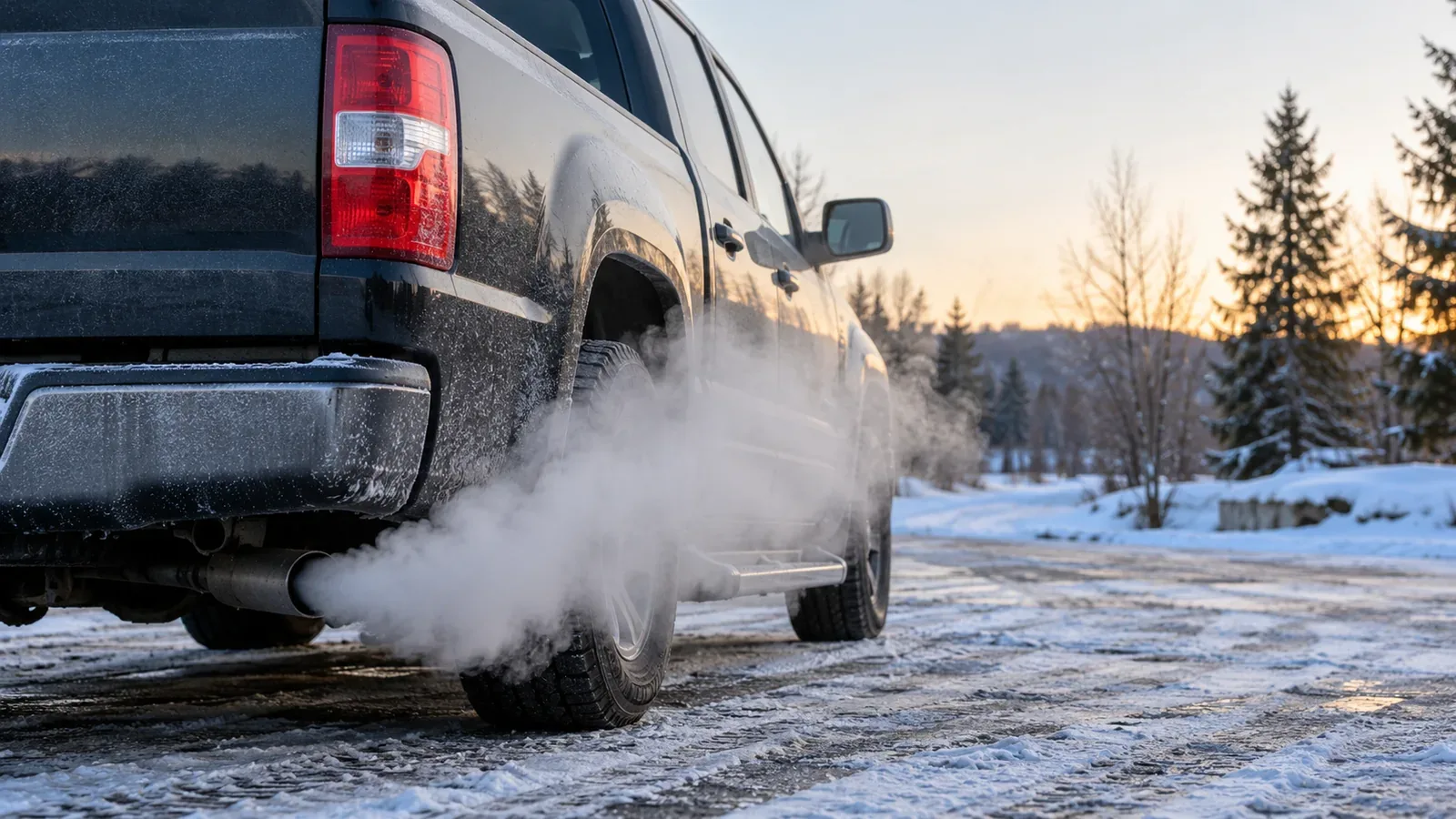
White Smoke From Truck Exhaust? Causes and Warning Signs
A white cloud follows your truck on a cold morning. You glance in the mirror, and a few minutes later it is gone. That can be entirely different from thick white exhaust that continues after the engine warms up, especially if the truck is also losing coolant or running poorly.
White smoke from a truck exhaust does not point to one part. What looks white can be ordinary water vapor, unburned fuel, or coolant-related vapor. On some diesel trucks, aftertreatment operation can also change what you see near the tailpipe. The useful clues are how long it lasts, the driving conditions and what else the truck is doing—not color alone.
This guide explains what owners can observe safely on gasoline pickups, diesel pickups and work trucks. It will not ask you to inhale exhaust fumes, touch a hot tailpipe, open a pressurized cooling system or run a vehicle in an enclosed area.
Quick answer: Thin white vapor on a cool startup that clears as the exhaust warms can be normal condensation. Persistent dense white exhaust, rough running, coolant loss, overheating or a serious warning needs prompt evaluation. Diesel combustion and aftertreatment issues can look similar to coolant-related smoke, so a proper diagnosis matters before approving a head-gasket or injector repair.
First: is it normal condensation?
Burning fuel produces water vapor, and water can also collect inside a cool exhaust system. When the air is cold or humid, that moisture can become a visible white cloud behind the truck. It is often most noticeable just after starting.
A normal-looking pattern is light vapor that fades as the exhaust warms up, with no worsening drivability, fluid loss, abnormal warning or overheating. The timing is not identical on every truck. Ambient temperature, trip length, exhaust size and operating conditions all affect how quickly visible vapor disappears. There is no universal five-minute cutoff.
A concerning pattern is white exhaust that remains heavy under conditions where it previously cleared, grows substantially under load, or appears with falling coolant levels, misfires, difficult starts or rising engine temperature. That combination needs diagnosis; it still does not prove a single failure.
| What you see | What it could mean | Next step |
|---|---|---|
| Light white vapor shortly after a cold start | Condensation in the exhaust | Observe whether it clears as the vehicle reaches normal operation |
| Dense white exhaust that continues when warm | Coolant-related issue or combustion problem | Avoid hard driving and arrange diagnosis; stop if severe symptoms appear |
| White/gray haze mainly during a diesel cold start with rough running | Incomplete combustion, intake heating or fuel-system concern | Note weather, starting behavior and fault messages; request diesel-specific tests |
| Light smoke during a documented diesel regeneration procedure | May be a vehicle-specific normal event | Follow the manufacturer’s aftertreatment instructions |
| White exhaust plus high temperature, coolant warning, misfire or major power loss | Potential serious engine or cooling fault | Stop safely, switch off as directed and arrange assistance |
Ford’s diesel owner information notes that a light amount of white smoke may occur during certain manual regeneration operations. That narrow exception is one reason not to label every white cloud a blown head gasket.
The most common explanations for persistent white exhaust
Coolant entering a place it should not
Engine coolant is supposed to circulate through the cooling system, away from the combustion process. A failure in a sealing surface or component can allow it to reach an intake, combustion chamber or exhaust pathway. Depending on the engine, possible sources include a head-gasket problem, a damaged cylinder head or a leaking EGR cooler.
Clues can include unexplained coolant loss, overheating, rough running, misfires or persistent white vapor. Sometimes an odor is noticeable near the vehicle, but do not put your face in an exhaust plume to identify a smell. Odor is not a reliable test by itself.
It is easy to jump straight to “blown head gasket” when white exhaust and coolant loss occur together. Resist that jump. An internal EGR cooler leak on an applicable diesel engine may create similar observations, and external leaks or other cooling faults can explain low coolant without exhaust involvement.
Poor combustion or unburned fuel
If fuel does not burn as intended, some engines can produce light-colored exhaust. Causes depend heavily on the engine and may include injection-related faults, cold-start heating problems, fuel quality, timing or low compression. A diesel that runs roughly on a cold start and clears as it warms needs a different test sequence from a gasoline engine with an overheating warning.
Persistent rough running and a strong fuel odor warrant prompt attention. Do not loosen high-pressure diesel fuel lines, disconnect injectors or attempt a “cylinder test” by removing fuel connections while the engine is running. Modern diesel fuel systems can operate at dangerous pressures.
Diesel exhaust aftertreatment
Diesel particulate filter (DPF) regeneration raises exhaust temperatures so accumulated soot can be processed. Certain manufacturer instructions note that a light white haze may sometimes occur during an authorized manual regeneration event. This does not mean thick persistent smoke is automatically normal; it means you should read the correct dashboard message and manual before interpreting it.
The exhaust hardware can remain dangerously hot during and after regeneration. Never stand close to the tailpipe, park over dry vegetation, or initiate a parked regeneration outside the manufacturer’s specified conditions.
Diesel and gasoline trucks: the checks are not interchangeable
A gasoline pickup uses spark ignition. A diesel engine depends on compression ignition and may also have intake heaters, glow plugs or other cold-start strategies depending on its design. Large commercial diesel engines may not share the same cold-start components as a particular light-duty pickup.
If a diesel shows white haze chiefly on a cold morning and also cranks for a long time, a technician may investigate cold-start aids, air handling and fueling. If a gasoline engine produces continuous white exhaust and is losing coolant, testing the cooling system and combustion sealing may be more relevant. Neither pattern is enough to diagnose by sight.
For diesel-specific context, a Cummins engine troubleshooting procedure checks coolant consumption, ambient and operating conditions before proceeding through targeted engine tests. The correct sequence depends on the actual engine, not just the appearance of the exhaust.
Four warning signs you should not ignore
1. Rising temperature or an overheating warning. If the engine temperature moves into the danger range or the display tells you to stop, follow the manufacturer’s instructions, pull over safely and shut down as directed. Continued driving can increase damage. See what to do when a truck overheats.
2. Coolant level keeps dropping. A repeated drop is not normal. Coolant can escape externally as well as internally. With the system fully cool and following the owner’s manual, record the reservoir level and visible evidence. Never open a hot radiator or pressurized reservoir cap.
3. Rough running, difficult starting or substantial power loss. These observations suggest the smoke is part of a broader operating problem. A heavy new misfire or inability to maintain power in traffic is a reason to seek help instead of continuing the trip.
4. Abrupt cranking stop or loud mechanical impact. Do not repeatedly crank an engine that suddenly stops turning normally or makes a severe new impact noise. A mechanical obstruction or liquid in a cylinder is one of several possibilities requiring professional attention.
You may have heard that “milky oil proves a head-gasket failure.” It does not. Contamination and moisture can have different explanations, and some coolant leaks occur without changing the oil’s appearance. Report a marked change in oil condition, but let a technician confirm its source.
Safe checks before calling a workshop
When the truck is safely parked and cooled as required, write down:
- Temperature and weather: Was this a freezing morning, a hot day, or a humid start?
- Timing: Did it happen only at startup, while idling, during acceleration or throughout the trip?
- Appearance: Was the cloud light and fleeting or dense and persistent? A short video from a safe location can help.
- Dashboard information: Record the exact warning message and whether it is steady or flashing.
- Coolant and oil observations: Note levels only as instructed by the vehicle manual; do not open hot components.
- Recent history: Any cooling repair, coolant refill, difficult start, overheating incident or diesel regeneration message?
You do not need to run repeated experiments. In particular, never warm up an engine inside a garage to see whether the smoke clears: exhaust gases create a serious carbon-monoxide hazard.
What a mechanic may test
A shop should reproduce or review the symptoms and choose tests based on the actual vehicle. That may include a cooling-system pressure test, inspection for external coolant leaks, scan-tool data, checking for misfire or injector-related faults, and—when justified—tests for combustion gases in the cooling system or cylinder sealing.
A chemical combustion-gas test can be useful in the right context, but it does not confirm every internal leak nor does a single negative result rule one out. Similarly, coolant loss with a clean driveway is a reason to investigate, not proof the engine is consuming coolant. Diesel aftertreatment and EGR components may require additional model-specific tests.
Before approving a head-gasket job, injector replacement or major engine work, ask the shop to identify the test result that supports that repair. Get the scope and estimated labor in writing. The FTC’s auto-repair guidance provides a useful starting point for understanding estimates and additional authorizations.
A practical service conversation
Instead of saying “I need a head gasket,” try something more descriptive: “The truck puts out thick white exhaust after it is fully warm. The coolant level has gone down twice, and the temperature warning came on during an uphill drive.” That gives the technician valuable information without prescribing an unconfirmed part.
If the smoke happened once on a freezing morning and disappeared with no other symptom, note it and keep an eye on changes. If it continues or develops alongside warnings, coolant loss or poor running, have it inspected promptly. The best decision comes from the full symptom pattern, not the color of the cloud by itself.
Frequently asked questions
Is white smoke from a truck normal on a cold morning?
Thin visible water vapor can be normal during cold or humid starts. It should generally lessen as the exhaust warms. Persistent dense exhaust or additional symptoms need assessment.
Does white exhaust always mean a blown head gasket?
No. Condensation, combustion problems, EGR cooler faults on some diesels, and certain aftertreatment conditions can look similar. Head-gasket failure requires supporting tests.
Why does my diesel truck smoke white when starting?
Cold-start conditions, incomplete combustion or an engine-specific fuel and heating problem may be involved. Record whether it clears with warmup and whether there are starting, idle or warning issues.
Can I drive if my truck is blowing white smoke?
If it is simply light cold-start vapor with normal operation, it may not be concerning. Heavy persistent smoke, overheating, significant coolant loss, stalling or reduced power calls for stopping safely and professional advice.
Could a diesel regeneration cause light white smoke?
Some manufacturer manuals allow for a light amount during certain manual regeneration operations. Follow the instructions for your exact truck and do not treat every smoke event as normal regeneration.
Is a sweet smell enough to confirm a coolant leak?
No. Avoid breathing exhaust deliberately. Odor is only one imperfect clue; cooling-system and engine-specific testing is needed to confirm the fault.