
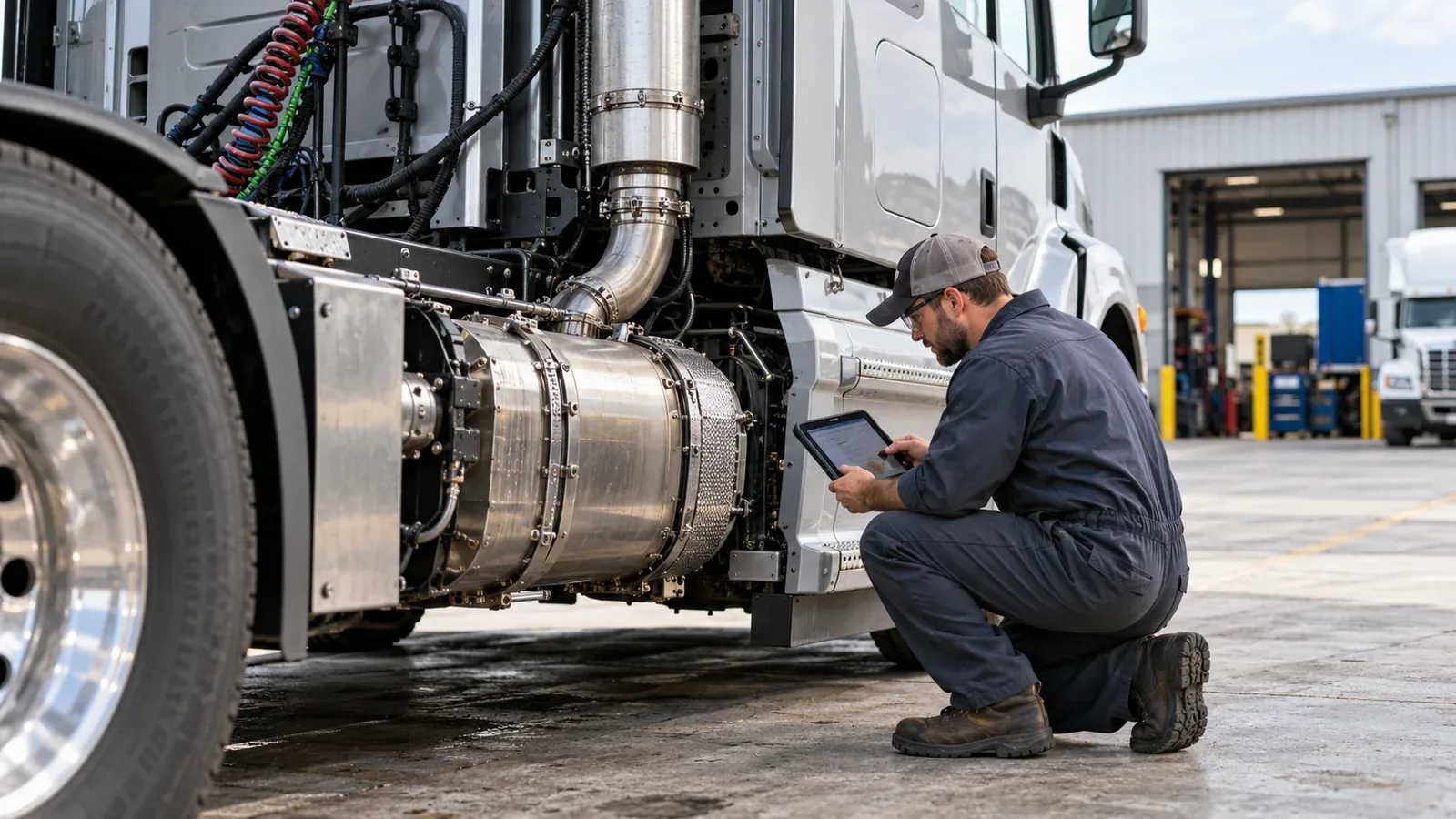
A driver finishes a week of short, stop-and-go deliveries. The truck has plenty of fuel, but the DPF warning light appears just as the last stop is completed. A friend suggests a long highway drive; a different driver says to park and press the regeneration switch. The service desk says it needs the fault codes first.
Those answers are not interchangeable. A DPF problem is a diagnostic question before it is a cleaning, regeneration or replacement decision. Some operating conditions simply prevent enough exhaust heat from being produced. Other cases involve sensors, excessive soot, accumulated ash or a damaged component. The right response depends on the engine model, the active warning and what the diagnostic data actually show.
This guide is for U.S. commercial highway diesel tractors equipped with diesel particulate filters. It covers what regeneration does, what warning signs mean, how to investigate repeated events and how to compare service quotes. It does not replace a vehicle’s operator manual, authorized diagnostic software or a technician’s inspection. For general engine life and overhaul decisions, use our semi-truck engine lifespan guide; this article stays with DPF and aftertreatment behavior.
Quick answer: is a DPF warning a repair emergency?
Not every DPF event is an emergency, and not every illuminated lamp means the filter has failed. Regeneration is part of normal operation. But warnings can escalate when soot accumulation continues, a regeneration does not complete or the engine controller detects another fault.
| What the operator sees | What it may suggest | Responsible next action |
|---|---|---|
| Regeneration in progress; no fault warning | A normal active event | Follow operating guidance; be alert to elevated exhaust temperatures |
| DPF lamp or request message | Soot loading may call for a specified regeneration response | Identify the exact lamp/message and follow that vehicle/engine manual |
| Flashing DPF lamp or accompanying check-engine warning | Higher urgency or an incomplete regeneration condition | Follow OEM instructions promptly; arrange service if required |
| Stop-engine indication, severe derate or unsafe exhaust condition | Potentially serious engine/aftertreatment issue | Move to safety and take the OEM-prescribed stop/service action |
| Regen seems to finish but warnings return repeatedly | Duty-cycle, sensor, engine-out soot or restriction issue | Preserve fault history and have qualified diagnostics performed |
Do not rely on a universal color-to-action chart. Manufacturers, years and dash implementations vary. The Cummins aftertreatment FAQ and its engine-specific operating literature describe different strategies and intervals across generations. A warning hierarchy from one 2007 engine is not a substitute for the documentation of a newer truck.
What the DPF does—and what regeneration actually removes
Diesel combustion creates particulate matter, including combustible soot. A diesel particulate filter traps much of that material as exhaust passes through its porous substrate. The engine and aftertreatment controls use temperature, pressure and calculated loading information to determine whether the filter can continue operating normally and when regeneration is necessary.
The important distinction is soot versus ash:
| Material | Where it comes from | What regeneration does | What resolves excessive accumulation |
|---|---|---|---|
| Soot | Carbonaceous particulate from diesel combustion | Oxidizes much of it when correct temperatures are achieved | Successful regeneration, plus correction of excess soot production |
| Ash | Noncombustible residue associated with oil/fuel additives and wear | Does not burn it away | OEM-approved filter cleaning or replacement as appropriate |
The U.S. EPA’s DPF operation and maintenance bulletin explains that short-term soot restriction can be reduced through regeneration, whereas long-term ash restriction eventually requires cleaning. That is why a filter can show high backpressure even after a completed regeneration.
DPF, DOC, SCR and DEF are not the same component
The diesel oxidation catalyst (DOC) helps condition exhaust and supports parts of the aftertreatment process. The DPF captures particulate matter. Selective catalytic reduction (SCR) uses diesel exhaust fluid (DEF) and catalysts to address nitrogen oxides. Faults in one part can affect behavior elsewhere, but adding DEF does not clean a soot-loaded DPF. Cummins’ aftertreatment system overview illustrates the different flow stages.
This distinction matters when a repair estimate says only “aftertreatment problem.” Ask whether the technician found a particulate restriction, a DEF/SCR issue, a sensor or wiring fault, or more than one problem.
Passive, active and parked regeneration compared
Three terms describe related but different events. They should not be treated as three interchangeable ways of pressing a button.
| Regeneration mode | What provides the heat? | Where can it occur? | Driver involvement |
|---|---|---|---|
| Passive | Sufficient exhaust temperature during the normal duty cycle | Normal driving/operation | Often none |
| Active while driving | Engine/aftertreatment controls add or manage heat | Vehicle operation when permitted by system logic | Usually monitoring and normal operation |
| Stationary / parked | A controlled active-regeneration sequence | Suitable stationary location, only if OEM and fault conditions permit | Follow the exact OEM instructions and safety precautions |
For context, the EPA general DPF bulletin describes passive and active mechanisms, while DieselNet’s technical guide discusses the balance between soot capture and oxidation.
Why the same truck sometimes regenerates more often
A long steady route can produce more favorable exhaust temperatures than repeated low-speed movements, queues and prolonged idling. But regeneration frequency is not controlled by highway miles alone. Engine-out soot rate, filter age, thermal conditions, control calibration, sensor readings and different trailer loads also influence the result.
A driver who changes from a 500-mile highway lane to 50-mile urban turns may notice more active events without the filter suddenly becoming defective. The opposite is also possible: a fault can cause frequent attempts despite apparently favorable operating conditions. Trend records and codes determine which explanation is credible.
Is a “highway drive” the cure?
Do not prescribe a fixed number of miles or minutes. Certain OEM procedures may allow driving under qualifying conditions to complete regeneration, but that advice is conditional. It can be wrong when a warning has progressed, an emissions-control fault is present, or the system has disabled regeneration. Never attempt to outdrive a stop-engine warning or bypass the specified service response.
What to do when the DPF lamp appears
The safest process starts with identification and documentation, not a guess about what to press. You can carry out these observation and escalation steps without attempting repair yourself.
- Read the exact cluster message. Record the DPF lamp state, check-engine indicators, any HEST/high-exhaust-temperature lamp, power limitation and whether the warning is steady or flashing.
- Confirm the truck. Note the VIN, engine make, engine serial number where available, model year, odometer, engine hours and operating duty cycle.
- Check the current manual. Use the vehicle and engine operator instructions applicable to that build; not an online shortcut for a different engine generation.
- Prioritize safe parking. If the manual calls for stopping or service, pull over safely and follow that instruction. Do not continue solely to meet a delivery appointment.
- Avoid unsafe regeneration attempts. Never initiate a parked regen inside a building, near dry vegetation or combustible materials, or when the fault/OEM instructions prohibit it. Exhaust components can remain dangerously hot.
- Preserve the evidence. Record fault codes and time of occurrence, regen history if available, recent operating pattern and any other symptoms.
- Escalate intelligently. Ask the service provider to identify root cause and the required OEM repair procedure before approving repeated forced regens or a filter replacement.
This is intentionally not a universal parked-regeneration tutorial. Buttons, interlocks, minimum conditions, exhaust clearances, temperatures and emergency-stop behavior vary by engine and chassis. A remotely copied sequence would be less safe than the right OEM manual.
Warning signs that merit a proper diagnostic visit
Some symptoms are obvious; others appear only as a pattern in operating records.
Regens seem unusually frequent
Log the last several events, miles and engine hours between them, route type, idle share, faults and weather. A change matters more than an isolated event. Cummins explains in its DPF parts information that soot/ash accumulation and restriction tests are central to determining service need; that source is manufacturer material, not an independent price study.
Regeneration begins but never completes
This can result from conditions that do not support sufficient temperature, repeated interruption, a system fault, or a filter condition that cannot be corrected merely by another attempt. Ask the shop for the event history, fault-code interpretation and measured exhaust conditions, not a diagnosis based solely on a dashboard icon.
Reduced power or an engine protection warning
Power reduction can protect engine/aftertreatment components, but its triggers vary. Do not attribute derating to “just a clogged filter” without diagnostics. A stop-engine indicator or other serious warning takes precedence over any schedule. If unsafe operation or a significant fault is indicated, stop and obtain help as instructed by the manual.
High backpressure or recurring restriction reports
Backpressure changes naturally with soot loading. Persistent restriction after appropriate regeneration, with verified pressure readings and sensor health, can justify an ash-cleaning assessment or filter integrity inspection. A failed pressure sensor or damaged measurement hose can imitate a filter problem, so measuring-system checks matter.
Other engine symptoms arrive at the same time
Unusual oil consumption, injector issues and air/fuel faults can increase engine-out particulate production. The EPA explicitly notes that an inadequately maintained engine can damage a filter, and that oil-consumption trends should be monitored. A newly cleaned DPF installed behind an unresolved engine problem may soon show the same restriction.
The shop diagnosis: seven questions that prevent expensive guesses
Before authorizing a large bill, ask for answers specific to the engine serial number and symptoms:
- What fault codes are active, inactive and historical? Ask for the code list and freeze-frame or timestamp information, not only a verbal description.
- What does the ECM estimate for soot and ash? Understand whether those numbers are model-based, sensor-supported or directly measured by a test.
- Are differential-pressure lines and sensors healthy? A bad signal can misrepresent restriction.
- Were exhaust-temperature sensors and regeneration conditions checked? Confirm the system can reach the expected operating condition.
- Was the upstream engine condition assessed? Injector behavior, oil consumption or other issues can be relevant if soot production is abnormal.
- Is filter cleaning approved for this specific assembly? Confirm method, inspection, testing, service records and any warranty condition.
- What proves that the repair worked? Request post-service verification and an explanation of what happens if the fault recurs.
A useful quote distinguishes testing, repair of the initiating fault, cleaning or replacement, removal/reinstallation labor and post-repair verification. An invoice that says only “DPF service” does not answer those questions.
What evidence a qualified technician may use
Depending on platform, the shop can evaluate soot-load estimates, differential pressure at defined operating points, exhaust temperature trends, regen duration/history, dosing information, logged codes and filter integrity. These values need comparison to that engine’s service information. A pressure reading without engine speed or flow context can be misleading.
Detroit’s Vehicle Insights service description illustrates how manufacturer-connected diagnostics can bring powertrain fault information into a fleet workflow. Telematics is useful context, but a portal warning alone is not proof a $3,000 component needs replacement.
DPF cleaning versus replacement: what actually changes?
A filter is not disposable every time the cluster requests regeneration. The proper decision depends on restriction, ash condition, physical damage, serviceability, warranty and manufacturer procedures.
| Possible work | When a shop may recommend it | What it will not automatically solve |
|---|---|---|
| Diagnose sensor/hoses/wiring | Implausible pressure/temperature signals or fault codes | Existing ash or a physically damaged substrate |
| Resolve upstream combustion/air issue | Excessive engine-out soot or related faults | Existing ash trapped inside the filter |
| Complete an OEM-approved regen | Soot accumulation when a regen is indicated and permitted | Ash loading, cracks, melted substrate or failed sensors |
| Remove and professionally clean filter | Ash restriction on a serviceable filter | An engine that is still overproducing soot |
| Replace DPF assembly | Failed integrity test, unserviceable damage or a specific OEM requirement | Other faults that caused the original filter problem |
Professional ash-removal services use specialized equipment and containment rather than uncontrolled blowing-out of hazardous particulate material. The EPA’s maintenance guidance discusses professional cleaning, service tracking and the need to reinstall correctly. A driver should not improvise cleaning with a household pressure washer or compressed air in an open yard.
How often does a DPF need ash cleaning?
There is no universal semi-truck mileage. Engine generation, oil specification, application, oil consumption, filter design and OEM intervals all matter. EPA guidance for retrofit DPFs describes certain cleaning patterns; those retrofit examples should not be copied as a maintenance schedule for a modern factory-installed Class 8 aftertreatment system.
Cummins states that its regeneration interval differs substantially across system generations in its aftertreatment FAQ. For cleaning, the engine and filter manuals, fault evidence and approved service process control. Ask for the specific recommended interval and its basis rather than accepting a round-number mileage claim.
What does DPF regeneration, cleaning or replacement cost?
A useful cost estimate needs multiple line items. A ten-minute discussion about a warning lamp cannot justify a national price quotation. Parts, aftertreatment architecture, regional labor, specialized testing, core charges, access, warranty and downtime create substantial differences.
| Quote component | What to ask for | Why it matters |
|---|---|---|
| Diagnostic time | Scope, hourly rate, fault report | Prevents a replacement based on guesses |
| Filter removal / installation | Labor hours and gaskets/clamps | A cleaning quote may exclude disassembly |
| DPF cleaning and inspection | Method, pass/fail criteria, certificate | Confirms serviceability and outcome |
| New/reman DPF (if necessary) | Part number, approved option, warranty, core | Prices vary widely by application |
| Upstream repair | Injector, sensors, hoses or other root cause | Prevents repeat failure |
| Retest and road verification | Codes, readings, operating confirmation | Shows the complaint was addressed |
| Operational impact | Hours missed, true contribution margin, alternate vehicle | Separates invoice cost from business loss |
Worked example 1: approved cleaning after diagnosis
Assume a hypothetical shop quote for one truck:
| Line item | Illustrative budget |
|---|---|
| Diagnostic scan and testing | $165 |
| DPF removal/reinstall, seals and labor | $300 |
| Off-vehicle cleaning and inspection | $550 |
| Lost operating contribution: 6 hours × $50/hour | $300 |
| Total economic impact | $1,315 |
The cash paid to the shop is $1,015, assuming no further repairs; the additional $300 represents actual lost contribution only if the work prevented otherwise profitable work that could not be recovered or reassigned. A truck waiting at home during an already scheduled idle day would have a different economic result. None of these line items is a claim about average American repair prices.
Worked example 2: replacement after an integrity failure
A second illustrative quote assumes that qualified testing finds the filter unserviceable, and the engine’s underlying problem has been corrected:
| Line item | Illustrative budget |
|---|---|
| Replacement filter assembly | $2,700 |
| Installation parts, labor and verification | $650 |
| Lost contribution: 10 hours × $50/hour | $500 |
| Total economic impact | $3,850 |
Here, $3,350 would be the assumed shop charge, and $500 is a separate operating impact. If a $500 core credit applies, the net invoiced parts cost would need adjusting—do not assume every quote includes it. If the repair is under warranty or an alternate truck covers the run, revise the appropriate items.
Do not compare these two totals as if cleaning and replacement are interchangeable choices. Cleaning a cracked or melted filter may not be a valid remedy. Replacing a healthy filter without addressing a sensor or engine fault may be wasteful.
Measure the economic decision without double counting
The right business question is not “How much gross revenue is on tomorrow’s load?” but “What contribution would this particular truck have earned after avoidable variable costs, and can the work be recovered?” For a broader cost model, use the cost-per-mile calculator and load-profitability calculator.
A missed $2,000 load is not necessarily a $2,000 economic loss when fuel, tolls and other variable expenses are avoided. Equally, even a small repair can become expensive if it strands the equipment for multiple days. Keep shop expenditure, opportunity cost and contingency separately visible.
How to reduce preventable DPF problems
Maintenance should focus on preserving healthy engine combustion, proper aftertreatment function and a stable operating record—not trying to game the regeneration system.
- Use the engine-approved fuel and lubricant specification. Oil chemistry and oil consumption matter to ash accumulation; the exact approved specifications vary by engine.
- Maintain air, fuel and engine systems. Unusual injector behavior, leaks and rising oil use deserve attention before they damage downstream components.
- Understand your duty cycle. Document long-haul routes, urban stop-and-go, extended idle hours and PTO work; do not assume every truck sees comparable exhaust temperatures.
- Do not inhibit regeneration unnecessarily. A specialized inhibit feature may be needed for hazardous or constrained operations; use it only as the OEM intends.
- Respond to warnings promptly. Delaying a manual-prescribed action can lead to more invasive repairs or a loss of available operation.
- Keep a usable service log. Record engine/vehicle ID, codes, regeneration behavior, filter cleaning/replacement, software updates and symptoms after repair.
- Never remove or bypass mandated emission controls. Seek authorized and lawful repair instead of DPF/SCR/DEF deletes or defeat devices.
A practical DPF event log
A spreadsheet or maintenance system is enough to start. Its value comes from consistent entries.
| Date | Odometer / hours | Operation | Driver observation | Shop/diagnostic result | Follow-up |
|---|---|---|---|---|---|
| Week 1 | 326,200 mi / 9,700 h | Highway freight | One normal active event | No active faults | Continue recording |
| Week 2 | 327,100 mi / 9,755 h | Local deliveries | Repeated DPF message | Codes saved for assessment | Book qualified diagnosis |
| Week 3 | 327,450 mi / 9,783 h | Service and test | Message no longer active | Sensor problem repaired and verified | Recheck trend after normal routes |
All figures are fictional, to illustrate the record format. Do not copy this frequency as a normal benchmark for your truck.
Three representative field situations
These examples represent possible operational decisions, not interviews or real customer case studies.
1. Local work changes an otherwise stable regen pattern
Problem: A tractor doing mostly open-highway work is reassigned to heavy urban stop-start deliveries. Its active events become more noticeable.
Complication: The owner assumes a worn-out DPF and requests replacement without reading any fault data.
Practical resolution: First compare duty cycle, engine hours, regen history and active codes; have the shop establish whether the increase is a normal response to reduced exhaust heat or a fault. Lesson: a change in route is context, not proof of filter failure.
2. A new filter does not fix a recurring warning
Problem: A restriction complaint returns shortly after DPF service.
Complication: Only the filter was addressed; increased oil consumption or another upstream fault was never investigated.
Practical resolution: Request a documented engine and aftertreatment diagnosis, corrective work and post-repair verification. Lesson: repairing the consequence without the cause may repeat the expense.
3. A driver tries to “force regen” in an unsafe place
Problem: A DPF message appears while a truck is near a loading dock and stored packaging material.
Complication: A generic online video suggests triggering parked regeneration immediately.
Practical resolution: Do not begin an unsafe procedure. Follow the exact manual, obtain a clear safe location if stationary regeneration is permitted, or arrange service if the warning level or faults require it. Lesson: hot exhaust clearance and fault-specific instructions matter more than speed.
When should an owner-operator stop diagnosing and call for service?
Call a qualified shop or road service when the vehicle displays severe or escalating warnings, significant derate, persistent check-engine faults, unexplained high exhaust temperature indicators in an unsafe location, repeated failed regens or evidence of an exhaust leak or overheating. Do not operate a vehicle contrary to an OEM stop instruction. The earlier you can provide exact fault data and a clear event history, the more useful the first diagnostic conversation will be.
Before leaving the shop, request the replaced-part number if relevant, the test results, the actual reason service was needed, the fault-code list after repair and a written warranty. Also ask what would constitute a return visit rather than another paid repeat job. Keep that record with the truck’s broader maintenance history; see our vehicle maintenance file guide.
Bottom line: diagnose soot, ash and sensors separately
A healthy DPF system is supposed to regenerate. A regeneration event is not a repair bill. The expensive errors are assuming every warning means a failed filter, confusing soot with ash, performing repeated forced regens without understanding active faults, or choosing parts before measuring the underlying condition.
For a practical next step, document the warning, verify the correct engine manual, collect the recent history and ask the repair provider which measurable evidence supports its proposed work. That protects safety, downtime and the operating budget better than any one-size-fits-all regeneration shortcut.