
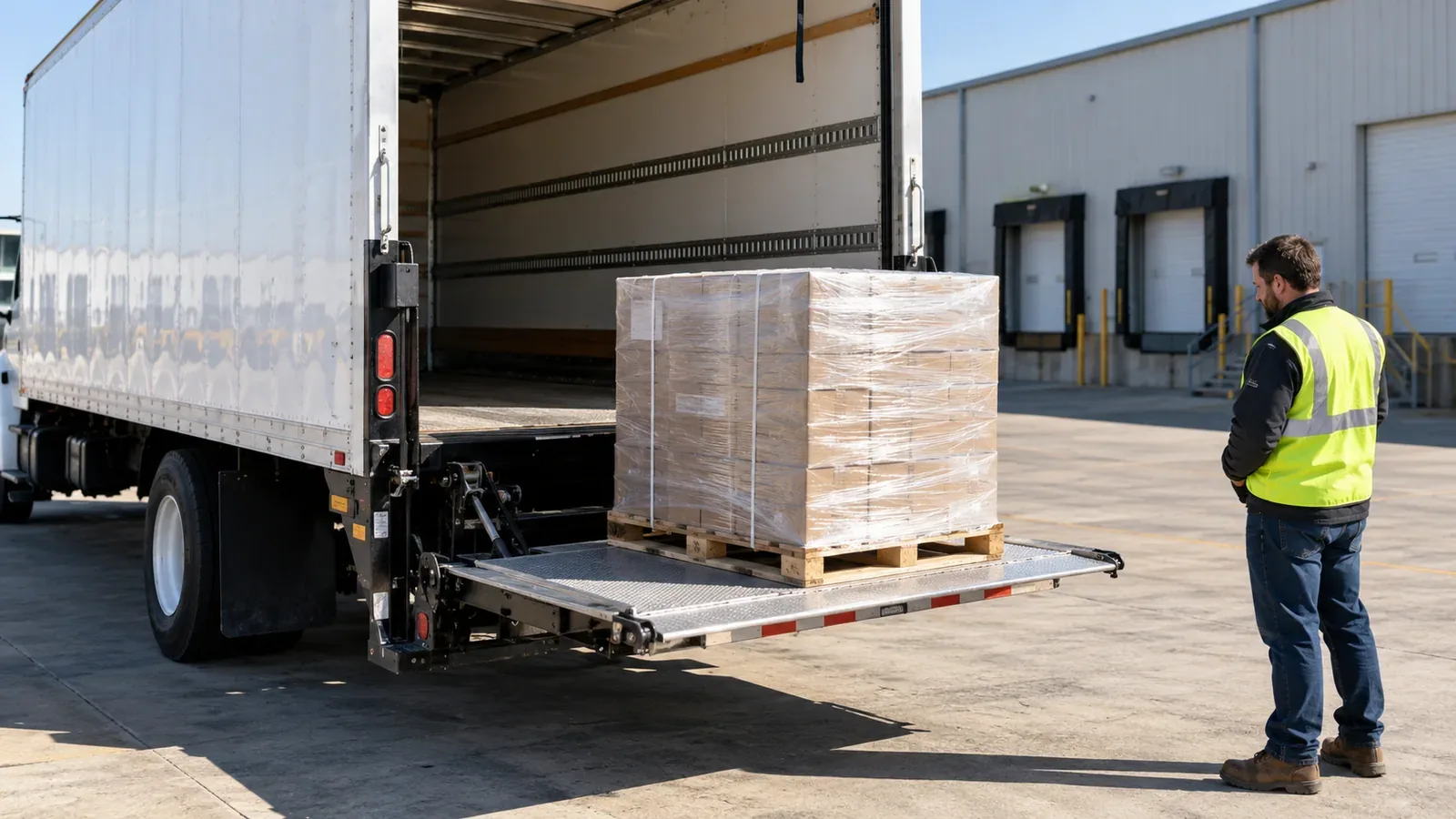
A customer says, “It’s just one pallet, and the truck has a liftgate.” The dispatcher says yes. At the delivery address, the pallet fits inside the truck but cannot be unloaded: the gate is too small for the load, the pallet jack adds weight, or the destination has a steep gravel driveway. Everyone loses time because the first question was about the number of pallets instead of the whole unloading operation.
A liftgate is valuable precisely because it can make a delivery possible without a matching-height dock. It does not turn every box truck into a universal material-handling vehicle. Before promising a delivery, three questions need separate answers: Can the freight ride legally on the truck? Can it move through the opening? Can the exact gate and unloading equipment handle it safely at the destination?
This guide is written for small US delivery fleets, box-truck owner-operators and dispatchers who need a repeatable screening method. Its worked examples are original planning scenarios, not manufacturer approvals, load charts or operating instructions. Follow the exact equipment manual and trained site procedures for actual work.
How much weight can a box truck liftgate hold?
There is no standard capacity for a “16-foot liftgate” or “26-foot liftgate.” The lift is separately selected and installed. A manufacturer may offer several lifting capacities, platform designs and truck-bed height ranges within one product family.
For example, Anthony’s AST TuckUnder product page lists configurations rated 1,500, 2,000, 2,500, 3,000 and 3,500 lb. Its MTU-GLR product family includes heavier configurations and different bed-height applications. Those published family figures demonstrate the range available; they do not establish the capacity of an unidentified gate on a rental or owned truck.
| Item you are checking | What its number means | What it does not tell you |
|---|---|---|
| Liftgate capacity | Manufacturer-rated lifting limit for the identified gate, subject to its stated conditions | Truck payload, pallet fit, forklift permission or axle ratings |
| Truck available payload | Cargo weight remaining after accounting for the actual truck and its equipment | Safe maximum weight for one liftgate cycle |
| GVWR and axle ratings | Vehicle and axle weight limits to check against the loaded truck | Whether a pallet can pass through the rear door |
| Rear door opening | Clear height and width through which the load must move | Usable width or depth on the deployed platform |
| Liftgate platform dimensions | Physical support area available in the relevant deployed position | Approval for overhang, wheeled equipment or off-center loads |
Use the gate’s identification plate and the correct operation manual—not an advertisement, general rental listing or the truck’s 26-foot body length. Manufacturer documentation may contain loading-position limits, load-center diagrams or restrictions that make a seemingly under-capacity load unacceptable.
The mistake that turns a 1,900-pound delivery into an overload
Suppose a carrier is offered a pallet described as weighing 1,900 lb for delivery with a liftgate marked 2,000 lb. It sounds as though there are 100 pounds to spare. But the shipper expects a manual pallet jack to travel on the gate with the freight.
In a purely hypothetical calculation:
| Supported item | Assumed weight |
|---|---|
| Product, packaging and pallet | 1,900 lb |
| Pallet jack | 175 lb |
| Total supported by liftgate | 2,075 lb |
| Stated liftgate rating | 2,000 lb |
| Amount above that rating | 75 lb |
The 2,075 lb load exceeds the 2,000 lb marking even before considering position or other restrictions. The pallet jack’s 175 lb in this example is an assumption, not a universal specification; use the actual equipment weight.
Do not treat “take away the jack” as an automatic workaround. The operator still needs an approved way to move and control the pallet on and off the platform. Likewise, a load weighing 1,950 lb in total is not necessarily acceptable on a nominal 2,000 lb gate: concentrated wheel loads, poor load centering, overhang or platform limitations may rule it out.
What if the operator stands on the platform?
Some gates and manuals have particular rules about passengers or operators on the platform, while others advise against that practice or restrict it. Never assume riding is permitted. Consult the exact manufacturer’s documentation; when it allows a person, account for that person’s supported weight and all operating conditions. Do not improvise standing positions or recommendations from a numerical example.
Anthony maintains model-specific liftgate operation manuals. Verify the model and serial number before relying on a procedure. The approved way to use a platform is a safety question, not a dispatch preference.
Capacity is not just a number: load position matters
A hydraulic lifting mechanism experiences different forces as a load moves away from the truck body or concentrates on one end of the platform. A nominal capacity is therefore not permission to put that much weight at any point on the metal surface.
The relevant manual may specify centering, loading near the truck sill, even distribution and restrictions on loads extending beyond the platform. The exact instructions depend on liftgate design. This guide deliberately avoids inventing a universal safe distance from the truck or a percentage reduction formula.
Consider two hypothetical 1,400-pound freight units. One is compact and evenly supported. The other is a tall, narrow machine resting on small casters near the outer edge of the gate. Their total weights match, but the forces, stability and movement risks can be very different. The unit’s center of gravity, contact points and restraint plan must be assessed under the manufacturer’s directions.
The safer planning question is not “Is it under the rating?” but “Has the installed gate been verified for this load, this support equipment and this arrangement?” A load that passes one condition can still fail another.
Measure the platform, the truck door and the delivery site
A pallet may fit inside the cargo box yet fail at the rear doorway or on the liftgate. The pallet-layout guide explains the difference between a theoretical floor position and a usable loading space. The same principle applies at the unloading end.
For each shipment, record the following actual measurements, without relying on nominal truck length:
- Loaded width and length. Measure all product overhang, strapping and packaging, not merely the wooden pallet footprint.
- Loaded height. Compare it with the rear-door opening and any roof, track or hardware obstruction.
- Platform support area. Confirm the model’s usable length and width in the appropriate operating position, including space needed by the permitted handling device.
- Clear travel path. Make sure the load can transition between truck bed and gate using equipment and methods allowed by the gate’s manual.
- Delivery-site conditions. Check that the destination provides a suitable, stable, accessible surface and a safe place to position the truck and work around the lift.
A hypothetical 48 × 40-inch pallet can be wider once the wrap and cartons project beyond its edges. And a pallet jack can require a footprint or maneuvering area that the pallet itself does not. A platform’s advertised outer width may not equal its usable support area.
Ground-level clearance is part of the quote
Imagine a warehouse that loads from a flat, smooth dock but a customer who needs the goods placed in a storefront reached from a sloped, uneven alley. The pallet’s weight did not change. The destination did.
Ask for photographs or a documented site description when the unload is unusual: entrance width, vehicle stopping position, surface condition, grade, access restrictions and equipment available. A standard liftgate route may need rescheduling, a different vehicle, a dock appointment or specialized handling. Do not assume that a person with a pallet jack can move a heavy load safely across any surface once it touches the ground.
Liftgate, ramp or dock: different tools for different deliveries
The words are sometimes used casually, but the equipment is not interchangeable.
| Delivery arrangement | How freight changes height | Main questions before dispatch |
|---|---|---|
| Hydraulic liftgate | Rated platform moves cargo between truck bed and ground | Model rating, load placement, platform size, approved handling method, site |
| Loading ramp | Wheeled freight moves along a slope | Ramp rating, width, incline, traction, securing method, approved equipment |
| Matching-height loading dock | Freight crosses a dock leveler or plate | Dock/plate rating, truck restraint, floor capacity, forklift access |
| Forklift-assisted site | Trained operator uses suitable industrial equipment | Forklift capacity, access, ground stability, truck-floor rating and permissions |
OSHA’s loading and unloading guidance identifies hazards from vehicles moving at docks and from unsuitable equipment or surfaces. Its forklift load-handling guidance also emphasizes equipment ratings and site checks.
A forklift should not be driven onto a liftgate just because its forks can reach the pallet. Wheel concentrations, forklift self-weight and travel forces create different loads from an evenly distributed pallet. Require explicit equipment compatibility under the liftgate maker’s directions and a trained loading method; otherwise use a suitable dock or another approved arrangement.
Truck payload and liftgate capacity must both work
It is possible for a truck to have ample space and enough overall cargo weight allowance but a gate that cannot safely unload the freight. It is also possible to have a strong gate attached to a truck with too little remaining payload.
Take this invented dispatch scenario:
- Loaded vehicle’s estimated available freight allowance after people, fuel and installed equipment: 4,600 lb (to be verified against its labels and scale weights).
- Two separate palletized shipping units: 1,700 lb each, including their pallets.
- Verified weight of permitted handling equipment: 175 lb, assumed for this example.
- Installed liftgate identified as 2,000 lb rated, with further load-position conditions in its manual.
The two pallets total 3,400 lb, below the assumed 4,600 lb available freight allowance, subject to axle and tire limitations. If one pallet and the jack are supported at a time, the numerical sum is 1,875 lb. That is below the label’s 2,000 lb figure, but this arithmetic alone is not authorization to lift. The gate model, permitted load position, support area, equipment type and site still need confirmation.
If the same freight were instead placed as one 3,400 lb unit, the 2,000 lb gate would plainly be unsuitable for that whole unit even though the truck may legally carry it. Splitting or repackaging requires the shipper’s approval and a safe handling method, not an on-site improvisation by the driver.
This is the practical reason to keep a truck-specific capacity card. The 26-foot payload guide explains GVWR, empty operating weight and available freight allowance. It should be used alongside, not instead of, the liftgate manual.
An enclosed box is not a cargo-restraint exemption
Freight secured for highway travel and freight lowered by a gate are different stages, but both matter. A box’s walls and closed rear door do not automatically immobilize every pallet inside.
FMCSA expressly says that its applicable cargo securement rules also cover enclosed commercial vehicles. The applicable requirements depend on the commercial operation and commodity. The agency’s cargo securement overview explains protection against shifting and falling cargo and the proper condition of securement components.
A common delivery mistake is to plan unloading first and then arrange freight in the truck solely by drop order. Delivery order matters, but so do load distribution, forward restraint, door clearance and the stability of the remaining load after intermediate stops.
Make the restraint plan before leaving the loading point. A strap or load bar must be appropriate for the cargo, anchorage and actual system requirements; this guide does not assert that any single bar, wall or quantity of straps is universally sufficient.
The seven checks to complete before quoting a liftgate stop
A useful dispatcher checklist is short enough to complete before accepting the job and specific enough to reveal missing data:
| Check | What to record | Stop and verify when… |
|---|---|---|
| Freight unit | Total loaded dimensions, quantity, weight and stability | The shipper has only approximate product weight |
| Handling equipment | Exact jack or other equipment weight and compatibility | The unloading method is unspecified |
| Liftgate identity | Model, serial and stated rating, correct manual | Someone quotes only “it has a liftgate” |
| Platform and door | Clear sizes and manufacturer load-position restrictions | There is overhang or a tight entry |
| Vehicle limits | Available payload and axle/tire ratings | Cargo weight is based on truck size alone |
| Destination | Surface, grade, access, parking and work area | The delivery address lacks an accessible unloading position |
| Responsibility | Who unloads, who provides equipment and what happens if refused | Contract or rate confirmation leaves unloading ambiguous |
Do not force a yes/no answer when one measurement is missing. The correct operational response may be “pending verification” rather than “yes, a 26-foot truck can do it.” A firm dispatch commitment should follow those checks, not precede them.
A realistic delivery case: the cheap quote that becomes expensive
Here is a representative, hypothetical example, not a customer testimonial or industry cost average.
A small carrier prices a boxed commercial appliance delivery as one pallet, one stop and no special handling. At pickup, the driver learns that the consignee expects unloading to ground level, but no dock is available. The gate is rated for a particular load arrangement; the total pallet-plus-jack weight has not been verified. The carrier cannot safely complete the delivery as planned.
The carrier calls the customer, arranges an approved unloading method and makes a later attempt. Suppose the change consumes two extra hours of driver and vehicle availability. At an illustrative internal time budget of $48 per hour, the planning impact is 2 × $48 = $96, before any separate re-delivery fee, storage charge, extra miles or third-party handling expense. That $96 is not a market charge or an OSHA penalty. It is simply a way to make unplanned time visible.
The lesson is not to add a surcharge for every unknown. It is to obtain site and equipment details before pricing. The box truck operating-cost guide helps quantify time, miles and equipment costs, while the load profitability calculator can illustrate how avoidable delays affect a job’s estimated economics.
Inspect the liftgate without substituting guesswork for maintenance
A liftgate must be in serviceable condition before it is relied on. Operator-level pre-use checks should follow the exact manual and employer procedures. Problems can include unreadable capacity decals, obvious structural damage, leaks, poor platform movement, damaged controls and improper stowage or latching.
If the liftgate is damaged, behaves unexpectedly or cannot be identified or rated, do not use it until appropriately evaluated. Do not bypass safety devices, improvise repairs or test an uncertain gate with a customer shipment. Trained maintenance personnel and the manufacturer or authorized dealer should handle diagnosis and repairs according to the correct documentation.
For commercial vehicles subject to federal maintenance requirements, recordkeeping and inspection duties are also relevant; see DOT vehicle maintenance file requirements. Those rules are distinct from the manufacturer’s gate-specific maintenance schedule.
Drivers and dispatchers also benefit from recording gate downtime as a distinct reason for failed deliveries. That separates equipment problems from planning, staffing or site-access issues and helps determine whether preventive maintenance or a change in delivery equipment would save money.
A reusable liftgate job brief
Before the next pallet job, put the following information on one dispatch record. The values belong to the specific truck and shipment, not a generic class of box trucks:
| Field | Entry to obtain |
|---|---|
| Truck identification | Unit number and current equipment configuration |
| Liftgate identity and rating | Exact model/serial, label, applicable manual and permitted load arrangement |
| Freight dimensions and weight | Fully packaged dimensions and gross weight of each unit |
| Supported equipment weight | Pallet jack and other approved items, verified—not guessed |
| Vehicle freight allowance | Actual configuration, GVWR, axle and tire checks as appropriate |
| Load restraint | Documented method suitable for the actual freight and operation |
| Delivery location | Access, level work surface, clearance, dock/ramp availability |
| Unloading responsibility | Agreed division of work and fallback if the site cannot accept the load |
A dispatcher who can answer each line can make a defensible routing decision. A dispatcher who only knows “26-foot box truck, two pallets, liftgate included” still lacks the critical facts.
Final decision: can this box truck handle the delivery?
A usable liftgate is the intersection of rated equipment, appropriately arranged freight, physical fit, vehicle weight allowance and a suitable unloading site. None of those checks can replace the others. Manufacturer instructions and applicable workplace and road-safety rules control actual operation; the numerical examples above are teaching tools, not loading authorizations.
For the next planning step, compare box truck sizes and access limits, revisit pallet placement and dimensional fit, and calculate the financial consequences with the cost-per-mile tool. A complete dispatch decision combines all three perspectives: physical fit, safe handling and profitable execution.