
How to Tie Down Cargo in a Pickup Truck Without Guessing
You have loaded a dresser into your truck, shut the tailgate, and pulled on the furniture to make sure it feels heavy. Can you drive home? Not yet. A heavy object can slide into the cab wall when you brake or tip sideways when you turn. The fact that it is difficult to lift by hand does not mean it will stay in place on the road.
The fix is not a complicated engineering lesson. It is a short sequence of decisions: Can the truck carry the weight? Is the load stable? What will stop it moving? Are the straps and anchor points suitable? This guide walks through that sequence in plain English, then applies it to furniture, lumber and loose yard waste.
The short answer: secure the object, not just the tailgate. Use properly rated restraints on approved anchors, block sliding or rolling where necessary, cover loose material, and check the result before driving. If you cannot confidently secure the item, use a correctly rated trailer or a delivery service. The NHTSA’s Secure Your Load advice describes the same overall responsibility.
The seven-step pickup cargo checklist
Use this table at the loading spot, not after you have reached the highway.
| Step | What to check | Stop and fix it when… |
|---|---|---|
| 1. Know the weight | Read actual truck payload and estimate or weigh all onboard loads | Total payload or an axle/component limit could be exceeded |
| 2. Choose the position | Put dense objects low and in a stable area; keep the load balanced | The item can tip, roll, or change the truck’s handling |
| 3. Find approved anchors | Confirm the correct tie-down points in the owner manual | The only convenient hook is unapproved or damaged |
| 4. Check restraint labels | Look for a readable working load limit (WLL), suitable hooks and intact webbing | A strap is cut, the hook does not seat correctly, or the rating is unknown |
| 5. Control movement | Use the appropriate combination of restraint, blocking and edge protection | The load could slide, lift, rotate or roll during braking or turns |
| 6. Contain the small stuff | Secure bags, loose debris, nets and tarps so they cannot escape | Anything can blow out or the cover can flap free |
| 7. Do a departure check | Check lights, plate, visibility, tire pressures and rear overhang | You have to ignore a warning sign to leave |
Each box concerns a different failure. A truck can have plenty of unused payload but weak or unsuitable cargo anchors. An expensive ratchet strap can be useless if its hook is attached to plastic trim. A net can stop leaves blowing away but cannot safely hold a refrigerator upright.
For a one-page checklist you can fill out beside the truck, open the Pickup Load-Securement Field Sheet. It includes space to record load weight, anchor ratings and reasons not to proceed.
Start with the truck’s real payload, not the bed’s size
The previous guide, Pickup Truck Bed Sizes: What Actually Fits?, answers whether your cargo fits through the available space. This guide answers a different question: can you transport that cargo without it escaping or destabilizing the truck?
Find the tire-and-loading label on your actual vehicle. Do not substitute the manufacturer’s maximum payload advertisement, which may describe a completely different configuration. Include passengers, work gear, permanently fitted accessories that are not already reflected in the label basis, and the proposed cargo. If towing, the actual tongue or pin load also matters; see How Much Can My Truck Tow?.
Here is a simplified, hypothetical screening example (not a rating for any particular Ford, Ram or Chevrolet):
| Payload check | Example |
|---|---|
| Door-label payload | 1,600 lb |
| Driver and passenger | -350 lb |
| Tools and removable equipment | -150 lb |
| Dresser and packed items | -250 lb |
| Simple payload remainder | 850 lb |
The arithmetic is correct: 1,600 - 350 - 150 - 250 = 850 lb. But that is not a sign-off. You still need to consider GVWR, rear gross axle weight rating (GAWR), tire capacity, the loading position and restraint hardware. Two 250-pound objects can behave very differently: one may sit low inside the bed while another stands tall and narrow, ready to topple.
If the numbers are uncertain, weigh the truck appropriately, consult its manual or ask a qualified professional. Cargo that barely fits by weight with no verified anchor solution does not pass the checklist.
The anchor points can be the weak link
Look for factory-provided bed cleats, approved cargo rails or properly installed rated attachment points. Not every metal opening, step, bed divider, bumper or tailgate part is a certified anchor.
The distinction matters. The 2026 Ford F-150 owner’s manual separately describes pickup-bed and tailgate anchor limitations. It also warns against connecting restraints between bed anchors and tailgate anchors in certain arrangements, because the tailgate could detach. That does not mean all trucks use Ford’s ratings: check the owner’s manual for the actual truck, year and installed hardware.
A restraint system is limited by its weakest element. A strap labeled for substantial force does not magically strengthen a corroded bolt or a low-capacity cleat. Record the strap’s working load limit, not its larger breaking-strength marketing number. Manufacturers such as Kinedyne explain why the label and condition of the strap matter.
Do not try to solve uncertainty by simply tightening the ratchet harder. Excessive tension can damage furniture, bend lightweight anchor hardware or overload bed structures. If the rating or correct routing is unknown, do not rely on the connection.
Furniture: keeping one heavy item from sliding or tipping
Imagine collecting a second-hand chest of drawers. It fits with the tailgate closed, and you have two straps in the toolbox. You still need to ask what will happen if the truck brakes suddenly or turns sharply.
First, empty the drawers and secure doors and moving parts. Protect sharp furniture corners where webbing touches them. Position the piece so its weight is low and stable, with padding or blocking appropriate to the item. Do not wedge it against a fragile tailgate and assume the door latch provides restraint.
Next, identify the approved attachment points and choose restraints appropriate to the load and their attachment geometry. The goal is to prevent movement forward, back, sideways and upward, not merely to stop the dresser falling out of the rear. A tall wardrobe has different stability concerns from a flat, low cabinet even if both weigh 250 lb.
Important: there is no universal two-strap recipe that proves an arbitrary dresser safe. Large or top-heavy items can require different equipment, additional support or professional handling. If you cannot prevent tipping without damaging the item or the truck, the right decision is a larger vehicle or delivery service.
Lumber, plywood and ladders: long does not mean secure
Long materials can be awkward because the weight may be modest while the leverage and wind exposure are substantial. If you carried a 4-by-8-foot panel in the previous guide, you already know that 96 inches of length does not disappear when you lower the tailgate.
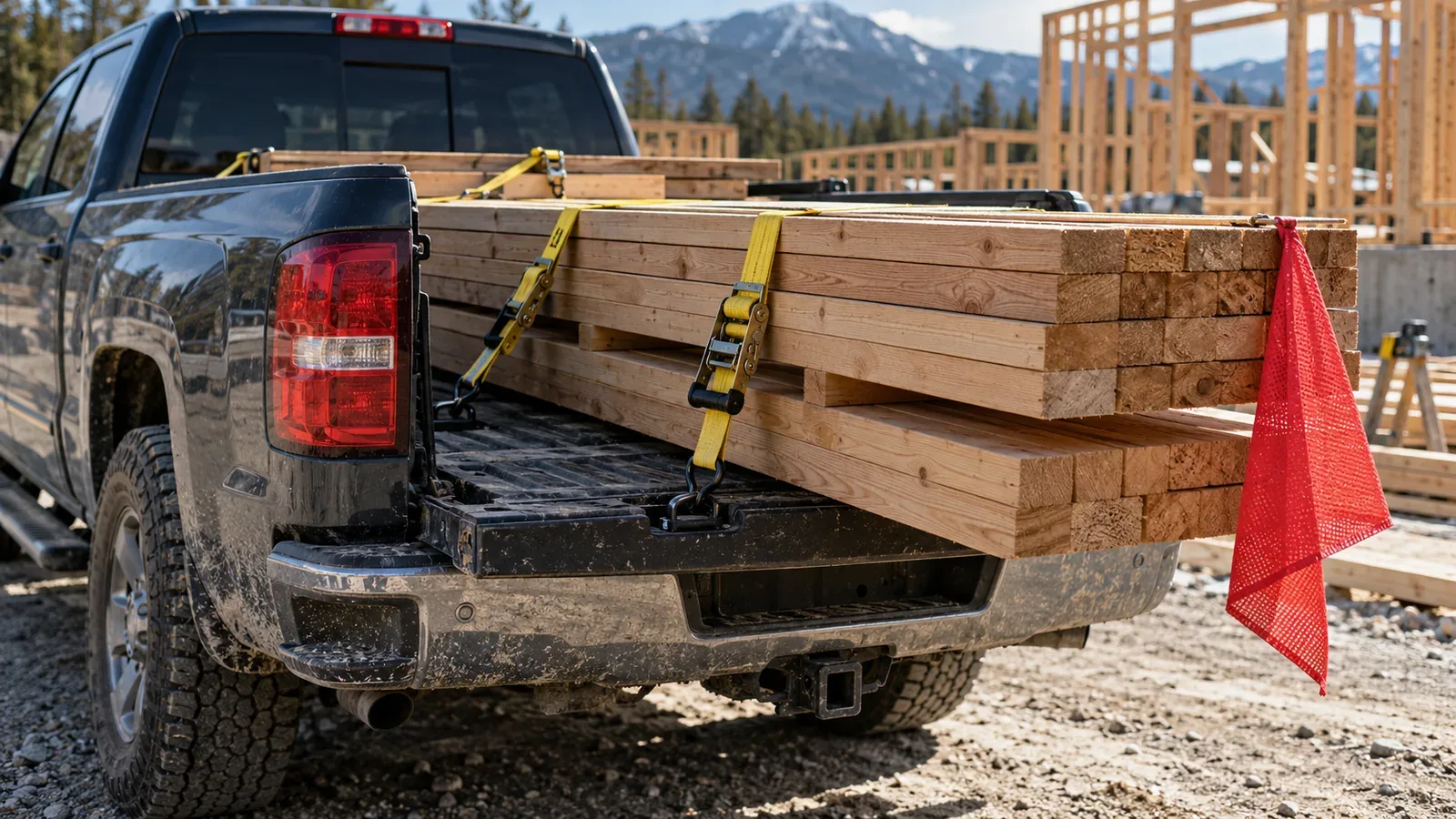
Keep boards bundled so individual pieces cannot slide out. Check whether the bed actually supports the material or leaves a long unsupported section. Prevent movement in every direction, protect restraints from sharp edges, and do not obscure rear lights or the license plate. When a ladder or several boards extend beyond the vehicle, confirm the manufacturer’s tailgate/support limits and applicable marking laws before leaving.
For example, Washington’s projecting-load rule contains particular flag and lighting requirements for certain side and rear projections. It is a Washington example, not a uniform 50-state rule. The route and time of day can change what is required. A flag does not replace support, a securement system or a vehicle that can safely carry the material.
One helpful practical question: If I had to brake hard at the next traffic light, which direction would each board want to go? If the answer is “through the front of the bed” or “out over the tailgate,” the load is not ready to travel.
Bags, mulch and yard waste: why a cover matters
Saturday yard cleanup is a different problem from hauling a dresser. Leaves, clippings, cardboard and light packaging may not be heavy enough to make the suspension sag, but they can escape in airflow.
A suitable tarp or cargo net can contain loose material when properly fitted and secured. Close bins and bags, avoid overfilling, and attach the covering so its edges cannot lift. Washington’s Department of Ecology specifically recommends securing the covering itself and checking for shifting or rattling.
Keep this distinction clear:
| Material | Main problem | First useful question |
|---|---|---|
| Loose leaves or cardboard | Wind may lift it | Is it fully contained by a secured net, tarp or enclosed container? |
| Bagged soil or mulch | Bags may slide or split | Are bags packed below the bed edge and prevented from moving? |
| Long lumber | Sliding, leverage, unsupported overhang | Is it supported and independently restrained? |
| Cabinet or appliance | Tipping, sliding, high center of gravity | What prevents a turn or sudden stop from moving it? |
| Round pipe or cylinders | Rolling | Are suitable chocks/blocking and restraints installed? |
A tarp is not a substitute for rated restraint of a heavy object. Likewise, adding one strap across a pile of leaves may leave the loose edges exposed. The NHTSA recommends securing large objects directly and considering a sturdy cover or net for the whole load.
Three decision examples from an ordinary weekend
The following examples are illustrative scenarios, not customer testimonials or evidence of field testing.
Case A: a 250-lb chest of drawers. The truck has plenty of payload, but the only available hook appears to be part of a removable plastic bed accessory. Decision: do not leave yet. Identify an approved rated anchor and a stable restraint arrangement, or arrange professional delivery. Payload availability alone does not secure the dresser.
Case B: yard trimmings in an open bed. A small pile looks harmless at walking speed. On the highway, dry branches and cardboard can blow out. Decision: contain and cover the entire load, secure the cover, check that nothing protrudes, and inspect before departure. Do not treat a thin loose sheet as a secure tarp.
Case C: 10-foot lumber in a short bed. The boards fit diagonally only with an open tailgate and project behind the truck. Decision: verify support, the complete restraint plan, component ratings and applicable overhang/lighting rules. If the load cannot be safely supported and secured, choose a suitable trailer or delivery. Do not assume a red flag solves the physical problem.
Each decision has the same logic: identify the actual failure mode and the equipment that prevents it. A generic strap count or “it has worked before” is not evidence that today’s load is safe.
How to check straps without making common mistakes
Before loading, read every restraint label and look closely at the material. Reject straps that have cuts, excessive abrasion, damaged stitching, bent hooks, seized mechanisms or missing ratings. Check that hooks seat in the approved anchor and cannot slip off if the load settles. Protect the strap where it crosses sharp or rough edges; an otherwise suitable strap can be weakened by a cut surface.
Do not confuse breaking strength with working load limit (WLL). Kinedyne’s ratchet-strap guidance distinguishes them; WLL is the relevant stated rating for use. That number is only one part of a securement plan: direction of restraint, angle, anchor points, cargo shape and vehicle limitations still matter.
For commercial transport subject to the federal cargo-securement rules, the FMCSA specifies additional system capacity and tiedown requirements. Those rules apply to covered commercial motor vehicles operating in interstate commerce. This guide is written primarily for private pickup owners; it deliberately does not tell every pickup driver to apply a commercial-vehicle tiedown formula as universal law. If you operate a regulated commercial pickup or trailer, verify all relevant federal and state requirements with a qualified safety professional.
Before you drive: a realistic two-minute walk-around
Once the load is secured, close the doors, put away unused tie-downs, and walk around the truck. Look from the side and behind, not just from the cab.
- Front: could anything move toward the cab under hard braking?
- Side: could the item tip or slide through a turn? Are anchors and hooks seated properly?
- Top: could wind lift the cargo, a bag, or the tarp?
- Rear: are the tailgate, rear lights, license plate and any load markings appropriate?
- Underneath/at the tires: is the truck level enough to prompt an axle-load check? Do tires and axle limits need verification?
- Inside: is the load recorded and the restraint method checked before starting?
The NHTSA’s self-check questions are a useful final filter: would you feel safe driving behind this load? If you notice whipping, rattling or shifting once moving, follow Washington’s advice and pull over where it is safe to do so. Reinspect the full setup before continuing.
A five-mile trip is not automatically safe just because it is short. Loose objects can leave a truck bed on the first turn or during the first sudden stop.
A simple worksheet for the next hardware-store run
Open the Pickup Cargo Tie-Down Checklist (PDF) and write down your actual load, weight estimate, vehicle payload, anchor points and restraint ratings. Tick the stop box if a critical rating or securement method remains unknown. The worksheet is a decision aid, not a certification or substitute for hands-on professional inspection.
If your cargo is awkward because of its length or width, start with Pickup Truck Bed Sizes. If you are moving commercial loads inside a box truck, use the separate box-truck cargo securement guide and the requirements that apply to your operation. Both topics are related, but neither replaces checking the exact vehicle and cargo you plan to move today.
Final takeaway: the best load-securement method is the one that fits the real object, your actual truck and correctly rated equipment. If those facts cannot be verified, postpone the trip or choose a different transport method.