
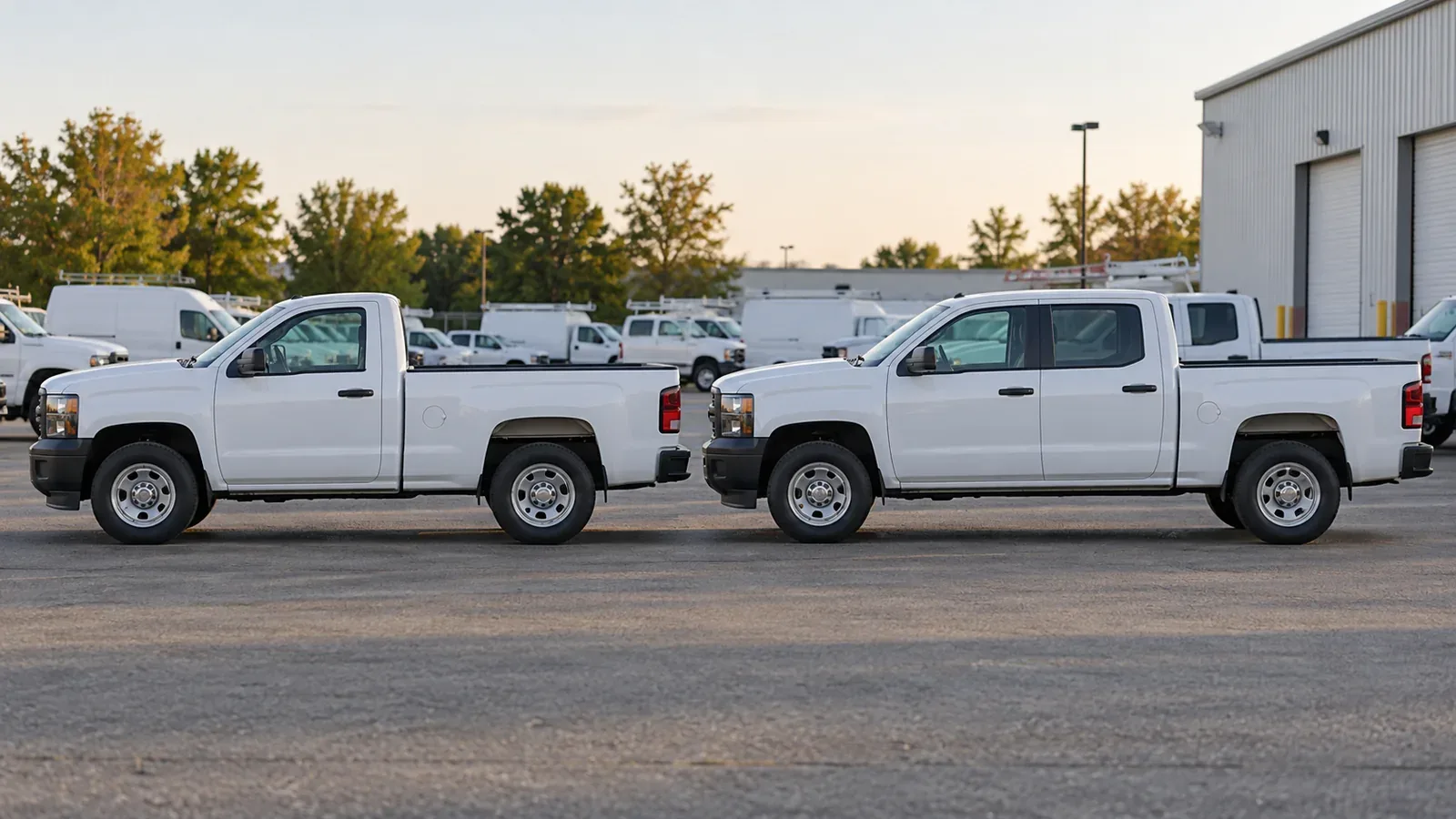
Regular Cab vs. Crew Cab Trucks: Choose the One That Fits Your Day
Imagine you run a small landscaping business. On Monday morning, one worker drives the truck with mowers and tools in the bed. By Wednesday, three people need a ride to a jobsite. By Friday, you have to collect long materials from a supplier. Which truck body would make all three days easier?
A regular cab looks like a bargain when you only consider the purchase price. A crew cab looks appealing when you picture a full team riding together. Neither choice is automatically better. The right one depends on who sits inside, what rides in the bed, where you park and what your actual truck is rated to carry.
The practical answer: start with the number of people who ride most days, then measure the longest load and the available parking space. Only after that should you compare payload labels and written prices. You’ll find a printable Work Pickup Cab-Choice Worksheet at the end of this process to take to the dealership.
Regular cab, extended cab and crew cab in plain English
A regular cab has one row of seats. Many configurations have two doors and room for two or three people, depending on the front seat. It is a sensible layout for a truck that usually carries a driver, possibly one passenger, and work materials outside the cab.
A crew cab has a second row with easier everyday passenger access. In common configurations it has four full-size doors. That makes a real difference if technicians, employees or family members regularly ride in the back. Do not assume every crew cab has identical rear-seat dimensions or seating capacity.
An extended cab sits between these choices. Manufacturers use different labels: Ford calls one version SuperCab, Chevrolet offers a Double Cab, and Ram calls a smaller four-door option Quad Cab. These are not guaranteed to have the same door mechanisms, rear legroom or seat arrangements. Compare specifications for the actual model year.
| Cab style | Usually best for | The question to ask before buying |
|---|---|---|
| Regular cab | One- or two-person route; equipment-first work | Does the one-row layout cover every normal trip? |
| Extended cab | Occasional rear passengers or more interior storage | Can adults really ride comfortably for the trip length? |
| Crew cab | Team transport; frequent rear passengers; mixed family/work use | Does the required bed length still fit the jobsite and parking space? |
A cab name tells you the general shape of the vehicle. It does not tell you the door-label payload, cargo-bed measurements, wheelbase, price or exact passenger count.
The most important trade-off: people versus bed space
Here is where a shopping decision can go wrong. A contractor visits a dealer, sees a truck with a spacious rear seat and assumes it will still have the same eight-foot cargo bed as the work truck it replaces. That may not be an available combination on the model in question.
Ford’s 2026 F-150 information lists these cab-and-bed choices for its lineup:
| 2026 Ford F-150 cab | Listed bed choices |
|---|---|
| Regular Cab | 6.5-foot or 8-foot bed |
| SuperCab | Standard 6.5-foot bed |
| SuperCrew | 5.5-foot or 6.5-foot bed |
These are nominal bed categories, not measurements of every interior surface. The exact configuration must be available for the trim you want. This is one manufacturer’s light-duty truck lineup, not a rule for every pickup on sale.
Ford’s 2026 F-250 XL gives a useful counterexample to any overly broad rule. Its official configuration page shows Regular Cab with an eight-foot bed, SuperCab with 6.75- or eight-foot options, and Crew Cab with 6.75- or eight-foot options. Moving to a crew cab does not always mean giving up the long bed. It may mean a much longer truck overall.
Other manufacturers divide their lineups differently. Chevrolet’s 2026 Silverado 1500 page describes Regular, Double and Crew Cab choices; Ram’s 2026 1500 specifications list Quad Cab and Crew Cab options. That Ram 1500 listing does not offer a regular cab. So don’t compare a dealer’s three photos as though they represent equivalent configurations from every brand.
If you need to know whether a plywood sheet, equipment case or machine fits, use our separate pickup bed-size and cargo-fit guide. This article focuses on choosing the passenger compartment, not repeating every bed dimension.
Five checks to make before you ask for a price
Take a notebook, or download the worksheet, and go through these in order. If you skip the first two, you may end up negotiating on a truck that cannot do the job.
| Check | Record this | Why it matters |
|---|---|---|
| 1. Typical riders | People on ordinary days and busiest days | Tells you if extra seats are essential or only occasionally useful |
| 2. Longest everyday load | Item length, width, shape and frequency | Determines whether your preferred bed is sufficient |
| 3. Parking and access | Garage, loading bay, turning space and tight streets | A long crew-cab/long-bed combination may be inconvenient |
| 4. Actual payload | Tire-and-loading label, passengers, tools, equipment | A seat that can hold someone does not add carrying capacity |
| 5. Delivered cost | Written quote plus use-related costs | Avoids deciding from MSRP or monthly payments alone |
The order is deliberate. First find a configuration that works. Then check whether it is safe and within the ratings. Finally, decide whether you can justify the cost. Reversing that order is a common way to buy the wrong truck for a tempting price.
What changes when more people ride in the cab?
More seat space is not free from a loading perspective. Every passenger, personal bag and work item counts toward the pickup’s available capacity. A larger passenger compartment is useful only when the entire truck can accommodate the intended people, tools, trailer weight and equipment within its ratings.
Here is a hypothetical calculation, not a quoted rating for any F-150, Silverado or Ram:
| Simplified payload example | One-person day | Four-person day |
|---|---|---|
| Actual vehicle-label payload | 1,800 lb | 1,800 lb |
| Occupants | -190 lb | -680 lb |
| Work tools and supplies | -420 lb | -420 lb |
| Added removable storage | -100 lb | -100 lb |
| Simple payload remainder | 1,090 lb | 600 lb |
Both cases use the same hypothetical door-label payload. The only change is the passenger load. It leaves 490 pounds less on the four-person day, even before a trailer tongue load or extra cargo is added. This does not prove that a real truck is safe to load to those remainders; axle limits, tire ratings, gross vehicle weight, hitch ratings and load placement also matter.
Do not compare a regular cab at one trim and engine with a crew cab at a completely different trim and simply attribute every difference to the cab. Ask to see the tire-and-loading label on both physical vehicles. If the truck is modified or carrying installed equipment, confirm how those changes affect usable capacity.
For choosing truck classes and reading key weight limits, see our 3/4-ton vs. 1-ton explanation. For an example of comparing two actual Ford configurations, read F-250 vs. F-350.
An extended cab can be the middle ground—if the rear seat works
Suppose most trips involve one driver, but a colleague occasionally travels along. A smaller rear compartment may seem ideal. It can be—provided that the colleague actually fits, can get in and out safely, and has the appropriate seat belt and headroom. Do not guess from the number of doors.
Bring your usual passenger or sit in the rear seat yourself. Check where the front seat must be positioned for the driver. Open every door, sit in the back for several minutes and try the entry and exit with the pickup parked in a realistic space. A small rear seat that looks acceptable in a photograph may be unpleasant for daily 60-minute drives.
Also check whether rear-seat storage competes with passenger space. A folding rear bench can make a convenient space for tools on a solo day, but tools and loose equipment must be appropriately secured. Never use an occupied passenger area as an improvised cargo rack.
For child passengers, be stricter. The NHTSA’s seat-belt guidance recommends that children younger than 13 ride in the rear seat, and its child-restraint information explains how to choose and install a suitable car seat. If a child regularly rides with you, verify the actual rear seating and compatible restraint positions. Do not assume that a regular cab with a front passenger seat is an equivalent alternative.
Case 1: a one-person maintenance business
Illustrative situation: a self-employed contractor drives alone between small jobs, carries a long ladder, toolboxes and materials, and parks in narrow streets. The contractor is considering a regular cab and a crew cab with similar equipment.
A regular cab may suit this business if there is no genuine need for daily rear passengers. The shorter passenger compartment could make it easier to select a long bed without the exterior dimensions of a large crew-cab long-bed combination. But the buyer should still check the overall vehicle length; the bed-and-cab pairing changes it.
What to check on-site: carry the longest tool’s measurements, test the bed’s internal clearances, and find the truck’s actual payload label. Secure loose equipment instead of relying on an open bed. Our pickup cargo securement guide covers the loading part.
Decision: choose the regular cab if the passenger arrangement is genuinely enough and its full configuration passes the bed, length and load checks. A claimed price advantage alone is not sufficient.
Case 2: a crew that travels together
Illustrative situation: a small installation company sends four people to jobsites several days a week. It also needs tool storage and sometimes tows a trailer.
A crew cab becomes attractive because four workers can travel together in one vehicle instead of arranging another ride. But it is not automatically the cheapest option: a bigger cab may affect the truck configuration, purchase price, space for equipment and the actual payload margin after four adults are aboard.
Run a simple loading check like the example above using your own passenger weights and your real door-label capacity. Then verify hitch and trailer limits if you tow. A pickup that seats four but cannot carry the required workers, tools and tongue load within its ratings is the wrong truck.
Decision: shortlist crew-cab configurations that meet both passenger and loaded-trip needs. Measure parking access rather than assuming a four-door truck will fit the yard.
Case 3: one truck for the family and the business
Illustrative situation: someone uses the pickup for weekday deliveries and family travel on weekends. On a typical weekday there are two occupants; on weekends there may be three or four including children.
A regular cab could cover weekday work but conflict with family needs. A crew cab is likely to offer more flexible passenger space. Whether it is worth the cost comes down to how often that extra space is used, whether the chosen bed can handle typical jobs, and what the full budget looks like.
Decision: test a child-seat or booster installation with the actual truck and restraint manuals before signing. Compare genuine delivered quotes, not just online headline prices. If the crew cab meets the family’s safety needs but a particular bed is too short for work, check a different available cab-bed configuration or a suitable trailer rather than forcing an unsafe load.
These three situations are examples designed to help you reason through a choice. They are not accounts from customers or field testing performed by this publication.
Compare the real cost—not just the window sticker
A regular cab is often marketed as a straightforward work-truck purchase. That does not make every regular cab cheaper than every crew cab. Trim, equipment packages, availability, discounts, financing and business use all influence what you pay.
For two suitable configurations, collect written quotations with the same assumptions:
| Cost question | Truck A | Truck B |
|---|---|---|
| Total out-the-door price | Record a quote | Record a quote |
| Insurance for your work use | Obtain an estimate | Obtain an estimate |
| Expected annual miles | Use the same route | Use the same route |
| Fuel and maintenance | Based on actual engine/use | Based on actual engine/use |
| Crew transport and second-vehicle costs | Include if applicable | Include if applicable |
| Parking or storage limitations | Record actual restrictions | Record actual restrictions |
| Expected years of ownership | Same horizon | Same horizon |
A simple hypothetical example: the crew cab costs $3,800 more up front, but your business would otherwise pay $22 a day, 120 days a year, to provide another authorized vehicle for staff travel. At that assumed rate, the avoided transport expense is $2,640 per year. Dividing the $3,800 price difference by $2,640 per year gives roughly 1.44 years of simple payback, before differences in fuel, insurance, maintenance, taxes or resale value. That is an illustration, not a quotation, forecast or guarantee. If you rarely need an extra vehicle, the same purchase may never pay for itself on that basis.
For a closer look at powertrain ownership costs, use our gas-versus-diesel work pickup comparison. That page answers an engine-cost question; this one answers the passenger-and-body-configuration decision.
A 15-minute dealership test you can actually use
You can learn more from fifteen minutes with a tape measure and the actual truck than from another round of marketing photos. Ask the salesperson to show you two available VINs, then:
- Seat the normal crew. Adjust the driver seat first; check rear access and comfort with everyone belted correctly.
- Measure the cargo box. Use the usable floor length, width between wheel housings, and actual access openings—not the nominal bed name.
- Check the parking footprint. Record overall length, wheelbase and the clearance your driveway or worksite actually offers.
- Read the door labels. Record payload, GVWR and rear GAWR, and obtain the exact towing/hitch documentation if applicable.
- Compare the two written quotes. Match the options and intended uses rather than comparing different trims without adjustments.
- Circle every unknown. If the dealer cannot verify a load limit or cab-and-bed combination, do not resolve it with a guess.
Print the Regular Cab vs. Crew Cab Buyer Worksheet, complete it for each truck and keep it with the quotes. The sheet makes it obvious which vehicle fits the people, which fits the equipment and which figures still need confirmation.
The mistakes that cause expensive regrets
Buying extra seats that never get used. It is fine to prefer a crew cab for comfort. Just separate that preference from a business argument about transporting employees.
Assuming a bigger cab means more towing capacity. Towing depends on the exact vehicle, drivetrain, axle ratio, equipment and payload; verify manufacturer data and the physical truck. Extra passengers also consume payload.
Comparing bed names instead of measurements. A nominal 6.5-foot bed is not a promise that every 78-inch object will fit with the tailgate closed. See the bed-size guide for the dimensional check.
Ignoring the rear seat on a test drive. An occasional emergency seat and a place for adult coworkers to spend hours are different needs. Sit there before buying.
Treating theoretical payload as permission to load. Axles, tires, hitch hardware, tie-down points and stability all have independent limits. A spreadsheet remainder is only one part of the check.
Buying from a photo or badge alone. Cab, box and trim names are useful shortcuts, but the correct purchase decision comes from an identifiable configuration, its ratings and its use on your route.
Which cab should you choose?
Choose regular cab when your work truly involves one or two people, the available bed matches the jobs, and the truck fits your site and ratings. Choose crew cab when you often need the second row and you can verify the required bed, payload, dimensions and price. Consider an extended cab when rear passengers are occasional and the manufacturer offers a combination that suits your route.
There is no universal winner. There is a way to make the decision with fewer surprises: count the riders, measure the load, read the labels and compare actual quotes. That is what turns a truck-brochure comparison into a useful purchase decision.