
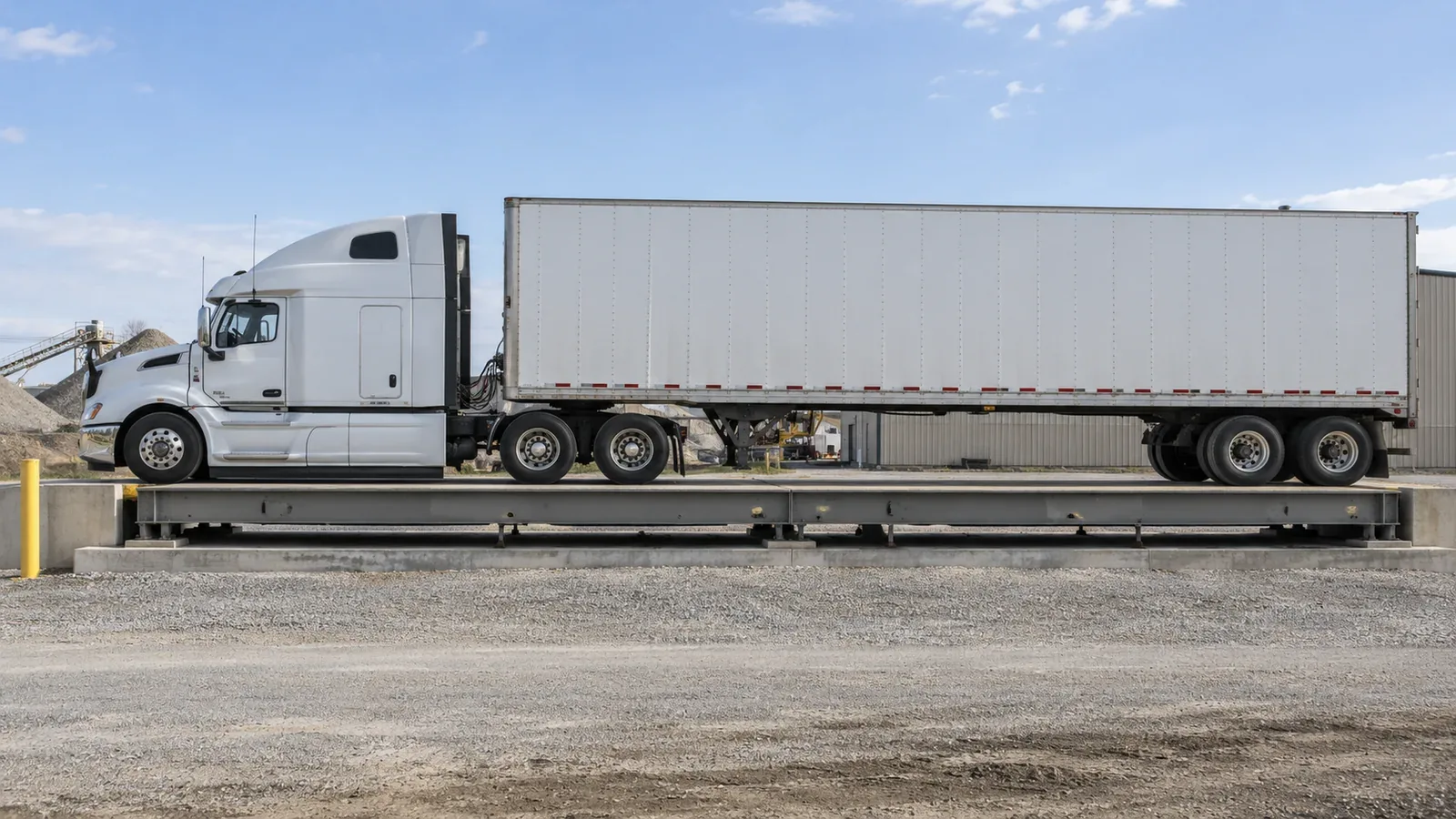
Semi-Truck Axle Weights: Steer, Drive and Trailer Limits
A dispatcher says the truck is under 80,000 pounds. The driver shows a scale ticket with a total of 78,800. Everything looks fine until someone reads the middle line: 34,600 pounds on the drive tandems. On a conventional five-axle tractor-trailer operating under the usual federal Interstate tandem limit, the drive group may be overweight even though the overall vehicle is comfortably below the familiar gross-weight ceiling.
That is why a scale ticket should be read from the axle groups outward, not from the gross-weight number inward. The same principle applies to a steering axle carrying more than its manufacturer rating, to tires with insufficient capacity or to an axle spacing that produces a more restrictive bridge limit.
This guide is written for U.S. owner-operators, dispatchers and small fleets using conventional semitrailers. It shows what steer, drive and trailer weights mean, how to interpret a three-platform ticket, what the federal Interstate rules actually say and how to recognize a problem before leaving the shipper. Examples are constructed for teaching; they are not equipment approvals or permits. State, local, route-specific and manufacturer restrictions must always be checked separately.
What the three axle-weight readings mean
On a typical five-axle tractor-semitrailer, a platform-scale ticket divides the combination into three major groups. The names refer to where the load rests, not to how much cargo is physically located above one part of the vehicle.
| Scale-ticket reading | What it generally represents | Why it matters |
|---|---|---|
| Steer axle | The front axle and its two steer-wheel positions on the tractor | Steering-axle rating, tire capacity and controllability |
| Drive axles | The tractor’s rear tandem, usually two driven axles | Tandem weight, suspension and axle component ratings |
| Trailer axles | The semitrailer’s rear tandem on a conventional configuration | Tandem weight, position and applicable bridge spacing |
| Gross | Steer + drive + trailer group weights | Overall combination limit and some bridge calculations |
This layout is not universal. A spread-axle trailer, lift axles, a different number of tractor axles or a specialized trailer may require a different scale procedure and different rules. CAT Scale’s official how-to-weigh instructions explicitly show different procedures for standard, spread-axle and more complex combinations.
Important distinction: the phrase axle ratio does not mean axle weight. Our semi-truck axle ratio guide is about final-drive gearing, RPM and torque multiplication. This article is about vertical load carried by axle groups, scale measurements and legal or mechanical limits. Changing differential gearing does not authorize carrying additional pounds.
The familiar 20,000 / 34,000 / 80,000 federal figures
The Federal Highway Administration’s vehicle-size and weight FAQ and Bridge Formula guide identify these general federal limits for ordinary operations on the Interstate Highway System:
| Weight rule | General federal Interstate figure | Crucial qualification |
|---|---|---|
| Single axle | 20,000 lb | Equipment, tires and other applicable limits can be lower |
| Tandem axle group | 34,000 lb | Only a qualifying tandem; relevant spacing and exceptions matter |
| Gross combination weight | 80,000 lb | Bridge Formula may prescribe a lower allowable total |
| Groups of two or more consecutive axles | Bridge Formula | Depends on axle count and axle spacing; exceptions may apply |
These are legal ceilings within a defined federal road system, not a manufacturer promise that every tractor can run at those numbers. A loaded combination must fit the lowest applicable legal and equipment constraint, including posted restrictions and routes outside the Interstate network. Grandfather provisions and special statutory exceptions exist, but they should never be assumed simply because another truck has carried a heavier load nearby.
The legal text appears in 23 CFR 658.17. The rule also explains why the numbers are not a standalone checklist: it imposes the bridge weight calculation on certain groups of consecutive axles and recognizes defined exceptions. State regulations can differ on roads outside the Interstate System, and particular local bridges may be posted for lower weights.
Why 12,000 pounds on the steer is not the federal law
Drivers often memorize 12,000 steer / 34,000 drives / 34,000 trailer = 80,000 gross. That is a familiar illustration of one loading pattern, not a statement that federal law universally caps every steer axle at 12,000 pounds.
The FHWA FAQ specifically addresses steering-axle limits. On the Interstate System, the federal rule does not permit a state to impose a steer-axle limit below the lower of 20,000 pounds or the axle rating established by the manufacturer, subject to the regulatory context and exceptions. A tractor with a manufacturer-rated front axle of 12,000 pounds may therefore have an equipment limitation at 12,000; a different approved tractor may have a different rating. Tire load ratings and other restrictions remain relevant.
Do not turn a planning target into a universal rule. Read the actual axle identification and chassis documentation, inspect the tires and confirm the applicable route laws. It would be just as wrong to interpret the federal 20,000-pound single-axle figure as permission to load a 12,000-pound-rated steer axle to 20,000.
Worked example: a legal-looking gross number hides a heavy tandem
Consider this illustrative scale ticket for a conventional five-axle combination. All weights are fabricated to demonstrate arithmetic; the example assumes the standard 34,000-pound drive-tandem restriction applies without a higher exception.
| Group | Scale reading | Comparison with the common limit |
|---|---|---|
| Steer | 12,300 lb | Check actual front GAWR and tires; do not apply an invented universal 12,000-lb legal limit |
| Drives | 34,600 lb | 600 lb over the 34,000-lb tandem figure |
| Trailer | 31,900 lb | 2,100 lb below the 34,000-lb tandem figure, before other checks |
| Gross | 78,800 lb | 1,200 lb below 80,000, before bridge and route checks |
The arithmetic is straightforward: 12,300 + 34,600 + 31,900 = 78,800 pounds. The middle line is still a problem. There is no federal rule that lets unused gross capacity offset an overloaded tandem.
Suppose a qualified operator determines an approved load adjustment can shift an illustrative 900 pounds from the tractor’s drive tandem to the trailer’s tandem without changing the steer reading. The next hypothetical ticket would be 12,300 steer / 33,700 drives / 32,800 trailer = 78,800 gross. The overall weight is unchanged. That new ticket may resolve the initial 34,600-pound drive reading, but it does not independently prove that all axle, tire, bridge and route constraints are met.
This is not an instruction to move a particular slider by a particular number of holes. The amount transferred is not fixed, and actual distribution depends on vehicle geometry, cargo placement, suspension and equipment. Any adjustment must be lawful, manufacturer-approved, safely performed and verified by a new measurement.
A second example: every main group can look acceptable while gross is too high
Consider another completely hypothetical ticket: 13,000 steer / 34,000 drives / 34,000 trailer. The sum is 81,000 pounds. Even assuming the front axle, tires, tandem spacing and equipment are properly rated, this exceeds the ordinary 80,000-pound federal Interstate gross limit unless a lawful exception applies. Nothing about group redistribution makes that 1,000 pounds vanish.
By contrast, 12,000 + 34,000 + 34,000 = 80,000 is only a preliminary screening example. A real truck must also pass the relevant bridge, tire, rating and route checks. A legal-looking trio of numbers is not a legal certificate for every road and axle configuration.
How to weigh a loaded tractor-trailer correctly
A commercial multi-platform scale allows you to measure the three groups independently. According to CAT Scale’s standard-trailer procedure, the usual arrangement is:
- Bring the loaded tractor and trailer to the scale following the site’s posted directions and staff instructions.
- Position the steer axle on platform 1, the tractor drive axles on platform 2 and the trailer axle group on platform 3 for a standard configuration.
- Obtain the ticket and record each separate group weight and the gross total.
- Compare the readings with the applicable limits, including ratings and axle spacing, not only the 80,000-pound figure.
- If any measurement raises a question, confirm the equipment identification and route rules before deciding on an adjustment.
- After an approved cargo-position or axle-position adjustment, reweigh and keep the new ticket with the load’s documentation as appropriate.
A split-axle or unusual configuration may require multiple positions or staff assistance; do not force those trucks through the ordinary three-number method. The same CAT instructions have separate diagrams for other configurations.
What a ticket does not tell you: the individual tire or wheel-position loading, the manufacturer-rated axle capacity, every possible federal bridge-formula group or the state and local restrictions on your route. CAT Scale notes that its platform readings are not individual corner weights. The service provides a measurement, not a blanket assurance of legal carriage on every highway.
What to record along with the ticket
A useful owner-operator record contains more than four numbers:
| Record | Practical purpose |
|---|---|
| Date, location, ticket identifier | Makes the measurement traceable |
| Tractor and trailer identification | Connects the weight to the actual equipment |
| Fuel and fluid state at weighing | Explains subsequent changes in operating weight |
| Load description and cargo seal status | Preserves context for what was actually on board |
| Steer / drive / trailer / gross readings | Documents observed group weights |
| GAWR, tire capacities and axle layout | Supports comparison to equipment restrictions |
| Route and any permit conditions | Avoids using the wrong jurisdiction’s rules |
| Corrective action and reweigh ticket | Demonstrates that an identified problem was rechecked |
When a later measurement differs, investigate what changed: additional fuel, cargo movement, a different tractor, a shifted trailer axle group or simply an incorrectly positioned vehicle on the scale. Keep a record of the cause rather than quietly replacing the original ticket.
The Federal Bridge Formula: why length and spacing matter
Weight law is not just a tally of individual axle groups. A short wheelbase can concentrate loads over a bridge differently from a longer truck carrying the same gross weight. The FHWA Bridge Formula publication explains the principle and provides tables for groups of consecutive axles.
For a specified group of two or more consecutive axles, the federal formula is commonly written:
W = 500 × ((L × N) / (N − 1) + 12 × N + 36)
Here W is the permitted group weight in pounds as determined under the federal methodology, L is the distance in feet between the outermost axle centers of that particular group, and N is the number of axles in the group. FHWA’s official publication describes the rounding and tabulated values. For an actual load, use the official bridge table or approved weight-compliance process; do not treat a rough calculation as an enforcement ruling.
A conventional five-axle combination can have a group of axles that is overweight under the bridge calculation even while the total gross and both tandem readings look ordinary. Not every truck uses identical spacing, and not every pair of groups is eligible for an exception.
The FHWA also describes a specific exception for two consecutive tandem groups of 34,000 pounds each when the distance between the outermost axles of those two tandems is at least 36 feet. That is a defined exception, not a blanket release from 80,000 gross, manufacturer ratings or other regulations. Confirm the actual grouping and measurements on your equipment.
A practical lesson follows: when someone says, “This rig is five axles, so 80,000 is always fine,” ask for the axle-spacing and route information. The combination’s configuration is relevant evidence, not a formality.
Equipment ratings: legal weight and safe weight are different checks
Even if a particular highway would legally allow a heavier axle group, the truck and trailer still have physical limits. Your review should include GAWR (gross axle weight rating), GVWR (gross vehicle weight rating), GCWR where supplied and applicable, suspension or axle assembly ratings, tire ratings and component limitations. The proper rating must come from the particular vehicle and component documentation.
For tire safety, 49 CFR 393.75 addresses load carrying capacity and inflation requirements for commercial motor vehicle tires. A group total may conceal uneven left-right loading or an unsuitable tire. Do not infer that two tires or four wheel ends necessarily share a measured group weight perfectly.
The suspension standard in 49 CFR 393.207 also addresses adjustable axles and locking components. Axle-position or slider changes are not just a weight optimization exercise: locking and alignment are safety-critical and must be secured and verified by competent personnel using the manufacturer’s instructions.
Registration is not the same as mechanical capacity
A registered weight, a manufacturer’s published rating and a weight permitted on a particular road answer separate questions. Registering a truck for a higher amount does not upgrade its axle assemblies or tires. Similarly, finding a heavier legal limit on a state route does not mean a truck with lower equipment ratings may use it.
When unsure which figure controls, work from the most restrictive applicable requirement. Resolve ambiguities with the state transportation agency, the manufacturer or a qualified commercial-vehicle specialist. This is particularly important when combining a used tractor with a different trailer or when the load will cross several jurisdictions.
Moving freight versus moving axle groups
There are two different kinds of weight-distribution decisions: cargo placement and, on some equipped combinations, adjustable axle or fifth-wheel position. Both can alter how a load is supported; neither makes the actual goods lighter.
Cargo position changes
Moving a pallet toward the trailer front may increase the load transmitted to the tractor through the kingpin and alter drive loading. Moving cargo toward the rear may move more weight toward the trailer axles. The actual amount depends on lever arms, pallet position, trailer geometry and total load distribution.
A cargo repositioning decision must also preserve loading stability and proper securement. See the box-truck cargo securement guide for principles on load movement, restraints and checking the securement system; its box-truck examples are not a substitute for semitrailer-specific loading instructions. Cargo placement may also affect cargo damage risk and vehicle handling.
Trailer tandems and fifth-wheel adjustments
Some tractors and trailers permit changes to fifth-wheel and tandem positions. Such changes can redistribute weight among groups, but the relation is vehicle-specific, and adjustments can change bridge spacing and handling characteristics. Follow the equipment maker’s written procedure and company policy, including secure parking, brakes, release and lock verification and inspection by appropriately trained people.
Do not try to correct an overweight axle by guessing how many pounds one slider hole will move. Do not make safety-critical adjustments while loaded on a highway shoulder or leave without confirming the position is properly locked. Use a new scale ticket after changes and recheck legal axle spacing.
When the load must be reduced
When the gross is genuinely too high and no lawful exception applies, transferring load between tandems cannot fix the gross problem. The remedy may require reducing the cargo, using different authorized equipment or arranging a properly permitted movement where legally available. Permits are not automatic, and many overweight-load provisions relate to nondivisible loads rather than ordinary divisible freight.
Route and state-law differences: where the federal numbers stop
Federal Interstate limits give drivers an important baseline, but they do not replace every state, bridge, county-road or permit rule. As the FHWA commercial vehicle size and weight overview states, states can establish their own limits on roads outside the Interstate Highway System, subject to governing law. Posted bridges and restricted routes may have additional constraints.
Use the FHWA state-law compilation as background research and confirm your actual current route with the responsible agency. A dated compilation is not a live permit, a statewide summary is not the same as the restriction on a county bridge, and a special exception for a particular vehicle or commodity should not be assumed for general freight.
If you are moving oversize or overweight freight, our California oversize and overweight permits and Texas overweight permits explain separate state permit workflows. Those pages answer a different question from basic scale-ticket interpretation and cannot be generalized to an entire multistate journey.
A dispatch-ready axle-weight worksheet
Before taking a loaded combination onto the road, ask the dispatcher or owner-operator to complete this sequence. Each line must be based on actual records, not a salesperson’s generalization.
| Stage | Evidence | Decision |
|---|---|---|
| 1. Identify vehicle | Tractor, trailer, VIN/build documentation, number and spacing of axles | Use the correct equipment configuration |
| 2. Read ratings | GAWR, tire load and inflation limits, other component ratings | Determine any physical limit below the road ceiling |
| 3. Identify route | Interstate, state and local roads, bridges and permit conditions | Apply the rules for the roads actually used |
| 4. Weigh loaded unit | Original dated steer, drive, trailer and gross ticket | Find a real measured baseline |
| 5. Compare limits | Single/tandem/gross, bridge formula, ratings and restrictions | Identify the first binding limit |
| 6. Resolve problems | Qualified loading and equipment review; lawful action only | Correct an overload without compromising safety |
| 7. Verify | New scale ticket, axle lock and securement checks | Confirm the specific departure configuration |
| 8. Retain evidence | Tickets, load identification and approved changes | Make the decision traceable later |
The first binding limit is the one that controls the decision, not the number that looks most generous. For example, a trailer tandem can have 2,000 pounds of theoretical legal room while the tractor drive tandem has only 200 pounds; that does not mean an additional 2,000 pounds of cargo is safe, feasible or legal for the combination as configured.
For operating decisions after the truck is legally loaded, use our semi-truck MPG guide for fuel measurement. A heavier or more poorly distributed load may change how the vehicle performs, but this article does not attempt to predict gallons from axle weights alone.
Three representative situations from small trucking operations
The following are constructed training scenarios, not reported stories from customers or purported reader testimonials. Each illustrates a different decision mistake and a practical response.
Situation 1: a misleading green gross total
Problem: An owner-operator sees 78,800 pounds gross and assumes the load can go. Complication: The drive tandem reads 34,600 pounds under ordinary federal Interstate limits. Response: Review the full ticket and constraints, arrange a lawful adjustment with qualified personnel and obtain another ticket before dispatch. Lesson: Gross weight and group weight are independent checks.
Situation 2: a 12,400-pound steer reading sparks an argument
Problem: Two drivers disagree about whether any reading above 12,000 on the steer is automatically unlawful. Complication: Nobody has checked the front axle maker’s rating, tires or applicable route rules. Response: Obtain the actual equipment ratings and state route requirements rather than quoting a memorized rule. Lesson: The common 12,000-pound example is not a universal federal steer-axle statute, but the manufacturer’s lower rating still matters.
Situation 3: a tandem shift fixes one number but changes another
Problem: A fleet makes an approved tandem adjustment to reduce drive loading. Complication: The driver assumes the change makes the combination legal without another weigh, even though trailer loading and bridge spacing changed. Response: Reweigh, verify the new group figures and spacing rules and inspect the axle-locking system according to manufacturer procedure. Lesson: A theoretical transfer is not the same as verified compliance.
Common mistakes to avoid when reading semi-truck weights
Mistake: ‘Under 80,000 means legal.’ It ignores single and tandem axle caps, bridge formulas, route restrictions and equipment ratings.
Mistake: ‘The steer axle is legally limited to 12,000 everywhere.’ It mistakes a conventional loading target for a universal legal rule. The vehicle-specific rating and relevant law govern.
Mistake: ‘A 34,000-pound tandem means 17,000 on every axle.’ A two-axle group total does not establish equal loading on the two individual axles, much less on every wheel position.
Mistake: ‘Sliding tandems makes the load lighter.’ It can change support distribution, but does not remove freight from the vehicle.
Mistake: ‘A CAT ticket certifies legal operation in every state.’ It measures weights. The route, axle spacing, tire ratings and permits must be evaluated separately.
Mistake: ‘A weight permit is always available if needed.’ Permit eligibility varies and may be limited to nondivisible loads and specific roads or conditions.
Mistake: ‘A legal cargo position is necessarily a safe cargo position.’ Securement, vehicle stability and handling still matter; do not solve a ticket problem by creating a loading hazard.
Final takeaway: read the complete ticket, then the complete rule
A weight ticket becomes useful when it is read as a set of separate measurements. Start with steer, drive and trailer loads. Add them to confirm gross. Then compare every relevant group against the correct legal limits, bridge spacing requirements and real equipment ratings. A comfortable gross margin cannot excuse an overloaded tandem; spare tandem capacity cannot override a tire limit; and a state’s permit process cannot make an unsafe vehicle safe.
Keep the example of 78,800 gross with a 34,600-pound drive tandem in mind: it is a concise demonstration of why weighing is about more than a single number. For gear selection, our semi-truck axle ratios guide addresses an entirely different topic. For buying equipment capable of carrying the work, use the used semi-truck inspection checklist and confirm ratings before accepting the load.