
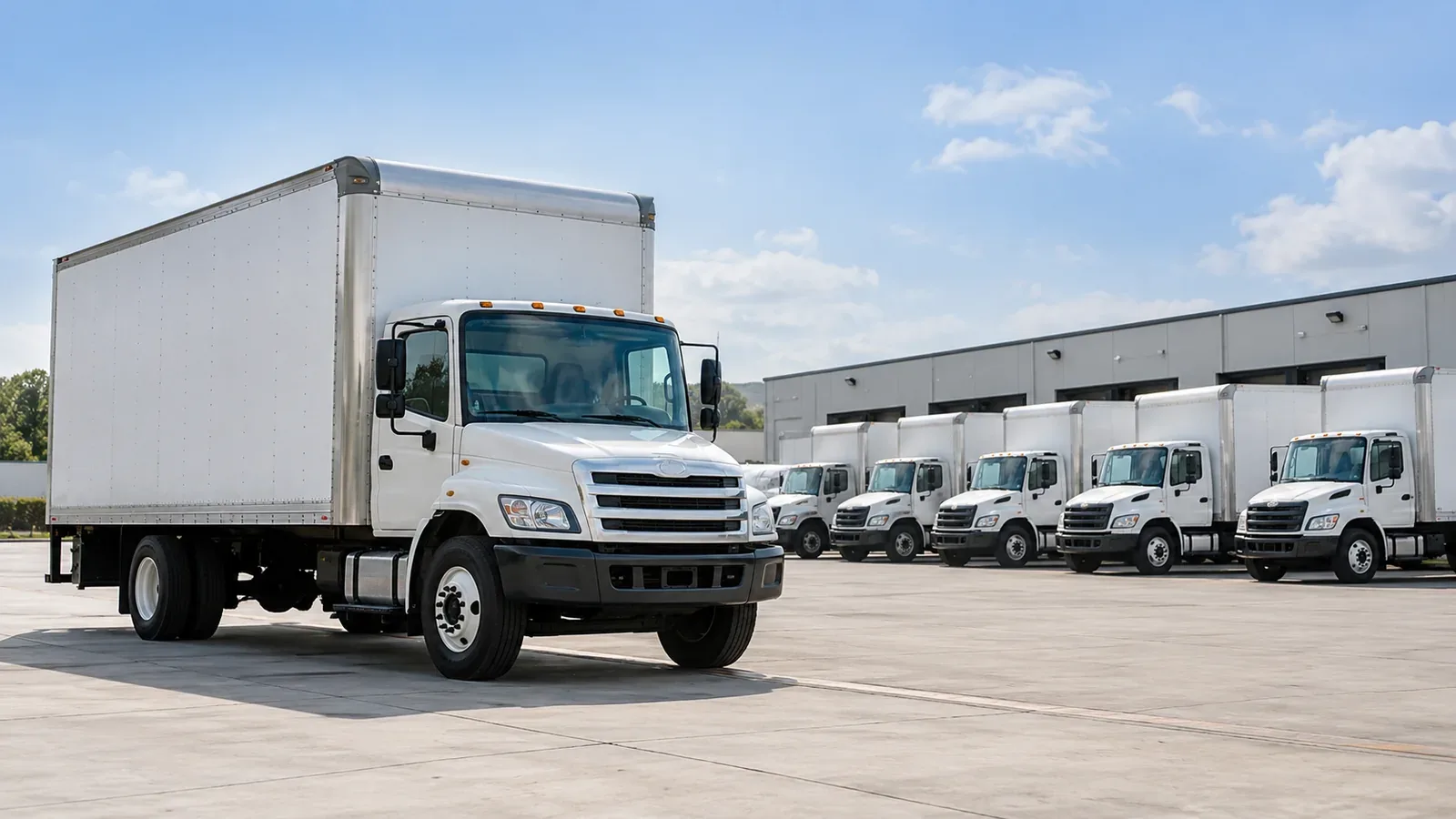
A bakery distributor has a busy holiday month coming. The owner wants a 20-foot or 26-foot box truck for the overflow deliveries. The rental counter offers a daily price; an equipment dealer offers a monthly payment that looks lower. Buying seems like the obvious deal—until someone asks what the truck will do in January, who pays if the liftgate fails, and how much cash the business can afford to tie up.
Those questions are the real rent-versus-buy decision for a box truck. The answer depends less on one attractive quoted number than on how many days you use the same vehicle, how far it travels, what its contract includes and what happens when demand changes.
This guide is for US box-truck operators, delivery businesses and small fleets. It provides an original, fully disclosed planning model. Every dollar figure in the worked example is hypothetical, not a current market quote, lender offer, supplier price or industry average. Use your own contracts and records before committing money.
Quick decision: rent, buy or consider a full-service lease?
| Your situation | Often worth evaluating first | The deciding question |
|---|---|---|
| A few delivery days per month | Short-term commercial rental | Can your full rental cost stay below ownership’s monthly carrying cost? |
| A one-off project or seasonal surge | Daily, weekly or monthly rental | Does the contract allow your freight, routes and estimated miles? |
| A new delivery service with untested demand | Rental while validating the route | Can you confirm paid work before taking on fixed debt? |
| Predictable near-daily business | Purchase or finance | Can gross margin reliably cover cash obligations and repair reserves? |
| Stable multi-year work but limited maintenance capacity | Quoted full-service lease | What is included, and what happens at mileage or term limits? |
| A business that needs specialized equipment | Compare configured units, then contract type | Does the offered truck really have the required liftgate, payload and access? |
The US Small Business Administration’s equipment guidance explains the general tradeoff: leasing may require less initial cash and can help test equipment; buying can provide ownership value, while leaving the business exposed to repairs and replacement. Those are general business principles, not a promise that one particular box-truck transaction will be cheaper.
First, compare the same truck—not three different promises
An operator may request “a 26-foot box truck” and receive three quotes that aren’t comparable. One has a liftgate; another has a ramp. One is rated at a different GVWR; another has higher usable payload. One has a mileage allowance; another bills every mile. The day rate or payment can be identical while the service you can actually deliver is not.
Record the following for each actual vehicle or quote before comparing costs:
- Body and door: usable cargo floor, rear door height and width, and whether the truck fits customer loading areas.
- Weights: GVWR, as-equipped empty weight, available payload and axle limits—not simply nominal body length. The 26-foot payload guide explains the distinction.
- Handling equipment: liftgate rated capacity and platform dimensions, or a suitable ramp/dock method. For palletized work, see pallet capacity and liftgate safety.
- Authorized use: commercial cargo, interstate or intrastate routes, permitted drivers, towing restrictions and any excluded freight.
- Time and distance: charged rental days, included miles, excess mileage, pickup/return windows and deadhead miles.
- Responsibility: insurance, deductibles, routine maintenance, roadside assistance, tires, damage inspections and replacement trucks.
Enterprise Truck Rental describes commercial and business rental programs with different vehicle categories and timeframes. Penske distinguishes rentals, truck leasing and maintenance programs. Their publicly described offerings demonstrate why the specific commercial contract matters; neither general product page supplies a binding price for your exact job.
The rental quote checklist nobody should skip
Ask the supplier to identify the all-in conditions in writing. Is the quote for commercial delivery use or personal moving? Are miles charged from collection to return, even when no freight is aboard? Are taxes, cleaning, drop fees, after-hours collection, toll programs or physical-damage products extra? Who pays for a tire or liftgate breakdown, and how quickly can you get a replacement truck?
A damage waiver is not automatically commercial liability insurance. Verify required coverage and what the program actually provides with the supplier and your insurance professional. Do not accept a load on the assumption that any rental advertisement makes a freight operation insured.
All-in rental cost: day rate, miles, coverage and friction
For a normal month of planned work, start with:
Rental cost = rental days × daily rate + charged miles × mileage rate + applicable protection, taxes and other fees.
That looks simple, but the input values are where budgets fail. Some deals have a base allowance, mileage bands, weekly pricing, minimum terms or deposit holds; replace the simple expression with the actual contract when necessary. Deposits that are returned are cash tied up, not necessarily a final expense.
Suppose a small regional delivery business receives an imaginary planning offer of $185 per rental day, $0.35 per charged mile, and $25 per day for a relevant additional protection product. The model assumes 140 charged miles for every active delivery day and assumes no included miles. It deliberately excludes fuel, drivers, tolls and taxes to isolate vehicle acquisition; those must be budgeted separately.
| Illustrative rental item | Per active day |
|---|---|
| Truck daily charge | $185 |
| Additional protection line | $25 |
| Mileage: 140 × $0.35 | $49 |
| Total modeled rental cost | $259 |
These amounts are invented calculation inputs, not Enterprise or Penske rates. The $25 charge is not evidence that insurance obligations have been satisfied. The mileage and coverage rules must come from a real written quote.
Even a seemingly minor distance error matters. If the job travels 140 miles with freight but the operator must drive another 50 miles to return the truck, the model’s 140-mile assumption is wrong. Track the full odometer distance, including collection, staging, delivery, empty return and vehicle return.
What owning actually costs—even in a quiet month
Buying creates an asset, but also creates continuing obligations. A box truck parked for three weeks can still cost money, lose resale value and need maintenance when it finally returns to service.
For an economic comparison over a defined horizon, consider:
| Ownership item | How to estimate it | Common oversight |
|---|---|---|
| Value used up | Purchase price minus expected sale proceeds | Assuming the vehicle will resell for the purchase price |
| Financing/capital cost | Actual interest or a reasoned capital charge | Counting loan principal again after depreciation |
| Commercial insurance | Written premium for the exact business activity | Assuming a personal-auto policy will do |
| Registration and mandatory charges | State and local estimates and renewals | Forgetting annual bills in a monthly spreadsheet |
| Parking or storage | Quoted contract or actual site cost | Assuming suitable truck parking is free |
| Maintenance and tires | Actual invoices and forward-looking allowance | Assuming a new truck will never be down |
| Downtime and replacement | Expected interruption and contingency plan | Assuming repair costs are the only breakdown loss |
| End-of-horizon disposal | Estimated sale value and selling costs | Ignoring the uncertainty of resale |
Financed ownership also needs a separate cash-flow forecast: down payment, tax and registration paid upfront, monthly loan installments, and repair liquidity. A down payment may be a large near-term cash commitment without being the economic cost of the entire truck. Conversely, an affordable monthly payment does not mean the vehicle’s total ownership cost is low.
If you compare financed buying with a rental offer, the truck loan-versus-lease calculator can help organize finance assumptions. Use the carrier cash-runway calculator to test the risk of slow months. Neither substitutes for the signed lender or rental contract.
Worked example: the monthly break-even is about eight days
Here is a transparent model for one hypothetical business and one equivalently suitable vehicle. Its question is: at how many active delivery days per month does owning cost less than short-term renting under these stated assumptions?
Step 1 — Set the ownership assumptions
Assume a truck purchased for $60,000 and sold for $32,000 after 36 months. The expected $28,000 loss of value works out to approximately $778 per month. This is a planning estimate of economic depreciation—not an IRS depreciation schedule or an appraisal.
| Modeled ownership item | Monthly estimate |
|---|---|
| Economic loss of value: ($60,000 − $32,000) ÷ 36 | $778 (rounded) |
| Assumed capital charge | $150 |
| Commercial insurance | $650 |
| Registration and recurring fixed charges | $115 |
| Truck parking | $95 |
| Fixed monthly ownership cost | About $1,788 |
| Maintenance and tire allowance | $0.20 per driven mile |
Important accounting distinction: the $150 monthly capital charge is a modeling assumption used instead of a loan-interest amortization schedule. The example does not add a loan payment to depreciation. With an actual lender offer, model real interest and financing cash flows, and do not double-count financing or capital charges. The estimated sale value, insurance and repair allowance are uncertain and must be sensitivity-tested.
At 140 total miles per active delivery day, the owner’s incremental modeled vehicle cost is 140 × $0.20 = $28 per active day. The assumed other operating inputs—fuel, wages, tolls and job revenue—are treated as equal across scenarios and excluded from both sides. If the trucks differ in efficiency, reliability or labor time, include those differences too.
Step 2 — Put both choices on the same denominator
Under these assumptions:
- Rent: $259 × active days per month.
- Own: approximately $1,788 + ($28 × active days per month).
| Active days per month | Charged miles | Rental estimate | Owned estimate | Lower modeled cost |
|---|---|---|---|---|
| 4 | 560 | $1,036 | $1,900 | Rent |
| 6 | 840 | $1,554 | $1,956 | Rent |
| 8 | 1,120 | $2,072 | $2,012 | Own, by about $60 |
| 10 | 1,400 | $2,590 | $2,068 | Own |
| 12 | 1,680 | $3,108 | $2,124 | Own |
| 18 | 2,520 | $4,662 | $2,292 | Own |
The crossover is approximately $1,788 ÷ ($259 − $28) = 7.74 active days. Since a day is billed as a whole unit in this simplified model, eight active days is the first modeled month in which owning has a lower estimated cost. This result is not a US trucking benchmark or buying recommendation: it belongs only to the invented figures shown above.
A more defensible real-world break-even may use a different model. For example, a monthly rental discount, an included mileage allowance, a higher owned-truck insurance premium, a costly liftgate or a lower resale estimate can materially change the answer.
Step 3 — Check the full 36-month horizon
At a consistent eight active days per month, the rental model spends $2,072 × 36 = $74,592 on the modeled acquisition-and-vehicle lines. The ownership model has approximately $64,360 in fixed economic costs across 36 months (using the unrounded $28,000 loss of value) plus $8,064 of maintenance allowances (1,120 miles × $0.20 × 36), totaling approximately $72,424.
That is just $2,168 of modeled difference over three years. A modest resale shortfall or uninsured repair could eliminate it. The point of the example is not “always buy at eight days”—it is that a crossover near the margin may be too fragile to base a major purchase on.
Step 4 — Stress-test the decision
Ask what would happen if the following change:
| What changes? | Why the answer moves |
|---|---|
| The rental company gives a lower weekly rate | Renting may remain attractive at higher utilization |
| The truck’s 36-month sale value falls below $32,000 | Ownership loses more value and becomes costlier |
| The driver covers 220 miles rather than 140 miles per day | Per-mile rental charges and owned wear both change |
| Insurance is more expensive for your cargo and radius | The ownership cost changes; rental coverage also needs verification |
| Unexpected downtime cancels two jobs | Lost revenue and replacement capacity may dominate a small cost advantage |
| Business demand drops for three months | Owner fixed costs continue while rental days may be reduced |
A financial decision that fails when one reasonable assumption changes is not settled by a spreadsheet. It needs a cash buffer, contract protections or a more reversible vehicle choice.
Financing the truck: cheap payments can hide an expensive deal
A dealer may say, “This truck is only $950 a month.” That quote does not tell you the down payment, APR, loan term, final balance, origination fees, equipment condition, balloon payment or total amount financed. It does not pay the insurance premium or fix a failed transmission.
Request an itemized financing offer. Separate the acquisition price and any added fees from interest, and estimate total cash required in the first 90 days. If the truck is used, budget independent inspection, tires, emissions or aftertreatment repairs where applicable, and any liftgate servicing. If a truck is advertised for $60,000 but requires major repairs before it can take the first job, the usable acquisition cost is not $60,000.
The SBA advises business owners to compare financing and lease terms, look beyond the monthly installment and understand buyout and termination provisions. See its equipment financing overview.
For a start-up, a cash-runway stress test can be more important than marginal cost per mile. A financed truck can be the economically cheaper option over three years while still creating an immediate cash shortage that puts the business at risk.
What about a full-service box-truck lease?
An operating rental, an equipment finance lease, a full-service fleet lease and an outright purchase are not interchangeable contracts. A full-service lease may bundle maintenance and support. Another lease may require the customer to pay for repairs and tires. A finance-style lease can include a final purchase option. Prices and accounting treatment depend on the actual written arrangement.
Penske’s business offerings distinguish truck rentals, leasing and maintenance. Enterprise Truck Rental also describes longer-term business rental options. Use these as examples of different product categories, not evidence that any particular maintenance or replacement service is automatically included with every agreement.
Compare the contract on mileage allowances, excess-mile rates, preventive maintenance, roadside support, tire responsibility, substitute-vehicle availability, equipment installation, early termination, end-of-term damage and vehicle-return condition. If the lease includes maintenance, reduce the separately modeled maintenance allowance accordingly; do not count included service twice.
A delivery job must be legal and possible regardless of who owns the truck
The method of acquisition does not override vehicle or driver rules. For interstate commercial operations, the FMCSA’s commercial motor vehicle guidance describes safety-regulation thresholds, including 10,001 lb GVWR in relevant property-carrying cases. That threshold is different from the general CDL vehicle-class thresholds; renting a truck does not remove compliance duties.
Likewise, “26 feet” is a cargo-body description, not a legal weight rating. Our CDL guide explains which ratings and uses matter. Intrastate state rules may differ. Check the truck’s certification labels and the actual operation with the applicable agencies.
Before dispatch, verify that the rented or purchased truck can carry the freight by weight and dimensions, has the required loading equipment, and is permitted and insured for the job. A cheaper truck that cannot enter the customer’s site or safely unload one pallet is not a cheaper solution.
The decision checklist to use before signing
Ask these questions in order and write the answers down:
- Is the work confirmed? How many paid days and stops are already contracted, and how many depend on forecasts?
- What truck do you actually need? Compare body dimensions, payload, door opening, liftgate, GVWR and fuel type using real VIN or fleet-unit information.
- What miles will you really drive? Count pickup, deadhead, jobs, return journeys and any supplier return requirements.
- What does the rental quote actually include? Get a written business-use quote with charged days, mileage, insurance requirements, deductibles, deposits and other fees.
- What does buying truly commit? Obtain purchase inspection, taxes, down payment, APR, insurance quote, parking, maintenance forecast and plausible resale range.
- What is the downside month? Model a quarter with half the planned work and a repair large enough to disrupt several jobs.
- Can the business change direction? Compare cancellation rights, resale costs, loan payoff, lease termination and replacement-truck options.
- Have you separated cash from economic cost? Keep loan principal, interest, depreciation and repair reserves in the correct schedules.
The box-truck operating cost guide takes the next step: building the full business budget including fuel, driver labor, empty miles and the pricing needed to generate a margin. This article isolates how to obtain the truck; the two questions must be answered together, not confused.
A small-fleet scenario: the holiday route that almost became a bad purchase
Consider a hypothetical retailer with four confirmed delivery days in November and 12 possible days in December, but no freight contract after the holidays. A dealer offers a payment that sounds appealing, so the owner imagines twelve working days every month. The error is subtle: the business is treating possible December demand as though it were a three-year contracted workload.
In the illustrated model above, four rental days cost $1,036, compared with about $1,900 in one month of ownership cost. Twelve active days reverse the monthly arithmetic—but only if that work actually occurs, the revenue covers the driver and fuel, and the truck can earn money in the other months. Renting for the initial confirmed demand buys a useful kind of information: actual route time, loading requirements, customers’ payment behavior and true utilization.
A different operator with a signed, recurring five-day-a-week distribution contract might rationally favor ownership or a full-service lease. The human lesson is the same for both businesses: choose an acquisition commitment that matches the reliability of the work, not the optimism of one busy week.
Taxes and recordkeeping: do not let a deduction make the decision
The IRS explains that the treatment of depreciable business property depends on qualifying use, property type and applicable rules, including those for transportation property. Publication 946 is a primary starting point for depreciation; Publication 463 explains relevant vehicle expenses and records, subject to vehicle classification and eligibility.
Do not assume a generic business-mile rate necessarily applies to your particular heavy or specialty box truck, or that you can deduct a financed truck’s loan principal and its depreciation as separate expenses. Do not treat a full-service rental bill as a purchase or assume that all business use qualifies for an immediate write-off. A tax preparer should apply the current law to the actual vehicle, business entity, and records.
Regardless of rent or buy, keep dated invoices, mileage logs, insurance policies, maintenance records, financing documents, delivery records and proof of commercial-use percentages when relevant. Those records support better pricing and better compliance decisions.
Bottom line: match commitment to proven utilization
Renting is a serious business option, not merely a stepping stone to ownership. It offers flexibility and can help validate demand; buying can preserve value and lower cost at sustained utilization but creates obligations that continue between jobs. A full-service lease deserves its own written comparison rather than being treated as either one.
The best decision is the lowest-risk option that can reliably perform the contracted deliveries at an acceptable total cost. Before buying, test the same scenario at low, expected and high work volumes; confirm the truck’s actual specifications and coverage; and keep enough cash to operate through a slow month. An exact break-even number is only as trustworthy as the assumptions behind it.